
Algorytmy
W publikacjach zawartych w kategorii Algorytmy znajdziecie cały szereg użytecznych informacji dotyczących algorytmów i związanych z nimi struktur danych.
Poznacie takie pojęcia jak rekurencja, analiza złożoności czy algorytmy sortowania i przeszukiwania oraz metody numeryczne. Nauczycie się stosować w praktyce techniki programowania typu dziel i rządź, algorytmy żarłoczne oraz metody przeszukiwania tekstów takie jak brute-force, Rabina i Karpa czy K-M-P. Dzięki książkom o strukturach i algorytmach szybko opanujecie metody optymalizacji, sposoby kodowania i kompresji danych. Dane te pozwolą Wam szybko i bezboleśnie opanować najlepsze techniki programowania.
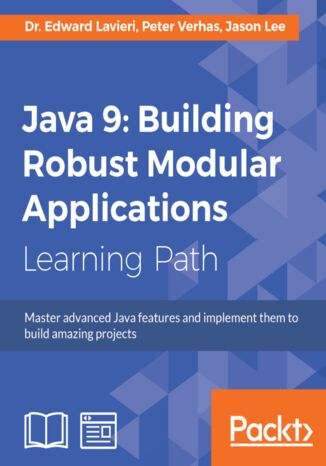
Dr. Edward Lavieri Jr., Peter Verhas, Jason...
Java 9 and its new features add to the richness of the language; Java is one of the languages most used by developers to build robust software applications. Java 9 comes with a special emphasis on modularity with its integration with Jigsaw. This course is your one-stop guide to mastering the language.You'll be provided with an overview and explanation of the new features introduced in Java 9 and the importance of the new APIs and enhancements. Some new features of Java 9 are ground-breaking; if you are an experienced programmer, you will be able to make your enterprise applications leaner by learning these new features. You'll be provided with practical guidance in applying your newly acquired knowledge of Java 9 and further information on future developments of the Java platform. This course will improve your productivity, making your applications faster. Next, you'll go on to implement everything you've learned by building 10 cool projects. You will learn to build an email filter that separates spam messages from all your inboxes, a social media aggregator app that will help you efficiently track various feeds, and a microservice for a client/server note application, to name just a few.By the end of this course, you will be well acquainted with Java 9 features and able to build your own applications and projects.This Learning Path contains the best content from the following two recently published Packt products:• Mastering Java 9• Java 9 Programming Blueprints
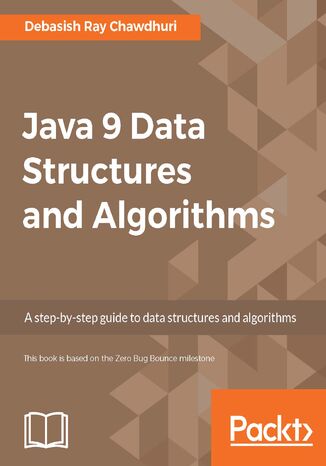
Java 9 Data Structures and Algorithms. A step-by-step guide to data structures and algorithms
Debasish Ray Chawdhuri
Java 9 Data Structures and Algorithms covers classical, functional, and reactive data structures, giving you the ability to understand computational complexity, solve problems, and write efficient code. This book is based on the Zero Bug Bounce milestone of Java 9.We start off with the basics of algorithms and data structures, helping you understand the fundamentals and measure complexity. From here, we introduce you to concepts such as arrays, linked lists, as well as abstract data types such as stacks and queues. Next, we’ll take you through the basics of functional programming while making sure you get used to thinking recursively.We provide plenty of examples along the way to help you understand each concept. You will also get a clear picture of reactive programming, binary searches, sorting, search trees, undirected graphs, and a whole lot more!
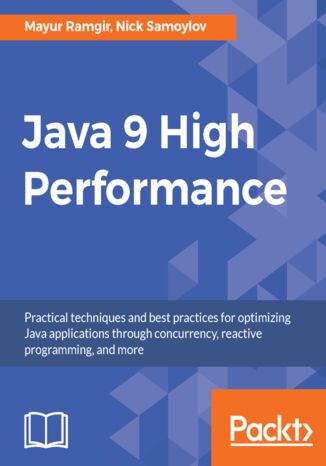
Mayur Ramgir, Nick Samoylov
Finally, a book that focuses on the practicalities rather than theory of Java application performance tuning. This book will be your one-stop guide to optimize the performance of your Java applications.We will begin by understanding the new features and APIs of Java 9. You will then be taught the practicalities of Java application performance tuning, how to make the best use of garbage collector, and find out how to optimize code with microbenchmarking. Moving ahead, you will be introduced to multithreading and learning about concurrent programming with Java 9 to build highly concurrent and efficient applications. You will learn how to fine tune your Java code for best results. You will discover techniques on how to benchmark performance and reduce various bottlenecks in your applications. We'll also cover best practices of Java programming that will help you improve the quality of your codebase.By the end of the book, you will be armed with the knowledge to build and deploy efficient, scalable, and concurrent applications in Java.
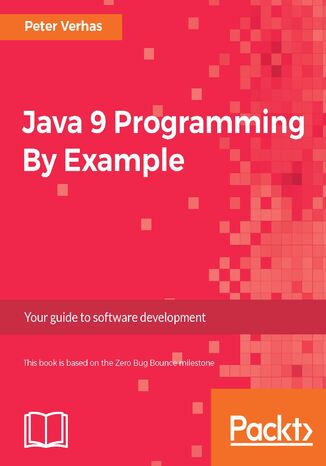
Java 9 Programming By Example. Your guide to software development
Peter Verhas
This book gets you started with essential software development easily and quickly, guiding you through Java’s different facets. By adopting this approach, you can bridge the gap between learning and doing immediately. You will learn the new features of Java 9 quickly and experience a simple and powerful approach to software development. You will be able to use the Java runtime tools, understand the Java environment, and create Java programs. We then cover more simple examples to build your foundation before diving to some complex data structure problems that will solidify your Java 9 skills. With a special focus on modularity and HTTP 2.0, this book will guide you to get employed as a top notch Java developer.By the end of the book, you will have a firm foundation to continue your journey towards becoming a professional Java developer.
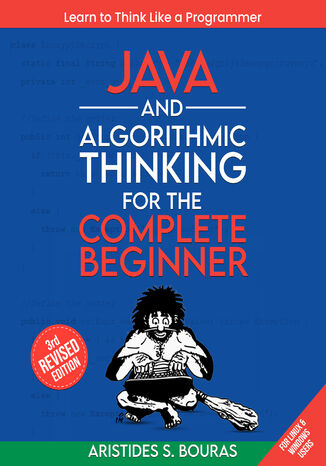
Aristides Bouras
Begin your programming journey with a comprehensive course designed to introduce you to the world of Java and algorithmic thinking. The course starts by laying a solid foundation with an understanding of how computers work and an introduction to integrated development environments. As you advance, you'll delve into essential Java concepts, learning about variables, constants, and basic algorithmic concepts that are crucial for any aspiring programmer.Moving forward, the course offers a deep dive into more complex topics, including handling input and output, using operators, and creating trace tables. You'll get hands-on experience with Visual Studio Code and explore sequence control structures, manipulating numbers, and crafting complex mathematical expressions.In the final stages, the course covers advanced topics such as data structures, subprograms, and object-oriented programming. You'll learn to manipulate one-dimensional and two-dimensional arrays, work with HashMaps, and understand the intricacies of user-defined subprograms. The course concludes with a focus on file management and offers numerous tips and tricks to enhance your programming efficiency. By the end, you'll have a strong foundation in Java programming and algorithmic thinking, well-prepared to tackle more advanced challenges.
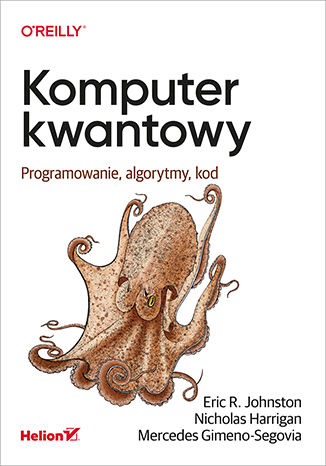
Komputer kwantowy. Programowanie, algorytmy, kod
Eric R. Johnston, Nicholas Harrigan, Mercedes Gimeno-Segovia
Komputery kwantowe nie są już tylko urządzeniami teoretycznymi. Nie są też futurystycznym monstrum, obcą maszyną, która zamieni całe istniejące oprogramowanie w jakąś jego niezrozumiałą alternatywę. Komputery kwantowe (QPU) staną się raczej radykalnym rozszerzeniem możliwości współczesnej informatyki, które pozwoli nam rozwiązać problemy dotychczas nierozwiązywalne. Istnieją ważne zadania, z którymi QPU potrafią sobie świetnie poradzić, a których rozwiązanie byłoby niemożliwe na jakimkolwiek standardowym urządzeniu komputerowym. Z drugiej strony z wieloma standardowymi obliczeniami QPU nie radzi sobie dużo lepiej niż najzwyklejszy laptop. Z punktu widzenia programisty zatem stanowi rodzaj koprocesora o ciekawych możliwościach. Oto przewodnik po wspaniałym, nieodkrytym jeszcze do końca świecie informatyki kwantowej. Aby ją zrozumieć, niepotrzebny jest doktorat z fizyki kwantowej i wyższej matematyki. Dzięki tej książce opanujesz zestaw pojęć niezbędnych do zrozumienia działania QPU, dowiesz się, jakie problemy mogą rozwiązać aplikacje QPU i nauczysz się korzystać z narzędzi do pisania programów dla QPU. Zaprezentowane tu koncepcje są bogato ilustrowane przykładami, które można łatwo uruchomić na darmowym symulatorze QCEngine. Istnieje też możliwość korzystania z fizycznych QPU (kilka prototypów QPU udostępniono w chmurze). Interesującą, choć nieco trudniejszą częścią przewodnika jest rozdział poświęcony zastosowaniu obliczeń kwantowych w uczeniu maszynowym. W tej książce: koncepcje programowania procesorów kwantowych kubity, superpozycja i teleportacje kwantowe prymitywy QPU wzmacnianie amplitudy, kwantowa transformacja Fouriera i szacowanie fazy przykłady aplikacji QPU QPU: zrób pierwszy krok ku technologii przyszłości!
Mercury Learning and Information, Oswald Campesato
This book provides a comprehensive overview of large language models (LLMs) and generative AI, covering foundational principles, advanced concepts, and practical applications. It begins with an introduction to the generative AI landscape, examining key features, popular techniques, and its influence on industries like art, business, and technology. The book also explores prominent models like ChatGPT and GPT-4, detailing their architectures, capabilities, and applications in text generation, code assistance, and conversational AI.Additionally, the book traces the evolution of LLMs, particularly focusing on the BERT family and its wide-ranging applications in natural language processing, translation, and multilingual tasks. Readers will also gain expertise in prompt engineering, learning practical tips and examples to interact more effectively with LLMs.In later chapters, the book tackles advanced topics such as fine-tuning LLMs, working with SVG, and concepts like few-shot learning and reinforcement learning. It concludes with discussions on ethical issues, biases in generative AI, and emerging trends like AI’s integration with IoT, quantum computing, and neuromorphic computing. This guide equips professionals and enthusiasts with a thorough understanding of generative AI's present and future.
Eric Traub
Learn Blockchain Programming with JavaScript begins by giving you a clear understanding of what blockchain technology is. You’ll then set up an environment to build your very own blockchain and you’ll add various functionalities to it. By adding functionalities to your blockchain such as the ability to mine new blocks, create transactions, and secure your blockchain through a proof-of-work you’ll gain an in-depth understanding of how blockchain technology functions.As you make your way through the chapters, you’ll learn how to build an API server to interact with your blockchain and how to host your blockchain on a decentralized network. You’ll also build a consensus algorithm and use it to verify data and keep the entire blockchain network synchronized. In the concluding chapters, you’ll finish building your blockchain prototype and gain a thorough understanding of why blockchain technology is so secure and valuable. By the end of this book, you'll understand how decentralized blockchain networks function and why decentralization is such an important feature for securing a blockchain.
Cody Jackson
Python is a cross-platform language used by organizations such as Google and NASA. It lets you work quickly and efficiently, allowing you to concentrate on your work rather than the language. Based on his personal experiences when learning to program, Learn Programming in Python with Cody Jackson provides a hands-on introduction to computer programming utilizing one of the most readable programming languages–Python. It aims to educate readers regarding software development as well as help experienced developers become familiar with the Python language, utilizing real-world lessons to help readers understand programming concepts quickly and easily. The book starts with the basics of programming, and describes Python syntax while developing the skills to make complete programs. In the first part of the book, readers will be going through all the concepts with short and easy-to-understand code samples that will prepare them for the comprehensive application built in parts 2 and 3. The second part of the book will explore topics such as application requirements, building the application, testing, and documentation. It is here that you will get a solid understanding of building an end-to-end application in Python. The next part will show you how to complete your applications by converting text-based simulation into an interactive, graphical user interface, using a desktop GUI framework. After reading the book, you will be confident in developing a complete application in Python, from program design to documentation to deployment.
Learn Python in 7 Days. Begin your journey with Python
Mohit Raj, Bhaskar N. Das
Python is a great language to get started in the world of programming and application development. This book will help you to take your skills to the next level having a good knowledge of the fundamentals of Python.We begin with the absolute foundation, covering the basic syntax, type variables and operators. We'll then move on to concepts like statements, arrays, operators, string processing and I/O handling. You’ll be able to learn how to operate tuples and understand the functions and methods of lists. We’ll help you develop a deep understanding of list and tuples and learn python dictionary. As you progress through the book, you’ll learn about function parameters and how to use control statements with the loop. You’ll further learn how to create modules and packages, storing of data as well as handling errors. We later dive into advanced level concepts such as Python collections and how to use class, methods, objects in python.By the end of this book, you will be able to take your skills to the next level having a good knowledge of the fundamentals of Python.
Wisnu Anggoro
Functional programming allows developers to divide programs into smaller, reusable components that ease the creation, testing, and maintenance of software as a whole. Combined with the power of C++, you can develop robust and scalable applications that fulfill modern day software requirements. This book will help you discover all the C++ 17 features that can be applied to build software in a functional way.The book is divided into three modules—the first introduces the fundamentals of functional programming and how it is supported by modern C++. The second module explains how to efficiently implement C++ features such as pure functions and immutable states to build robust applications. The last module describes how to achieve concurrency and apply design patterns to enhance your application’s performance. Here, you will also learn to optimize code using metaprogramming in a functional way.By the end of the book, you will be familiar with the functional approach of programming and will be able to use these techniques on a daily basis.
Adnan Masood
If you have just started your adventure with F#, then this book will help you take the right steps to become a successful F# coder. An intermediate knowledge of imperative programming concepts, and a basic understanding of the algorithms and data structures in .NET environments using the C# language and BCL (Base Class Library), would be helpful.
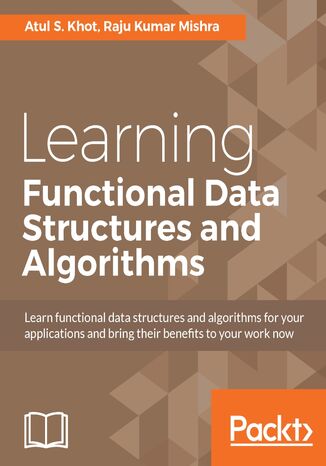
Atul S. Khot, Raju Kumar Mishra
Functional data structures have the power to improve the codebase of an application and improve efficiency. With the advent of functional programming and with powerful functional languages such as Scala, Clojure and Elixir becoming part of important enterprise applications, functional data structures have gained an important place in the developer toolkit. Immutability is a cornerstone of functional programming. Immutable and persistent data structures are thread safe by definition and hence very appealing for writing robust concurrent programs. How do we express traditional algorithms in functional setting? Won’t we end up copying too much? Do we trade performance for versioned data structures? This book attempts to answer these questions by looking at functional implementations of traditional algorithms. It begins with a refresher and consolidation of what functional programming is all about. Next, you’ll get to know about Lists, the work horse data type for most functional languages. We show what structural sharing means and how it helps to make immutable data structures efficient and practical. Scala is the primary implementation languages for most of the examples. At times, we also present Clojure snippets to illustrate the underlying fundamental theme. While writing code, we use ADTs (abstract data types). Stacks, Queues, Trees and Graphs are all familiar ADTs. You will see how these ADTs are implemented in a functional setting. We look at implementation techniques like amortization and lazy evaluation to ensure efficiency.By the end of the book, you will be able to write efficient functional data structures and algorithms for your applications.
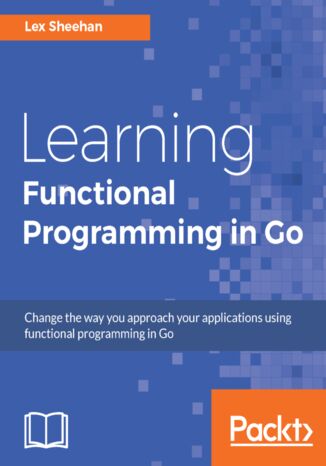
Lex Sheehan
Lex Sheehan begins slowly, using easy-to-understand illustrations and working Go code to teach core functional programming (FP) principles such as referential transparency, laziness, recursion, currying, and chaining continuations.This book is a tutorial for programmers looking to learn FP and apply it to write better code. Lex guides readers from basic techniques to advanced topics in a logical, concise, and clear progression.The book is divided into four modules. The first module explains the functional style of programming: pure functional programming, manipulating collections, and using higher-order functions. In the second module, you will learn design patterns that you can use to build FP-style applications. In the next module, you will learn FP techniques that you can use to improve your API signatures, increase performance, and build better cloud-native applications. The last module covers Category Theory, Functors, Monoids, Monads, Type classes and Generics.By the end of the book, you will be adept at building applications the FP way.
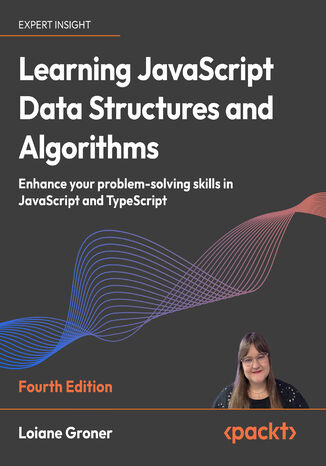
Loiane Groner, Aris Markogiannakis, Daniel Ostrovsky
Data structures and algorithms are foundational topics for software developers.This easy-to-follow book from experienced developer and trainer Loiane Groner will help you to fill in the gaps in your knowledge – whether you’re a self-taught developer, you’re preparing for technical interviews, or you just want to write better code and improve your problem-solving skills.This fourth edition covers essential data structures, algorithms, and their usage in the context of JavaScript. You’ll follow examples in both JavaScript and TypeScript, in line with the latest standards and best practices, learning how to do complexity analysis along the way. New to this edition are LeetCode and HackerRank exercises at the end of each chapter, which you'll be guided through solving. You’ll also find brand-new chapters on the tries data structure, and string and math algorithms.By the end of the book, you will know how to develop programs using the best data structures and algorithms for the job.
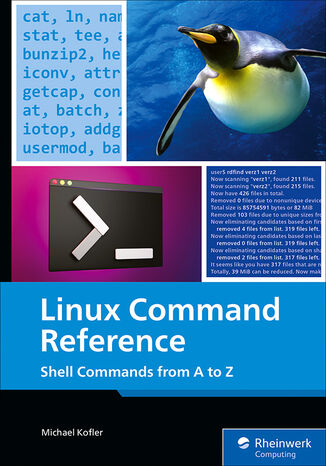
Linux Command Reference. Shell Commands from A to Z
Rheinwerk Publishing, Inc, Michael Kofler
This guide takes readers through the essentials of Linux commands, starting with basic commands and progressing to advanced techniques. The first few sections focus on foundational commands and their practical applications. As the book progresses, it introduces more complex concepts, including bash scripting, advanced command usage, and system management techniques. This ensures readers build a strong command-line proficiency step by step.The book’s structure is organized alphabetically from A to Z, making it easy to find and reference commands. It also covers important special bash characters and configuration files, essential for system administrators. Readers will also learn about efficient keyboard shortcuts that can enhance productivity when working in the terminal.By the end of the book, readers will be equipped with the tools to effectively manage Linux systems, automate tasks with scripts, and troubleshoot common issues. With this knowledge, users will gain confidence in navigating and optimizing their Linux environments.