
Big data
Greg Deckler
To succeed in today's transforming business world, organizations need business intelligence capabilities to make smarter decisions faster than ever before. This Power BI book is an entry-level guide that will get you up and running with data modeling, visualization, and analytical techniques from scratch.You'll find this book handy if you want to get well-versed with the extensive Power BI ecosystem. You'll start by covering the basics of business intelligence and installing Power BI. You'll then learn the wide range of Power BI features to unlock business insights. As you progress, the book will take you through how to use Power Query to ingest, cleanse, and shape your data, and use Power BI DAX to create simple to complex calculations. You'll also be able to add a variety of interactive visualizations to your reports to bring your data to life. Finally, you'll gain hands-on experience in creating visually stunning reports that speak to business decision makers, and see how you can securely share these reports and collaborate with others.By the end of this book, you'll be ready to create simple, yet effective, BI reports and dashboards using the latest features of Power BI.
Greg Deckler
To succeed in today's transforming business world, organizations need business intelligence capabilities to make smarter decisions faster than ever before. This updated second edition of Learn Power BI takes you on a journey of data exploration and discovery, using Microsoft Power BI to ingest, cleanse, and organize data in order to unlock key business insights that can then be shared with others.This newly revised and expanded edition of Learn Power BI covers all of the latest features and interface changes and takes you through the fundamentals of business intelligence projects, how to deploy, adopt, and govern Power BI within your organization, and how to leverage your knowledge in the marketplace and broader ecosystem that is Power BI. As you progress, you will learn how to ingest, cleanse, and transform your data into stunning visualizations, reports, and dashboards that speak to business decision-makers.By the end of this Power BI book, you will be fully prepared to be the data analysis hero of your organization – or even start a new career as a business intelligence professional.
KC Tung
TensorFlow as a machine learning (ML) library has matured into a production-ready ecosystem. This beginner’s book uses practical examples to enable you to build and deploy TensorFlow models using optimal settings that ensure long-term support without having to worry about library deprecation or being left behind when it comes to bug fixes or workarounds.The book begins by showing you how to refine your TensorFlow project and set it up for enterprise-level deployment. You’ll then learn how to choose a future-proof version of TensorFlow. As you advance, you’ll find out how to build and deploy models in a robust and stable environment by following recommended practices made available in TensorFlow Enterprise. This book also teaches you how to manage your services better and enhance the performance and reliability of your artificial intelligence (AI) applications. You’ll discover how to use various enterprise-ready services to accelerate your ML and AI workflows on Google Cloud Platform (GCP). Finally, you’ll scale your ML models and handle heavy workloads across CPUs, GPUs, and Cloud TPUs.By the end of this TensorFlow book, you’ll have learned the patterns needed for TensorFlow Enterprise model development, data pipelines, training, and deployment.
Renato Baruti
Alteryx, as a leading data blending and advanced data analytics platform, has taken self-service data analytics to the next level. Companies worldwide often find themselves struggling to prepare and blend massive datasets that are time-consuming for analysts. Alteryx solves these problems with a repeatable workflow designed to quickly clean, prepare, blend, and join your data in a seamless manner. This book will set you on a self-service data analytics journey that will help you create efficient workflows using Alteryx, without any coding involved. It will empower you and your organization to take well-informed decisions with the help of deeper business insights from the data.Starting with the fundamentals of using Alteryx such as data preparation and blending, you will delve into the more advanced concepts such as performing predictive analytics. You will also learn how to use Alteryx’s features to share the insights gained with the relevant decision makers. To ensure consistency, we will be using data from the Healthcare domain throughout this book. The knowledge you gain from this book will guide you to solve real-life problems related to Business Intelligence confidently. Whether you are a novice with Alteryx or an experienced data analyst keen to explore Alteryx’s self-service analytics features, this book will be the perfect companion for you.
Learning Apache Apex. Real-time streaming applications with Apex
Ananth Gundabattula, Thomas Weise, Munagala V. Ramanath,...
Apache Apex is a next-generation stream processing framework designed to operate on data at large scale, with minimum latency, maximum reliability, and strict correctness guarantees.Half of the book consists of Apex applications, showing you key aspects of data processing pipelines such as connectors for sources and sinks, and common data transformations. The other half of the book is evenly split into explaining the Apex framework, and tuning, testing, and scaling Apex applications.Much of our economic world depends on growing streams of data, such as social media feeds, financial records, data from mobile devices, sensors and machines (the Internet of Things - IoT). The projects in the book show how to process such streams to gain valuable, timely, and actionable insights. Traditional use cases, such as ETL, that currently consume a significant chunk of data engineering resources are also covered.The final chapter shows you future possibilities emerging in the streaming space, and how Apache Apex can contribute to it.
Sandeep Yarabarla, Graham Doman
Cassandra is a distributed database that stands out thanks to its robust feature set and intuitive interface, while providing high availability and scalability of a distributed data store. This book will introduce you to the rich feature set offered by Cassandra, and empower you to create and manage a highly scalable, performant and fault-tolerant database layer.The book starts by explaining the new features implemented in Cassandra 3.x and get you set up with Cassandra. Then you’ll walk through data modeling in Cassandra and the rich feature set available to design a flexible schema. Next you’ll learn to create tables with composite partition keys, collections and user-defined types and get to know different methods to avoid denormalization of data. You will then proceed to create user-defined functions and aggregates in Cassandra. Then, you will set up a multi node cluster and see how the dynamics of Cassandra change with it. Finally, you will implement some application-level optimizations using a Java client.By the end of this book, you'll be fully equipped to build powerful, scalable Cassandra database layers for your applications.
Chandramani Tiwary
If you are a Java developer and want to use Mahout and machine learning to solve Big Data Analytics use cases then this book is for you. Familiarity with shell scripts is assumed but no prior experience is required.
Muhammad Asif Abbasi
Apache Spark has seen an unprecedented growth in terms of its adoption over the last few years, mainly because of its speed, diversity and real-time data processing capabilities. It has quickly become the preferred choice of tool for many Big Data professionals looking to find quick insights from large chunks of data. This book introduces you to the Apache Spark framework, and familiarizes you with all the latest features and capabilities introduced in Spark 2.Starting with a detailed introduction to Spark’s architecture and the installation procedure, this book covers everything you need to know about the Spark framework in the most practical manner. You will learn how to perform the basic ETL activities using Spark, and work with different components of Spark such as Spark SQL, as well as the Dataset and DataFrame APIs for manipulating your data. Then, you will perform machine learning using Spark MLlib, as well as perform streaming analytics and graph processing using the Spark Streaming and GraphX modules respectively. The book also gives special emphasis on deploying your Spark models, and how they can be operated in a clustered mode.During the course of the book, you will come across implementations of different real-world use-cases and examples, giving you the hands-on knowledge you need to use Apache Spark in the best possible manner.
Learning ArcGIS Runtime SDK for .NET. Build a GIS app Using ArcGIS Runtime SDK
Ron Vincent
ArcGIS is a geographic information system (GIS) that enables you to work with maps and geographic information. It can be used to create and utilize maps, compile geographic data, analyze mapped information, share and discover geographic information and manage geographic information in a database.This book starts by showing you where ArcGIS Runtime fits within Esri’s overall platform strategy. You'll create an initial map using the SDK, then use it to get an understanding of the MVVM model. You'll find out about the different kinds of layers and start adding layers, and you'll learn to transform maps into a 3D scene. The next chapters will help you comprehend and extract information contained in the maps using co-ordinates and layer objects. Towards the end, you will learn to set the symbology, decide whether to use 2D or 3D, see how to implement 2D or 3D, and learn to search and find objects. You'll also get to grips with many other standard features of the Application Programming Interface (API), including create applications and finally testing, licensing, and deploying them. Once completed, you will be able to meet most of the common requirements of any mapping application for desktop or mobile platforms.
Shiwang Kalkhanda
AWK is one of the most primitive and powerful utilities which exists in all Unix and Unix-like distributions. It is used as a command-line utility when performing a basic text-processing operation, and as programming language when dealing with complex text-processing and mining tasks. With this book, you will have the required expertise to practice advanced AWK programming in real-life examples. The book starts off with an introduction to AWK essentials. You will then be introduced to regular expressions, AWK variables and constants, arrays and AWK functions and more. The book then delves deeper into more complex tasks, such as printing formatted output in AWK, control flow statements, GNU's implementation of AWK covering the advanced features of GNU AWK, such as network communication, debugging, and inter-process communication in the GAWK programming language which is not easily possible with AWK. By the end of this book, the reader will have worked on the practical implementation of text processing and pattern matching using AWK to perform routine tasks.
Hari Manassery Koduvely
Bayesian Inference provides a unified framework to deal with all sorts of uncertainties when learning patterns form data using machine learning models and use it for predicting future observations. However, learning and implementing Bayesian models is not easy for data science practitioners due to the level of mathematical treatment involved. Also, applying Bayesian methods to real-world problems requires high computational resources. With the recent advances in computation and several open sources packages available in R, Bayesian modeling has become more feasible to use for practical applications today. Therefore, it would be advantageous for all data scientists and engineers to understand Bayesian methods and apply them in their projects to achieve better results.Learning Bayesian Models with R starts by giving you a comprehensive coverage of the Bayesian Machine Learning models and the R packages that implement them. It begins with an introduction to the fundamentals of probability theory and R programming for those who are new to the subject. Then the book covers some of the important machine learning methods, both supervised and unsupervised learning, implemented using Bayesian Inference and R.Every chapter begins with a theoretical description of the method explained in a very simple manner. Then, relevant R packages are discussed and some illustrations using data sets from the UCI Machine Learning repository are given. Each chapter ends with some simple exercises for you to get hands-on experience of the concepts and R packages discussed in the chapter.The last chapters are devoted to the latest development in the field, specifically Deep Learning, which uses a class of Neural Network models that are currently at the frontier of Artificial Intelligence. The book concludes with the application of Bayesian methods on Big Data using the Hadoop and Spark frameworks.
Learning Couchbase. Design documents and implement real world e-commerce applications with Couchbase
Henry Potsangbam
This book achieves its goal by taking up an end-to-end development structure, right from understanding NOSQL document design to implementing full fledged eCommerce application design using Couchbase as a backend. Starting with the architecture of Couchbase to get you up and running, this book quickly takes you through designing a NoSQL document and implementing highly scalable applications using Java API. You will then be introduced to document design and get to know the various ways to administer Couchbase. Followed by this, learn to store documents using bucket. Moving on, you will then learn to store, retrieve and delete documents using smart client base on Java API. You will then retrieve documents using SQL like syntax call N1QL. Next, you will learn how to write map reduce base views. Finally, you will configure XDCR for disaster recovery and implement an eCommerce application using Couchbase.
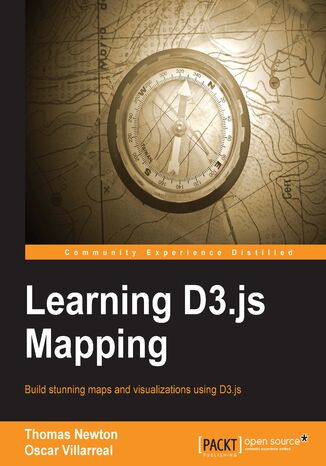
Learning D3.js Mapping. Build stunning maps and visualizations using D3.js
Thomas Newton, Oscar Villarreal
If you are interested in creating maps for the web GIS data, this book is for you. Familiarity with D3.js will be helpful but is not necessary.
Robert Layton
This book teaches you to design and develop data mining applications using a variety of datasets, starting with basic classification and affinity analysis. This book covers a large number of libraries available in Python, including the Jupyter Notebook, pandas, scikit-learn, and NLTK. You will gain hands on experience with complex data types including text, images, and graphs. You will also discover object detection using Deep Neural Networks, which is one of the big, difficult areas of machine learning right now.With restructured examples and code samples updated for the latest edition of Python, each chapter of this book introduces you to new algorithms and techniques. By the end of the book, you will have great insights into using Python for data mining and understanding of the algorithms as well as implementations.
Pranav Shukla, Sharath Kumar
The Elastic Stack is a powerful combination of tools for distributed search, analytics, logging, and visualization of data from medium to massive data sets. The newly released Elastic Stack 6.0 brings new features and capabilities that empower users to find unique, actionable insights through these techniques. This book will give you a fundamental understanding of what the stack is all about, and how to use it efficiently to build powerful real-time data processing applications.After a quick overview of the newly introduced features in Elastic Stack 6.0, you’ll learn how to set up the stack by installing the tools, and see their basic configurations. Then it shows you how to use Elasticsearch for distributed searching and analytics, along with Logstash for logging, and Kibana for data visualization. It also demonstrates the creation of custom plugins using Kibana and Beats. You’ll find out about Elastic X-Pack, a useful extension for effective security and monitoring. We also provide useful tips on how to use the Elastic Cloud and deploy the Elastic Stack in production environments.On completing this book, you’ll have a solid foundational knowledge of the basic Elastic Stack functionalities. You’ll also have a good understanding of the role of each component in the stack to solve different data processing problems.
Abhishek Andhavarapu
Elasticsearch is a modern, fast, distributed, scalable, fault tolerant, and open source search and analytics engine. You can use Elasticsearch for small or large applications with billions of documents. It is built to scale horizontally and can handle both structured and unstructured data. Packed with easy-to- follow examples, this book will ensure you will have a firm understanding of the basics of Elasticsearch and know how to utilize its capabilities efficiently.You will install and set up Elasticsearch and Kibana, and handle documents using the Distributed Document Store. You will see how to query, search, and index your data, and perform aggregation-based analytics with ease. You will see how to use Kibana to explore and visualize your data. Further on, you will learn to handle document relationships, work with geospatial data, and much more, with this easy-to-follow guide. Finally, you will see how you can set up and scale your Elasticsearch clusters in production environments.