
Big data
David Bellot
Probabilistic graphical models (PGM, also known as graphical models) are a marriage between probability theory and graph theory. Generally, PGMs use a graph-based representation. Two branches of graphical representations of distributions are commonly used, namely Bayesian networks and Markov networks. R has many packages to implement graphical models.We’ll start by showing you how to transform a classical statistical model into a modern PGM and then look at how to do exact inference in graphical models. Proceeding, we’ll introduce you to many modern R packages that will help you to perform inference on the models. We will then run a Bayesian linear regression and you’ll see the advantage of going probabilistic when you want to do prediction. Next, you’ll master using R packages and implementing its techniques. Finally, you’ll be presented with machine learning applications that have a direct impact in many fields. Here, we’ll cover clustering and the discovery of hidden information in big data, as well as two important methods, PCA and ICA, to reduce the size of big problems.
Tomasz Drabas, Denny Lee
Apache Spark is an open source framework for efficient cluster computing with a strong interface for data parallelism and fault tolerance. This book will show you how to leverage the power of Python and put it to use in the Spark ecosystem. You will start by getting a firm understanding of the Spark 2.0 architecture and how to set up a Python environment for Spark. You will get familiar with the modules available in PySpark. You will learn how to abstract data with RDDs and DataFrames and understand the streaming capabilities of PySpark. Also, you will get a thorough overview of machine learning capabilities of PySpark using ML and MLlib, graph processing using GraphFrames, and polyglot persistence using Blaze. Finally, you will learn how to deploy your applications to the cloud using the spark-submit command. By the end of this book, you will have established a firm understanding of the Spark Python API and how it can be used to build data-intensive applications.
Anita Graser
QGIS is a user-friendly open source geographic information system (GIS) that runs on Linux, Unix, Mac OS X, and Windows. The popularity of open source geographic information systems and QGIS in particular has been growing rapidly over the last few years.Learning QGIS Third Edition is a practical, hands-on guide updated for QGIS 2.14 that provides you with clear, step-by-step exercises to help you apply your GIS knowledge to QGIS. Through clear, practical exercises, this book will introduce you to working with QGIS quickly and painlessly.This book takes you from installing and configuring QGIS to handling spatial data to creating great maps. You will learn how to load and visualize existing spatialdata and create data from scratch. You will get to know important plugins, perform common geoprocessing and spatial analysis tasks and automate them with Processing.We will cover how to achieve great cartographic output and print maps. Finally, you will learn how to extend QGIS using Python and even create your own plugin.
PRASHANT VATS, Dr. Param Jeet
The role of a quantitative analyst is very challenging, yet lucrative, so there is a lot of competition for the role in top-tier organizations and investment banks. This book is your go-to resource if you want to equip yourself with the skills required to tackle any real-world problem in quantitative finance using the popular R programming language.You'll start by getting an understanding of the basics of R and its relevance in the field of quantitative finance. Once you've built this foundation, we'll dive into the practicalities of building financialmodels in R. This will help you have a fair understanding of the topics as well as their implementation, as the authors have presented some use cases along with examples that are easy to understand and correlate.We'll also look at risk management and optimization techniques for algorithmic trading. Finally, the book will explain some advanced concepts, such as trading using machine learning, optimizations, exotic options, and hedging.By the end of this book, you will have a firm grasp of the techniques required to implement basic quantitative finance models in R.
Learning R Programming. Language, tools, and practical techniques
Kun Ren
R is a high-level functional language and one of the must-know tools for data science and statistics. Powerful but complex, R can be challenging for beginners and those unfamiliar with its unique behaviors. Learning R Programming is the solution - an easy and practical way to learn R and develop a broad and consistent understanding of the language. Through hands-on examples you'll discover powerful R tools, and R best practices that will give you a deeper understanding of working with data. You'll get to grips with R's data structures and data processing techniques, as well as the most popular R packages to boost your productivity from the offset.Start with the basics of R, then dive deep into the programming techniques and paradigms to make your R code excel. Advance quickly to a deeper understanding of R's behavior as you learn common tasks including data analysis, databases, web scraping, high performance computing, and writing documents. By the end of the book, you'll be a confident R programmer adept at solving problems with the right techniques.
Shilpi Saxena
If you want to efficiently use Storm and Cassandra together and excel at developing production-grade, distributed real-time applications, then this book is for you. No prior knowledge of using Storm and Cassandra together is necessary. However, a background in Java is expected.
Erik Hanchett, Christoph Körner
Using D3.js and Responsive Design principles, you will not just be able to implement visualizations that look and feel awesome across all devices and screen resolutions, but you will also boost your productivity and reduce development time by making use of Bootstrap—the most popular framework for developing responsive web applications.This book teaches the basics of scalable vector graphics (SVG), D3.js, and Bootstrap while focusing on Responsive Design as well as mobile-first visualizations; the reader will start by discovering Bootstrap and how it can be used for creating responsive applications, and then implement a basic bar chart in D3.js. You will learn about loading, parsing, and filtering data in JavaScript and then dive into creating a responsive visualization by using Media Queries, responsive interactions for Mobile and Desktop devices, and transitions to bring the visualization to life. In the following chapters, we build a fully responsive interactive map to display geographic data using GeoJSON and set up integration testing with Protractor to test the application across real devices using a mobile API gateway such as AWS Device Farm. You will finish the journey by discovering the caveats of mobile-first applications and learn how to master cross-browser complications.
David Lai, Riaz Ahmed
The book starts with the basics of SAP Analytics Cloud (formerly known as SAP BusinessObjects Cloud) and exposes almost every significant feature a beginner needs to master. Packed with illustrations and short, essential, to-the-point descriptions, the book provides a unique learning experience. Your journey of exploration starts with a basic introduction to the SAP Analytics Cloud platform. You will then learn about different segments of the product, such as Models, Stories, Digital Boardroom, and so on. Then, you are introduced to the product's interface: the Home screen, the main menu, and more. Then comes the hands-on aspect of the book, which starts with model creation. Next, you learn how to utilize a model to prepare different types of stories(reports) with the help of charts, tables, Geo Maps, and more. In the final chapters of this book, you will learn about Digital Boardroom, Collaboration, and Administration.
Dipanjan Sarkar, Karthik Ganapathy, Raghav Bali, Tushar...
The Internet has truly become humongous, especially with the rise of various forms of social media in the last decade, which give users a platform to express themselves and also communicate and collaborate with each other. This book will help the reader to understand the current social media landscape and to learn how analytics can be leveraged to derive insights from it. This data can be analyzed to gain valuable insights into the behavior and engagement of users, organizations, businesses, and brands. It will help readers frame business problems and solve them using social data.The book will also cover several practical real-world use cases on social media using R and its advanced packages to utilize data science methodologies such as sentiment analysis, topic modeling, text summarization, recommendation systems, social network analysis, classification, and clustering. This will enable readers to learn different hands-on approaches to obtain data from diverse social media sources such as Twitter and Facebook. It will also show readers how to establish detailed workflows to process, visualize, and analyze data to transform social data into actionable insights.
Learning Spark SQL. Architect streaming analytics and machine learning solutions
Aurobindo Sarkar
In the past year, Apache Spark has been increasingly adopted for the development of distributed applications. Spark SQL APIs provide an optimized interface that helps developers build such applications quickly and easily. However, designing web-scale production applications using Spark SQL APIs can be a complex task. Hence, understanding the design and implementation best practices before you start your project will help you avoid these problems.This book gives an insight into the engineering practices used to design and build real-world, Spark-based applications. The book's hands-on examples will give you the required confidence to work on any future projects you encounter in Spark SQL.It starts by familiarizing you with data exploration and data munging tasks using Spark SQL and Scala. Extensive code examples will help you understand the methods used to implement typical use-cases for various types of applications. You will get a walkthrough of the key concepts and terms that are common to streaming, machine learning, and graph applications. You will also learn key performance-tuning details including Cost Based Optimization (Spark 2.2) in Spark SQL applications. Finally, you will move on to learning how such systems are architected and deployed for a successful delivery of your project.
Learning Splunk Web Framework. Create, extend and publish real time Splunk applications
Vincent Sesto
Building rich applications on the Web using Splunk is now simpler than ever before with the Splunk Web Framework. It empowers developers to build their own web applications with custom dashboards, tables, charts, form searches, and other functionalities in the datasets at their disposal. The book will start with the fundamentals of the Splunk Web Framework, teaching you the secrets of building interesting and user-friendly applications. In the first application, you will learn to analyze and monitor traffic hitting the NASA website and learn to create dashboards for it. You will then learn additional, and more detailed, techniques to enhance the functionalities of the app such as dashboards and forms, editing simple XML, using simple XML extensions, tokens, post-process searches, dynamic drill-downs, the Splunk Web Framework and REST API, and much more. The second app will use historical stock market data and will create custom dashboards using Splunk Web Framework; the book will now cover important topics such as creating HTML dashboards, enhancing the visual appeal of the app using CSS, and moving your app with SplunkJS.The book will provide different and interesting examples instead of the usual “Log, Index, Search, and Graph” so that Splunk will be the first tool readers think of to resolve a problem.
Joshua N. Milligan
Tableau is the gold standard of business intelligence and visual analytics tools in every industry. It enables rapid data visualization and interpretation with charts, graphs, dashboards, and much more. Updated with the latest features of Tableau, this book takes you from the foundations of the Tableau 2019 paradigm through to advanced topics.This third edition of the bestselling guide by Tableau Zen Master, Joshua Milligan, will help you come to grips with updated features, such as set actions and transparent views. Beginning with installation, you'll create your first visualizations with Tableau and then explore practical examples and advanced techniques. You'll create bar charts, tree maps, scatterplots, time series, and a variety of other visualizations. Next, you'll discover techniques to overcome challenges presented by data structure and quality and engage in effective data storytelling and decision making with business critical information. Finally, you'll be introduced to Tableau Prep, and learn how to use it to integrate and shape data for analysis.By the end of this book, you will be equipped to leverage the powerful features of Tableau 2019 for decision making.
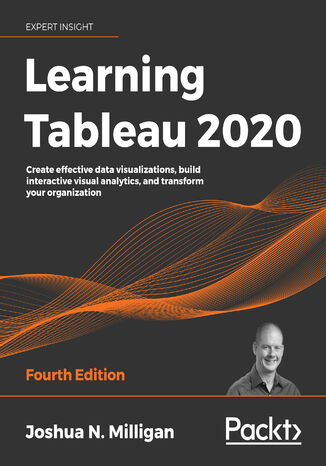
Joshua N. Milligan
Learning Tableau strengthens your command on Tableau fundamentals and builds on advanced topics.The book starts by taking you through foundational principles of Tableau. We then demonstrate various types of connections and how to work with metadata. We teach you to use a wide variety of visualizations to analyze and communicate the data, and introduce you to calculations and parameters. We then take an in-depth look at level of detail (LOD) expressions and use them to solve complex data challenges. Up next, we show table calculations, how to extend and alter default visualizations, build an interactive dashboard, and master the art of telling stories with data.This Tableau book will introduce you to visual statistical analytics capabilities, create different types of visualizations and dynamic dashboards for rich user experiences. We then move on to maps and geospatial visualization, and the new Data Model capabilities introduced in Tableau 2020.2. You will further use Tableau Prep’s ability to clean and structure data and share the stories contained in your data.By the end of this book, you will be proficient in implementing the powerful features of Tableau 2020 for decision-making.
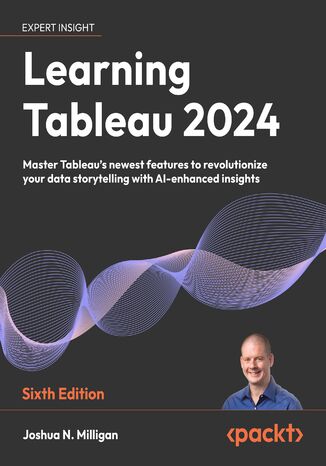
Joshua N. Milligan
Tableau 2025 marks a new era in data visualization and analysis, bringing together advanced AI integrations and dynamic user experiences. This sixth edition, written by Tableau Visionary and Zen Master Joshua Miligan, is an end-to-end guide to mastering the latest innovations in Tableau that transform raw data into actionable insights.This edition introduces groundbreaking features like Tableau AI (including Tableau Pulse and Tableau Agent), enhancing your analytical capabilities with AI-driven data exploration and automated insights. With detailed walkthroughs, you’ll learn to build dynamic dashboards that respond to your data in real time and work with sophisticated AI functionalities that predict trends and model scenarios.Whether you're a seasoned data professional or new to Tableau, this book provides the tools you need to leverage Tableau’s full potential. From integrating diverse data sources using the enhanced data model to employing advanced geospatial functions for detailed mapping, every chapter is packed with expert knowledge and practical applications designed to put powerful analytics at your fingertips.*Email sign-up and proof of purchase required
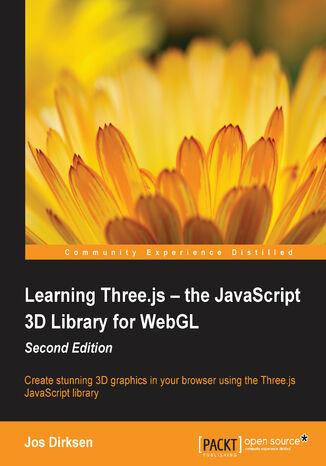
Jos Dirksen
If you know JavaScript and want to start creating 3D graphics that run in any browser, this book is a great choice for you. You don't need to know anything about math or WebGL; all that you need is general knowledge of JavaScript and HTML.
Akhil Arora, Shrey Mehrotra
Today enterprises generate huge volumes of data. In order to provide effective services and to make smarter and more intelligent decisions from these huge volumes of data, enterprises use big-data analytics. In recent years, Hadoop has been used for massive data storage and efficient distributed processing of data. The Yet Another Resource Negotiator (YARN) framework solves the design problems related to resource management faced by the Hadoop 1.x framework by providing a more scalable, efficient, flexible, and highly available resource management framework for distributed data processing.This book starts with an overview of the YARN features and explains how YARN provides a business solution for growing big data needs. You will learn to provision and manage single, as well as multi-node, Hadoop-YARN clusters in the easiest way. You will walk through the YARN administration, life cycle management, application execution, REST APIs, schedulers, security framework and so on. You will gain insights about the YARN components and features such as ResourceManager, NodeManager, ApplicationMaster, Container, Timeline Server, High Availability, Resource Localisation and so on.The book explains Hadoop-YARN commands and the configurations of components and explores topics such as High Availability, Resource Localization and Log aggregation. You will then be ready to develop your own ApplicationMaster and execute it over a Hadoop-YARN cluster.Towards the end of the book, you will learn about the security architecture and integration of YARN with big data technologies like Spark and Storm. This book promises conceptual as well as practical knowledge of resource management using YARN.