
Big data
Allan Visochek
Around 80% of time in data analysis is spent on cleaning and preparing data for analysis. This is, however, an important task, and is a prerequisite to the rest of the data analysis workflow, including visualization, analysis and reporting. Python and R are considered a popular choice of tool for data analysis, and have packages that can be best used to manipulate different kinds of data, as per your requirements. This book will show you the different data wrangling techniques, and how you can leverage the power of Python and R packages to implement them.You’ll start by understanding the data wrangling process and get a solid foundation to work with different types of data. You’ll work with different data structures and acquire and parse data from various locations. You’ll also see how to reshape the layout of data and manipulate, summarize, and join data sets. Finally, we conclude with a quick primer on accessing and processing data from databases, conducting data exploration, and storing and retrieving data quickly using databases.The book includes practical examples on each of these points using simple and real-world data sets to give you an easier understanding. By the end of the book, you’ll have a thorough understanding of all the data wrangling concepts and how to implement them in the best possible way.
Yong Liu
The book starts with an overview of the deep learning (DL) life cycle and the emerging Machine Learning Ops (MLOps) field, providing a clear picture of the four pillars of deep learning: data, model, code, and explainability and the role of MLflow in these areas.From there onward, it guides you step by step in understanding the concept of MLflow experiments and usage patterns, using MLflow as a unified framework to track DL data, code and pipelines, models, parameters, and metrics at scale. You’ll also tackle running DL pipelines in a distributed execution environment with reproducibility and provenance tracking, and tuning DL models through hyperparameter optimization (HPO) with Ray Tune, Optuna, and HyperBand. As you progress, you’ll learn how to build a multi-step DL inference pipeline with preprocessing and postprocessing steps, deploy a DL inference pipeline for production using Ray Serve and AWS SageMaker, and finally create a DL explanation as a service (EaaS) using the popular Shapley Additive Explanations (SHAP) toolbox.By the end of this book, you’ll have built the foundation and gained the hands-on experience you need to develop a DL pipeline solution from initial offline experimentation to final deployment and production, all within a reproducible and open source framework.
Practical GIS. Learn novice to advanced topics such as QGIS, Spatial data analysis, and more
Gábor Farkas
The most commonly used GIS tools automate tasks that were historically done manually—compiling new maps by overlaying one on top of the other or physically cutting maps into pieces representing specific study areas, changing their projection, and getting meaningful results from the various layers by applying mathematical functions and operations. This book is an easy-to-follow guide to use the most matured open source GIS tools for these tasks.We’ll start by setting up the environment for the tools we use in the book. Then you will learn how to work with QGIS in order to generate useful spatial data. You will get to know the basics of queries, data management, and geoprocessing.After that, you will start to practice your knowledge on real-world examples. We will solve various types of geospatial analyses with various methods. We will start with basic GIS problems by imitating the work of an enthusiastic real estate agent, and continue with more advanced, but typical tasks by solving a decision problem. Finally, you will find out how to publish your data (and results) on the web. We will publish our data with QGIS Server and GeoServer, and create a basic web map with the API of the lightweight Leaflet web mapping library.
Valery Manokhin, Agus Sudjianto
In the rapidly evolving landscape of machine learning, the ability to accurately quantify uncertainty is pivotal. The book addresses this need by offering an in-depth exploration of Conformal Prediction, a cutting-edge framework to manage uncertainty in various ML applications.Learn how Conformal Prediction excels in calibrating classification models, produces well-calibrated prediction intervals for regression, and resolves challenges in time series forecasting and imbalanced data. Discover specialised applications of conformal prediction in cutting-edge domains like computer vision and NLP. Each chapter delves into specific aspects, offering hands-on insights and best practices for enhancing prediction reliability. The book concludes with a focus on multi-class classification nuances, providing expert-level proficiency to seamlessly integrate Conformal Prediction into diverse industries. With practical examples in Python using real-world datasets, expert insights, and open-source library applications, you will gain a solid understanding of this modern framework for uncertainty quantification.By the end of this book, you will be able to master Conformal Prediction in Python with a blend of theory and practical application, enabling you to confidently apply this powerful framework to quantify uncertainty in diverse fields.
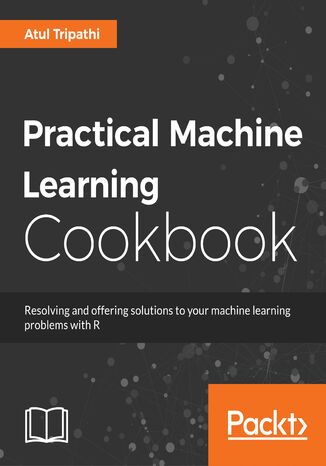
Practical Machine Learning Cookbook. Supervised and unsupervised machine learning simplified
Vikram Chandra Jha, Atul Tripathi
Machine learning has become the new black. The challenge in today’s world is the explosion of data from existing legacy data and incoming new structured and unstructured data. The complexity of discovering, understanding, performing analysis, and predicting outcomes on the data using machine learning algorithms is a challenge. This cookbook will help solve everyday challenges you face as a data scientist. The application of various data science techniques and on multiple data sets based on real-world challenges you face will help you appreciate a variety of techniques used in various situations.The first half of the book provides recipes on fairly complex machine-learning systems, where you’ll learn to explore new areas of applications of machine learning and improve its efficiency. That includes recipes on classifications, neural networks, unsupervised and supervised learning, deep learning, reinforcement learning, and more.The second half of the book focuses on three different machine learning case studies, all based on real-world data, and offers solutions and solves specific machine-learning issues in each one.
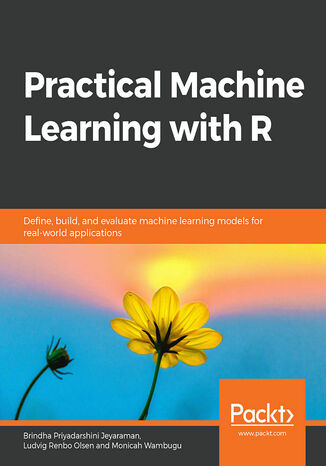
Brindha Priyadarshini Jeyaraman, Ludvig Renbo Olsen, Monicah...
With huge amounts of data being generated every moment, businesses need applications that apply complex mathematical calculations to data repeatedly and at speed. With machine learning techniques and R, you can easily develop these kinds of applications in an efficient way.Practical Machine Learning with R begins by helping you grasp the basics of machine learning methods, while also highlighting how and why they work. You will understand how to get these algorithms to work in practice, rather than focusing on mathematical derivations. As you progress from one chapter to another, you will gain hands-on experience of building a machine learning solution in R. Next, using R packages such as rpart, random forest, and multiple imputation by chained equations (MICE), you will learn to implement algorithms including neural net classifier, decision trees, and linear and non-linear regression. As you progress through the book, you’ll delve into various machine learning techniques for both supervised and unsupervised learning approaches. In addition to this, you’ll gain insights into partitioning the datasets and mechanisms to evaluate the results from each model and be able to compare them. By the end of this book, you will have gained expertise in solving your business problems, starting by forming a good problem statement, selecting the most appropriate model to solve your problem, and then ensuring that you do not overtrain it.
Paul Done
Officially endorsed by MongoDB, Inc., Practical MongoDB Aggregations helps you unlock the full potential of the MongoDB aggregation framework, including the latest features of MongoDB 7.0. This book provides practical, easy-to-digest principles and approaches for increasing your effectiveness in developing aggregation pipelines, supported by examples for building pipelines to solve complex data manipulation and analytical tasks.This book is customized for developers, architects, data analysts, data engineers, and data scientists with some familiarity with the aggregation framework. It begins by explaining the framework's architecture and then shows you how to build pipelines optimized for productivity and scale.Given the critical role arrays play in MongoDB's document model, the book delves into best practices for optimally manipulating arrays. The latter part of the book equips you with examples to solve common data processing challenges so you can apply the lessons you've learned to practical situations. By the end of this MongoDB book, you’ll have learned how to utilize the MongoDB aggregation framework to streamline your data analysis and manipulation processes effectively.
Ralph Winters
This is the go-to book for anyone interested in the steps needed to develop predictive analytics solutions with examples from the world of marketing, healthcare, and retail. We'll get startedwith a brief history of predictive analytics and learn about different roles and functions people play within a predictive analytics project. Then, we will learn about various ways of installing R along with their pros and cons, combined with a step-by-step installation of RStudio,and a description of the best practices for organizing your projects.On completing the installation, we will begin to acquire the skills necessary to input, clean, and prepare your data for modeling. We will learn the six specific steps needed to implement andsuccessfully deploy a predictive model starting from asking the right questions through model development and ending with deploying your predictive model into production. We will learn whycollaboration is important and how agile iterative modeling cycles can increase your chances of developing and deploying the best successful model.We will continue your journey in the cloud by extending your skill set by learning about Databricks and SparkR, which allow you to develop predictive models on vast gigabytes of data.