
Big data
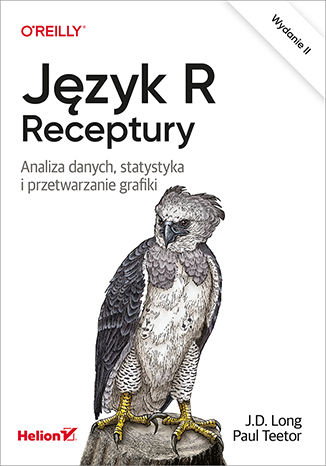
Język R. Receptury. Analiza danych, statystyka i przetwarzanie grafiki. Wydanie II
JD Long, Paul Teetor
Język R jest potężnym narzędziem używanym w statystyce, przetwarzaniu grafiki i programowaniu statystycznym; stanowi konkurencję dla komercyjnych systemów do obliczeń tego rodzaju. Zawiera wszystkie narzędzia, których potrzebują statystycy. Równocześnie jest to specyficzny język, przez co jego użytkowanie może sprawiać problemy. Zarówno proste, jak i złożone zadania są łatwe do wykonania, jeśli tylko wiadomo, w jaki sposób je zrobić. Jeżeli jednak trzeba stopniowo dochodzić do właściwego rozwiązania, może to kosztować sporo cierpliwości i zniechęcać. Oto zbiór 275 receptur instruktażowych, z których każda pomaga w rozwiązaniu konkretnego problemu. Wszystkie zostały starannie przetestowane i wielokrotnie dowodziły swojej przydatności. Każda z omawianych receptur została poprzedzona krótkim wprowadzeniem i omówieniem zastosowanych mechanizmów działania. Nie jest to klasyczny podręcznik programowania, jednak z pewnością przyśpieszy naukę praktycznego wykorzystania możliwości R. Jeśli masz już pewne doświadczenie z tym językiem, odświeżysz swoją wiedzę i uzyskasz szerszą perspektywę. Wśród receptur znajdziesz obejmujące szeroki zakres zadania - od podstawowych operacji na danych wejściowych i wyjściowych, poprzez statystykę ogólną, aż po grafikę i regresję liniową. Dowiesz się również, jak wykorzystać język R do wizualizacji danych za pomocą ciekawych wykresów graficznych. W tej książce między innymi: przygotowywanie danych wejściowych i upraszczanie danych wyjściowych macierze, listy, wektory czynnikowe, ramki danych testy statystyczne, przedziały ufności, prawdopodobieństwa modele statystyczne z wykorzystaniem regresji liniowej i analizy wariancji stosowanie zaawansowanych technik statystycznych R: błyskawicznie osiągniesz znakomite wyniki!
Bogumił Kamiński, Przemysław Szufel
Julia, with its dynamic nature and high-performance, provides comparatively minimal time for the development of computational models with easy-to-maintain computational code. This book will be your solution-based guide as it will take you through different programming aspects with Julia.Starting with the new features of Julia 1.0, each recipe addresses a specific problem, providing a solution and explaining how it works. You will work with the powerful Julia tools and data structures along with the most popular Julia packages. You will learn to create vectors, handle variables, and work with functions. You will be introduced to various recipes for numerical computing, distributed computing, and achieving high performance. You will see how to optimize data science programs with parallel computing and memory allocation. We will look into more advanced concepts such as metaprogramming and functional programming. Finally, you will learn how to tackle issues while working with databases and data processing, and will learn about on data science problems, data modeling, data analysis, data manipulation, parallel processing, and cloud computing with Julia.By the end of the book, you will have acquired the skills to work more effectively with your data
Julia for Data Science. high-performance computing simplified
Anshul Joshi
Julia is a fast and high performing language that's perfectly suited to data science with a mature package ecosystem and is now feature complete. It is a good tool for a data science practitioner. There was a famous post at Harvard Business Review that Data Scientist is the sexiest job of the 21st century. (https://hbr.org/2012/10/data-scientist-the-sexiest-job-of-the-21st-century).This book will help you get familiarised with Julia's rich ecosystem, which is continuously evolving, allowing you to stay on top of your game.This book contains the essentials of data science and gives a high-level overview of advanced statistics and techniques. You will dive in and will work on generating insights by performing inferential statistics, and will reveal hidden patterns and trends using data mining. This has the practical coverage of statistics and machine learning. You will develop knowledge to build statistical models and machine learning systems in Julia with attractive visualizations.You will then delve into the world of Deep learning in Julia and will understand the framework, Mocha.jl with which you can create artificial neural networks and implement deep learning.This book addresses the challenges of real-world data science problems, including data cleaning, data preparation, inferential statistics, statistical modeling, building high-performance machine learning systems and creating effective visualizations using Julia.
Toomey, Nikhil Borkar, Nikhil Akki, Juan Tomás...
Jupyter has garnered a strong interest in the data science community of late, as it makes common data processing and analysis tasks much simpler. This book is for data science professionals who want to master various tasks related to Jupyter to create efficient, easy-to-share, scientific applications.The book starts with recipes on installing and running the Jupyter Notebook system on various platforms and configuring the various packages that can be used with it. You will then see how you can implement different programming languages and frameworks, such as Python, R, Julia, JavaScript, Scala, and Spark on your Jupyter Notebook. This book contains intuitive recipes on building interactive widgets to manipulate and visualize data in real time, sharing your code, creating a multi-user environment, and organizing your notebook. You will then get hands-on experience with Jupyter Labs, microservices, and deploying them on the web. By the end of this book, you will have taken your knowledge of Jupyter to the next level to perform all key tasks associated with it.
Toomey
Jupyter Notebook is a web-based environment that enables interactive computing in notebook documents. It allows you to create documents that contain live code, equations, and visualizations. This book is a comprehensive guide to getting started with data science using the popular Jupyter notebook. If you are familiar with Jupyter notebook and want to learn how to use its capabilities to perform various data science tasks, this is the book for you! From data exploration to visualization, this book will take you through every step of the way in implementing an effective data science pipeline using Jupyter. You will also see how you can utilize Jupyter's features to share your documents and codes with your colleagues. The book also explains how Python 3, R, and Julia can be integrated with Jupyter for various data science tasks.By the end of this book, you will comfortably leverage the power of Jupyter to perform various tasks in data science successfully.
Giuseppe Ciaburro
Keras 2.x Projects explains how to leverage the power of Keras to build and train state-of-the-art deep learning models through a series of practical projects that look at a range of real-world application areas. To begin with, you will quickly set up a deep learning environment by installing the Keras library. Through each of the projects, you will explore and learn the advanced concepts of deep learning and will learn how to compute and run your deep learning models using the advanced offerings of Keras. You will train fully-connected multilayer networks, convolutional neural networks, recurrent neural networks, autoencoders and generative adversarial networks using real-world training datasets. The projects you will undertake are all based on real-world scenarios of all complexity levels, covering topics such as language recognition, stock volatility, energy consumption prediction, faster object classification for self-driving vehicles, and more. By the end of this book, you will be well versed with deep learning and its implementation with Keras. You will have all the knowledge you need to train your own deep learning models to solve different kinds of problems.
Keras Deep Learning Cookbook. Over 30 recipes for implementing deep neural networks in Python
Rajdeep Dua, Manpreet Singh Ghotra
Keras has quickly emerged as a popular deep learning library. Written in Python, it allows you to train convolutional as well as recurrent neural networks with speed and accuracy.The Keras Deep Learning Cookbook shows you how to tackle different problems encountered while training efficient deep learning models, with the help of the popular Keras library. Starting with installing and setting up Keras, the book demonstrates how you can perform deep learning with Keras in the TensorFlow. From loading data to fitting and evaluating your model for optimal performance, you will work through a step-by-step process to tackle every possible problem faced while training deep models. You will implement convolutional and recurrent neural networks, adversarial networks, and more with the help of this handy guide. In addition to this, you will learn how to train these models for real-world image and language processing tasks. By the end of this book, you will have a practical, hands-on understanding of how you can leverage the power of Python and Keras to perform effective deep learning
Giuseppe Ciaburro, Sudharsan Ravichandiran, Suriyadeepan Ramamoorthy
Reinforcement learning has evolved a lot in the last couple of years and proven to be a successful technique in building smart and intelligent AI networks. Keras Reinforcement Learning Projects installs human-level performance into your applications using algorithms and techniques of reinforcement learning, coupled with Keras, a faster experimental library.The book begins with getting you up and running with the concepts of reinforcement learning using Keras. You’ll learn how to simulate a random walk using Markov chains and select the best portfolio using dynamic programming (DP) and Python. You’ll also explore projects such as forecasting stock prices using Monte Carlo methods, delivering vehicle routing application using Temporal Distance (TD) learning algorithms, and balancing a Rotating Mechanical System using Markov decision processes.Once you’ve understood the basics, you’ll move on to Modeling of a Segway, running a robot control system using deep reinforcement learning, and building a handwritten digit recognition model in Python using an image dataset. Finally, you’ll excel in playing the board game Go with the help of Q-Learning and reinforcement learning algorithms.By the end of this book, you’ll not only have developed hands-on training on concepts, algorithms, and techniques of reinforcement learning but also be all set to explore the world of AI.