
Aplikacje biurowe
Jak wykonać skomplikowane obliczenia w arkuszu kalkulacyjnym? Jak napisać i poprawnie sformatować urzędowe pismo w edytorze tekstu albo wykonać interesującą prezentację dla szefa? Tutaj znajdziecie odpowiedź.
Podręczniki w tym dziale pozwolą poznać tajniki najbardziej popularnych aplikacji biurowych jak pakiet MS Office czy Open Office, poczty elektronicznej jak Outlook, czy zagadnień języka programowania VBA oraz w pełni wykorzystać potencjał jaki te programy oferują. Nauczycie się jak aktywnie zarządzać budżetem w MS Project, tworzyć prezentację w PowerPoint slajd po slajdzie, oraz znajdziecie tu szereg wskazówek i porad jak usprawnić Waszą pracę z programami Excel czy Word.
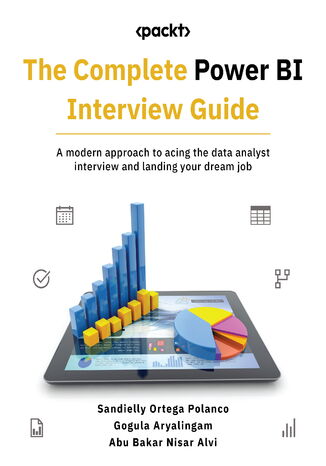
Sandielly Ortega Polanco, Gogula Aryalingam, Abu Bakar...
The Complete Power Interview Guide helps you excel in a Power BI interview, secure desired roles, and be ready with the knowledge and skills to ace your role from the first day. Whether you're beginning your career journey or transitioning into a data analytics role, this guide offers hands-on skills and interview questions you need to succeed as a BI or data analyst. This book also offers supplemental content for PowerBI certification exams like PL-300. The book will equip you with the knowledge and strategies to effectively navigate the competitive job market. From creating an outstanding online professional profile to optimizing your resume and building a compelling work portfolio, you'll learn how to establish a strong personal brand. The essentials of Power BI, including data preparation, data modeling, DAX programming, expert report development, and impactful storytelling, are covered in-depth through real-world examples and valuable tips.By the end of this book, you'll have the confidence to interview for Power BI roles, navigate technical assessments, answer behavioral questions, and tackle case studies. You’ll have gained applied knowledge and the competitive edge needed to succeed in the data analytics job market and stay ahead of industry trends for career advancement.
The DevOps 2.2 Toolkit. Self-Sufficient Docker Clusters
Viktor Farcic
Building on The DevOps 2.0 Toolkit and The DevOps 2.1 Toolkit: Docker Swarm, Viktor Farcic brings his latest exploration of the Docker technology as he records his journey to explore two new programs, self-adaptive and self-healing systems within Docker. The DevOps 2.2 Toolkit: Self-Sufficient Docker Clusters is the latest book in Viktor Farcic’s series that helps you build a full DevOps Toolkit. This book in the series looks at Docker, the tool designed to make it easier in the creation and running of applications using containers. In this latest entry, Viktor combines theory with a hands-on approach to guide you through the process of creating self-adaptive and self-healing systems. Within this book, Viktor will cover a wide-range of emerging topics, including what exactly self-adaptive and self-healing systems are, how to choose a solution for metrics storage and query, the creation of cluster-wide alerts and what a successful self-sufficient system blueprint looks like. Work with Viktor and dive into the creation of self-adaptive and self-healing systems within Docker.
James Bryant, Aloke Mukherjee
In today's rapidly evolving economic landscape, the combination of finance, analytics, and artificial intelligence (AI) heralds a new era of decision-making. Finance and data analytics along with AI can no longer be seen as separate disciplines and professionals have to be comfortable in both in order to be successful. This book combines finance concepts, visualizations through Power BI and the application of AI and ChatGPT to provide a more holistic perspective.After a brief introduction to finance and Power BI, you will begin with Tesla's data-driven financial tactics before moving to John Deere's AgTech strides, all through the lens of AI. Salesforce's adaptation to the AI revolution offers profound insights, while Moderna's navigation through the biotech frontier during the pandemic showcases the agility of AI-focused companies. Learn from Silicon Valley Bank's demise, and prepare for CrowdStrike's defensive maneuvers against cyber threats. With each chapter, you'll gain mastery over new investing ideas, Power BI tools, and integrate ChatGPT into your workflows.This book is an indispensable ally for anyone looking to thrive in the financial sector. By the end of this book, you'll be able to transform your approach to investing and trading by blending AI-driven analysis, data visualization, and real-world applications.
The Node Craftsman Book. An Advanced Node.js Tutorial
Manuel Kiessling
The Node Craftsman Book helps JavaScript programmers with basic Node.js knowledge to now thoroughly master Node.js and JavaScript. This book dives you deeper into the craft of software development with Node.js and JavaScript, incuding object-orientation, test-driven development, database handling, web frameworks, and much more.The Node Craftsman Book shows you how to work with Node.js and how to think deeply about how you build your Node projects. You'll master how to build a complete Node.js application across six crafting milestones, and you'll learn many specific skills to achieve that mastery. These skills include how to work with the Node Package Manager in depth, how to connect your Node applications to databases, and how to write unit tests and end-to-end tests for your code. You'll experience the full Node.js development picture, and learn how to craft and control your Node.js applications - right through to fully-fledged web applications using REST, and integration with Angular applications.
Srini Munagavalasa
Salesforce projects often fail not due to technology limitations but because of unclear requirements, poor stakeholder alignment, and a lack of business context. The Salesforce Business Analyst Playbook, Second Edition, addresses these challenges head-on, offering a complete, real-world guide for Business Analysts looking to elevate their impact on Salesforce implementations.Written by Srini Munagavalasa, a seasoned Salesforce leader with over 20 years of global experience across Salesforce and SAP CRM, this updated edition introduces powerful new content, including generative AI tools, advanced analysis techniques, automated traceability, and modern Salesforce features such as Flows and in-app guidance. These updates empower analysts to work smarter, whether gathering requirements, optimizing solution design, managing testing, or driving adoption. You’ll walk through the entire Salesforce project life cycle with practical methods, stakeholder collaboration strategies, testing plans, and certification guidance, ensuring you can handle complex projects with confidence.By the end of this book, you’ll be able to lead the business analysis efforts across every stage of a Salesforce project, solve real-world problems, and adapt to Salesforce’s evolving capabilities.*Email sign-up and proof of purchase required
Srini Munagavalasa
Salesforce business analysis skills are in high demand, and there are scant resources to satisfy this demand. This practical guide for business analysts contains all the tools, techniques, and processes needed to create business value and improve user adoption.The Salesforce Business Analyst Handbook begins with the most crucial element of any business analysis activity: identifying business requirements. You’ll learn how to use tacit business analysis and Salesforce system analysis skills to rank and stack all requirements as well as get buy-in from stakeholders. Once you understand the requirements, you’ll work on transforming them into working software via prototyping, mockups, and wireframing. But what good is a product if the customer cannot use it? To help you achieve that, this book will discuss various testing strategies and show you how to tailor testing scenarios that align with business requirements documents. Toward the end, you’ll find out how to create easy-to-use training material for your customers and focus on post-production support – one of the most critical phases. Your customers will stay with you if you support them when they need it!By the end of this Salesforce book, you’ll be able to successfully navigate every phase of a project and confidently apply your new knowledge in your own Salesforce implementations.
The Service Desk Handbook. A guide to service desk implementation, management and support
IT Governance Publishing, Sanjay Nair
This book provides practical insights into service desk management, focusing on building and optimizing a service desk to meet organizational needs. It starts with an understanding of the service desk's role, mission, and vision, laying the foundation for effective operations. It covers strategic planning for a well-structured service desk, focusing on staffing, SLAs, and using knowledge bases and self-service portals.The book discusses essential tools and technologies like telephony systems and ITSM tools, and how to configure them for efficiency. It emphasizes developing high-performance teams focused on respect, integrity, and teamwork, highlighting the importance of clear documentation, such as standard operating procedures and incident management, to ensure consistency in service delivery.Performance measurement is emphasized with strategies for tracking success using CSFs, KPIs, and customer satisfaction metrics. It explores both qualitative and quantitative evaluations to improve service desk performance.Finally, it examines emerging trends such as AI and chatbots, and their integration into service desk operations. The last chapters offer professional tips, techniques for root cause analysis, and provide a roadmap to optimize service desk operations for future success.
Patrick Haggerty
From data ingestion and storage, through data processing and data analytics, to application hosting and even machine learning, whatever your IT infrastructural need, there's a good chance that Google Cloud has a service that can help. But instant, self-serve access to a virtually limitless pool of IT resources has its drawbacks. More and more organizations are running into cost overruns, security problems, and simple why is this not working? headaches.This book has been written by one of Google’s top trainers as a tutorial on how to create your infrastructural foundation in Google Cloud the right way. By following Google’s ten-step checklist and Google’s security blueprint, you will learn how to set up your initial identity provider and create an organization. Further on, you will configure your users and groups, enable administrative access, and set up billing. Next, you will create a resource hierarchy, configure and control access, and enable a cloud network. Later chapters will guide you through configuring monitoring and logging, adding additional security measures, and enabling a support plan with Google.By the end of this book, you will have an understanding of what it takes to leverage Terraform for properly building a Google Cloud foundational layer that engenders security, flexibility, and extensibility from the ground up.