
Hardware
Dział poświęcony w całości tematyce związanej ze sprzętem komputerowym. Gdy Twój pecet nie działa jak należy, sięgnij po którąś z niniejszych pozycji.
Książki nie tylko dla profesjonalistów: serwisantów, projektantów urządzeń współpracujących z PC i programistów. Każdy, kto chce dowiedzieć się jak działa jego pecet znajdzie tu odpowiedzi na wszystkie swoje pytania.
Niedoświadczony użytkownik komputera nie będzie musiał się już obawiać samodzielnego majstrowania we wnętrzu "peceta". Dzięki naszym książkom pozna dokładnie budowę komputera, dowie się jak połączyć poszczególne jego komponenty, tak by pracował on szybko i stabilnie. Zaawansowani znajdą tu wiele cennych wskazówek, podpowiedzi i sprawdzonych sposobów osiągania maksymalnej wydajności komputera.
Sonia Mezzetta
Data can be found everywhere, from cloud environments and relational and non-relational databases to data lakes, data warehouses, and data lakehouses. Data management practices can be standardized across the cloud, on-premises, and edge devices with Data Fabric, a powerful architecture that creates a unified view of data. This book will enable you to design a Data Fabric solution by addressing all the key aspects that need to be considered.The book begins by introducing you to Data Fabric architecture, why you need them, and how they relate to other strategic data management frameworks. You’ll then quickly progress to grasping the principles of DataOps, an operational model for Data Fabric architecture. The next set of chapters will show you how to combine Data Fabric with DataOps and Data Mesh and how they work together by making the most out of it. After that, you’ll discover how to design Data Integration, Data Governance, and Self-Service analytics architecture. The book ends with technical architecture to implement distributed data management and regulatory compliance, followed by industry best practices and principles.By the end of this data book, you will have a clear understanding of what Data Fabric is and what the architecture looks like, along with the level of effort that goes into designing a Data Fabric solution.
Edouard Camou
Pro Tools HD is a digital audio workstation platform for Microsoft Windows and Mac OS X operating systems. It is the leading audio software when it comes to professional audio work. Working effectively with audio and producing professional music with Pro Tools HD is not an easy task.Beginning with what the software is about, we will take you all the way through to the steps required to efficiently record your audio. You will discover how to improve the workflow of Pro Tools software and receive innovative tips to enable flawless editing in music production, film scoring, film, and television post-production.Packed with concise and clear instructions on using Pro Tools HD: Advanced Techniques and Workflows, this book starts with different possible hardware and software combinations to help you understand the strengths and limitations of each, before taking you through powerful editing and advanced mixing techniques.When it comes to choosing a ProTools HD system there are different technologies available and therefore, many ways to use the system optimally so, you will learn about some digital audio concepts for better software optimisation. You will then learn editing using Beat detective, as well as covering excellent workflow and routing concepts to take full advantage of ProTools mixing capabilities, integrating both hardware analogue units with your favorite plugins. Finally, you will see how you can export your project safer, faster and better.This guide shows you the framework to enable you to take your usage of ProTools to the next level by explaining and discussing new and advanced features to achieve industry standard techniques.
Deepak Vohra
XML is an open standard for creating markup languages and exchanging structured documents and data over the Internet. JDeveloper 11g presents an effective, quick, and easy-to-use means of processing XML documents.Inspired by the author's previous XML articles for the Oracle community, this expanded hands-on tutorial guides newcomers and intermediate users through JDeveloper 11g and XML document development. It offers up-to-date information on working with the latest version of JDeveloper, and brand new information on JAXB 2.0 support in JDeveloper 11g. Filled with illustrations, explanatory tables, and comprehensive instructions, this book walks the reader through the wide assortment of JDeveloper's capabilities.Oracle's JDeveloper 11g is an Integrated Development Environment that provides a visual and declarative approach to application development. Over the course of 14 chapters, readers will get hands-on with JDeveloper as the comprehensive and self-contained tutorials provide clear instruction on the key XML tasks that JDeveloper can accomplish.Filled with practical information and illustrated examples, this book shows the reader how to create, parse, and store XML documents quickly, as well as providing step-by-step instructions on how to construct an XML schema and use the schema to validate an XML document. Oracle's XML Developer Kit (XDK) offers a set of components, tools, and utilities for developing XML-based applications, and developers will find the detailed XDK coverage invaluable. Later chapters are given over to using XPath, transforming XML with XSLT, and using the JSTL XML Tag Library. Moving through the book, a chapter on the JAXB 2.0 API shows you how to bind, marshal and unmarshal XML documents, before we finally delve into comparing XML documents, and converting them into PDF and Excel formats. In all, this book will enable the reader to gain a good and wide-ranging understanding of what JDeveloper has to offer for XML processing.
Professional Plone 4 Development. Build robust, content-centric web applications with Plone 4
Martin Aspeli
A years of experience in Plone development and project management are combined with an approachable writing style to create an engaging and highly-informative guide to working with Plone. Professional Plone 4 Development stands as an excellent resource for developers of all levels.- Eric Steele, Plone Release ManagerPlone is a web content management system that features among the top 2% of open source projects and is used by more than 300 solution providers in 57 countries. Its powerful workflow system, outstanding security track record, friendly user interface, elegant development model and vibrant community makes Plone a popular choice for building content-centric applications. By customising and extending the base platform, integrators can build unique solutions tailored to specific projects quickly and easily.If you want to create your own web applications and advanced websites using Plone 4, Professional Plone 4 Development is the book you need.The https://www.packtpub.com/Professional-Plone-web-applications-CMS/book first edition of this book remains one of the most widely read and recommended Plone books. This second edition is completely revised and up-to-date for Plone 4.1, covering new topics such as Dexterity, Diazo, jQuery and z3c.form, as well as improved ways of working with existing technologies such as Buildout, SQLAlchemy and the Pluggable Authentication Service. It retains the writing style and comprehensive approach that made the first edition so popular.Built around a realistic case study, Professional Plone 4 Development will take you from an understanding of Plone’s central concepts, through basic customization, theming, and custom development, to deployment and optimization.The book is divided into four sections:First, you will be introduced to Plone and the case study, and learn how to set up a development environment.The second section covers basic customization, including theming a Plone site using Diazo.The third section focuses on custom development – building new content types and user interfaces, customizing security and integrating with external databases.The final chapters cover deployment and performance optimization.
Eric Pimpler
ArcGIS is an industry standard geographic information system from ESRI.This book will show you how to use the Python programming language to create geoprocessing scripts, tools, and shortcuts for the ArcGIS Desktop environment.This book will make you a more effective and efficient GIS professional by showing you how to use the Python programming language with ArcGIS Desktop to automate geoprocessing tasks, manage map documents and layers, find and fix broken data links, edit data in feature classes and tables, and much more.Programming ArcGIS 10.1 with Python Cookbook starts by covering fundamental Python programming concepts in an ArcGIS Desktop context. Using a how-to instruction style you'll then learn how to use Python to automate common important ArcGIS geoprocessing tasks.In this book you will also cover specific ArcGIS scripting topics which will help save you time and effort when working with ArcGIS. Topics include managing map document files, automating map production and printing, finding and fixing broken data sources, creating custom geoprocessing tools, and working with feature classes and tables, among others.In Python ArcGIS 10.1 Programming Cookbook you'll learn how to write geoprocessing scripts using a pragmatic approach designed around an approach of accomplishing specific tasks in a Cookbook style format.
David Studebaker
Microsoft Dynamics NAV is a well established Enterprise Resource Planning (ERP) application, part of the Microsoft Dynamics family. Dynamics NAV is installed worldwide, with well over one million users. Version 2009 contains many major new features and structures, requiring even experienced Dynamics NAV developers to refresh their NAV development knowledge.Renowned for its challenging learning curve, Dynamics NAV is a complex piece of software with a unique design structure. For developers learning to modify or enhance Dynamics NAV for vital business purposes, the task can sometimes be intimidating.This book is an in-depth step-by-step guide to programming NAV, designed to ease you through the complexities of NAV application development. You will learn the skills and develop the confidence to tackle your own critical NAV applications. This book will act as your experienced NAV programming mentor, helping you to become productive as a NAV developer much more quickly.NAV development is quite complex, with a steep learning curve. This book makes it easy for you. From basic NAV terminology and concept definitions, through the essential building blocks of NAV data structure and objects, you will gain an understanding of the fundamental underlying concepts of NAV. You will learn practical details about NAV object construction and the tools available, including table, page, and report design. You will learn how to use NAV's tools to effectively navigate through the various features of objects, including properties, triggers, and C/AL code, and receive practical guidance on ways to develop and test in the unique NAV C/SIDE development environment.Extensive guidance on software design for NAV is provided along with tips for efficient design of new NAV applications or enhancing existing applications. With its comprehensive collection of NAV information and distillation of years of NAV development experience, this book is not only designed to help you learn, but to act as a reference as well.
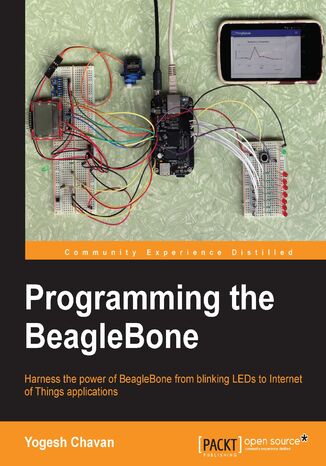
Yogesh Chavan
The whole world is moving from desktop computers to smartphones and embedded systems. We are moving towards utilizing Internet of Things (IoT). An exponential rise in the demand for embedded systems and programming in the last few years is driving programmers to use embedded development boards such as Beaglebone. BeagleBone is an ultra-small, cost-effective computer that comes with a powerful hardware. It runs a full-fledged Debian Linux OS and provides numerous electronics solutions. BeagleBone is open source and comes with an Ethernet port, which allows you to deploy IoT projects without any additions to the board. It provides plenty of GPIO, Anlaog pins, and UART, I2C, SPI pins which makes it the right choice to perform electronics projects. This gives you all the benefits of Linux kernel such as multitasking, multiusers, and extensive device driver support. This allows you to do programming in many languages including high-level languages such as JavaScript and Python.This book aims to exploit the hardware and software capabilities of BeagleBone to create real-life electronics and IoT applications quickly. It is divided into two parts. The first part covers JavaScript programs. The second part provides electronics projects and IoT applications in Python.First, you will learn to use BeagleBone as tool to write useful applications on embedded systems. Starting with the basics needed to set up BeagleBone and the Cloud9 IDE, this book covers interfacing with various electronics components via simple programs. The electronics theory related to these components is then explained in depth before you use them in a program. Finally, the book helps you create some real-life IoT applications.
Kenneth Scott Allen
Windows Workflow Foundation (WF) is a technology for defining, executing, and managing workflows. It is part of the .NET Framework 3.0 and will be available natively in the Windows Vista operating system.Windows Workflow Foundation might be the most significant piece of middleware to arrive on the Windows platform since COM+ and the Distributed Transaction Coordinator. The difference is, not every application needs a distributed transaction, but nearly every application does have a workflow encoded inside it.In this book, K Scott Allen, author of renowned .NET articles at www.odetocode.com, provides you with all the information needed to develop successful products with Windows Workflow.From the basics of how Windows Workflow can solve the difficult problems inherent in workflow solutions, through authoring workflows in code, learning about the base activity library in Windows Workflow and the different types of workflow provided, and on to building event-driven workflows using state machines, workflow communications, and finally rules and conditions in Windows Workflow, this book will give you the in-depth information you need. Throughout the book, an example bug reporting workflow system is developed, showcasing the technology and techniques used.
Brendan Burns
Brendan Burns prezentuje praktyczne wzorce i paradygmaty projektowe, które są niezbędne do budowy nowoczesnych aplikacji natywnych dla chmury! Lalithkumar Prakashchand, programista w Meta Platforms Rozpowszechnienie kontenerów i narzędzi do ich orkiestracji zrewolucjonizowało sposób projektowania i rozwijania systemów rozproszonych. Dziś projektanci mają do dyspozycji gotowe obiekty, interfejsy, a także coraz bogatszy zestaw sprawdzonych wzorców. Dzięki temu mogą budować komponenty nadające się do wielokrotnego użytku i łatwo skalować całe systemy. To drugie, zaktualizowane wydanie popularnego podręcznika przedstawia bogatą kolekcję wzorców, dzięki którym tworzenie niezawodnych aplikacji rozproszonych staje się prostsze i bardziej efektywne. Zastosowanie komponentów wielokrotnego użytku pozwala uniknąć ciągłej reimplementacji tych samych rozwiązań, a praktyczne wzorce opisane w książce świetnie sprawdzają się w pracy z systemem Kubernetes. To niezbędny przewodnik dla każdego architekta i inżyniera oprogramowania, który chce budować skalowalne i odporne na awarie aplikacje natywne dla chmury. W książce: koncepcje i podstawowe pojęcia dotyczące systemów rozproszonych wzorce jednowęzłowe: Przyczepa, Adapter i Ambasador wzorce serwowania usług i programowanie zdarzeniowe wzorce wsadowego przetwarzania danych infrastruktura sztucznej inteligencji typowe błędy projektowe, monitorowanie aplikacji i reakcje na typowe awarie Lektura obowiązkowa dla inżynierów odpowiedzialnych za niezawodność witryn internetowych, a także programistów, którzy chcą w pełni wykorzystać możliwości systemu Kubernetes. Swapnil Shevate, inżynier i pasjonat niezawodnych witryn internetowych
John Arundel
A revolution is coming to IT operations. Configuration management tools can build servers in seconds, and automate your entire network. Tools like Puppet are essential to take full advantage of the power of cloud computing, and build reliable, scalable, secure, high-performance systems.The book takes you beyond the basics to explore the full power of Puppet, showing you in detail how to tackle a variety of real-world problems and applications. At every step it shows you exactly what commands you need to type, and includes full code samples for every recipe. The book takes the reader from a basic knowledge of Puppet to a complete and expert understanding of Puppet’s latest and most advanced features, community best practices, writing great manifests, scaling and performance, and how to extend Puppet by adding your own providers and resources.The book includes real examples from production systems and techniques that are in use in some of the world’s largest Puppet installations, including a distributed Puppet architecture and a high-performance Puppetmaster solution using Apache and Passenger.
Mike Ohlson de Fine
Python is a great object-oriented and interactive programming language that lets you develop graphics, both static and animated, using built-in vector graphics functions that are provided with Python.Python 2.6 Graphics Cookbook is a collection of straightforward recipes and illustrative screenshots for creating and animating graphic objects using the Python language. This book makes the process of developing graphics interesting and entertaining by working in a graphic workspace without the burden of mastering complicated language definitions and opaque examples.If you choose to work through all the recipes from the beginning, you will learn to install Python and create basic programs for making lines and shapes using the built-in Tkinter module. The confusing topic of color manipulation is explored in detail using existing Python tools as well as some new tools in the recipes. Next you will learn to manipulate font size, color, and placement of text as placing text exactly where you want on a screen can be tricky because font height, inter-character spacing, and text window dimensions all interfere with each other. Then you will learn how to animate graphics, for example having more than one independent graphic object co-exist and interact using various Python methods.You will also learn how you can work with raster images, such as converting their formats using the Python Imaging Library. Next you will learn how you can combine vector images with raster images so that you can animate the raster images with ease. You will also walk through a set of recipes with the help of which you can handle and manipulate blocks of raw data that may be hundreds of megabytes in size using datastreams, files, and hard drives. You will also learn how you can use Inkscape to dismantle existing images and use parts of them for your own graphics and Python programs. At the end of the book you will learn how you can create GUIs for different purposes.
Ninad Sathaye
Multimedia applications are used by a range of industries to enhance the visual appeal of a product. This book will teach the reader how to perform multimedia processing using Python.This step-by-step guide gives you hands-on experience for developing exciting multimedia applications using Python. This book will help you to build applications for processing images, creating 2D animations and processing audio and video.Writing applications that work with images, videos, and other sensory effects is great. Not every application gets to make full use of audio/visual effects, but a certain amount of multimedia makes any application a lot more appealing. There are numerous multimedia libraries for which Python bindings are available. These libraries enable working with different kinds of media, such as images, audio, video, games, and so on. This book introduces the reader to the most widely used open source libraries through several exciting, real world projects. Popular multimedia frameworks and libraries such as GStreamer,Pyglet, QT Phonon, and Python Imaging library are used to develop various multimedia applications.
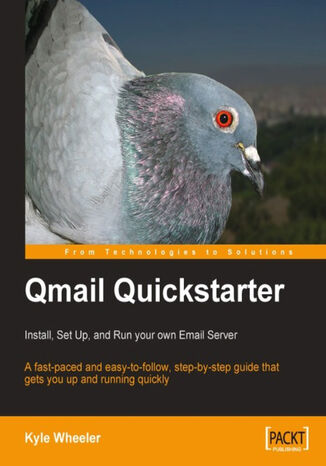
Kyle Wheeler
This book starts with setting up a qmail server and takes you through virtualization, filtering, and other advanced features like hosting multiple domains, mailing lists, and SSL Encryption. Finally, it discusses the log files and how to make qmail work faster.Qmail is a secure, reliable, efficient, simple message transfer agent. It is designed for typical Internet-connected UNIX hosts. Qmail is the second most common SMTP server on the Internet, and has by far the fastest growth of any SMTP server. Qmail's straight-paper-path philosophy guarantees that a message, once accepted into the system, will never be lost. Qmail also optionally supports maildir, a new, super-reliable user mailbox format.
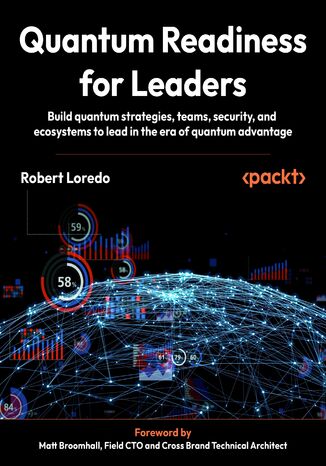
Robert Loredo, Matt Broomhall
Prepare for a computing shift that will reshape security, optimization, and competitive advantage across every industry. This book helps you build a clear actionable approach to quantum readiness covering strategy, technology, talent, and risk in one framework.Written by Robert Loredo, Founder and CEO of Entangled Solutions Group, this book draws on 25 years of experience across IBM, academia, and enterprise innovation. As a former IBM Quantum Global Strategist, leader of the IBM Quantum Ambassador program, and holds over 275 patents, he translates this complex technology transition into decisions leaders can act on immediately.This book is organized as a complete strategic operating system for the quantum transition. Part One equips executives with investment frameworks, governance structures, and talent roadmaps. Part Two guides technical leaders through infrastructure assessment, workforce development, and quantum-era data strategy. Part Three delivers a security playbook covering post-quantum cryptography and adaptive architecture. Part Four maps the full quantum ecosystem and partnerships that will determine which institutions lead commercially.By the end, you’ll be able to define a quantum strategy, build the right capabilities, and lead your organization through quantum-driven change with clarity and control.
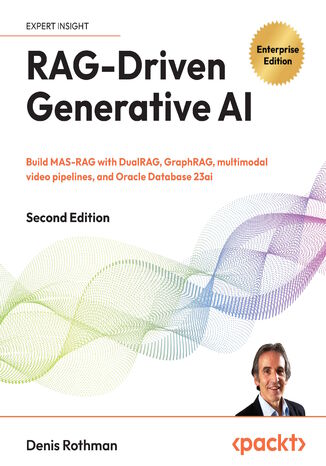
Denis Rothman
Stop moving your data to the AI. This second edition defines a revolutionary architectural shift: bringing the AI to the data. By using Oracle Database 23ai as a converged engine in this book, you will architect Sovereign AI systems that eliminate the fragmentation, latency, and massive security risks inherent in traditional data extraction.You’ll work with DualRAG, synchronizing unstructured vector semantics with the deterministic truth of structured SQL, Graph, and Spatial retrieval. This allows your systems to reason over verified corporate data rather than probabilistic guesses, reducing hallucinations at the source. Moving beyond simple pipelines, you’ll also build MAS-RAG (multi-agent systems for RAG), where autonomous agents coordinate across hybrid retrieval workflows, multimodal video pipelines, and graph-based knowledge structures.Designed for developers and architects, these blueprints transform disconnected data silos into a unified engine to architect autonomous enterprise intelligence that scales with RLHF and model fine-tuning. By the end of the book, you’ll be able to design and deploy enterprise AI systems that combine retrieval, reasoning, and structured data to build reliable generative AI applications.*Email sign-up and proof of purchase required
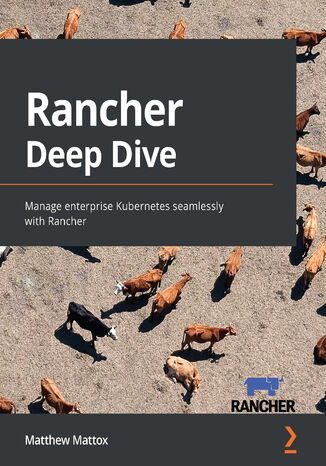
Rancher Deep Dive. Manage enterprise Kubernetes seamlessly with Rancher
Matthew Mattox
Knowing how to use Rancher enables you to manage multiple clusters and applications without being locked into a vendor’s platform. This book will guide you through Rancher’s capabilities while deepening your understanding of Kubernetes and helping you to take your applications to a new level.The book begins by introducing you to Rancher and Kubernetes, helping you to learn and implement best practices. As you progress through the chapters, you’ll understand the strengths and limitations of Rancher and Kubernetes and discover all the different ways to deploy Rancher. You’ll also find out how to design and deploy Kubernetes clusters to match your requirements. The concluding chapters will show you how to set up a continuous integration and continuous deployment (CI/CD) pipeline for deploying applications into a Rancher cluster, along with covering supporting services such as image registries and Helm charts.By the end of this Kubernetes book, you’ll be able to confidently deploy your mission-critical production workloads on Rancher-managed Kubernetes clusters.