
Bezpieczeństwo systemów
David J. Gee, Darryl West
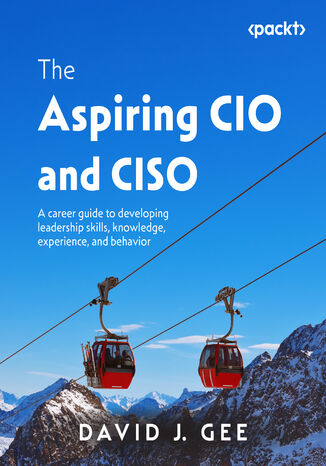
Explore the intricacies of CIO and CISO roles with The Aspiring CIO and CISO by David Gee. This book leverages Gee's 20+ years of digital and cyber leadership experience, providing real-world insights, making it a valuable resource for those navigating the evolving landscape of the C-suite.Tailored to entry-level, mid-level, and senior managers looking to advance to the C-suite, this book serves a unique purpose in the realm of career guidance. The narrative speaks directly to individuals uncertain about their readiness for CIO or CISO roles, offering a personal mentorship experience that goes beyond technicalities. Armed with insights into crafting a powerful 90-day plan, you'll be well-equipped to catapult into CIO or CISO roles successfully. Beyond technical proficiency, the book instills survival skills, ensuring longevity and helping you prevent burnout in these pivotal positions. Additionally, by mastering the art of brand development and soft skills, you'll grasp the interpersonal dynamics crucial for executive leadership. This book is an indispensable guide for ambitious professionals, offering foresight and empowerment to thrive in the digital age.By the end of this book, you'll emerge with strategic dexterity, confidently steering your career trajectory towards the C-suite.
The California Privacy Rights Act (CPRA). An implementation and compliance guide
IT Governance Publishing, Preston Bukaty
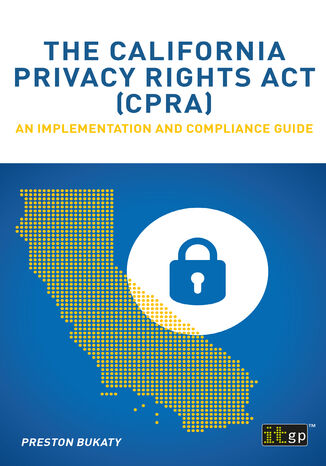
This comprehensive guide to the California Privacy Rights Act (CPRA) explores its impact on businesses and consumers within California. The book begins with a clear explanation of CPRA’s territorial and material jurisdiction, providing readers with an understanding of where and how the law applies. It delves into key definitions critical for businesses and individuals alike, covering terms such as personal information, pseudonymization, and consumer rights. One of the focal points of the book is the examination of the rights granted to consumers, including the right to access, delete, and opt-out of data sales. Alongside this, it addresses the business obligations, such as the need for privacy notices and compliance with security requirements. The book also offers an analysis of penalties for non-compliance and breach notification procedures, making it an essential resource for understanding the legal landscape of consumer privacy in California. It concludes with an overview of related laws that further influence how businesses must manage customer data.
Akash Mukherjee, Jason D. Clinton
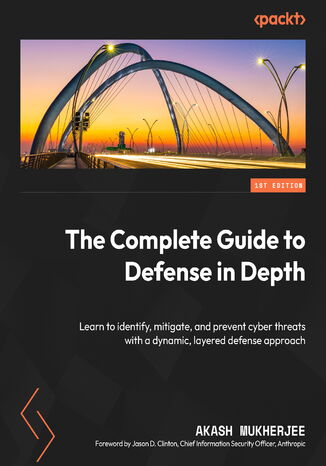
In an era of relentless cyber threats, organizations face daunting challenges in fortifying their defenses against increasingly sophisticated attacks. The Complete Guide to Defense in Depth offers a comprehensive roadmap to navigating the complex landscape, empowering you to master the art of layered security.This book starts by laying the groundwork, delving into risk navigation, asset classification, and threat identification, helping you establish a robust framework for layered security. It gradually transforms you into an adept strategist, providing insights into the attacker's mindset, revealing vulnerabilities from an adversarial perspective, and guiding the creation of a proactive defense strategy through meticulous mapping of attack vectors. Toward the end, the book addresses the ever-evolving threat landscape, exploring emerging dangers and emphasizing the crucial human factor in security awareness and training. This book also illustrates how Defense in Depth serves as a dynamic, adaptable approach to cybersecurity.By the end of this book, you’ll have gained a profound understanding of the significance of multi-layered defense strategies, explored frameworks for building robust security programs, and developed the ability to navigate the evolving threat landscape with resilience and agility.
IT Governance Publishing, Alan Calder
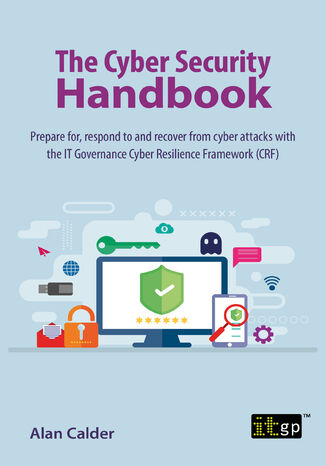
This book offers a deep dive into cybersecurity, equipping professionals with tools and frameworks to protect organizations from diverse cyber threats. It covers critical areas such as information security, cyber resilience, and the regulatory and contractual requirements organizations must meet. The book delves into threat anatomy, analyzing technical, human, physical, and third-party vulnerabilities, and includes real-world case studies like the TalkTalk breach and WannaCry ransomware attack.It also emphasizes third-party risk management to ensure robust security practices across all areas. The book introduces the IT Governance Cyber Resilience Framework (CRF), a structured method for managing critical systems, guiding readers through the processes of identification, detection, response, recovery, and continual improvement. Practical strategies in areas like asset management, network security, and staff training are included.The final section offers actionable steps for implementing cybersecurity practices and introduces reference frameworks like NIST and ISO 27001 for compliance and ongoing improvement. With real-world examples and actionable frameworks, this guide is essential for professionals aiming to enhance their organization's cyber resilience.
Jeremy Wittkop
Security is everyone's responsibility and for any organization, the focus should be to educate their employees about the different types of security attacks and how to ensure that security is not compromised.This cybersecurity book starts by defining the modern security and regulatory landscape, helping you understand the challenges related to human behavior and how attacks take place. You'll then see how to build effective cybersecurity awareness and modern information security programs. Once you've learned about the challenges in securing a modern enterprise, the book will take you through solutions or alternative approaches to overcome those issues and explain the importance of technologies such as cloud access security brokers, identity and access management solutions, and endpoint security platforms. As you advance, you'll discover how automation plays an important role in solving some key challenges and controlling long-term costs while building a maturing program. Toward the end, you'll also find tips and tricks to keep yourself and your loved ones safe from an increasingly dangerous digital world.By the end of this book, you'll have gained a holistic understanding of cybersecurity and how it evolves to meet the challenges of today and tomorrow.
Viktor Farcic
Viktor Farcic's latest book, The DevOps 2.1 Toolkit: Docker Swarm, takes you deeper into one of the major subjects of his international best seller, The DevOps 2.0 Toolkit, and shows you how to successfully integrate Docker Swarm into your DevOps toolset.Viktor shares with you his expert knowledge in all aspects of building, testing, deploying, and monitoring services inside Docker Swarm clusters. You'll go through all the tools required for running a cluster. You'll travel through the whole process with clusters running locally on a laptop. Once you're confident with that outcome, Viktor shows you how to translate your experience to different hosting providers like AWS, Azure, and DigitalOcean. Viktor has updated his DevOps 2.0 framework in this book to use the latest and greatest features and techniques introduced in Docker. We'll go through many practices and even more tools. While there will be a lot of theory, this is a hands-on book. You won't be able to complete it by reading it on the metro on your way to work. You'll have to read this book while in front of the computer and get your hands dirty.
The DevOps 2.2 Toolkit. Self-Sufficient Docker Clusters
Viktor Farcic
Building on The DevOps 2.0 Toolkit and The DevOps 2.1 Toolkit: Docker Swarm, Viktor Farcic brings his latest exploration of the Docker technology as he records his journey to explore two new programs, self-adaptive and self-healing systems within Docker. The DevOps 2.2 Toolkit: Self-Sufficient Docker Clusters is the latest book in Viktor Farcic’s series that helps you build a full DevOps Toolkit. This book in the series looks at Docker, the tool designed to make it easier in the creation and running of applications using containers. In this latest entry, Viktor combines theory with a hands-on approach to guide you through the process of creating self-adaptive and self-healing systems. Within this book, Viktor will cover a wide-range of emerging topics, including what exactly self-adaptive and self-healing systems are, how to choose a solution for metrics storage and query, the creation of cluster-wide alerts and what a successful self-sufficient system blueprint looks like. Work with Viktor and dive into the creation of self-adaptive and self-healing systems within Docker.
Viktor Farcic
Building on The DevOps 2.0 Toolkit, The DevOps 2.1 Toolkit: Docker Swarm, and The DevOps 2.2 Toolkit: Self-Sufficient Docker Clusters, Viktor Farcic brings his latest exploration of the DevOps Toolkit as he takes you on a journey to explore the features of Kubernetes.The DevOps 2.3 Toolkit: Kubernetes is a book in the series that helps you build a full DevOps Toolkit. This book in the series looks at Kubernetes, the tool designed to, among other roles, make it easier in the creation and deployment of highly available and fault-tolerant applications at scale, with zero downtime.Within this book, Viktor will cover a wide range of emerging topics, including what exactly Kubernetes is, how to use both first and third-party add-ons for projects, and how to get the skills to be able to call yourself a “Kubernetes ninja.” Work with Viktor and dive into the creation and exploration of Kubernetes with a series of hands-on guides.
Chad Maurice, Jeremiah Ginn, William Copeland
Threat hunting is a concept that takes traditional cyber defense and spins it onto its head. It moves the bar for network defenses beyond looking at the known threats and allows a team to pursue adversaries that are attacking in novel ways that have not previously been seen. To successfully track down and remove these advanced attackers, a solid understanding of the foundational concepts and requirements of the threat hunting framework is needed. Moreover, to confidently employ threat hunting in a business landscape, the same team will need to be able to customize that framework to fit a customer’s particular use case.This book breaks down the fundamental pieces of a threat hunting team, the stages of a hunt, and the process that needs to be followed through planning, execution, and recovery. It will take you through the process of threat hunting, starting from understanding cybersecurity basics through to the in-depth requirements of building a mature hunting capability. This is provided through written instructions as well as multiple story-driven scenarios that show the correct (and incorrect) way to effectively conduct a threat hunt.By the end of this cyber threat hunting book, you’ll be able to identify the processes of handicapping an immature cyber threat hunt team and systematically progress the hunting capabilities to maturity.
The Modern C# Challenge. Become an expert C# programmer by solving interesting programming problems
Rod Stephens
C# is a multi-paradigm programming language. The Modern C# Challenge covers with aspects of the .NET Framework such as the Task Parallel Library (TPL) and CryptoAPI. It also encourages you to explore important programming trade-offs such as time versus space or simplicity. There may be many ways to solve a problem and there is often no single right way, but some solutions are definitely better than others. This book has combined these solutions to help you solve real-world problems with C#.In addition to describing programming trade-offs, The Modern C# Challenge will help you build a useful toolkit of techniques such as value caching, statistical analysis, and geometric algorithms.By the end of this book, you will have walked through challenges in C# and explored the .NET Framework in order to develop program logic for real-world applications.
The OSINT Handbook. A practical guide to gathering and analyzing online information
Dale Meredith, Greg Shields
The OSINT Handbook offers practical guidance and insights to enhance your OSINT capabilities and counter the surge in online threats that this powerful toolset was built to tackle. Starting with an introduction to the concept of OSINT, this book will take you through all the applications, as well as the legal and ethical considerations associated with OSINT research. You'll conquer essential techniques for gathering and analyzing information using search engines, social media platforms, and other web-based resources. As you advance, you’ll get to grips with anonymity and techniques for secure browsing, managing digital footprints, and creating online personas. You'll also gain hands-on experience with popular OSINT tools such as Recon-ng, Maltego, Shodan, and Aircrack-ng, and leverage OSINT to mitigate cyber risks with expert strategies that enhance threat intelligence efforts. Real-world case studies will illustrate the role of OSINT in anticipating, preventing, and responding to cyber threats. By the end of this book, you'll be equipped with both the knowledge and tools to confidently navigate the digital landscape and unlock the power of information using OSINT.*Email sign-up and proof of purchase required
The Ransomware Threat Landscape. Prepare for, recognise and survive ransomware attacks
IT Governance Publishing, Alan Calder
The Ransomware Threat Landscape offers an in-depth examination of ransomware, explaining how it works, its modes of access, and the consequences of attacks. The book begins by detailing the mechanisms of ransomware, how cybercriminals exploit vulnerabilities, and the damage it causes to organizations. It further explores the types of ransomware, their infection methods, and how attackers use ransomware for financial gain.The guide provides practical, actionable advice on basic and advanced cybersecurity measures to protect against ransomware. Topics like cybersecurity hygiene, staff awareness, and the importance of creating an anti-ransomware program are covered. The book emphasizes the role of a well-structured risk management framework and its application in preventing attacks and mitigating fallout from infections.For organizations of all sizes, the book offers tailored controls to strengthen defenses. It also explains the steps needed for a comprehensive recovery plan. Advanced prevention strategies for larger enterprises are discussed, making this guide suitable for IT professionals, security experts, and organizational leaders aiming to protect their systems from ransomware threats.
IT Governance Publishing, Richard Bingley
Becoming a successful security consultant requires a unique set of skills that span both the business and security worlds. This handbook serves as a practical guide to help professionals navigate the complex landscape of security consulting. It covers everything from the entrepreneurial aspects of starting a business to the essential security disciplines like private investigations, information security, and protective security. You’ll also explore the growing importance of resilience in both personal and organizational contexts.The book also delves into the crucial elements of security legislation and regulation, offering a thorough understanding of the legal frameworks that affect security professionals. From UK human rights laws to international laws related to corporate management and conflict, readers will gain the knowledge necessary to operate securely and legally in a variety of environments. Whether you are just starting out or looking to refine your security consulting expertise, this handbook provides the insights needed to thrive in the ever-evolving security industry. It’s a must-read for anyone seeking to build a reputation as a trusted expert in the security consulting field.
Glen D. Singh
Build practical ethical hacking skills through realistic attack scenarios that reflect how security assessments are performed in real organizations. This book helps you move beyond theory by showing how vulnerabilities are discovered, exploited responsibly, and reported clearly.Written by Glen D. Singh, a cybersecurity instructor and author with deep experience in offensive security, networking, and security operations, this book emphasizes practical skill development and responsible testing practices. You begin by setting up a safe lab and learning ethical hacking principles, methodologies, and legal considerations. Then you progress through reconnaissance, scanning, and enumeration to understand how attackers gather intelligence and how defenders reduce exposure. You’ll continue with vulnerability assessment, system hacking, malware basics, and network attacks using structured labs.As environments grow more complex, you explore wireless attacks, IoT and OT threats, and gain awareness of SIEM and EDR detection. The final chapters focus on professional reporting and career development, showing how to present findings clearly and ethically.By the end of this book, you will be able to perform ethical hacking engagements from reconnaissance to reporting with confidence.
Glen D. Singh
Journey into the world of Kali Linux – the central hub for advanced penetration testing, with this ultimate guide to exposing security vulnerabilities in websites and both wired and wireless enterprise networks.With real-world scenarios, practical steps and coverage of popular tools, this third edition of the bestselling Ultimate Kali Linux Book is your fast track to learning penetration testing with Kali Linux 2024.x. As you work through the book, from preliminary penetration testing activities through performing network and website penetration testing, to exploring Active Directory and social engineering attacks, you’ll discover the range of vulnerability assessment tools in Kali Linux, building your confidence and proficiency as a penetration tester or ethical hacker.This new edition of the book features a brand new chapter on Open Source Intelligence (OSINT), as well as new labs on web applications and social engineering. Procedures for building virtual labs have also been improved, making these easier to understand and follow.Think of this book as your stepping stone into the modern world of penetration testing and ethical hacking – with the practical guidance and industry best practices the book provides, you’ll be ready to tackle real-world cybersecurity challenges head-on.*Email sign-up and proof of purchase required
Glen D. Singh
Kali Linux is the most popular and advanced penetration testing Linux distribution within the cybersecurity industry. Using Kali Linux, a cybersecurity professional will be able to discover and exploit various vulnerabilities and perform advanced penetration testing on both enterprise wired and wireless networks. This book is a comprehensive guide for those who are new to Kali Linux and penetration testing that will have you up to speed in no time. Using real-world scenarios, you’ll understand how to set up a lab and explore core penetration testing concepts. Throughout this book, you’ll focus on information gathering and even discover different vulnerability assessment tools bundled in Kali Linux. You’ll learn to discover target systems on a network, identify security flaws on devices, exploit security weaknesses and gain access to networks, set up Command and Control (C2) operations, and perform web application penetration testing. In this updated second edition, you’ll be able to compromise Active Directory and exploit enterprise networks. Finally, this book covers best practices for performing complex web penetration testing techniques in a highly secured environment. By the end of this Kali Linux book, you’ll have gained the skills to perform advanced penetration testing on enterprise networks using Kali Linux.