
Inne
Eric Pimpler
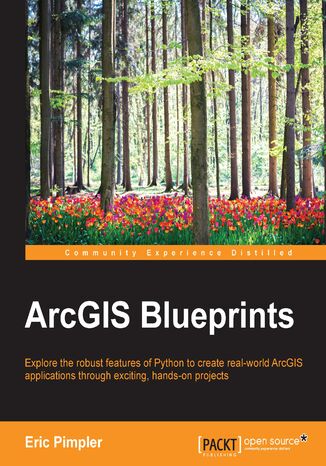
This book is an immersive guide to take your ArcGIS Desktop application development skills to the next levelIt starts off by providing detailed description and examples of how to create ArcGIS Desktop Python toolboxes that will serve as containers for many of the applications that you will build. We provide several practical projects that involve building a local area/community map and extracting wildfire data. You will then learn how to build tools that can access data from ArcGIS Server using the ArcGIS REST API. Furthermore, we deal with the integration of additional open source Python libraries into your applications, which will help you chart and graph advanced GUI development; read and write JSON, CSV, and XML format data sources; write outputs to Google Earth Pro, and more. Along the way, you will be introduced to advanced ArcPy Mapping and ArcPy Data Access module techniques and use data-driven Pages to automate the creation of map books.Finally, you will learn advanced techniques to work with video and social media feeds. By the end of the book, you will have your own desktop application without having spent too much time learning sophisticated theory.
Tripp Corbin, GISP
ArcGIS is Esri's catalog of GIS applications with powerful tools for visualizing, maintaining, and analyzing data. ArcGIS makes use of the modern ribbon interface and 64-bit processing to increase the speed and efficiency of using GIS. It allows users to create amazing maps in both 2D and 3D quickly and easily. If you want to gain a thorough understanding of the various data formats that can be used in ArcGIS Pro and shared via ArcGIS Online, then this book is for you. Beginning with a refresher on ArcGIS Pro and how to work with projects, this book will quickly take you through recipes about using various data formats supported by the tool. You will learn the limits of each format, such as Shapefiles, Geodatabase, and CAD files, and learn how to link tables from outside sources to existing GIS data to expand the amount of data that can be used in ArcGIS. You'll learn methods for editing 2D and 3D data using ArcGIS Pro and how topology can be used to ensure data integrity. Lastly the book will show you how data and maps can be shared via ArcGIS Online and used with web and mobile applications.
Sjoukje Zaal
Architecting Microsoft Azure Solutions: Exam Guide 70-535 will get Azure architects and developers up-to-date with the latest updates on Azure from an architecture and design perspective. The book includes all the topics that are still relevant from the previous 70-534 exam, and is updated with latest topics covered, including Artificial Intelligence, IoT, and architecture styles.This exam guide is divided into six parts, where the first part will give you a good understanding of how to design a compute infrastructure. It also dives into designing networking and data implementations. You will learn about designing solutions for Platform Service and operations. Next, you will be able to secure your resources and data, as well as design a mechanism for governance and policies. You will also understand the objective of designing solutions for Platform Services, by covering Artificial Intelligence, IoT, media services, and messaging solution concepts. Finally, you will cover the designing for operations objective. This objective covers application and platform monitoring, as well as designing alerting strategies and operations automation strategies. By the end of the book, you’ll have met all of the exam objectives, and will have all the information you need to ace the 70-535 exam. You will also have become an expert in designing solutions on Microsoft Azure.
Serdar Simsekler, Eric Du
SAP BTP is the foundation of SAP’s intelligent and sustainable enterprise vision for its customers. It’s efficient, agile, and an enabler of innovation. It’s technically robust, yet its superpower is its business centricity.If you’re involved in building IT and business strategies, it’s essential to familiarize yourself with SAP BTP to see the big picture for digitalization with SAP solutions. Similarly, if you have design responsibilities for enterprise solutions, learning SAP BTP is crucial to produce effective and complete architecture designs.This book teaches you about SAP BTP in five parts. First, you’ll see how SAP BTP is positioned in the intelligent enterprise. In the second part, you’ll learn the foundational elements of SAP BTP and find out how it operates. The next part covers integration architecture guidelines, integration strategy considerations, and integration styles with SAP’s integration technologies. Later, you’ll learn how to use application development capabilities to extend enterprise solutions for innovation and agility. This part also includes digital experience and process automation capabilities. The last part covers how SAP BTP can facilitate data-to-value use cases to produce actionable business insights.By the end of this SAP book, you’ll be able to architect solutions using SAP BTP to deliver high business value.
Robert Stackowiak, Carla Romano, Shyam Varan Nath
The Industrial Internet or the IIoT has gained a lot of traction. Many leading companies are driving this revolution by connecting smart edge devices to cloud-based analysis platforms and solving their business challenges in new ways. To ensure a smooth integration of such machines and devices, sound architecture strategies based on accepted principles, best practices, and lessons learned must be applied.This book begins by providing a bird's eye view of what the IIoT is and how the industrial revolution has evolved into embracing this technology. It then describes architectural approaches for success, gathering business requirements, and mapping requirements into functional solutions. In a later chapter, many other potential use cases are introduced including those in manufacturing and specific examples in predictive maintenance, asset tracking and handling, and environmental impact and abatement. The book concludes by exploring evolving technologies that will impact IIoT architecture in the future and discusses possible societal implications of the Industrial Internet and perceptions regarding these projects.By the end of this book, you will be better equipped to embrace the benefits of the burgeoning IIoT.
Architectures for the Intelligent AI-Ready Enterprise. Building real-world solutions with MongoDB
Boris Bialek, Sebastian Rojas Arbulu, Taylor Hedgecock,...
AI is reshaping industries, yet most organizations struggle to scale beyond pilots. Architectures for the Intelligent AI-Ready Enterprise bridges this gap with practical frameworks for building AI-ready architectures that deliver lasting business value.The book helps you explore System of Action databases and see why they're revolutionizing real-time decision-making. Through real-world applications across industries, from manufacturing and healthcare to financial services and retail, you'll discover how leading organizations transform their operations. You'll learn semantic data protection techniques that enable AI in regulated industries, as well as master advanced patterns including agentic AI and multi-agent orchestration.Written by MongoDB and industry practitioners, this book combines strategy with technical depth and proven business value. You’ll modernize by enabling AI innovation while preserving existing investments, implement trustworthy AI with governance frameworks, and build scalable solutions using a unified data platform like MongoDB that delivers measurable ROI and transformation.Whether you're architecting next-generation systems or modernizing legacy infrastructure, this book provides the patterns, case studies, and expert guidance to build enterprises that’ll thrive in an intelligent future.
ArcPy and ArcGIS. Automating ArcGIS for Desktop and ArcGIS Online with Python - Second Edition
Silas Toms, Jerry Davis, Dara OBeirne
ArcGIS allows for complex analyses of geographic information. The ArcPy module is used to script these ArcGIS analyses, providing a productive way to perform geo-analyses and automate map production.The second edition of the book focuses on new Python tools, such as the ArcGIS API for Python. Using Python, this book will guide you from basic Python scripting to advanced ArcPy script tools.This book starts off with setting up your Python environment for ArcGIS automation. Then you will learn how to output maps using ArcPy in MXD and update feature class in a geodatabase using arcpy and ArcGIS Online. Next, you will be introduced to ArcREST library followed by examples on querying, updating and manipulating ArcGIS Online feature services. Further, you will be enabling your scripts in the browser and directly interacting with ArcGIS Online using Jupyter notebook. Finally, you can learn ways to use of ArcPy to control ArcGIS Enterprise and explore topics on deployments, data quality assurances, data updates, version control, and editing safeguards.By the end of the book, you will be equipped with the knowledge required to create automated analysis with administration reducing the time-consuming nature of GIS.
Arkusze Google. Ćwiczenia praktyczne
Krzysztof Masłowski
Policz to szybko i sprawnie Arkusze Google są sieciowym odpowiednikiem Excela, programu szeroko rozpowszechnionego, nauczanego w szkołach i stosowanego w wielu firmach i urzędach. Dlatego ich twórcy starali się stworzyć środowisko pracy możliwie najdokładniej imitujące narzędzia Excela. Zadbali także o zgodność z formatem Excela - dlatego Arkusze potrafią odczytywać i zapisywać pliki w excelowych formatach .xls i .xlsx. Jest to niezwykle wygodne, pozwala bowiem dość swobodnie poruszać się między produktami Google i Microsoftu. W porównaniu z Excelem, Arkusze Google są prostsze i równocześnie trudniejsze w obsłudze. Nie ma w tym sprzeczności – Arkusz Google jest po prostu nieco inny, można go np. współdzielić z wieloma użytkownikami sieci, w łatwy sposób sprawdzić kto i jakiej zmiany w nim dokonał, realizowane w Arkuszu operacje zapisują się na bieżąco itd. Jakie jeszcze możliwości – ale i ograniczenia – ma Arkusz Google w porównaniu z plikiem Excela? Tego dowiesz się pracując z niniejszym, czysto praktycznym zeszytem ćwiczeń.