
Inne - Programowanie
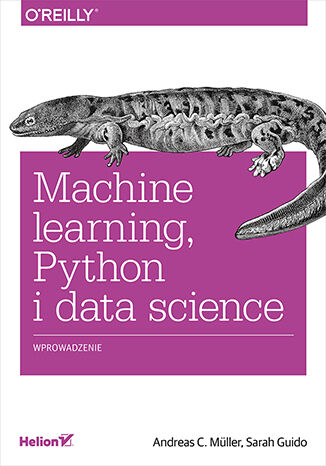
Machine learning, Python i data science. Wprowadzenie
Andreas Müller, Sarah Guido
Uczenie maszynowe kojarzy się z dużymi firmami i rozbudowanymi zespołami. Prawda jest taka, że obecnie można samodzielnie budować zaawansowane rozwiązania uczenia maszynowego i korzystać do woli z olbrzymich zasobów dostępnych danych. Trzeba tylko mieć pomysł i... trochę podstawowej wiedzy. Tymczasem większość opracowań na temat uczenia maszynowego i sztucznej inteligencji wymaga biegłości w zaawansowanej matematyce. Utrudnia to naukę tego zagadnienia, mimo że uczenie maszynowe jest coraz powszechniej stosowane w projektach badawczych i komercyjnych. Ta praktyczna książka ułatwi Ci rozpoczęcie wdrażania rozwiązań rzeczywistych problemów związanych z uczeniem maszynowym. Zawiera przystępne wprowadzenie do uczenia maszynowego i sztucznej inteligencji, a także sposoby wykorzystania Pythona i biblioteki scikit-learn, uwzględniające potrzeby badaczy i analityków danych oraz inżynierów pracujących nad aplikacjami komercyjnymi. Zagadnienia matematyczne ograniczono tu do niezbędnego minimum, zamiast tego skoncentrowano się na praktycznych aspektach algorytmów uczenia maszynowego. Dokładnie opisano, jak konkretnie można skorzystać z szerokiej gamy modeli zaimplementowanych w dostępnych bibliotekach. W książce między innymi: podstawowe informacje o uczeniu maszynowym najważniejsze algorytmy uczenia maszynowego przetwarzanie danych w uczeniu maszynowym ocena modelu i dostrajanie parametrów łańcuchy modeli i hermetyzacja przepływu pracy przetwarzanie danych tekstowych Python i uczenie maszynowe: programowanie do zadań specjalnych!

Makra i VBA w tydzień. Odkryj potęgę programowania!
Mateusz Boryga
Nauka programowania dla nieprogramistów Jeśli zastanawiasz się nad przekwalifikowaniem i karierą w branży informatycznej albo chcesz poszerzyć swoje umiejętności o programowanie, ale wydaje Ci się ono czarną magią, zapewniamy - w programowaniu nie ma nic z magii. To proces polegający na tworzeniu zbioru instrukcji, dzięki którym komputer wykona to, czego od niego oczekujesz. Jak się nauczyć pisać te instrukcje? Jeśli dysponujesz pakietem Microsoft Office i arkuszem kalkulacyjnym Excel, to masz też dostęp do języka programowania VBA (Visual Basic for Applications). Autor tego poradnika pokaże Ci, że programowania najłatwiej nauczyć się właśnie w VBA. Pośród innych użytecznych narzędzi bowiem Microsoft Excel posiada również rejestrator makr. To on zamienia klikane w Excelu działania na pełnoprawny kod VBA. Dzięki właściwemu użyciu rejestratora możliwe jest więc proste generowanie kodu, na którym można dalej pracować. Wygeneruj kod za pomocą rejestratora makr Excela Zamień go na uniwersalny kod, przydatny w wielu projektach Zobacz najpopularniejsze gotowe do użycia fragmenty kodu VBA Poznaj dobre praktyki programowania w VBA Przejdź na wyższy poziom kodowania i doceń, jak wiele czasu dzięki temu oszczędzasz O książce w mediach: Recenzja książki [Recenzje na widelcu]
Mapping with ArcGIS Pro. Design accurate and user-friendly maps to share the story of your data
Amy Rock, Ryan Malhoski
ArcGIS Pro is a geographic information system for working with maps and geographic information. This book will help you create visually stunning maps that increase thelegibility of the stories being mapped and introduce visual and design concepts intoa traditionally scientific, data-driven process. The book begins by outlining the stepsof gathering data from authoritative sources and lays out the workflow of creating a great map. Once the plan is in place you will learn how to organize the Contents Pane in ArcGIS Pro and identify the steps involved in streamlining the production process. Then you will learn Cartographic Design techniques using ArcGIS Pro's feature set to organize thepage structure and create a custom set of color swatches. You will be then exposedto the techniques required to ensure your data is clear and legible no matter the sizeor scale of your map. The later chapters will help you understand the various projectionsystems, trade-offs between them, and the proper applications of them to make sureyour maps are accurate and visually appealing. Finally, you will be introducedto the ArcGIS Online ecosystem and how ArcGIS Pro can utilize it within theapplication. You will learn Smart Mapping, a new feature of ArcGIS Online that willhelp you to make maps that are visually stunning and useful.By the end of this book, you will feel more confident in making appropriate cartographic decisions.
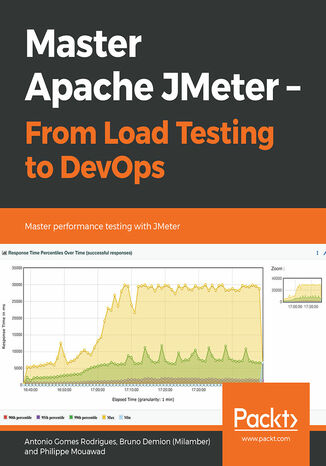
Master Apache JMeter - From Load Testing to DevOps. Master performance testing with JMeter
Antonio Gomes Rodrigues, Bruno Demion (Milamber), Philippe...
Load tests help identify the maximum number of requests a software system can handle. One popular open source tool for load testing is JMeter. By leveraging the features and capabilities of JMeter, you can perform extensive load testing and fix issues in your application before they become problematic. This book is written by JMeter developers and begins by discussing the whole process, including recording a script, setting it up, and launching it, enabling you to almost immediately start load testing. You'll learn the best practices that you must follow while designing test cases. You'll also explore the different protocols offered by JMeter through various real-world examples. Finally, you'll see how to integrate JMeter into the DevOps approach and create professional reports. You'll discover ways to use the eco-system of JMeter to integrate new protocols, enrich its monitoring, and leverage its power through the use of the cloud. By the end of this book, you'll know all that's needed to perform comprehensive load testing on your applications by using all the best practices and features of JMeter.
Mastering Android Studio 3. Build Dynamic and Robust Android applications
Kyle Mew
Android Studio is an Integrated Development Environment (IDE) designed for developing Android apps. As with most development processes, Android keeps resources and logic nicely separated, and so this book covers the management of imagery and other resources, and the development and testing tools provided by the IDE.After introducing the software, the book moves straight into UI development using the sophisticated, WYSIWYG layout editor and XML code to design and test complex interfaces for a wide variety of screen configurations.With activity design covered, the book continues to guide the reader through application logic development, exploring the latest APIs provided by the SDK. Each topic will be demonstrated by working code samples that can be run on a device or emulator.One of Android Studio's greatest features is the large number of third-party plugins available for it, and throughout the book we will be exploring the most useful of these, along with samples and libraries that can be found on GitHub.The final module of the book deals with the final stages of development: building and distribution. The book concludes by taking the reader through the registration and publication processes required by Google. By the time you have finished the book, you will be able to build faster, smoother, and error-free Android applications, in less time and with fewer complications than you ever thought possible.
James Freeman, Jesse Keating
Automation is essential for success in the modern world of DevOps. Ansible provides a simple, yet powerful, automation engine for tackling complex automation challenges.This book will take you on a journey that will help you exploit the latest version's advanced features to help you increase efficiency and accomplish complex orchestrations. This book will help you understand how Ansible 2.7 works at a fundamental level and will also teach you to leverage its advanced capabilities. Throughout this book, you will learn how to encrypt Ansible content at rest and decrypt data at runtime. Next, this book will act as an ideal resource to help you master the advanced features and capabilities required to tackle complex automation challenges. Later, it will walk you through workflows, use cases, orchestrations, troubleshooting, and Ansible extensions. Lastly, you will examine and debug Ansible operations, helping you to understand and resolve issues.By the end of the book, you will be able to unlock the true power of the Ansible automation engine and tackle complex, real- world actions with ease.
Mastering Arduino. A project-based approach to electronics, circuits, and programming
Jon Hoffman, Ejike (George Steve) Ifeanyichukwu, Pratik...
Mastering Arduino is an all-in-one guide to getting the most out of your Arduino. This practical, no-nonsense guide teaches you all of the electronics and programming skills that you need to create advanced Arduino projects. This book is packed full of real-world projects for you to practice on, bringing all of the knowledge in the book together and giving you the skills to build your own robot from the examples in this book. The final two chapters discuss wireless technologies and how they can be used in your projects. The book begins with the basics of electronics, making sure that you understand components, circuits, and prototyping before moving on. It then performs the same function for code, getting you into the Arduino IDE and showing you how to connect the Arduino to a computer and run simple projects on your Arduino.Once the basics are out of the way, the next 10 chapters of the book focus on small projects centered around particular components, such as LCD displays, stepper motors, or voice synthesizers. Each of these chapters will get you familiar with the technology involved, how to build with it, how to program it, and how it can be used in your own projects.
Mithun Pattankar, Malendra Hurbuns
Microsoft has unified their main web development platforms. This unification will help develop web applications using various pieces of the ASP.NET platform that can be deployed on both Windows and LINUX. With ASP.NET Core (Web API), it will become easier than ever to build secure HTTP services that can be used from any client.Mastering ASP.NET Web API starts with the building blocks of the ASP.NET Core, then gradually moves on to implementing various HTTP routing strategies in the Web API. We then focus on the key components of building applications that employ the Web API, such as Kestrel, Middleware, Filters, Logging, Security, and Entity Framework.Readers will be introduced to take the TDD approach to write test cases along with the new Visual Studio 2017 live unit testing feature. They will also be introduced to integrate with the database using ORMs. Finally, we explore how the Web API can be consumed in a browser as well as by mobile applications by utilizing Angular 4, Ionic and ReactJS.By the end of this book, you will be able to apply best practices to develop complex Web API, consume them in frontend applications and deploy these applications to a modern hosting infrastructure.