
Robotyka
Richard Grimmett
If you are a programmer with an interest in building advanced robotics projects using inexpensive hardware and open source software, then this book is for you. Some experience with computer programming and implementing simple mechanical systems is required.
Remote Usability Testing. Actionable insights in user behavior across geographies and time zones
Inge De Bleecker, Rebecca Okoroji
Usability testing is a subdiscipline of User Experience. Its goal is to ensure that a given product is easy to use and the user's experience with the product is intuitive and satisfying. Usability studies are conducted with study participants who are representative of the target users to gather feedback on a user interface. The feedback is then used to refine and improve the user interface.Remote studies involve fewer logistics, allow participation regardless of location and are quicker and cheaper to execute compared to in person studies, while delivering valuable insights. The users are not inhibited by being in a new environment under observation; they can act naturally in their familiar environment. Remote unmoderated studies additionally have the advantage of being independent of time zones.This book will teach you how to conduct qualitative remote usability studies, in particular remote moderated and unmoderated studies. Each chapter provides actionable tips on how to use each methodology and how to compensate for the specific nature of each methodology. The book also provides material to help with planning and executing each study type.
Danny Staple
Dziedzina robotyki rozrasta się i mamy teraz idealny moment, aby nauczyć się, jak tworzyć w domu roboty o różnym przeznaczeniu. Książka ta pomoże w podjęciu pierwszych kroków do planowania, budowy i programowania robota za pomocą Raspberry Pi Pico, robiącym wrażenie kontrolerze o ogromnym potencjale wejścia/wyjścia (I/O). Po krótkim przeglądzie Pico zaczniemy projektować korpus robota za pomocą narzędzia CAD 3D. Mając do dyspozycji proste do śledzenia instrukcje, listę zakupów i plany, zaczniecie budowę robota. Następnie dodacie proste czujniki i wyjścia, aby rozszerzyć działanie robota, podbudować swoje umiejętności projektowania i zdobyć wiedzę o programowaniu w języku CircuitPython. Dowiecie się także o interakcji z elektroniką, standardowych algorytmów robotyki oraz dyscypliny i procedur budowy robotów. Przechodząc dalej dowiecie się, jak dodawać bardziej skomplikowane czujniki i zachowania robota, na coraz wyższych poziomach złożoności, uzyskując praktyczne doświadczenia. Poznacie wspaniałe cechy Raspberry Pi Pico, jak PIO, dodawanie takich możliwości, jak unikanie ścian, wykrywanie ruchu i zrozumienie nagłówków. Połączycie to z Bluetooth BLE, aby oglądać dane z czujników i zdalnie kontrolować robota za pomocą smartfonu. Wreszcie zaprogramujecie robota, aby znajdować jego położenie na arenie. Kończąc tę książkę będziecie mieli zbudowanego samodzielnie robota i będziecie dobrze przygotowani do budowy innych o różnym stopniu złożoności. Czego się nauczycie? Interfejsu Raspberry Pi Pico z motorem do poruszania częściami Projektowania w CAD 3D za pomocą Free CAD Budowy prostego robota i rozszerzania na coraz bardziej złożone projekty Interfejsu Raspberry Pi Pico z czujnikami Bluetooth BLE Wizualizacji danych z pracy robota za pomocą MatPliotlib Algorytmów robotyki pozwalających na inteligentne zachowanie
Robotyka w LEGO Technic. Projektowanie i budowa własnych robotów
Mark Rollins
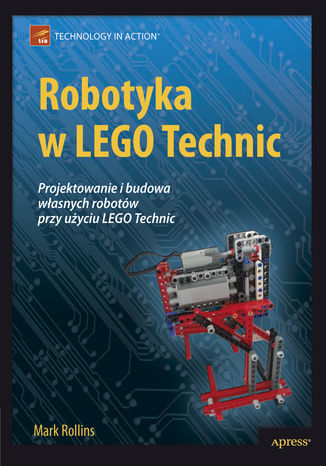
Dzięki książce Robotyka w LEGO Technic konstruowanie robotów stanie się całkiem proste! Zobaczymy, jak używać klocków LEGO i elementów mechanicznych i sterujących, takich jak silniki i piloty, do tworzenia wszelkiego rodzaju robotów. Najlepsze jest to, że nie musimy się uczyć programowania. Wystarczy nasza wyobraźnia i fachowe zasady konstrukcji zawarte w książce Robotyka w LEGO Technic. Autor, Mark Rollins, pokazuje i objaśnia sposoby projektowania w Technic. Nie są to tylko instrukcje składania części. Dzięki książce Robotyka w LEGO Technic aktywnie uczymy się podstaw dobrego projektowania, które może nas zaprowadzić do tworzenia prawdziwie efektownych konstrukcji robotów LEGO. Nauczymy się: - Tworzyć wyposażoną w koła podstawę robota LEGO Technic - Konstruować kroczącego robota LEGO Technic - Sterować dłońmi i ramionami robota - Przyłączać do robota silniki i piloty Ta książka pomoże tworzyć własną armię robotów, które jeżdżą na kołach, kroczą na dwóch lub czterech nogach, a także poruszają się i funkcjonują w dowolny wymarzony sposób. Skorzystaj z książki Robotyka w LEGO Technic i konstruuj z prawdziwą mocą! Po opanowaniu technik z tej książki osoby, które chcą budować większą liczbę konstrukcji, mogą zapoznać się z książką LEGO Technic w praktyce napisaną także przez Marka Rollinsa i dowiedzieć się, jak budować pojazdy, które mogą toczyć się, jeździć i nie tylko.
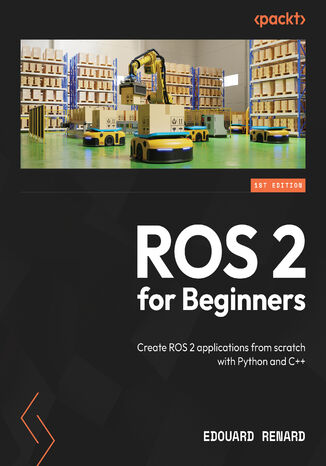
ROS 2 from Scratch. Get started with ROS 2 and create robotics applications with Python and C++
Edouard Renard
ROS 2 from Scratch, written by the cofounder of a robotics company with years of experience in teaching and engineering, will equip you with the skills necessary to develop cutting-edge robotic systems efficiently.This book will help you understand why you should use Robot Operating System (ROS), clarifying what ROS is and isn’t. It focuses on applied learning—no unnecessary filler, no abstract theory, and no abrupt leaps into complex topics. You’ll discover how to install ROS 2, set up your environment, and explore concepts through hands-on experiments, as well as create a ROS 2 application for a custom robot. The chapters expand upon core concepts such as nodes, communication via topics, client-server interactions with services, complex behaviors using actions, runtime configurations with parameters, and seamless node orchestration via launch files. Each concept is clearly explained with the help of real-life analogies and practical examples, using Python and C++. The book will also guide you through creating a real-world project that incorporates TFs, URDF, RViz, and Gazebo.By the end of this book, you’ll be able to create new software for any robot in no time and easily join existing projects for new job roles, research endeavors, and beyond.
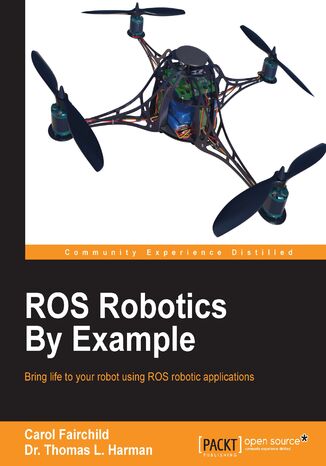
ROS Robotics By Example. Bring life to your robot using ROS robotic applications
Carol Fairchild, Dr. Thomas L. Harman
The visionaries who created ROS developed a framework for robotics centered on the commonality of robotic systems and exploited this commonality in ROS to expedite the development of future robotic systems. From the fundamental concepts to advanced practical experience, this book will provide you with an incremental knowledge of the ROS framework, the backbone of the robotics evolution. ROS standardizes many layers of robotics functionality from low-level device drivers to process control to message passing to software package management. This book provides step-by-step examples of mobile, armed, and flying robots, describing the ROS implementation as the basic model for other robots of these types. By controlling these robots, whether in simulation or in reality, you will use ROS to drive, move, and fly robots using ROS control.
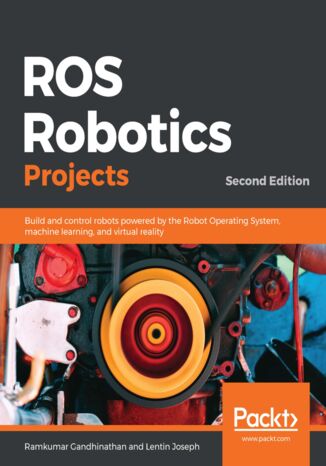
Ramkumar Gandhinathan, Lentin Joseph
Nowadays, heavy industrial robots placed in workcells are being replaced by new age robots called cobots, which don't need workcells. They are used in manufacturing, retail, banks, energy, and healthcare, among other domains. One of the major reasons for this rapid growth in the robotics market is the introduction of an open source robotics framework called the Robot Operating System (ROS).This book covers projects in the latest ROS distribution, ROS Melodic Morenia with Ubuntu Bionic (18.04). Starting with the fundamentals, this updated edition of ROS Robotics Projects introduces you to ROS-2 and helps you understand how it is different from ROS-1. You'll be able to model and build an industrial mobile manipulator in ROS and simulate it in Gazebo 9. You'll then gain insights into handling complex robot applications using state machines and working with multiple robots at a time. This ROS book also introduces you to new and popular hardware such as Nvidia's Jetson Nano, Asus Tinker Board, and Beaglebone Black, and allows you to explore interfacing with ROS. You'll learn as you build interesting ROS projects such as self-driving cars, making use of deep learning, reinforcement learning, and other key AI concepts.By the end of the book, you'll have gained the confidence to build interesting and intricate projects with ROS.
Spatial Analytics with ArcGIS. Build powerful insights with spatial analytics
Eric Pimpler
Spatial statistics has the potential to provide insight that is not otherwise available through traditional GIS tools. This book is designed to introduce you to the use of spatial statistics so you can solve complex geographic analysis.The book begins by introducing you to the many spatial statistics tools available in ArcGIS. You will learn how to analyze patterns, map clusters, and model spatial relationships with these tools. Further on, you will explore how to extend the spatial statistics tools currently available in ArcGIS, and use the R programming language to create custom tools in ArcGIS through the ArcGIS Bridge using real-world examples. At the end of the book, you will be presented with two exciting case studies where you will be able to practically apply all your learning to analyze and gain insights into real estate data.