
Sztuczna inteligencja
Projektowanie aplikacji LLM. Holistyczne podejście do dużych modeli językowych
Suhas Pai
Duże modele językowe przeniknęły do wielu dziedzin techniki uważa się je za skuteczne narzędzia do rozwiązywania szerokiej gamy problemów. Coraz więcej przedsiębiorstw korzysta z ich potencjału w celu własnego rozwoju. Jednak przekształcenie prototypów w funkcjonalne aplikacje bywa złożone i skomplikowane. To wyjątkowe opracowanie zawiera wszystkie ważne koncepcje w dziedzinie LLM! Madhav Singhal, CEO, AutoComputer W tej praktycznej książce opisano wszelkie niezbędne narzędzia, techniki i rozwiązania, których potrzebujesz do tworzenia użytecznych produktów wykorzystujących potęgę modeli językowych. Na początku zdobędziesz wiedzę o budowie modelu językowego. Następnie poznasz różne sposoby zastosowania modeli językowych, czy to poprzez bezpośrednie zapytania do modelu, czy też poprzez jego dostrajanie. Zrozumiesz ograniczenia LLM, takie jak halucynacje i problemy z rozumowaniem, a także dowiesz się, jak sobie z nimi poradzić. Znajdziesz tu również omówienie paradygmatów zastosowań, takich jak generowanie wspomagane wyszukiwaniem (RAG) czy agenty. Z tą książką: przygotujesz zbiory danych do treningu i dostrajania modeli zrozumiesz architekturę transformera zaadaptujesz wstępnie wytrenowane modele do własnych potrzeb poznasz skuteczne techniki optymalizacji i adaptacji dziedzinowej dowiesz się, jak integrować modele językowe z zewnętrznymi środowiskami i źródłami danych Gorąco polecam tę książkę! Megan Risdal, Kaggle (Google) To mistrzowski kurs budowania zaawansowanych systemów AI! Jay Alammar, autor książek
Prompt engineering i ChatGPT. Poradnik skutecznej komunikacji ze sztuczną inteligencją
Andrzej Kacprzak
Twój przewodnik po świecie prompt engineeringu Wszystkie znaki na niebie i ziemi wskazują wyraźnie: wkraczamy w erę, w której sztuczna inteligencja (SI) będzie wszechobecna. Wygra na tym ten, kto szybciej nauczy się z nią skutecznie porozumiewać. Nie czekaj zatem i już dziś opanuj sztukę tworzenia precyzyjnych i trafnych promptów, czyli instrukcji dla modeli językowych, takich jak ChatGPT. Autor z zapałem dzieli się swoją fascynacją sztuczną inteligencją i prezentuje praktyczne metody jej zastosowania w różnych obszarach. Korzystając z własnego doświadczenia inżynierskiego, w przystępny sposób wyjaśnia zasady prompt engineeringu, pozwalające optymalnie formułować "podpowiedzi" dla SI. Pracując z tym praktycznym przewodnikiem, nauczysz się między innymi: Efektywnie komunikować się z SI Budować prompty, które przynoszą oczekiwane rezultaty Korzystać z prostych, a także bardziej zaawansowanych strategii i technik prompt engineeringu Zaprzęgać ChatGPT do rozwiązywania problemów z różnych dziedzin życia zarówno prywatnego, jak i zawodowego Odkryj fascynujący świat sztucznej inteligencji i poznaj możliwości, jakie otwiera przed Tobą dobrze skonstruowany prompt.
Prompt engineering. Projektowanie aplikacji z wykorzystaniem LLM
John Berryman, Albert Ziegler
Duże modele językowe (ang. large language models) są fundamentem istnienia wielu nowoczesnych aplikacji. LLM mogą realizować szeroki zakres zadań i służą do rozwiązywania złożonych problemów. Jednak projektowanie niezawodnych rozwiązań z wykorzystaniem modeli wymaga opanowania zupełnie nowych kompetencji. Dowiedz się, na czym polega skuteczne komunikowanie się z modelami LLM i w jaki sposób przekuwać śmiałe pomysły w działające aplikacje. Poznaj filozofię działania modeli i kluczowe techniki inżynierii promptów: od pozyskiwania i oceny kontekstu, przez konstruowanie efektywnych promptów, aż po tworzenie szablonów gwarantujących wysoką jakość odpowiedzi. W książce znajdziesz także opis bardziej zaawansowanych technik, takich jak konstruowanie pętli, potoków i przepływów pracy czy budowa agentów konwersacyjnych. Poznasz też metody oceniania modeli LLM. A ponadto: zrozumiesz architekturę modeli LLM i nauczysz się je stosować zaprojektujesz przemyślaną strategię tworzenia promptów nauczysz się budować kontekst i przekształcać go w skuteczne zapytania opanujesz najlepsze praktyki w tworzeniu aplikacji opartych na LLM Styl autorów sprawia, że tematyka promptów staje się dostępna dla każdego! Hamel Husain, niezależny badacz i konsultant
Prompt Engineering Using ChatGPT. Crafting Effective Interactions and Building GPT Apps
Mercury Learning and Information, Mehrzad Tabatabaian
This book is designed for mastering prompt engineering in artificial intelligence, focusing on ChatGPT, GPT-4, and GPT plug-ins. It explores fundamental principles, practical techniques, and real-world applications. Readers will learn the role of prompts in AI interactions, the anatomy of well-constructed prompts, and various prompt styles. The book also covers setting constraints to guide AI responses and ensure ethical interactions, making it ideal for both beginners and advanced users.The journey begins with the foundations of prompts and crafting contextual prompts. It progresses to asking specific questions, providing constraints, and creating diverse content prompts. Advanced chapters cover debugging, iterating prompts, and using GPT-4 with plug-ins. The book concludes with real-world applications, future trends, and ethical considerations, ensuring a comprehensive understanding of prompt engineering.Understanding these concepts is crucial for effective AI interactions. This book transitions readers from basic to advanced prompt engineering, blending theoretical knowledge with practical skills. It is an essential resource for mastering prompt engineering and building innovative GPT applications.
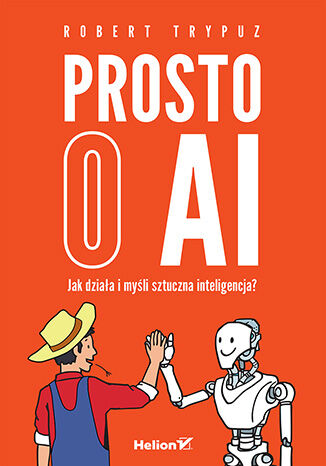
Prosto o AI. Jak działa i myśli sztuczna inteligencja?
Robert Trypuz
Książka Prosto o AI. Jak działa i myśli sztuczna inteligencja? Roberta Trypuza zdobyła III Nagrodę w konkursie na Najlepszą Polską Książkę Informatyczną 2025r. organizowanym przez Polskie Towarzystwo Informatyczne. Wszystko, co chcesz wiedzieć o AI i czego dotąd nikt nie był w stanie Ci (prosto) wyjaśnić Sztuczna inteligencja jest na ustach wszystkich. Odkąd pojawił się ChatGPT, newsy ze świata informatyki trafiają na pierwsze strony gazet, pojawiają się w serwisach informacyjnych, programach radiowych i telewizyjnych. Na temat AI dyskutują już nie tylko programiści, ale także fizycy, filozofowie i specjaliści zajmujący się rynkiem pracy. Wojskowi i naukowcy odkrywają dla niej kolejne zastosowania w swoich dziedzinach, futurolodzy zaś na zmianę straszą wizjami rodem z Terminatora i Czarnego lustra i uspokajają, że to wszystko dla naszego dobra, a sztuczna inteligencja pozostaje przecież pod ludzką kontrolą. W tym nowym, wspaniałym świecie, w którym każdy ma na temat AI swoje zdanie, opinie te są często sprzeczne, a ich uzasadnienia niezrozumiałe dla większości z nas, łatwo się pogubić. Jak się odnaleźć? Chcemy, by Twoim przewodnikiem po świecie sztucznej inteligencji stała się ta książka. Napisana prostym, przystępnym językiem przez informatyka i filozofa w jednej osobie, przybliży Ci najważniejsze zagadnienia związane z AI: Czym jest AI i jak się buduje sztuczną inteligencję, w tym ChatGPT Na jakich zasadach funkcjonują duże modele językowe W jaki sposób AI odczytuje tekst, a jak rozpoznaje obiekty na zdjęciu Czy sztuczna inteligencja może mieć wolną wolę Jakie znaczenie AI będzie miała dla edukacji O książce w mediach: Bać się, czy oswajać? „Prosto o AI”. Rozmowa z Robertem Trypuzem [Radio WNET] Eksperyment Myślowy - recenzja książki Kopalnia Wiedzy - recenzja książki Pozwól, że wyjaśnię - recenzja książki
Mercury Learning and Information, Oswald Campesato
This book bridges the gap between theoretical knowledge and practical application in Python programming, machine learning, and using ChatGPT-4 in data science. It starts with an introduction to Pandas for data manipulation and analysis. The book then explores various machine learning classifiers, from kNN to SVMs. Later chapters cover GPT-4's capabilities, enhancing linear regression analysis, and using ChatGPT in data visualization, including AI apps, GANs, and DALL-E.The journey begins with mastering Pandas and machine learning fundamentals. It progresses to applying GPT-4 in linear regression and machine learning classifiers. The final chapters focus on using ChatGPT for data visualization, making complex results accessible and understandable.Understanding these concepts is crucial for modern data scientists. This book transitions readers from basic Python programming to advanced applications of ChatGPT-4 in data science. Companion files with source code, datasets, and figures enhance learning, making this an essential resource for mastering Python, machine learning, and AI-driven data visualization.
Ashish Kumar, Joseph Babcock
Social Media and the Internet of Things have resulted in an avalanche of data. Data is powerful but not in its raw form; it needs to be processed and modeled, and Python is one of the most robust tools out there to do so. It has an array of packages for predictive modeling and a suite of IDEs to choose from. Using the Python programming language, analysts can use these sophisticated methods to build scalable analytic applications. This book is your guide to getting started with predictive analytics using Python.You'll balance both statistical and mathematical concepts, and implement them in Python using libraries such as pandas, scikit-learn, and NumPy. Through case studies and code examples using popular open-source Python libraries, this book illustrates the complete development process for analytic applications. Covering a wide range of algorithms for classification, regression, clustering, as well as cutting-edge techniques such as deep learning, this book illustrates explains how these methods work. You will learn to choose the right approach for your problem and how to develop engaging visualizations to bring to life the insights of predictive modeling.Finally, you will learn best practices in predictive modeling, as well as the different applications of predictive modeling in the modern world. The course provides you with highly practical content from the following Packt books:1. Learning Predictive Analytics with Python2. Mastering Predictive Analytics with Python
Hassi Norlen
IBM Quantum Experience® is a leading platform for programming quantum computers and implementing quantum solutions directly on the cloud. This book will help you get up to speed with programming quantum computers and provide solutions to the most common problems and challenges.You’ll start with a high-level overview of IBM Quantum Experience® and Qiskit®, where you will perform the installation while writing some basic quantum programs. This introduction puts less emphasis on the theoretical framework and more emphasis on recent developments such as Shor’s algorithm and Grover’s algorithm. Next, you’ll delve into Qiskit®, a quantum information science toolkit, and its constituent packages such as Terra, Aer, Ignis, and Aqua. You’ll cover these packages in detail, exploring their benefits and use cases. Later, you’ll discover various quantum gates that Qiskit® offers and even deconstruct a quantum program with their help, before going on to compare Noisy Intermediate-Scale Quantum (NISQ) and Universal Fault-Tolerant quantum computing using simulators and actual hardware. Finally, you’ll explore quantum algorithms and understand how they differ from classical algorithms, along with learning how to use pre-packaged algorithms in Qiskit® Aqua.By the end of this quantum computing book, you’ll be able to build and execute your own quantum programs using IBM Quantum Experience® and Qiskit® with Python.
Jeremy Samuelson
Quantum computing is advancing rapidly, yet practical guidance for machine learning engineers remains limited. Most resources emphasize physics or theory, leaving practitioners unsure how quantum methods fit into real-world ML workflows. 'Quantum Machine Learning in Practice' addresses this gap with a hands-on, Python-first approach built for data scientists and ML engineers.Rather than presenting quantum models as replacements for classical ML, this book focuses on disciplined experimentation, hybrid architectures, and rigorous benchmarking. You will learn how classical data is encoded into quantum circuits, how variational models serve as classifiers and regressors, and how to evaluate quantum kernels and generative models responsibly. Concepts are grounded in simulator-based experiments using PennyLane, Qiskit, TensorFlow Quantum, and Cirq. Classical baselines are treated as first-class citizens throughout. You will design fair comparisons, analyze computational tradeoffs, and identify when classical ML remains superior. A complete end-to-end mini project reinforces transferable workflow skills, from problem framing through evaluation and interpretation.By the end, you will be able to design, implement, and critically assess hybrid quantum-classical machine learning systems with clarity and confidence.
Robert Loredo, Matt Broomhall
Prepare for a computing shift that will reshape security, optimization, and competitive advantage across every industry. This book helps you build a clear actionable approach to quantum readiness covering strategy, technology, talent, and risk in one framework.Written by Robert Loredo, Founder and CEO of Entangled Solutions Group, this book draws on 25 years of experience across IBM, academia, and enterprise innovation. As a former IBM Quantum Global Strategist, leader of the IBM Quantum Ambassador program, and holds over 275 patents, he translates this complex technology transition into decisions leaders can act on immediately.This book is organized as a complete strategic operating system for the quantum transition. Part One equips executives with investment frameworks, governance structures, and talent roadmaps. Part Two guides technical leaders through infrastructure assessment, workforce development, and quantum-era data strategy. Part Three delivers a security playbook covering post-quantum cryptography and adaptive architecture. Part Four maps the full quantum ecosystem and partnerships that will determine which institutions lead commercially.By the end, you’ll be able to define a quantum strategy, build the right capabilities, and lead your organization through quantum-driven change with clarity and control.
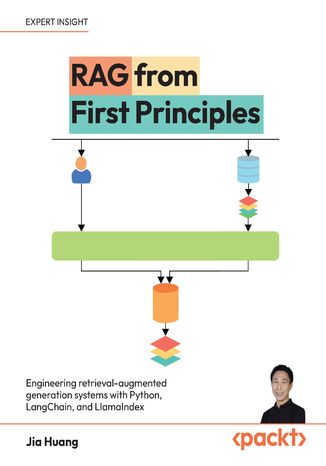
Jia Huang
Most developers can spin up a RAG pipeline in an afternoon using LangChain or LlamaIndex. Far fewer understand why retrieval fails or how to fix it. This book is for those who want to go deeper.'RAG From First Principles' dismantles the retrieval-augmented generation stack layer by layer, how documents are ingested and parsed, why chunking strategy directly impacts answer quality, how embedding models encode meaning, what happens inside a vector database, and how sparse and dense retrieval interact in a hybrid system. Written by Jia Huang, a research engineer and bestselling AI author, it brings research depth and production experience to one of AI's most critical engineering disciplines.Structured as a progressive dialogue between a seasoned engineer and two students, the book surfaces the questions practitioners actually ask. Each chapter builds on the last, from data import and chunking through embedding selection, index design, hybrid search, and post-retrieval processing, into response generation, evaluation, and advanced paradigms including GraphRAG, Agentic RAG, and Modular RAG.By the end, you'll have the architectural understanding to optimize, debug, and extend your RAG systems with confidence.
Denis Rothman
Stop moving your data to the AI. This second edition defines a revolutionary architectural shift: bringing the AI to the data. By using Oracle Database 23ai as a converged engine in this book, you will architect Sovereign AI systems that eliminate the fragmentation, latency, and massive security risks inherent in traditional data extraction.You’ll work with DualRAG, synchronizing unstructured vector semantics with the deterministic truth of structured SQL, Graph, and Spatial retrieval. This allows your systems to reason over verified corporate data rather than probabilistic guesses, reducing hallucinations at the source. Moving beyond simple pipelines, you’ll also build MAS-RAG (multi-agent systems for RAG), where autonomous agents coordinate across hybrid retrieval workflows, multimodal video pipelines, and graph-based knowledge structures.Designed for developers and architects, these blueprints transform disconnected data silos into a unified engine to architect autonomous enterprise intelligence that scales with RLHF and model fine-tuning. By the end of the book, you’ll be able to design and deploy enterprise AI systems that combine retrieval, reasoning, and structured data to build reliable generative AI applications.*Email sign-up and proof of purchase required
Rewolucja sztucznej inteligencji w medycynie. Jak GPT-4 może zmienić przyszłość
Peter Lee, Carey Goldberg, Isaac Kohane
Odkąd się pojawił, ChatGPT wzbudza ogromne zainteresowanie wśród ludzi różnych profesji. Szybko stało się jasne, że to jeden z największych przełomów technologicznych ostatnich kilkudziesięciu lat. Możemy oczekiwać, że modele językowe radykalnie wpłyną na to, jak ludzie będą pracować, komunikować się ze sobą i zdobywać wiedzę. Szczególnie dużo nadziei ― i obaw ― wiąże się z zastosowaniem GPT w medycynie. Niezależnie od tego, czy jesteś pracownikiem ochrony zdrowia, medykiem, czy pacjentem, powinieneś jak najszybciej zrozumieć możliwości tej technologii. W tej książce opisano różne zastosowania GPT-4 w medycynie: jako źródło informacji medycznej, wsparcie w podejmowaniu decyzji dotyczących leczenia czy też pomoc w tworzeniu dokumentacji, takiej jak podsumowanie wizyty pacjenta. Podczas lektury odkryjesz niezwykły potencjał tej technologii, przekonasz się także, jak bardzo może poprawić skuteczność diagnozowania i usprawnić niektóre procedury. Znajdziesz tu spostrzeżenia o potencjalnych wadach sztucznej inteligencji i najświeższe wnioski związane z jej zastosowaniem. Nie zabrakło również opisu zagrożeń związanych z tą technologią i wskazówek, do czego GPT nie można używać. Poszczególne zagadnienia zilustrowano prawdziwymi rozmowami z GPT-4. Są one w pełni spontaniczne i pozbawione poprawek, często błyskotliwe i czasami nietaktowne, wzbogacone o cenny kontekst i szczere komentarze. AI w medycynie: jutro zaczęło się wczoraj!
Paul Goodey GP, Paul Goodey
Do you want to be able to confidently design and build apps that support business processes within the Lightning Platform? Salesforce Platform App Builder Certification Guide not only helps you to do this, but also prepares you for the certification exam.The book starts by describing the core capabilities of the Lightning Platform. You'll learn techniques for data modeling to design, build, and deploy apps without writing code and achieve rapid results with the declarative capabilities that the Lightning Platform provides. Next, you'll explore utilities for importing and exporting data and the features available in the Lightning Platform to restrict and extend access to objects, fields, and records. You'll also be able to customize the Salesforce Lightning Experience user interface (UI) and build functionality for custom buttons, links, and actions. Later, this certification study guide will take you through reporting and the social and mobile features of the Lightning Platform. Finally, you’ll get to grips with Salesforce build environments and deployment options.By the end of this Salesforce book, you'll not only have learned how to build data models, enforce data security, and implement business logic and process automation, but also have gained the confidence to pass the Platform App Builder exam and achieve Salesforce certification.
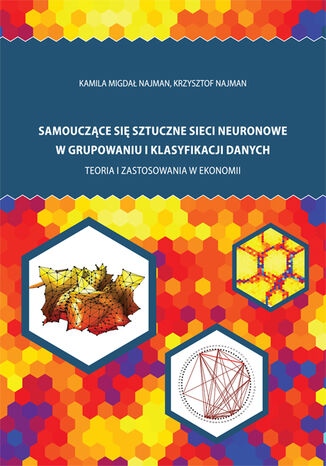
Kamila Migdał-Najman, Krzysztof Najman
Prezentowana książka składa się z dwóch zasadniczych części. Część pierwsza ma charakter teoretyczny. Omawia genezę, rozwój, podstawy empiryczne i teoretyczne procesu klasyfikacji i grupowania danych. Jest pełna faktów, anegdot i własnych przemyśleń autorów. Część druga książki jest poświęcona szerokim badaniom teoretycznym, symulacyjnym i empirycznym nad własnościami samouczących się sieci neuronowych w grupowaniu danych społeczno-ekonomicznych. Szczegółowo omówiono algorytm budowy i samouczenia się trzech modeli sztucznych sieci neuronowych: SOM (Self Organizing Map), GNG (Growing Neural Gas) i sieci hybrydowej SOM-GNG. Zaproponowano także ich modyfikacje zwiększające zdolność badanych sieci do poprawnego wyróżniania istniejących skupień. W książce położono szczególny nacisk na możliwie prosty i przejrzysty opis często złożonych zjawisk. Poza koniecznym formalizmem matematycznym autorzy posługują się wieloma zaawansowanymi metodami wizualizacji omawianych zagadnień. Dzięki temu, mimo naukowego charakteru książki, może ona stanowić wartościowy podręcznik dla bardziej zaawansowanych studentów, praktyków i naukowców nie będących specjalistami w zakresie klasyfikacji i grupowania danych.
Guillermo Moncecchi, Raul G Tompson, Trent Hauck,...
Machine learning, the art of creating applications that learn from experience and data, has been around for many years. Python is quickly becoming the go-to language for analysts and data scientists due to its simplicity and flexibility; moreover, within the Python data space, scikit-learn is the unequivocal choice for machine learning. The course combines an introduction to some of the main concepts and methods in machine learning with practical, hands-on examples of real-world problems. The course starts by walking through different methods to prepare your data—be it a dataset with missing values or text columns that require the categories to be turned into indicator variables. After the data is ready, you'll learn different techniques aligned with different objectives—be it a dataset with known outcomes such as sales by state, or more complicated problems such as clustering similar customers. Finally, you'll learn how to polish your algorithm to ensure that it's both accurate and resilient to new datasets. You will learn to incorporate machine learning in your applications. Ranging from handwritten digit recognition to document classification, examples are solved step-by-step using scikit-learn and Python. By the end of this course you will have learned how to build applications that learn from experience, by applying the main concepts and techniques of machine learning.