
Sztuczna inteligencja
Valentina Alto
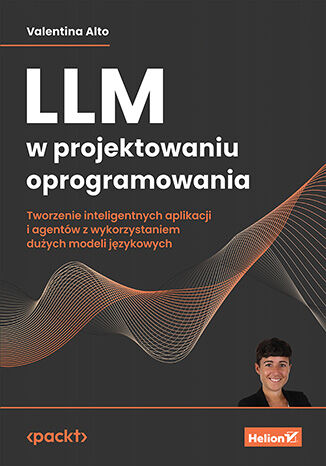
Duże modele językowe (LLM) stały się technologicznym przełomem. Ich wszechstronność i funkcjonalność sprawiły, że coraz częściej mówi się o nowej erze inteligentnie działających urządzeń i aplikacji. Umiejętność zastosowania LLM we własnych projektach już dziś jest koniecznością dla wielu projektantów i programistów. Dzięki tej książce opanujesz podstawowe koncepcje związane z użyciem LLM. Poznasz unikatowe cechy i mocne strony kilku najważniejszych modeli (w tym GPT, Gemini, Falcon). Następnie dowiesz się, w jaki sposób LangChain, lekki framework Pythona, pozwala na projektowanie inteligentnych agentów do przetwarzania danych o nieuporządkowanej strukturze. Znajdziesz tu również informacje dotyczące dużych modeli podstawowych, które wykraczają poza obsługę języka i potrafią wykonywać różne zadania związane na przykład z grafiką i dźwiękiem. Na koniec zgłębisz zagadnienia dotyczące ryzyka związanego z LLM, a także poznasz techniki uniemożliwiania tym modelom potencjalnie szkodliwych działań w aplikacji. Najciekawsze zagadnienia: architektura dużych modeli językowych unikatowe funkcje LLM komponenty służące do koordynacji sztucznej inteligencji, w tym tworzenia frontendu użycie wiedzy nieparametrycznej i wektorowych baz danych dostrajanie dużych modeli językowych do własnych potrzeb odpowiedzialność i etyka w systemach korzystających z LLM Odkryj, jak łatwo model generatywnej AI zintegruje się z Twoją aplikacją! O książce w mediach: Eksperyment Myślowy - recenzja książki
Oliver Theobald
Starting with Python syntax and data types, this guide builds toward implementing key machine learning models. Learn about loops, functions, OOP, and data cleaning, then transition into algorithms like regression, KNN, and neural networks. A final section walks you through model optimization and building projects in Python.The book is split into two major sections—foundational Python programming and introductory machine learning. Readers are guided through essential concepts such as data types, variables, control flow, object-oriented programming, and using libraries like pandas for data manipulation.In the machine learning section, topics like model selection, supervised vs unsupervised learning, bias-variance, and common algorithms are demystified with practical coding examples. It’s a structured, clear roadmap to mastering both programming and applied ML from zero knowledge.
Oliver Theobald
This book is an ideal starting point for anyone interested in Artificial Intelligence and Machine Learning. It begins with the foundational principles of AI, offering a deep dive into its history, building blocks, and the stages of development. Readers will explore key AI concepts and gradually transition to practical applications, starting with machine learning algorithms such as linear regression and k-nearest neighbors. Through step-by-step Python tutorials, the book helps readers build and implement models with hands-on experience.As the book progresses, readers will dive into advanced AI topics like deep learning, natural language processing (NLP), and generative AI. Topics such as recommender systems and computer vision demonstrate the real-world applications of AI technologies. Ethical considerations and privacy concerns are also addressed, providing insight into the societal impact of these technologies.By the end of the book, readers will have a solid understanding of both the theory and practice of AI and Machine Learning. The final chapters provide resources for continued learning, ensuring that readers can continue to grow their AI expertise beyond the book.
Uday Kamath, Krishna Choppella
Machine Learning is one of the core area of Artificial Intelligence where computers are trained to self-learn, grow, change, and develop on their own without being explicitly programmed. In this course, we cover how Java is employed to build powerful machine learning models to address the problems being faced in the world of Data Science. The course demonstrates complex data extraction and statistical analysis techniques supported by Java, applying various machine learning methods, exploring machine learning sub-domains, and exploring real-world use cases such as recommendation systems, fraud detection, natural language processing, and more, using Java programming. The course begins with an introduction to data science and basic data science tasks such as data collection, data cleaning, data analysis, and data visualization. The next section has a detailed overview of statistical techniques, covering machine learning, neural networks, and deep learning. The next couple of sections cover applying machine learning methods using Java to a variety of chores including classifying, predicting, forecasting, market basket analysis, clustering stream learning, active learning, semi-supervised learning, probabilistic graph modeling, text mining, and deep learning.The last section highlights real-world test cases such as performing activity recognition, developing image recognition, text classification, and anomaly detection. The course includes premium content from three of our most popular books:[*]Java for Data Science[*]Machine Learning in Java [*]Mastering Java Machine LearningOn completion of this course, you will understand various machine learning techniques, different machine learning java algorithms you can use to gain data insights, building data models to analyze larger complex data sets, and incubating applications using Java and machine learning algorithms in the field of artificial intelligence.
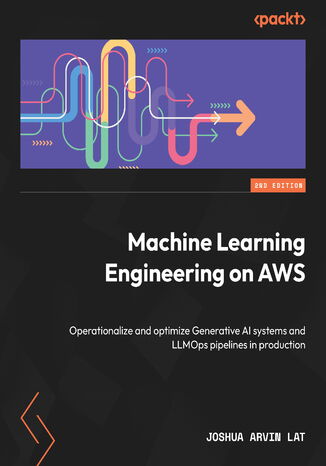
Joshua Arvin Lat
Modern AI systems increasingly leverage large language models, retrieval-augmented generation, and AI agents to power generative AI applications in the cloud. As organizations operationalize these systems at scale, there is a growing need for engineers with strong machine learning engineering expertise. To stay ahead in this rapidly evolving field, you need a deep understanding of AI and ML concepts as well as, practical, hands-on experience with the platforms and tools used to build and operate production-grade AI systems.Machine Learning Engineering on AWS is a practical guide that shows you how to use AWS services such as Amazon Bedrock and Amazon SageMaker AI to fine-tune, evaluate, and deploy LLMs and generative AI systems. You'll learn how to develop RAG-powered systems, build and deploy AI agents using Bedrock AgentCore and Strands Agents, evaluate models using LLM-as-a-judge techniques, and automate LLMOps pipelines using SageMaker Pipelines. The book also covers best practices for building scalable, secure, and production-ready GenAI systems.AWS AI hero Joshua Arvin Lat equips you with the skills and practical knowledge to handle a wide variety of ML engineering requirements, helping you design, operationalize, and secure generative AI systems and AI agents on AWS with confidence.*Email sign-up and proof of purchase required
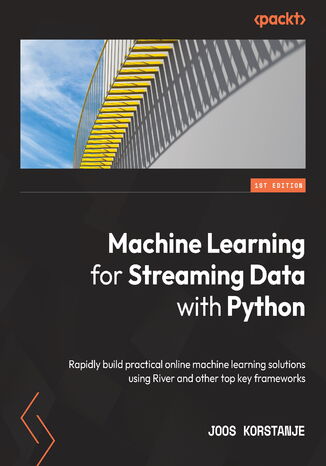
Joos Korstanje
Streaming data is the new top technology to watch out for in the field of data science and machine learning. As business needs become more demanding, many use cases require real-time analysis as well as real-time machine learning. This book will help you to get up to speed with data analytics for streaming data and focus strongly on adapting machine learning and other analytics to the case of streaming data.You will first learn about the architecture for streaming and real-time machine learning. Next, you will look at the state-of-the-art frameworks for streaming data like River. Later chapters will focus on various industrial use cases for streaming data like Online Anomaly Detection and others. As you progress, you will discover various challenges and learn how to mitigate them. In addition to this, you will learn best practices that will help you use streaming data to generate real-time insights.By the end of this book, you will have gained the confidence you need to stream data in your machine learning models.
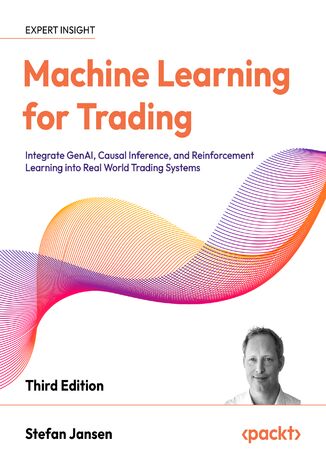
Stefan Jansen
The rapid rise of AI and the growing complexity of financial markets have transformed quantitative trading into a data-driven, process-oriented discipline. This third edition provides a comprehensive blueprint for designing, validating, and deploying systematic trading strategies powered by modern machine learning. It introduces the 7 stage ML4T Workflow, a professional framework that unites data engineering, model development, validation, and live deployment into one cohesive process. It demonstrates how to turn raw market, fundamental, and alternative data into predictive signals and robust, production-ready trading systems. You’ll learn to build advanced pipelines for feature engineering, model evaluation, and portfolio optimization using libraries such as Polars, LightGBM, PyTorch, and Optuna. Practical notebooks illustrate every stage of the workflow, from factor testing and backtesting with zipline reloaded to live deployment with MLOps tools such as MLflow, Feast, and Prometheus. Additional coverage of synthetic data generation, Graph Neural Networks, and Reinforcement Learning extends the toolkit for building resilient, adaptive strategies that thrive in dynamic markets. By the end of this book, you’ll be proficient to build your own industrial-grade “alpha factory.
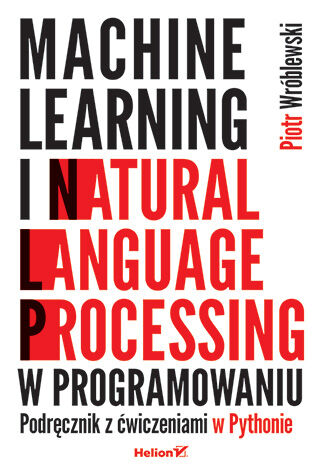
Machine learning i natural language processing w programowaniu. Podręcznik z ćwiczeniami w Pythonie
Piotr Wróblewski
Wejdź na nowy poziom programowania z ML i NLP Sztuczna inteligencja stale się rozwija. Właściwie codziennie słyszymy o jej rosnących możliwościach, nowych osiągnięciach i przyszłości, jaką nam przyniesie. Jednak w tej książce skupiamy się nie na przyszłości, a na teraźniejszości i praktycznym obliczu AI - na usługach, które świadczy już dziś. Większość najciekawszych zastosowań sztucznej inteligencji bazuje na ML (uczenie maszynowe, ang. machine learning), NLP (przetwarzanie języka naturalnego, ang. natural language processing) i architekturze RAG (ang. retrieval augmented generation) zwiększającej możliwości tzw. dużych modeli językowych (LLM, ang. large language model). Stanowią one podwaliny budowy systemów AI, bez których te systemy często wcale nie mogłyby powstać. Do niedawna ML i NLP pozostawały domeną badaczy i specjalistów - znajdowały się poza zasięgiem praktyków programowania. Aktualnie jest inaczej, szybkie komputery, pojemne pamięci RAM i zaawansowane procesory pozwalają stosować te technologie w codziennej pracy programisty. Szczególnie programisty języka Python, do którego są one niemal "naturalnie" przypisane. Mało tego, od kodujących w Pythonie coraz częściej wręcz wymaga się umiejętności znajomości obszaru AI. Tym bardziej warto sięgnąć po ten podręcznik z ćwiczeniami, dzięki któremu między innymi: Dowiesz się, jak używać Pythona do rozwiązywania problemów AI Poznasz tajniki analizy tekstów, analizy sentymentu Zrozumiesz, jak skutecznie używać algorytmów klasyfikacji, regresji i grupowania do rozwiązywania problemów biznesowych Pokonwersujesz z ChatGPT - i to bez wchodzenia na stronę internetową tego serwisu
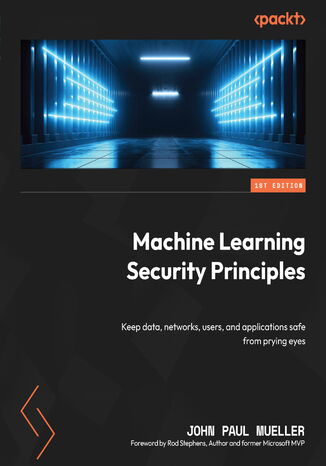
John Paul Mueller
Businesses are leveraging the power of AI to make undertakings that used to be complicated and pricy much easier, faster, and cheaper. The first part of this book will explore these processes in more depth, which will help you in understanding the role security plays in machine learning.As you progress to the second part, you’ll learn more about the environments where ML is commonly used and dive into the security threats that plague them using code, graphics, and real-world references.The next part of the book will guide you through the process of detecting hacker behaviors in the modern computing environment, where fraud takes many forms in ML, from gaining sales through fake reviews to destroying an adversary’s reputation. Once you’ve understood hacker goals and detection techniques, you’ll learn about the ramifications of deep fakes, followed by mitigation strategies.This book also takes you through best practices for embracing ethical data sourcing, which reduces the security risk associated with data. You’ll see how the simple act of removing personally identifiable information (PII) from a dataset lowers the risk of social engineering attacks.By the end of this machine learning book, you'll have an increased awareness of the various attacks and the techniques to secure your ML systems effectively.
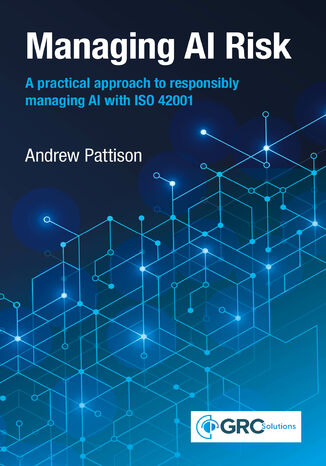
Managing AI Risk. A practical approach to responsibly managing AI with ISO 42001
IT Governance Publishing, Andrew Pattison
This book is a comprehensive guide to understanding and managing the risks associated with artificial intelligence (AI) technologies. It begins by exploring the fundamental aspects of AI, from its ethical and philosophical dimensions to its impact on organizational risk.As the book progresses, it delves into the creation of a risk-aware AI strategy, integrating AI risk management into existing organizational frameworks. It offers practical insights on identifying and assessing various risks, including data privacy, algorithmic transparency, and operational challenges related to AI deployment and maintenance.This book is designed for professionals, risk managers, and AI practitioners who seek to navigate the complexities of AI in organizations. Whether you’re just beginning to explore AI risks or looking to refine your existing strategies, this book equips you with the tools needed for effective management.By the end of this book, you will have gained a solid understanding of AI-related risks, be able to implement effective AI risk management frameworks, and integrate AI strategies within your organization.
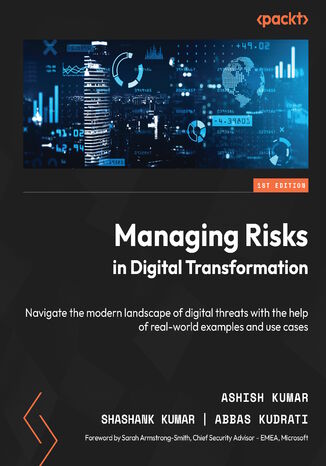
Ashish Kumar, Shashank Kumar, Abbas Kudrati
With the rapid pace of digital change today, especially since the pandemic sped up digital transformation and technologies, it has become more important than ever to be aware of the unknown risks and the landscape of digital threats. This book highlights various risks and shows how business-as-usual operations carried out by unaware or targeted workers can lead your organization to a regulatory or business risk, which can impact your organization’s reputation and balance sheet.This book is your guide to identifying the topmost risks relevant to your business with a clear roadmap of when to start the risk mitigation process and what your next steps should be. With a focus on the new and emerging risks that remote-working companies are experiencing across diverse industries, you’ll learn how to manage risks by taking advantage of zero trust network architecture and the steps to be taken when smart devices are compromised. Toward the end, you’ll explore various types of AI-powered machines and be ready to make your business future-proof.In a nutshell, this book will direct you on how to identify and mitigate risks that the ever- advancing digital technology has unleashed.
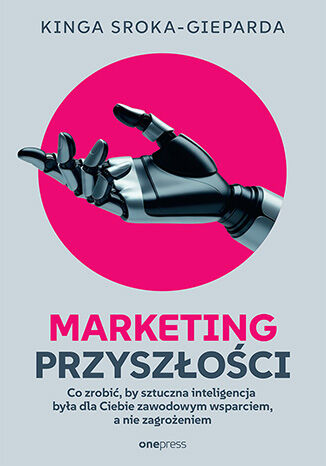
Kinga Sroka-Gieparda
Marketing w dobie sztucznej inteligencji Rewolucja AI, której jesteśmy świadkami, najprawdopodobniej odmieni nasz świat. Wpłynie także a może przede wszystkim na pracę. Pewne zawody znikną, inne znacznie się zmienią, pojawią się też zupełnie nowe stanowiska. Już dziś szeroko dyskutuje się na przykład o tym, że sztuczna inteligencja odbierze zajęcie marketerom. Czy naprawdę jest się czego bać? A może zamiast obawiać się rozwoju technologicznego, warto mu się przyjrzeć bliżej, poznać go i nauczyć się korzystać z nowych narzędzi po to, by wykonywać swoje zadania łatwiej, szybciej i skuteczniej? Celem, jaki postawiła sobie autorka tej książki, jest wprowadzenie czytelnika w zagadnienia rozwoju i historii AI, a także zapoznanie go z jej narzędziami: od modeli konwersacyjnych i służących do tworzenia treści po modele generujące kod i kreujące obrazy. Poradnik Kingi Sroki-Giepardy jest przeznaczony przede wszystkim dla osób działających w branżach marketingowej i technologicznej, jednak zawarta w nim wiedza przyda się każdemu, kto chce się zorientować, jak wyglądają bieżące możliwości narzędzi AI, i nauczyć się ich używać. Książka w mediach: annawolodko_mintconcept Instagram Magiczna.ja Sylwia Bookstagram Mamao.pl Instagram
Paul Battisson
As applications built on the Salesforce platform are now a key part of many organizations, developers are shifting focus to Apex, Salesforce’s proprietary programming language. As a Salesforce developer, it is important to understand the range of tools at your disposal, how and when to use them, and best practices for working with Apex. Mastering Apex Programming will help you explore the advanced features of Apex programming and guide you in delivering robust solutions that scale.This book starts by taking you through common Apex mistakes, debugging, exception handling, and testing. You'll then discover different asynchronous Apex programming options and develop custom Apex REST web services. The book shows you how to define and utilize Batch Apex, Queueable Apex, and Scheduled Apex using common scenarios before teaching you how to define, publish, and consume platform events and RESTful endpoints with Apex. Finally, you'll learn how to profile and improve the performance of your Apex application, including architecture trade-offs.With code examples used to facilitate discussion throughout, by the end of the book, you'll have developed the skills needed to build robust and scalable applications in Apex.
Lior Gazit, Meysam Ghaffari
Natural Language Processing has evolved beyond rule-based systems and classical machine learning (ML). This second edition guides you through that transformation from mathematical and ML foundations to large language models, retrieval pipelines, agentic automation, and AI-native system design. It strengthens core NLP concepts while expanding into modern architectures such as transformers, parameter-efficient fine-tuning (LoRA and QLoRA), and alignment methods like RLHF and DPO.You’ll begin with essential linear algebra, probability, and ML principles before moving into text preprocessing, feature engineering, classification pipelines, and deep learning architectures. From there, the focus shifts to system design: building Retrieval-Augmented Generation (RAG) pipelines, implementing model routing strategies that balance cost and performance, and orchestrating structured multi-agent workflows. You'll also introduce structured interoperability patterns, including the Model Context Protocol (MCP). Governance and safety will be treated as architectural concerns, demonstrating how policy and compliance can be integrated directly into AI systems. By the end, you will have the tools to implement NLP techniques and be equipped to design, govern, and deploy intelligent systems built on them.*Email sign-up and proof of purchase required
Mastering QuickBooks 2020. The ultimate guide to bookkeeping and QuickBooks Online
Crystalynn Shelton
Intuit QuickBooks is an accounting software package that helps small business owners to manage all their bookkeeping tasks. Its complete range of accounting capabilities, such as tracking income and expenses, managing payroll, simplifying taxes, and accepting online payments, makes QuickBooks software a must-have for business owners and aspiring bookkeepers.This book is a handy guide to using QuickBooks Online to manage accounting tasks and drawing business insights by generating reports easily. Using a fictitious company, the book demonstrates how to create a QuickBooks Online account; customize key settings for a business; manage customers, vendors, and products and services; generate reports; and close the books at the end of the period. QuickBooks records your debits and credits, so you don't need to learn accounting. However, you will find out what happens under the hood and understand how your financial statements are impacted by what you do in QuickBooks. You'll also discover tips, shortcuts, and best practices that will help you save time and become a QuickBooks pro.By the end of this book, you'll have become well-versed with the features of QuickBooks and be able to set up your business and manage all bookkeeping tasks with ease.
Matematyczne modele uczenia maszynowego w językach MATLAB i PYTHON
Stanisław Osowski, Robert Szmurło
Prezentowane opracowanie dotyczy różnych modeli i metod stosowanych w uczeniu maszynowym. W szczególności, w poszczególnych rozdziałach przedstawione są takie zagadnienia, jak: regresja liniowa; klasyfikatory KNN; klasyfikatory Bayesa; modele matematyczne drzew decyzyjnych; sieci neuronowe MLP; sieci RBF; sieci SVM do klasyfikacji i regresji; sieci głębokie (CNN, autoenkoder, LSTM, transformer); zagadnienia zdolności generalizacyjnych modeli, w tym zespoły klasyfikatorów i systemów regresyjnych; transformacje i metody redukcji wymiaru danych wielowymiarowych; metody grupowania danych wielowymiarowych; wybrane metody generacji i selekcji cech diagnostycznych; metody oceny jakości rozwiązań; podstawowe rozwiązania adaptacyjnych systemów rozmytych. W przedstawieniu poszczególnych rozwiązań modelowych zaprezentowano zarówno strukturę pod-stawowych modeli, jak i algorytmy uczące dostosowane do konkretnego modelu. Ponieważ z punktu widzenia aktualnego stanu wiedzy do najważniejszych rozwiązań sztucznej inteligencji należą sztuczne sieci neuronowe. Tym zagadnieniom poświęcono najwięcej uwagi, wprowadzając różne rozwiązania sieciowe, w tym perceptron wielowarstwowy (MLP), sieć o radialnej funkcji bazowej (RBF), maszynę wektorów nośnych (SVM) czy różne rozwiązania głębokich sieci neuronowych wielowarstwowych, takich jak sieć konwolucyjna (CNN), autoenkoder (AE) czy sieć LSTM. Teoretyczne podstawy algorytmów uczących zostały zilustrowane przykładowymi programami implementującymi je przy użyciu oprogramowania Matlab i Python. Prezentowane w podręczniku skrypty z przykładami w Matlabie i Pythonie zostały udostępnione na platformie Github pod adresem: https://github.com/szmurlor/mmum. Podręcznik jest przeznaczony dla słuchaczy wyższych lat studiów, doktorantów i ludzi zainteresowanych metodami uczenia maszynowego, podstawowego narzędzia sztucznej inteligencji. Ze względu na interdyscyplinarny charakter tematyki może być wykorzystany zarówno w informatyce, inżynierii biomedycznej, jak i innych naukach technicznych. Wprowadzenie zarówno podstawowych jak i zaawansowanych pojęć uczenia maszynowego powoduje, że może być użyteczny dla osób początkujących i zaawansowanych w tej tematyce.

Hala Nelson
Sztuczna inteligencja i technologie oparte na danych są coraz częściej integrowane z istniejącymi systemami i operacjami. Ta tendencja dotyczy licznych branż. Dziś przy budowaniu systemów SI można korzystać z gotowych bibliotek, jeżeli jednak zależy Ci na w pełni świadomym tworzeniu doskonalszych aplikacji, musisz dobrze opanować matematykę leżącą u podstaw sztucznej inteligencji. Nawet jeśli nie darzysz królowej nauk płomiennym uczuciem, dzięki temu kompleksowemu opracowaniu z łatwością poradzisz sobie z jej lepszym poznaniem. Nie znajdziesz tu skomplikowanych teorii naukowych, tylko przystępnie podane koncepcje matematyczne niezbędne do rozwoju w dziedzinie sztucznej inteligencji, w szczególności do praktycznego stosowania najnowocześniejszych modeli. Poznasz takie zagadnienia jak regresja, sieci neuronowe, sieci konwolucyjne, optymalizacja, prawdopodobieństwo, procesy Markowa, równania różniczkowe i wiele innych w ekskluzywnym kontekście sztucznej inteligencji. Książkę docenią pasjonaci nowych technologii, twórcy aplikacji, inżynierowie i analitycy danych, a także matematycy i naukowcy. W książce: wyjaśnienie pojęć z zakresu uczenia maszynowego, inżynierii danych i matematyki ujednolicanie modeli w ramach jednej struktury matematycznej grafy i dane sieciowe eksploracja rzeczywistych danych, zmniejszanie liczby wymiarów i przetwarzanie obrazów korzystanie z modeli w różnych projektach opartych na danych implikacje i ograniczenia sztucznej inteligencji Ta książka w zachwycający sposób sprawia, że matematyka staje się zabawą dla licznych uczestników przyszłości opartej na sztucznej inteligencji! Adri Purkayastha, analityk oceny ryzyka, BNP Paribas O książce w mediach: Eksperyment Myślowy – recenzja książki
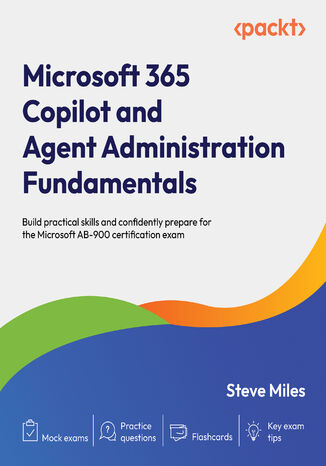
Steve Miles
Microsoft 365 Copilot and AI agents are transforming how organizations collaborate, automate workflows, and manage productivity. This practical certification guide prepares you for the Microsoft AB-900 exam while building real-world administration skills for modern AI-powered workplaces. Aligned with the latest Microsoft Learn objectives, the book covers Microsoft 365 services, security principles, governance controls, and Copilot administration fundamentals.You’ll begin with Microsoft 365 essentials, including licensing, Exchange Online, SharePoint, Teams, identity management, authentication, Conditional Access, and Zero Trust. You’ll then explore Microsoft Purview capabilities, including data classification, sensitivity labels, retention, DLP, Insider Risk Management, Communication Compliance, and DSPM for AI.The book also explains how Copilot accesses organizational data through Microsoft Graph, how to identify oversharing risks in SharePoint, and how to use Purview tools to investigate compliance and governance issues. Finally, you’ll learn how to manage Copilot licensing, billing, prompts, usage analytics, and AI agent lifecycles using Microsoft 365 and Power Platform admin centers.By the end of this book, you’ll be ready to confidently take the AB-900 exam and support secure, compliant Microsoft 365 Copilot deployments.
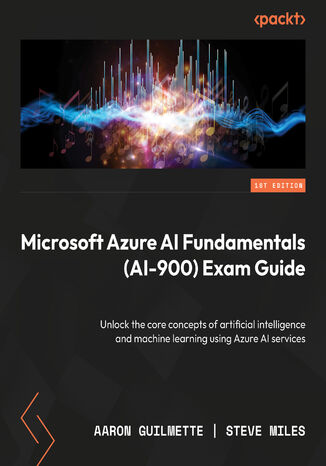
Aaron Guilmette, Steve Miles, Peter De Tender
The AI-900 exam helps you take your first step into an AI-shaped future. Regardless of your technical background, this book will help you test your understanding of the key AI-related topics and tools used to develop AI solutions in Azure cloud.This exam guide focuses on AI workloads, including natural language processing (NLP) and large language models (LLMs). You’ll explore Microsoft’s responsible AI principles like safety and accountability. Then, you’ll cover the basics of machine learning (ML), including classification and deep learning, and learn how to use training and validation datasets with Azure ML. Using Azure AI Vision, face detection, and Video Indexer services, you’ll get up to speed with computer vision-related topics like image classification, object detection, and facial detection. Later chapters cover NLP features such as key phrase extraction, sentiment analysis, and speech processing using Azure AI Language, speech, and translator services. The book also guides you through identifying GenAI models and leveraging Azure OpenAI Service for content generation. At the end of each chapter, you’ll find chapter review questions with answers, provided as an online resource.By the end of this exam guide, you’ll be able to work with AI solutions in Azure and pass the AI-900 exam using the online exam prep resources.
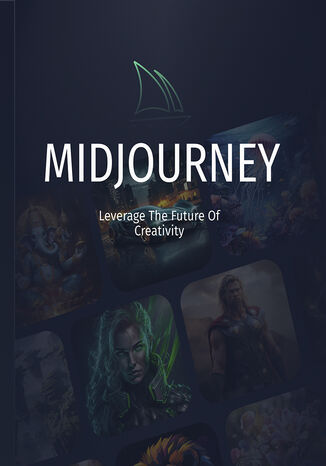
Midjourney. Leverage The Future Of Creativity
Adrian Twarog
Unleash the full potential of Midjourney by mastering the essentials of prompt creation. The book begins with an in-depth exploration of prompt anatomy, teaching you the key components that make up an effective input. From there, you'll move on to crafting your first Midjourney prompt, gaining confidence as you bring your creative ideas to life.As you progress, you'll delve into the vital commands and the parameter list that enable you to fine-tune your results. Each concept is broken down into actionable insights, ensuring you fully understand how to control Midjourney’s output. By learning the interplay of these elements, you’ll start crafting outputs tailored to your vision.Finally, advanced techniques take center stage, showing you how to push the boundaries of your creativity. Whether you're creating stunning visuals, refining complex ideas, or exploring new ways to express yourself, this course equips you with the tools and knowledge to excel in the world of Midjourney.

Mit sztucznej inteligencji. Dlaczego komputery nie potrafią myśleć jak my
Erik J. Larson
Czy superinteligencja naprawdę jest tuż za rogiem? Czy sztuczna inteligencja wkrótce przewyższy możliwości ludzkiego umysłu? Czy jesteśmy na drodze do stworzenia świadomych, rozumujących maszyn? Erik Larson, przedsiębiorca z branży technologicznej i pionier badań nad przetwarzaniem języka naturalnego, zabiera czytelnika w podróż po współczesnym krajobrazie AI, pokazując, jak daleko wciąż jesteśmy od stworzenia superinteligencji i co musiałoby się wydarzyć, by to osiągnąć. Od czasów Alana Turinga wielu entuzjastów AI utożsamia sztuczną inteligencję z ludzkim myśleniem. To poważne nieporozumienie. Obecne systemy AI bazują na rozumowaniu indukcyjnym - analizują dane i przewidują wyniki. Tymczasem ludzie nie porównują danych - formułują przypuszczenia, czerpiąc z kontekstu i doświadczenia. Nasza inteligencja to sieć domysłów opartych na wiedzy o świecie. Tego typu intuicyjnego rozumowania - nazywanego abdukcją - nie potrafimy jak dotąd zaprogramować. A to właśnie ono stanowi sedno ludzkiego rozumu i zdrowego rozsądku. Larson ostrzega, że mit nieuchronnej superinteligencji nie tylko zaciemnia obraz rzeczywistego postępu, ale też hamuje innowacje. Zamiast badać to, czego jeszcze nie rozumiemy, skupiamy się na przereklamowanych rozwiązaniach. AI będzie dalej doskonalić się w wyspecjalizowanych zadaniach, ale jeśli naprawdę chcemy zrobić krok naprzód, musimy lepiej poznać i docenić jedyną inteligencję, którą znamy - naszą własną. Erik J. Larson jest informatykiem, przedsiębiorcą w branży technologicznej i założycielem dwóch start-upów AI finansowanych przez DARPA. Obecnie zajmuje się podstawowymi zagadnieniami przetwarzania języka naturalnego i uczenia maszynowego. Publikował na łamach "The Atlantic" oraz w czasopismach naukowych, a także badał techniczne granice sztucznej inteligencji w ramach współpracy z inkubatorem technologicznym IC2 na Uniwersytecie Teksańskim w Austin.
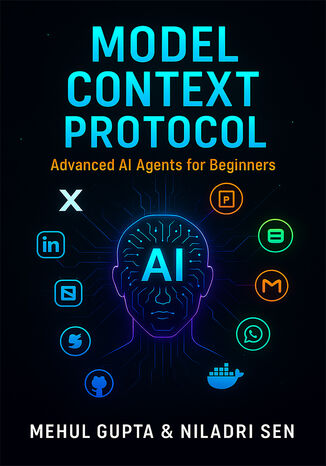
Mehul Gupta, Niladri Sen
This book offers a detailed introduction to the groundbreaking field of AI agents and Model Context Protocol (MCP). The first section delves into generative AI and large language models (LLMs), exploring how these technologies power modern AI systems. From there, the book introduces the concept of AI agents—autonomous systems capable of executing tasks with varying levels of complexity. Moving into practical applications, the book focuses on Model Context Protocol, explaining its key components and how it enables effective interaction between AI and various software tools. Each chapter offers step-by-step instructions for setting up MCP servers for popular tools like Gmail, YouTube, GitHub, and more, empowering readers to automate tasks and streamline workflows. The book concludes by addressing the future of MCP, its potential risks, and how to stay safe while using these advanced technologies. Whether you're a beginner or experienced practitioner, this guide will deepen your understanding of AI and enhance your ability to leverage cutting-edge automation in daily operations.
V Kishore Ayyadevara, Yeshwanth Reddy
Whether you are a beginner or are looking to progress in your computer vision career, this book guides you through the fundamentals of neural networks (NNs) and PyTorch and how to implement state-of-the-art architectures for real-world tasks.The second edition of Modern Computer Vision with PyTorch is fully updated to explain and provide practical examples of the latest multimodal models, CLIP, and Stable Diffusion.You’ll discover best practices for working with images, tweaking hyperparameters, and moving models into production. As you progress, you'll implement various use cases for facial keypoint recognition, multi-object detection, segmentation, and human pose detection. This book provides a solid foundation in image generation as you explore different GAN architectures. You’ll leverage transformer-based architectures like ViT, TrOCR, BLIP2, and LayoutLM to perform various real-world tasks and build a diffusion model from scratch. Additionally, you’ll utilize foundation models' capabilities to perform zero-shot object detection and image segmentation. Finally, you’ll learn best practices for deploying a model to production.By the end of this deep learning book, you'll confidently leverage modern NN architectures to solve real-world computer vision problems.
Valentina Alto
Generative AI models and AI language models are becoming increasingly popular due to their unparalleled capabilities. This book will provide you with insights into the inner workings of the LLMs and guide you through creating your own language models. You’ll start with an introduction to the field of generative AI, helping you understand how these models are trained to generate new data.Next, you’ll explore use cases where ChatGPT can boost productivity and enhance creativity. You’ll learn how to get the best from your ChatGPT interactions by improving your prompt design and leveraging zero, one, and few-shots learning capabilities. The use cases are divided into clusters of marketers, researchers, and developers, which will help you apply what you learn in this book to your own challenges faster.You’ll also discover enterprise-level scenarios that leverage OpenAI models’ APIs available on Azure infrastructure; both generative models like GPT-3 and embedding models like Ada. For each scenario, you’ll find an end-to-end implementation with Python, using Streamlit as the frontend and the LangChain SDK to facilitate models' integration into your applications.By the end of this book, you’ll be well equipped to use the generative AI field and start using ChatGPT and OpenAI models’ APIs in your own projects.