
Sztuczna inteligencja
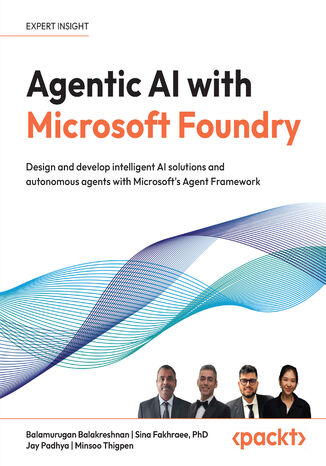
Balamurugan Balakreshnan, Sina Fakhraee, Jay Padhya, Minsoo...
Agentic AI with Microsoft Foundry is your complete guide to creating intelligent, enterprise-ready AI copilots and agents using Microsoft’s unified AI development platform. Whether you’re building with GPT models, integrating private data, or orchestrating multi-agent workflows, this book equips you with the technical foundation and practical skills to succeed.You’ll begin by mastering Microsoft Foundry essentials, including setting up your workspace, exploring the Model Catalog, and applying prompt engineering techniques for high-quality LLM outputs. You’ll then fine-tune large language models, implement retrieval-augmented generation (RAG), and integrate cognitive search capabilities to give your AI real-world context.The second half of the book dives deep into building and extending AI agents using the Agent Framework, covering everything from configuring tools and connectors to orchestrating multi-agent systems capable of reasoning, retrieving, and acting autonomously. You’ll also learn how to evaluate and govern your AI responsibly, monitor deployments effectively, and scale solutions for enterprise use.By the end, you’ll have built a production-ready AI copilot that leverages Microsoft Foundry, OpenAI models, and Microsoft’s Agent Framework, bringing together intelligence, automation, and ethical AI design.
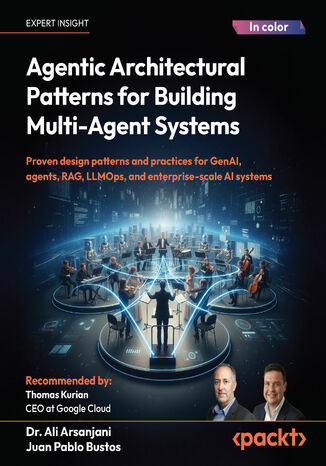
Dr. Ali Arsanjani, Juan Pablo Bustos, Thomas...
Generative AI has moved beyond the hype, and enterprises now face the challenge of turning prototypes into scalable solutions. This book is your guide to building intelligent agents powered by LLMs.Starting with a GenAI maturity model, you’ll learn how to assess your organization’s readiness and create a roadmap toward agentic AI adoption. You’ll master foundational topics such as model selection and LLM deployment, progressing to advanced methods such as RAG, fine-tuning, in-context learning, and LLMOps, especially in the context of agentic AI. You'll explore a rich library of agentic AI design patterns to address coordination, explainability, fault tolerance, and human-agent interaction. This book introduces a concrete, hierarchical multi-agent architecture where high-level orchestrator agents manage complex business workflows by delegating entire sub-processes to specialized agents. You’ll see how these agents collaborate and communicate using the Agent-to-Agent (A2A) protocol.To ensure your systems are production-ready, we provide a practical framework for observability using life cycle callbacks, giving you the granular traceability needed for debugging, compliance, and cost management. Each pattern is backed by real-world scenarios and code examples using the open source Agent Development Kit (ADK).*Email sign-up and proof of purchase required
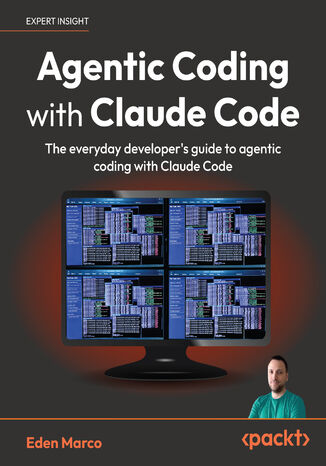
Agentic Coding with Claude Code. The everyday developer's guide to agentic coding with Claude Code
Eden Marco
Most developers encounter Claude Code through chat-style prompting, but that approach breaks down as projects grow and automation must be safe, repeatable, and controlled. Agentic Coding with Claude Code shows how to move beyond ad hoc prompts and use Claude Code as an extensible, agent-driven development platform.This book focuses on building context-aware AI workflows directly in your terminal and IDE. You will learn how to control Claude Code using slash commands, manage long-term context with persistent memory files, and automate development tasks using hooks that trigger actions across Claude Code's lifecycle.The book also covers the Model Context Protocol (MCP) as an important part of the modern agentic ecosystem. You will understand why MCP exists, explore its core architecture, and configure MCP servers inside Claude Code to improve context sharing across tools, agents, and workflows. The trade-offs between MCP, skills, and subagents are discussed to help you choose the right approach.You will design and orchestrate multi-agent systems using subagents, parallel sessions, and hierarchical delegation. By the end of the book, you will be able to integrate Claude Code into real-world development workflows with confidence and control.
Noah Gift
Opanuj skuteczne, gotowe do użycia rozwiązania biznesowe dla sztucznej inteligencji i uczenia maszynowego AI podejście pragmatyczne pomaga rozwiązywać praktyczne problemy przy użyciu nowoczesnego uczenia maszynowego, sztucznej inteligencji i chmurowych narzędzi obliczeniowych. Noah Gift demistyfikuje wszelkie koncepcje i narzędzia potrzebne do osiągnięcia wyników nawet jeśli Czytelnik nie ma solidnego przygotowania z matematyki lub data science. Autor wyjaśnia skuteczne, gotowe do użycia rozwiązania udostępniane przez Amazon, Google i Microsoft oraz demonstruje sprawdzone techniki wykorzystujące ekosystem analizy danych oparty na języku Python. Proponowane podejścia i przykłady pomagają ukierunkować i uprościć każdy krok od wdrożenia po produkcję i budować rozwiązania o niezwykłych możliwościach skalowania. W miarę poznawania działania rozwiązań Machine Language (ML) będziesz uzyskiwać coraz bardziej intuicyjne zrozumienie tego, co można dzięki nim osiągnąć i jak zmaksymalizować ich wartość. Na tych podstawach autor krok po kroku prezentuje budowanie chmurowych aplikacji AI/ML do rozwiązywania realistycznych problemów w dziedzinie marketingu, zarządzania projektami, wyceniania produktów, nieruchomości i dużo więcej. Bez względu na to, czy jesteś profesjonalistą biznesowym, osobą decyzyjną, studentem czy programistą, eksperckie wskazówki autora i rozbudowane analizy przypadków przygotują cię do rozwiązywania problemów data science w niemal dowolnym środowisku. Uzyskaj i skonfiguruj wszystkie potrzebne narzędzia Szybko przejrzyj wszystkie funkcjonalności Pythona, których potrzebujesz do budowania aplikacji uczenia maszynowego Opanuj narzędzia AI i ML oraz cykl życia projektu Korzystaj z narzędzi analitycznych Pythona, takich jak IPython, Pandas, Numpy, Juypter Notebook i Sklearn Dołącz pragmatyczną pętlę zwrotną, która pozwoli nieustannie poprawiać wydajność naszych procedur i systemów Projektuj chmurowe rozwiązania AI oparte na Google Cloud Platform, uwzględniając usługi TPU, Colaboratory i Datalab Definiuj chmurowe przepływy pracy w Amazon Web Services, w tym wystąpienia punktowe, potoki kodu i inne Pracuj z API sztucznej inteligencji w Microsoft Azure Poznaj budowanie sześciu rzeczywistych aplikacji AI od początku do końca
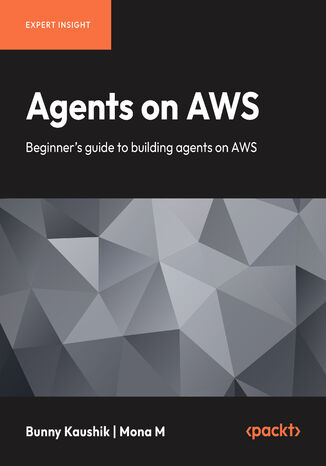
AI Agents on AWS. Beginner's guide to building AI agents on AWS
Bunny Kaushik, Mona M, Randy DeFauw
Build reliable AI agents on AWS and move beyond prototypes with practical guidance. This book helps you design, deploy, and manage agentic systems that reason, use tools, and collaborate to solve real-world tasks.You start with the foundations of agentic AI, understanding how agents think, act, and interact. Design single-agent systems, extend them with tool and function calling, and add memory for context-aware behavior using Amazon Bedrock and SageMaker AI. You will also use LangGraph and Strands to structure agent workflows.As you progress, create multi-agent systems and orchestrate workflows where specialized agents collaborate. Learn how MCP and A2A enable communication, interoperability, and modular design across agent ecosystems.Focus on production readiness by deploying and scaling agents with Bedrock AgentCore, evaluating performance, and implementing observability, monitoring, and governance. By the end, you will be able to design and operate robust AI agent systems on AWS.
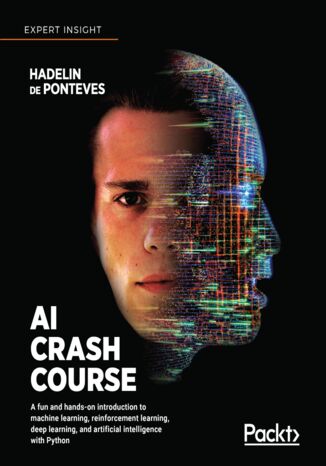
Hadelin de Ponteves
Welcome to the Robot World … and start building intelligent software now!Through his best-selling video courses, Hadelin de Ponteves has taught hundreds of thousands of people to write AI software. Now, for the first time, his hands-on, energetic approach is available as a book. Starting with the basics before easing you into more complicated formulas and notation, AI Crash Course gives you everything you need to build AI systems with reinforcement learning and deep learning. Five full working projects put the ideas into action, showing step-by-step how to build intelligent software using the best and easiest tools for AI programming, including Python, TensorFlow, Keras, and PyTorch.AI Crash Course teaches everyone to build an AI to work in their applications. Once you've read this book, you're only limited by your imagination.
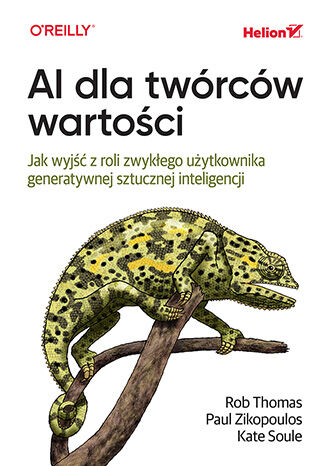
AI dla twórców wartości. Jak wyjść z roli zwykłego użytkownika generatywnej sztucznej inteligencji
Rob Thomas, Paul Zikopoulos, Kate Soule
Nie sposób przewidzieć, dokąd zmierza AI. Znajdujemy się w wyjątkowym momencie: przechodzimy od świata, w którym procesy realizowali ludzie za pomocą technologii, do świata, w którym technologie same będą prowadzić procesy, a ludzie będą je wspierać lub nadzorować. Gdzie chcesz się znaleźć w tym nowym świecie? Z tą książką rozwiniesz innowacje i skutecznie zareagujesz na kolejną falę rozwoju sztucznej inteligencji! Jessica Sibley, dyrektor generalna TIME Ta wnikliwa książka wykracza poza podstawy AI. Zawiera autentyczne historie sukcesów i konkretne wnioski z praktyki. Omawia sposób działania generatywnej AI i agentów, a także pokazuje możliwe kierunki przekształcania biznesu i społeczeństw dzięki tej technologii. Daje nową perspektywę perspektywę twórcy wartości AI. Udowadnia, że mimo niekorzystnych tendencji możesz osiągnąć sukces biznesowy, wykorzystując potencjał cyfrowej siły roboczej. Niezależnie od tego, czy dopiero zaczynasz, czy masz już doświadczenie, znajdziesz tu pełniejsze spojrzenie na znaczenie nowoczesnej strategii AI dla rozwoju Twojej firmy. Najciekawsze zagadnienia: potencjał transformacyjny sztucznej inteligencji w biznesie wyzwania etyczne i operacyjne związane z AI strategie integracji AI z kulturą organizacyjną rola twórcy wartości opartej na AI Podręcznik renesansu sztucznej inteligencji! will.i.am, dyrektor generalny FYI.AI
Andrzej Zybertowicz, Katarzyna Zybertowicz
"Andrzej Zybertowicz stworzył w tej książce przestrzeń dla rozmowy o AI, której wszyscy potrzebujemy. W dzisiejszym świecie przejrzystość w naszym dyskursie to kluczowe wymaganie. Ta książka powinna być lekturą dla każdego, kto pyta, czym AI jest dziś i czym może być w przyszłości. A must read." - Andrew A. Michta, Senior Fellow and Director, Scowcroft Strategy Initiative, The Atlantic Council of the United States "Książka AI Eksploracja zostawiła mnie z większą liczbą pytań niż miałam przed jej przeczytaniem. A mimo to właśnie dlatego warto po nią sięgnąć. Może stanowić ciekawy , inny punkt wyjścia, pretekst do dalszych rozważań na temat AI. Poznając bowiem lepiej tę technologię, paradoksalnie lepiej poznajemy samych siebie." - Natalia Hatalska, autorka książki Wiek paradoksów: Czy technologia nas ocali? "Komputery osobiste, Internet i smartfony, początkowo traktowane jako ciekawostka, głęboko zmieniły nasze życie. Brakuje nam wyobraźni socjologicznej, przewidywania skutków społecznych wprowadzania nowych technologii. Sztuczna inteligencja może mieć znacznie silniejszy wpływ niż rozwinięte wcześniej technologie. Rozważania prof. Zybertowicza na ten temat są kontrowersyjne, ale warto je krytycznie przemyśleć." - Prof. Włodzisław Duch, UMK