
Sztuczna inteligencja
Henry Habib, Sam McKay, Paul Siegel
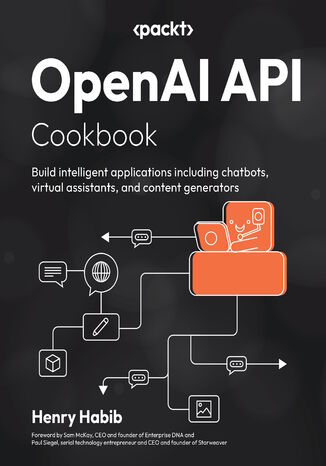
As artificial intelligence continues to reshape industries with OpenAI at the forefront of AI research, knowing how to create innovative applications such as chatbots, virtual assistants, content generators, and productivity enhancers is a game-changer. This book takes a practical, recipe-based approach to unlocking the power of OpenAI API to build high-performance intelligent applications in diverse industries and seamlessly integrate ChatGPT in your workflows to increase productivity.You’ll begin with the OpenAI API fundamentals, covering setup, authentication, and key parameters, and quickly progress to the different elements of the OpenAI API. Once you’ve learned how to use it effectively and tweak parameters for better results, you’ll follow advanced recipes for enhancing user experience and refining outputs. The book guides your transition from development to live application deployment, setting up the API for public use and application backend. Further, you’ll discover step-by-step recipes for building knowledge-based assistants and multi-model applications tailored to your specific needs.By the end of this book, you’ll have worked through recipes involving various OpenAI API endpoints and built a variety of intelligent applications, ready to apply this experience to building AI-powered solutions of your own.
Henry Habib
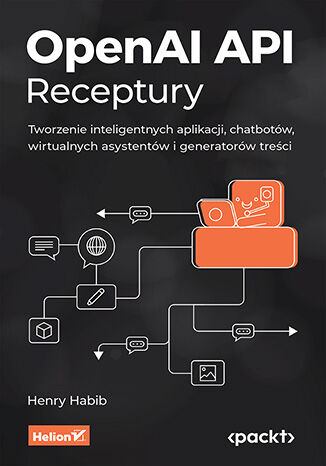
Firma OpenAI pozostaje niekwestionowanym liderem badań nad sztuczną inteligencją. Dzięki udostępnianym przez nią rozwiązaniom tworzenie innowacyjnych aplikacji, takich jak czatboty, wirtualne asystenty, generatory treści i narzędzia zwiększające produktywność, stało się o wiele prostsze. Bezsprzecznie powszechna dostępność technologii AI zmienia zasady gry! Receptury zawarte w tym zbiorze ułatwią Ci budowę szerokiej gamy inteligentnych aplikacji. Zaczniesz od podstaw OpenAI API - konfiguracji, uwierzytelniania i kluczowych parametrów - po czym szybko przejdziesz do nauki korzystania z najważniejszych elementów API. Następnie przyjdzie czas na zaawansowane receptury, dzięki którym poprawisz wrażenia użytkownika i dopracujesz dane wyjściowe. Dowiesz się, jak wdrażać aplikacje i przygotować je do publicznego użytku. Nauczysz się również budowania inteligentnych asystentów opartych na specjalistycznej wiedzy, a także aplikacji multimodalnych dostosowanych do Twoich specyficznych potrzeb. W książce: podstawy interfejsu OpenAI API, jego możliwości i ograniczenia konfiguracja OpenAI API krok po kroku zaawansowane funkcje, w tym komunikat systemowy i dostrajanie integracja OpenAI API z istniejącymi aplikacjami i procesami projektowanie aplikacji wykorzystujących w pełni możliwości OpenAI API Postęp technologii polega na dostosowaniu jej tak, abyśmy nawet jej nie zauważali i by mogła stać się częścią codziennego życia! Bill Gates
Joseph Howse, Steven Puttemans, Utkarsh Sinha
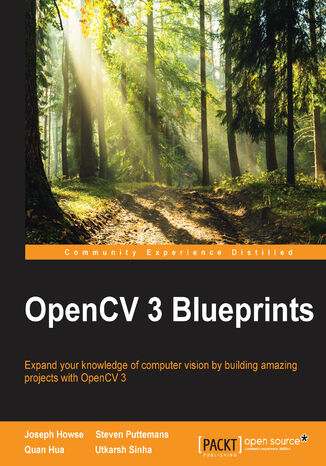
Computer vision is becoming accessible to a large audience of software developers who can leverage mature libraries such as OpenCV. However, as they move beyond their first experiments in computer vision, developers may struggle to ensure that their solutions are sufficiently well optimized, well trained, robust, and adaptive in real-world conditions. With sufficient knowledge of OpenCV, these developers will have enough confidence to go about creating projects in the field of computer vision.This book will help you tackle increasingly challenging computer vision problems that you may face in your careers. It makes use of OpenCV 3 to work around some interesting projects. Inside these pages, you will find practical and innovative approaches that are battle-tested in the authors’ industry experience and research. Each chapter covers the theory and practice of multiple complementary approaches so that you will be able to choose wisely in your future projects. You will also gain insights into the architecture and algorithms that underpin OpenCV’s functionality.We begin by taking a critical look at inputs in order to decide which kinds of light, cameras, lenses, and image formats are best suited to a given purpose. We proceed to consider the finer aspects of computational photography as we build an automated camera to assist nature photographers. You will gain a deep understanding of some of the most widely applicable and reliable techniques in object detection, feature selection, tracking, and even biometric recognition. We will also build Android projects in which we explore the complexities of camera motion: first in panoramic image stitching and then in video stabilization.By the end of the book, you will have a much richer understanding of imaging, motion, machine learning, and the architecture of computer vision libraries and applications!
Robert Laganiere
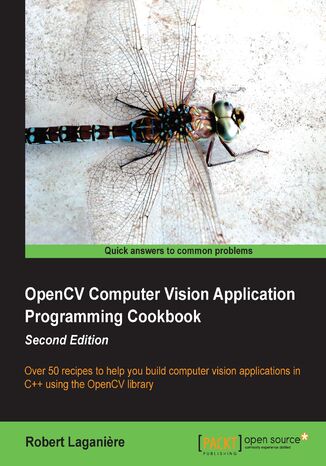
OpenCV 3 Computer Vision Application Programming Cookbook is appropriate for novice C++ programmers who want to learn how to use the OpenCV library to build computer vision applications. It is also suitable for professional software developers wishing to be introduced to the concepts of computer vision programming. It can also be used as a companion book in a university-level computer vision courses. It constitutes an excellent reference for graduate students and researchers in image processing and computer vision.
Joseph Howse
This book is for programmers who want to expand their skills by building fun, smart, and useful systems with OpenCV. The projects are ideal in helping you to think creatively about the uses of computer vision, natural user interfaces, and ubiquitous computers (in your home, car, and hand).
Prateek Joshi
Computer vision is found everywhere in modern technology. OpenCV for Python enables us to run computer vision algorithms in real time. With the advent of powerful machines, we are getting more processing power to work with. Using this technology, we can seamlessly integrate our computer vision applications into the cloud. Web developers can develop complex applications without having to reinvent the wheel.This book will walk you through all the building blocks needed to build amazing computer vision applications with ease. We start off with applying geometric transformations to images. We then discuss affine and projective transformations and see how we can use them to apply cool geometric effects to photos. We will then cover techniques used for object recognition, 3D reconstruction, stereo imaging, and other computer vision applications.This book will also provide clear examples written in Python to build OpenCV applications. The book starts off with simple beginner’s level tasks such as basic processing and handling images, image mapping, and detecting images. It also covers popular OpenCV libraries with the help of examples.The book is a practical tutorial that covers various examples at different levels, teaching you about the different functions of OpenCV and their actual implementation.
Ajeet Singh Raina, Harsh Manvar
Modern AI systems don’t fail at modeling; they fail in production. Moving from experiments to reliable, scalable systems requires more than notebooks and scripts. It requires infrastructure.Operational AI with Docker shows you how to build, deploy, and operate AI systems that work beyond a single machine. You’ll learn how to use Docker as a consistent runtime for machine learning workflows, package models as reproducible artifacts, and run them reliably across environments.Starting with containerized machine learning, you’ll progress to model serving, AI deployment, and scalable infrastructure using Kubernetes. You’ll implement production-ready patterns for resource management, autoscaling, observability, and performance tuning, ensuring your AI workloads remain stable under real-world conditions.The book goes beyond traditional MLOps by introducing agentic AI systems, including autonomous agents, multi-agent architectures, and secure execution environments. You’ll also explore modern integration patterns using the Model Context Protocol (MCP), enabling AI systems to interact safely with tools, APIs, and data sources.By the end of this book, you’ll be able to design and operate production AI systems that are reproducible, scalable, and ready for real-world deployment using Docker and Kubernetes.

Justyna Żywiołek
Monografia rozwija nowatorskie spojrzenie na bezpieczeństwo organizacyjne, proponując podejście integrujące technologię, prawo, zarządzanie i wiedzę użytkowników. Jest to podejście, które wpisuje się w interdyscyplinarny charakter nauk o bezpieczeństwie i jednocześnie odpowiada na bieżące potrzeby sektora przemysłowego. W monografii nie tylko dokonano analizy zagrożeń i regulacji, ale przede wszystkim wskazano, jak organizacje mogą budować modele odporności adekwatne do wyzwań XXI wieku. Kolejne części monografii przybliżają, jak ewolucja przemysłu wpływa na charakter zagrożeń, w jaki sposób systemy AI generują nowe podatności, jaką rolę odgrywa świadomość społeczna oraz jak budować odporność organizacyjną w erze systemów autonomicznych. W rozdziale pierwszym czytelnik zostanie wprowadzony w zjawisko przemysłowej transformacji oraz genezę cyberzagrożeń 6.0, w rozdziale drugim przedstawiono technologiczne aspekty zagrożeń, w rozdziale trzecim skupiono się na świadomości społecznej, w rozdziale czwartym na modelach przeciwdziałania zagrożeniom, natomiast w rozdziale piątym ukazano scenariusze przyszłości i kierunki rozwoju bezpieczeństwa w przemyśle w perspektywie Industry 6.0. Taka struktura monografii umożliwia całościowe, wielowymiarowe spojrzenie na zagadnienie bezpieczeństwa w erze sztucznej inteligencji. Monografia stanowi oryginalny i samodzielny wkład w rozwój dyscypliny nauk o bezpieczeństwie, zarówno w wymiarze teoretycznym, jak i metodologicznym oraz aplikacyjnym. Jej nowatorstwo polega na całościowym i systemowym ujęciu bezpieczeństwa informacyjnego w organizacjach przemysłowych funkcjonujących w warunkach transformacji określanej mianem Przemysłu 6.0, z uwzględnieniem roli sztucznej inteligencji jako czynnika generującego jakościowo nowe kategorie zagrożeń oraz znaczenia świadomości społecznej jako kluczowej determinanty skuteczności systemów bezpieczeństwa. Wprowadzenie pojęcia "cyberzagrożenia 6.0", połączenie perspektywy technologicznej i społecznej oraz spójne osadzenie rozważań w paradygmacie bezpieczeństwa sprawiają, że opracowanie ma charakter wartościowy i inspirujący. Jego znaczenie wykracza poza aktualny stan badań, tworząc solidne podstawy do dalszego rozwoju tej problematyki. W dotychczasowych analizach brakuje ujęć, które traktowałyby bezpieczeństwo organizacyjne jako zjawisko socjotechniczne, wynikające z interakcji pomiędzy technologią, strukturą organizacyjną i człowiekiem jako podmiotem interpretującym informacje i podejmującym decyzje. Niniejsza monografia wypełnia tę lukę, przesuwając punkt ciężkości analizy z samej infrastruktury technicznej na mechanizmy poznawcze, kulturowe i organizacyjne, które w praktyce decydują o odporności organizacji na zagrożenia generowane przez systemy sztucznej inteligencji.