
Hacking
W kategorii Hacking zebrano publikacje dotyczące nie tylko hackerów, crackerów i ich technik działania, ale także opisujące różne aspekty bezpieczeństwa komputerów i danych na nich przechowywanych. Poznacie technikę przeprowadzania audytów bezpieczeństwa oraz sposoby zabezpieczania się przed atakami hackerów, programami szpiegującymi czy zwykłą plagą wirusów.
Nauczycie się chronić nie tylko poszczególne komputery ale całe sieci komputerowe przez opracowanie i wdrożenie odpowiedniej polityki bezpieczeństwa, poprawne użycie firewalli czy odpowiednie skonfigurowanie serwerów pracujących pod Waszym nadzorem, a także opanujecie sposoby bezpiecznego surfowania po internecie.
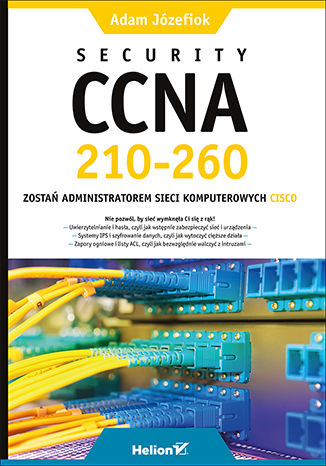
Security CCNA 210-260. Zostań administratorem sieci komputerowych Cisco
Adam Józefiok
Nie pozwól, by sieć wymknęła Ci się z rąk! Uwierzytelnianie i hasła, czyli jak wstępnie zabezpieczyć sieć i urządzenia Systemy IPS i szyfrowanie danych, czyli jak wytoczyć cięższe działa Zapory ogniowe i listy ACL, czyli jak bezwzględnie walczyć z intruzami Bezpieczeństwo sieci komputerowych to temat, którego nie da się zgłębić do końca. Systemy informatyczne bezustannie ewoluują, a utalentowany haker złamie najbardziej wyrafinowane zabezpieczenia. Jednak nie ma co załamywać rąk. Ta książka powstała po to, by pomóc Ci zabezpieczyć Twoją sieć tak dokładnie, jak to możliwe. Na tym etapie powinieneś wiedzieć, jak działają podstawowe technologie wykorzystywane w sieciach. Jeśli jeszcze tego nie wiesz, warto zapoznać się najpierw z pozycją CCNA 200-120. Zostań administratorem sieci komputerowych Cisco. W opisanej tu historii odegrasz kolejno rolę obserwatora, włamywacza i administratora bezpieczeństwa. Poznasz teorię, potem zastosujesz ją, by włamać się do sieci, a na końcu zabezpieczysz tę sieć. Dowiesz się stąd, jak ochronić całą sieć wraz z urządzeniami peryferyjnymi. Zobaczysz, jak wykorzystać różne protokoły uwierzytelniania, listy kontroli dostępu, firewalle systemowe i zewnętrzne oraz systemy IPS. Odkryjesz, na czym polega dobre szyfrowanie i jak zabezpieczyć komunikację przez skonfigurowanie sieci VPN. Zapoznasz się także bliżej z kwestią rejestrowania i raportowania niepożądanych zdarzeń. Wiedza zawarta w tej książce pozwoli Ci zdać egzamin na certyfikat Cisco CCNA Security, ale przede wszystkim zabezpieczyć Twoją sieć na mistrzowskim poziomie! Podstawy bezpieczeństwa sieci Lokalne zabezpieczanie urządzeń Działanie i wykorzystanie RADIUS i TACACS+ Sposoby zabezpieczania warstwy 2 modelu ISO OSI Listy ACL IPv4 ACL w sieci IPv6 Zapora i jej zastosowanie w oparciu o IOS Zapora ogniowa oparta na urządzeniu Cisco ASA Systemy IPS (Intrusion Prevention System) Konfiguracja szyfrowania i sieci VPN Logowanie zdarzeń, raportowanie i zarządzanie bezpieczeństwem sieci za pomocą 802.1x Administrowanie przez zabezpieczanie!
Bogdan Kireeve, Chas Clawson
Modernize your security operations with Sumo Logic’s Continuous Intelligence Platform that delivers real-time detection, analysis, and response to threats, and find out how it enables security teams to unify monitoring, apply advanced analytics, and strengthen defenses across diverse environments.Step by step, this guide takes you through configuring Sumo Logic to ingest and visualize log data, running versatile queries, and using Security Apps to meet compliance and audit demands. You’ll learn how to take full advantage of Cloud SIEM by creating enriched records, building correlation rules, proactively threat hunting, and tuning signals to reduce false positives.Beyond traditional SIEM use cases, discover how Sumo Logic supports modern DevSecOps practices that embed security into the development lifecycle without compromising delivery speed and features such as entity inventory, third-party integrations, and best practices that enhance investigation and detection accuracy.Finally, you’ll prepare for the future of security intelligence, where automation, machine learning, and AI-driven insights reshape threat defense, ensuring you’re ready to transform your security operations with Sumo Logic Cloud SIEM.*Email sign-up and proof of purchase required
Rajneesh Gupta, Santiago Bassett
Strengthen your cybersecurity posture with Wazuh’s powerful security monitoring and compliance capabilities.Security Monitoring with Wazuh is a comprehensive, hands-on guide that helps you deploy, configure, and optimize Wazuh to detect threats, automate incident response, and enforce compliance. With real-world use cases, step-by-step configurations, and tool integrations, this book equips you to build an enterprise-grade defense system.You'll begin by setting up an Intrusion Detection System (IDS) using Wazuh and integrating Suricata to monitor network and host-based threats. Moving forward, you'll explore malware detection, vulnerability assessment, and security automation with SOAR. The book also covers threat intelligence, incident response, and proactive threat hunting, helping you detect and mitigate cybersecurity risks effectively.Beyond detection, you'll enforce compliance with industry standards such as MITRE ATT&CK, PCI DSS, and GDPR, ensuring regulatory adherence and security best practices. By integrating Wazuh with TheHive, Cortex, MISP, and other security tools, you'll streamline threat analysis and response.By the end of this book, you'll master Wazuh's full potential, enabling you to deploy, manage, and enhance security monitoring across your infrastructure—from on-premises to cloud environments.
Benjamin Kovacevic
What your journey will look likeWith the help of this expert-led book, you’ll become well versed with SOAR, acquire new skills, and make your organization's security posture more robust.You’ll start with a refresher on the importance of understanding cyber security, diving into why traditional tools are no longer helpful and how SOAR can help.Next, you’ll learn how SOAR works and what its benefits are, including optimized threat intelligence, incident response, and utilizing threat hunting in investigations.You’ll also get to grips with advanced automated scenarios and explore useful tools such as Microsoft Sentinel, Splunk SOAR, and Google Chronicle SOAR.The final portion of this book will guide you through best practices and case studies that you can implement in real-world scenarios.By the end of this book, you will be able to successfully automate security tasks, overcome challenges, and stay ahead of threats.
Weimin Sun, Xun (Brian) Wu, Angela Kwok
The failure of initial coin offerings (ICOs) is no accident, as most ICOs do not link to a real asset and are not regulated. Realizing the shortcomings of ICOs, the blockchain community and potential investors embraced security token offerings (STOs) and stablecoins enthusiastically.In this book, we start with an overview of the blockchain technology along with its basic concepts. We introduce the concept behind STO, and cover the basic requirements for launching a STO and the relevant regulations governing its issuance. We discuss U.S. securities laws development in launching security digital tokens using blockchain technology and show some real use cases. We also explore the process of STO launches and legal considerations. We introduce popular security tokens in the current blockchain space and talk about how to develop a security token DApp, including smart contract development for ERC1404 tokens. Later, you'll learn to build frontend side functionalities to interact with smart contracts. Finally, we discuss stablecoin technical design functionalities for issuing and operating STO tokens by interacting with Ethereum smart contracts.By the end of this book, you will have learned more about STOs and gained a detailed knowledge of building relevant applications—all with the help of practical examples.

Security with Go. Explore the power of Golang to secure host, web, and cloud services
John Daniel Leon
Go is becoming more and more popular as a language for security experts. Its wide use in server and cloud environments, its speed and ease of use, and its evident capabilities for data analysis, have made it a prime choice for developers who need to think about security.Security with Go is the first Golang security book, and it is useful for both blue team and red team applications. With this book, you will learn how to write secure software, monitor your systems, secure your data, attack systems, and extract information.Defensive topics include cryptography, forensics, packet capturing, and building secure web applications.Offensive topics include brute force, port scanning, packet injection, web scraping, social engineering, and post exploitation techniques.
Security+(R) Practice Tests. Prepare for, practice, and pass the CompTIA Security+ exam
Mike Chapple
Security+ certification is the most popular entry-level certification for cybersecurity professionals. It has no work experience requirement, making it accessible to everyone willing to put in the time to prepare for the exam. Security+? Practice Tests are the perfect tools to prepare for the CompTIA Security+ exam.The first six chapters each cover one of the six Security+ domains. Each of those chapters contains around 100 practice test questions covering the material from that domain. The last two chapters each contain a full-length Security+ practice test that’s designed to assess your readiness to take the actual test. At the end of each chapter, you’ll find the answers to all of the questions along with detailed explanations to help reinforce your learning of the material.By the end of the book, you’ll have enough practice to easily ace the CompTIA Security+ exam.
Carl Cocchiaro
The Selenium WebDriver 3.x Technology is an open source API available to test both Browser and Mobile applications. It is completely platform independent in that tests built for one browser or mobile device, will also work on all other browsers and mobile devices. Selenium supports all major development languages which allow it to be tied directly into the technology used to develop the applications. This guide will provide a step-by-step approach to designing and building a data-driven test framework using Selenium WebDriver, Java, and TestNG.The book starts off by introducing users to the Selenium Page Object Design Patterns and D.R.Y Approaches to Software Development. In doing so, it covers designing and building a Selenium WebDriver framework that supports both Browser and Mobile Devices. It will lead the user through a journey of architecting their own framework with a scalable driver class, Java utility classes, JSON Data Provider, Data-Driven Test Classes, and support for third party tools and plugins.Users will learn how to design and build a Selenium Grid from scratch to allow the framework to scale and support different browsers, mobile devices, versions, and platforms, and how they can leverage third party grids in the Cloud like SauceLabs.Other topics covered include designing abstract base and sub-classes, inheritance, dual-driver support, parallel testing, testing multi-branded applications, best practices for using locators, and data encapsulation.Finally, you will be presented with a sample fully-functional framework to get them up and running with the Selenium WebDriver for browser testing.By the end of the book, you will be able to design your own automation testing framework and perform data-driven testing with Selenium WebDriver.