
Informatyka
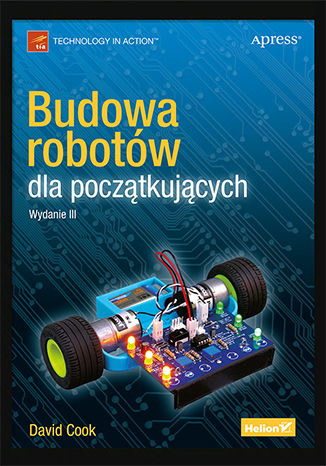
Budowa robotów dla początkujących. Wydanie III
David Cook
Samodzielne budowanie robotów wydaje się czymś bardzo trudnym, wymagającym imponującej wiedzy z tak skomplikowanych dziedzin, jak fizyka, informatyka czy elektronika. Warto wiedzieć, że to nie do końca prawda. Robotyka może być niezwykle inspirującą pasją, pozwalającą obudzić w sobie ducha prawdziwego wynalazcy, a zrozumienie teoretycznych podstaw najszybciej rodzi się w procesie samodzielnego budowania robota. Sprawdź sam! Niniejsza książka stanowi doskonałe wprowadzenie do amatorskiego budowania robotów. W poszczególnych rozdziałach przedstawiono kolejne etapy budowy prostego robota i uzupełniono je o charakterystykę poszczególnych komponentów oraz opis ich funkcjonowania. Znajdziesz tu przydatne tabele z danymi, wskazówki dotyczące rozwiązań konstruktorskich, a także niezbędne podstawy teoretyczne — dzięki temu nie trzeba martwić się brakiem wiedzy. Po przeczytaniu tego podręcznika będziesz mógł zabrać się za bardziej skomplikowane projekty! Najważniejsze zagadnienia omówione w książce: przygotowanie miejsca pracy, narzędzi i komponentów zasady bezpiecznej pracy podczas budowy robota funkcje poszczególnych części robota montowanie podzespołów robota i kontrola ich działania uruchomienie i dalsze rozwijanie robota druk 3D jako technologia tworzenia elementów konstrukcyjnych robota Obudź w sobie wynalazcę, złap lutownicę i zbuduj robota! David Cook — prowadzi popularny serwis RobotRoom.com i jest autorem ponad setki artykułów dotyczących oprogramowania, elektroniki i budowy maszyn. W przeszłości, jako programista, napisał popularną serię gier RPG TaskMaker. Kierował też pracą zespołów tworzących aplikacje dla platform Motorola, SmartSignal i GE. Jest autorem Copper Connection — aplikacji przeznaczonej do tworzenia projektów drukowanych płytek obwodów. Obecnie Cook zajmuje się inżynierią oprogramowania w firmie Microsystems.
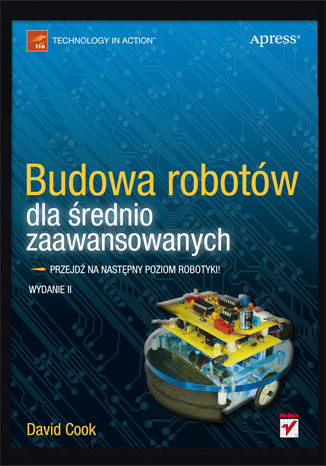
Budowa robotów dla średnio zaawansowanych. Wydanie II
David Cook
Przejdź na następny etap robotyki! Czy chcesz zbudować robota pozbawionego zdalnego sterowania, który jest w stanie przemierzać pomieszczenia, kroczyć po linii lub walczyć z przeciwnikami? W tej książce znajdziesz dokładne instrukcje oraz zdjęcia, opisy obwodów i części — wszystko, dzięki czemu będziesz mógł bez trudu skonstruować własnego, użytecznego robota. Książka Budowa robotów dla średnio zaawansowanych zawiera praktyczną wiedzę, którą podzielić może się wyłącznie doświadczony budowniczy robotów — wiedzę, którą początkujący może zdobyć tylko na własnych błędach. Znajdziesz tu wypróbowane algorytmy podążania za linią oraz porady na temat tego, które elementy elektroniczne warto szlifować. Dowiesz się, że dobrze umieszczony przełącznik pozwala lepiej unikać przeszkód niż para czułek. Nauczysz się również, jak zabezpieczać kondensatory przed eksplozją… Będziesz korzystać z wielu technik stosowanych przez zawodowych inżynierów robotyków — doświadczysz przy tym tych samych wyzwań i radości, gdy Twój robot „ożyje”. Książka ta jest doskonałą propozycją zarówno dla czytelników pierwszej książki Davida Cooka Budowa robotów dla początkujących, jak i dla domorosłych naukowców, którzy samodzielnie nauczyli się podstaw. Powodzenia! W trakcie lektury: zastosujesz zaawansowane detektory przeszkód rozwiążesz problemy z zarządzaniem energią efektywnie wykorzystasz silniki zbudujesz w pełni funkcjonalnego robota Spełnij swoje marzenia o budowie robota!
Budowanie zespołu. Młotek Scrum Mastera
Mateusz Żeromski
Zbuduj zwinny zespół - szybko i skutecznie! Poznaj zasady produktywności Naucz się zwinnie zarządzać ludźmi Wdróż metodykę Scrum w swojej organizacji Zwinne metody zarządzania przeobraziły oblicze branży IT w znacznie większym stopniu niż jakiekolwiek zmiany technologiczne, które mieliśmy okazję obserwować do tej pory. Wśród tych metod prym niewątpliwie wiedzie Scrum - iteracyjny sposób pracy, w ramach którego samoorganizujący się zespół w stałych odstępach czasu dostarcza klientowi realną wartość biznesową. Scrum nie wnosi dużego narzutu organizacyjnego, jest bardzo efektywny i znacznie ułatwia pracę. Jest też łatwy do zrozumienia i... trudny do opanowania w praktyce. Właśnie z tego powodu warto sięgnąć po odpowiednie źródło wiedzy! Ta książka pozwala z łatwością wkroczyć w świat Scruma, poznać jego zasady i w praktyczny sposób nauczyć się je stosować. Dzięki niej dowiesz się, jak budować zwinny zespół, dbać o efektywną komunikację i dostarczać klientowi wartość. W tym kontekście poznasz też role niezbędne do prawidłowego funkcjonowania zespołu, ich wpływ na pracę i przebieg procesu wytwarzania oprogramowania. Nauczysz się efektywnie planować, definiować wymagania i prezentować wyniki sprintów klientowi. Z tą książką zostaniesz wzorcowym Scrum Masterem doskonałego zespołu! Budowanie zespołu scrumowego Zasady, artefakty i wydarzenia Role, zakresy odpowiedzialności i wartości Metody ułatwiające komunikację Planowanie, wizja i strategia Zbieranie i uzgadnianie wymagań Prezentacja wyników pracy Wyciąganie wniosków ze sprintu Praktyczne narzędzia budowania zespołu Zostań takim Scrum Masterem, jakiego sam chciałbyś mieć!
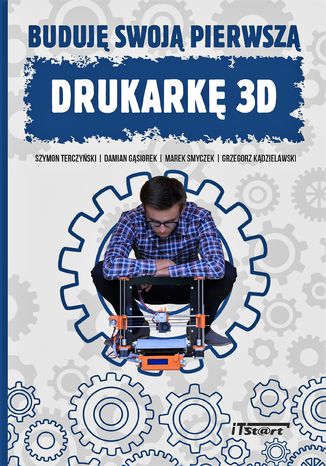
Buduję swoją pierwszą drukarkę 3D
Szymon Terczyński, Damian Gąsiorek, Marek Smyczek, Grzegorz...
Książka Buduję swoją pierwszą drukarkę 3D skierowana jest dla osób, które chcą poglądowo zapoznać się z technologiami przyrostowymi, a w szczególności technologią FDM (Fused Deposition Modeling), poznać historię technologii przyrostowych na świecie, a także dowiedzieć się jak można zbudować własną i tanią drukarkę 3D. Nie jest to podręcznik teoretyczny, skupiający się na szczegółowym opisie każdej technologii czy też współczesnej drukarki. Stanowi natomiast pełny, praktyczny przewodnik, opisujący proces budowy i użytkowania drukarek 3D na przykładzie modelu Prusa i3. Zawiera także instrukcję montażu niecodziennego projektu drukarki 3D z odzyskanych, starych napędów CD ROM. Książka ta, to również dowód i przykład jak obecnie wygląda współpraca uczelni wyższej z wybranymi szkołami średnimi (Zespół Szkół Nr1 z Piekar Śląskich oraz Śląskie Techniczne Zakłady Naukowe z Katowic). Współpraca szkół średnich z pracownikami Politechniki Śląskiej to dowód na wspieranie młodych talentów, a owocem tego jest między innymi budowa własnych drukarek, czyli urządzeń mechatronicznych, łączących konstrukcję, napędy i sterowanie. Tematyka związana z drukiem 3D jest jednym z filarów przemysłu 4.0 i coraz więcej firm poszukuje osób, które potrafią drukować modele przestrzenne. Autorzy tej książki to zespół międzypokoleniowy i interdyscyplinarny. Utalentowany uczeń Śląskich Technicznych Zakładów Naukowych z Katowic, Szymon Terczyński i jego nauczyciel mgr inż. Marek Smyczek. Pracownik Politechniki Śląskiej, również mentor i opiekun naukowy Szymona, dr hab. inż. Damian Gąsiorek prof. PŚ. Ważnym ogniwem łączącym przemysł z edukacją jest otoczenie społeczno gospodarcze, które reprezentuje wiceprezes zarządu Grupy Azoty S.A. dr Grzegorz Kądzielawski.
Detrick DeBurr
Gamification involves the process of leveraging the features of real games into real life. A gamified website has the potential to increase user engagement, ROI, and learning. This book will help you build gamified websites with PHP and jQuery by making you understand the gamification design process to implement game mechanics in practical applications.Gamified websites are very popular amongst Internet users. The gamification of a web content draws users into action to empower them and help them develop new skills. Games engage user attention into the task and each task accomplished will mean the development and enhancement of new skills. This book will help you to apply the essence of games into real word applications such as business and education.Build Gamified Websites with PHP and jQuery aims at empowering and educating the users with an educational gamified website. The book walks through the process of developing a gamified website. Through the course of the book, you will learn gamification development process. The book emphasizes on the application of game mechanics to motivate the user. You will then use the Fogg behaviour model to influence the user behaviour. By the end of the book, you will see yourself building more engaging yet simple websites based on rational principles.
Hrishikesh Andurlekar
While no game would be complete without visual effects, the ever-evolving VFX industry churns out stellar digital environments that can make your games stand out from the crowd. Build Stunning Real-time VFX with Unreal Engine 5 is here to help you boost your creativity using Niagara to make jaw-dropping particle systems backed by the power of Unreal Engine 5—without a line of code.This handy guide for VFX artists takes you through the principles and concepts of designing particle systems and design workflows, along with the architecture of Niagara, Unreal Engine 5’s VFX system. Throughout the book, you’ll build a series of mini projects that will put your particle system knowledge to the test. As you advance, you’ll cover topics such as creating your own custom modules, debugging workflows, and controlling particles with blueprints, and conclude by working on two projects that will bring everything together into a neat package.By the end of this VFX book, you’ll have a deeper understanding of particle systems, improving your skills, portfolio, and the chances of being employed by studios using Unreal Engine 5.
Carlos R. Morrison
Author Carlos R. Morrison (Staff Scientist, NASA) will empower the uninitiated reader to quickly assemble and operate a Pi3 supercomputer in the shortest possible time. The lifeblood of a supercomputer, the MPI code, is introduced early, and sample MPI code provides additional practice opportunities for you to test the effectiveness of your creation. You will learn how to configure various nodes and switches so that they can effectively communicate with each other. By the end of this book, you will have successfully built a supercomputer and the various applications related to it.
Clinton L. Jeffery
There are many reasons to build a programming language: out of necessity, as a learning exercise, or just for fun. Whatever your reasons, this book gives you the tools to succeed.You’ll build the frontend of a compiler for your language and generate a lexical analyzer and parser using Lex and YACC tools. Then you’ll explore a series of syntax tree traversals before looking at code generation for a bytecode virtual machine or native code. In this edition, a new chapter has been added to assist you in comprehending the nuances and distinctions between preprocessors and transpilers. Code examples have been modernized, expanded, and rigorously tested, and all content has undergone thorough refreshing. You’ll learn to implement code generation techniques using practical examples, including the Unicon Preprocessor and transpiling Jzero code to Unicon. You'll move to domain-specific language features and learn to create them as built-in operators and functions. You’ll also cover garbage collection.Dr. Jeffery’s experiences building the Unicon language are used to add context to the concepts, and relevant examples are provided in both Unicon and Java so that you can follow along in your language of choice.By the end of this book, you'll be able to build and deploy your own domain-specific language.
Aditya Iyengar
Elixir's functional nature and metaprogramming capabilities make it an ideal language for building web frameworks, with Phoenix being the most ubiquitous framework in the Elixir ecosystem and a popular choice for companies seeking scalable web-based products. With an ever-increasing demand for Elixir engineers, developers can accelerate their careers by learning Elixir and the Phoenix web framework. With Build Your Own Web Framework in Elixir, you’ll start by exploring the fundamental concepts of web development using Elixir. You'll learn how to build a robust web server and create a router to direct incoming requests to the correct controller. Then, you'll learn to dispatch requests to controllers to respond with clean, semantic HTML, and explore the power of Domain-Specific Languages (DSL) and metaprogramming in Elixir. You'll develop a deep understanding of Elixir's unique syntax and semantics, allowing you to optimize your code for performance and maintainability. Finally, you'll discover how to effectively test each component of your application for accuracy and performance. By the end of this book, you'll have a thorough understanding of how Elixir components are implemented within Phoenix, and how to leverage its powerful features to build robust web applications.
Buildbox 2.x Game Development. Develop & Distribute video games with Buildbox, no coding necessary!
Ty Audronis
Buildbox is an “any skill level” development platform to develop video games with no coding experience. It also exports these games to be compiled for any platform (from Windows to Mac to iOS to Android and Blackberry) all using the same graphic user interface.Using an example as a tutorial, we will relate the driving principles and you’ll see how you can implement these principles to develop any games on the platform. We begin by setting expectations and providing a brief overview of the software. But it’s not long before you “dive in” to creating your first video game. You will actually have a playable level (“world”) by the end of the second chapter.Later on, you’ll learn everything from basic graphics creation to advanced world design while you refine your first game, called “Ramblin’ Rover.” All along the way, you will see how certain functions could be used in tandem to create other types of games; hoping to spark imagination. We will follow the principles and process of monetization through ads and in-game rewards.Lastly, we will go through the process of exporting, compiling, and preparing your storefront to sell the games you will eventually create.
Andreas J Reichel
If you are a programmer, scientist, or someone interested in modern computer technology that goes beyond the typical PC, then this book will show you the outstanding possibilities of cluster computing with modern embedded systems based on ARM architecture. Whether you need a high-speed or low-cost scalable cluster for simulations or want to try something new, this book is the right guide for you.
Building a Cyber Resilient Business. A cyber handbook for executives and boards
Dr. Magda Lilia Chelly , Shamane Tan,...
With cyberattacks on the rise, it has become essential for C-suite executives and board members to step up and collectively recognize cyber risk as a top priority business risk. However, non-cyber executives find it challenging to understand their role in increasing the business’s cyber resilience due to its complex nature and the lack of a clear return on investment.This book demystifies the perception that cybersecurity is a technical problem, drawing parallels between the key responsibilities of the C-suite roles to line up with the mission of the Chief Information Security Officer (CISO).The book equips you with all you need to know about cyber risks to run the business effectively. Each chapter provides a holistic overview of the dynamic priorities of the C-suite (from the CFO to the CIO, COO, CRO, and so on), and unpacks how cybersecurity must be embedded in every business function. The book also contains self-assessment questions, which are a helpful tool in evaluating any major cybersecurity initiatives and/or investment required.With this book, you’ll have a deeper appreciation of the various ways all executives can contribute to the organization’s cyber program, in close collaboration with the CISO and the security team, and achieve a cyber-resilient, profitable, and sustainable business.
Lee Zhi Eng
In the wake of the indie game development scene, game development tools are no longer luxury items costing up to millions of dollars but are now affordable by smaller teams or even individual developers. Among these cutting-edge applications, Blender and Unity stand out from the crowd as a powerful combination that allows small-to-no budget indie developers or hobbyists alike to develop games that they have always dreamt of creating.Starting from the beginning, this book will cover designing the game concept, constructing the gameplay, creating the characters and environment, implementing game logic and basic artificial intelligence, and finally deploying the game for others to play. By sequentially working through the steps in each chapter, you will quickly master the skills required to develop your dream game from scratch.
Ludovic Dewailly
REST is an architectural style that tackles the challenges of building scalable web services. In today’s connected world, APIs have taken a central role on the web. APIs provide the fabric through which systems interact, and REST has become synonymous with APIs.The depth, breadth, and ease of use of Spring makes it one of the most attractive frameworks in the Java ecosystem. Marrying the two technologies is therefore a very natural choice.This book takes you through the design of RESTful web services and leverages the Spring Framework to implement these services. Starting from the basics of the philosophy behind REST, you’ll go through the steps of designing and implementing an enterprise-grade RESTful web service. Taking a practical approach, each chapter provides code samples that you can apply to your own circumstances.This book goes beyond the use of Spring and explores approaches to tackle resilience, security, and scalability concerns. You’ll learn techniques to deal with security in Spring and discover how to implement unit and integration test strategies.Finally, the book ends by walking you through building a Java client for your RESTful web service, along with some scaling techniques for it.
Sai S Sriparasa
This is a step-by-step, tutorial guide designed to help readers transition from beginners to more experienced developers using clear explanations. The variety of examples will help readers build, secure, and host real-time web applications. If you are a developer who wants to use PHP and MariaDB to build web applications, this book is ideal for you. Beginners can use this book to start with the basics and learn how to build and host web applications. Seasoned PHP Developers can use this book to get familiar with the new features of PHP 5.4 and 5.5, unit testing, caching, security, and performance optimization.
Anjanava Biswas, Wrick Talukdar, Matthew R. Scott,...
Gain unparalleled insights into the future of AI autonomy with this comprehensive guide to designing and deploying autonomous AI agents that leverage generative AI (GenAI) to plan, reason, and act. Written by industry-leading AI architects and recognized experts shaping global AI standards and building real-world enterprise AI solutions, it explores the fundamentals of agentic systems, detailing how AI agents operate independently, make decisions, and leverage tools to accomplish complex tasks.Starting with the foundations of GenAI and agentic architectures, you’ll explore decision-making frameworks, self-improvement mechanisms, and adaptability. The book covers advanced design techniques, such as multi-step planning, tool integration, and the coordinator, worker, and delegator approach for scalable AI agents.Beyond design, it addresses critical aspects of trust, safety, and ethics, ensuring AI systems align with human values and operate transparently. Real-world applications illustrate how agentic AI transforms industries such as automation, finance, and healthcare. With deep insights into AI frameworks, prompt engineering, and multi-agent collaboration, this book equips you to build next-generation adaptive, scalable AI agents that go beyond simple task execution and act with minimal human intervention.
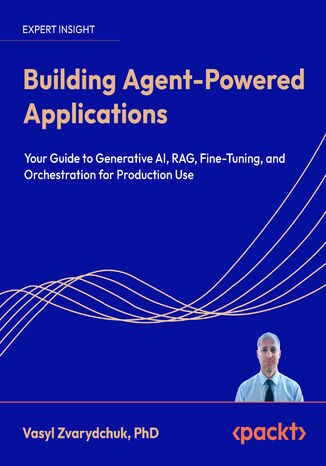
Vasyl Zvarydchuk
Large language models can produce impressive demos, but turning them into reliable products takes more than better prompts. You need to understand model behavior, know when to use retrieval or fine-tuning, structure agents correctly, and evaluate systems before deployment.Building Agent-Powered Applications gives an end-to-end engineering perspective on creating production-ready generative AI solutions. Written by Microsoft Principal AI Engineer Vasyl Zvarydchuk, it helps software engineers, data scientists, and applied AI practitioners move from concept to implementation. You’ll begin with AI, NLP, embeddings, transformers, and LLM behavior, then progress to prompt engineering, summarization, classification, extraction, reasoning, RAG, and fine-tuning.The book shows how to design agentic workflows with tools, memory, planning, orchestration, and human-in-the-loop controls. You’ll learn to evaluate quality with offline and online testing, task-specific metrics, LLM-as-a-judge methods, and responsible AI checks. Rather than treating prompting, RAG, fine-tuning, and agents as separate topics, this book shows how they work together in practice. By the end, you’ll be able to make better architectural trade-offs, reduce failure modes, and build scalable, trustworthy AI applications.*Email sign-up and proof of purchase required
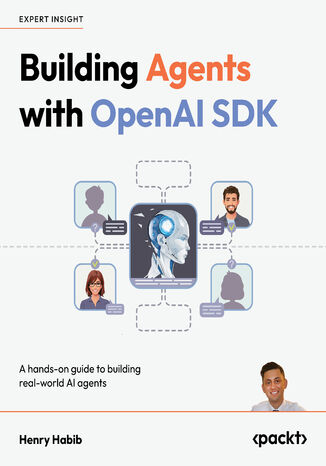
Henry Habib
Everyone’s talking about AI agents, but how do you build one that works in the real world? Not a toy demo, but an agent that solves real problems, saves time, and integrates into workflows. With vague frameworks, fragmented tooling, and endless hype, most developers are left without a clear path. The hardest part isn’t technical; it is knowing where to start.This book gives you that starting point. It’s a complete guide to building intelligent AI agents and agentic systems using the official OpenAI Agents SDK. It begins by grounding you in the core concepts, design principles, and architecture of AI agents, how they differ from other traditional systems, their advantages, and why that matters.Through practical step-by-step projects, you’ll master every feature of the SDK—tools, memory, RAG, multi-agent orchestration, tracing, handoffs, and more—while contributing to an end-to-end agent system that grows in complexity. Projects include a custom support agent, invoice and inventory assistant, health advisor, sales trainer, and data analyst, giving you production-ready skills.By the end, you’ll know how to design, build, and deploy agentic systems that interact with APIs, query databases, hand off to external systems, and drive meaningful outcomes. You won’t just understand AI agents; you’ll be ready to ship them.
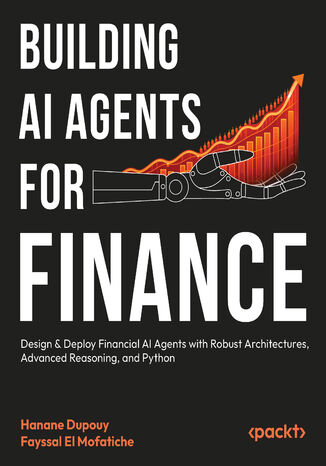
Hanane Dupouy, Fayssal El Mofatiche
AI agents are rapidly changing how financial systems analyze information, make decisions, and automate complex workflows. While many resources explain agentic AI concepts at a high level, few show how to design and deploy AI agents that work reliably in real financial environments. This book fills that gap. You will start by learning what AI agents are, how they differ from non-agentic systems, and when agentic architectures are the right choice. Next, explore core design patterns, memory management strategies, AI agents frameworks , and reasoning paradigms such as ReAct, reflection, self-consistency, LATS , and multi-agent collaboration across various architectural styles. You will apply these concepts through practical Python labs and deep-dive finance use cases, including fundamental analysis, research, trading, insurance, and compliance. Next, you will learn how to evaluate agent behavior, implement guardrails, and add tracing and observability to ensure safe and reliable operation. Finally, focus on operationalization and Responsible AI, covering cost and latency trade-offs, scaling strategies, human-in-the-loop systems, and ethical considerations required in regulated financial settings. By the end, you’ll know how to design, evaluate, and deploy finance AI agents that deliver real business value.
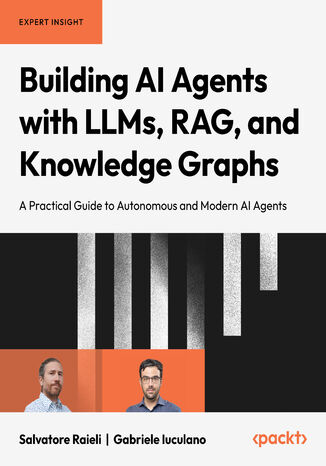
Salvatore Raieli, Gabriele Iuculano
This book addresses the challenge of building AI that not only generates text but also grounds its responses in real data and takes action. Authored by AI specialists with expertise in drug discovery and systems optimization, this guide empowers you to leverage retrieval-augmented generation (RAG), knowledge graphs, and agent-based architectures to engineer truly intelligent behavior. By combining large language models (LLMs) with up-to-date information retrieval and structured knowledge, you'll create AI agents capable of deeper reasoning and more reliable problem-solving.Inside, you'll find a practical roadmap from concept to implementation. You’ll discover how to connect language models with external data via RAG pipelines for increasing factual accuracy and incorporate knowledge graphs for context-rich reasoning. The chapters will help you build and orchestrate autonomous agents that combine planning, tool use, and knowledge retrieval to achieve complex goals. Concrete Python examples and real-world case studies reinforce each concept and show how the techniques fit together.By the end of this book, you’ll be able to build intelligent AI agents that reason, retrieve, and interact dynamically, empowering you to deploy powerful AI solutions across industries.*Email sign-up and proof of purchase required
Martin Yanev
Combining ChatGPT APIs with Python opens doors to building extraordinary AI applications. By leveraging these APIs, you can focus on the application logic and user experience, while ChatGPT’s robust NLP capabilities handle the intricacies of human-like text understanding and generation.This book is a guide for beginners to master the ChatGPT, Whisper, and DALL-E APIs by building ten innovative AI projects. These projects offer practical experience in integrating ChatGPT with frameworks and tools such as Flask, Django, Microsoft Office APIs, and PyQt.Throughout this book, you’ll get to grips with performing NLP tasks, building a ChatGPT clone, and creating an AI-driven code bug fixing SaaS application. You’ll also cover speech recognition, text-to-speech functionalities, language translation, and generation of email replies and PowerPoint presentations. This book teaches you how to fine-tune ChatGPT and generate AI art using DALL-E APIs, and then offers insights into selling your apps by integrating ChatGPT API with Stripe. With practical examples available on GitHub, the book gradually progresses from easy to advanced topics, cultivating the expertise required to develop, deploy, and monetize your own groundbreaking applications by harnessing the full potential of ChatGPT APIs.
Lucas A. Meyer
In the fast-paced world of AI, developers are constantly seeking efficient ways to integrate AI capabilities into their apps. Microsoft Semantic Kernel simplifies this process by using the GenAI features from Microsoft and OpenAI.Written by Lucas A. Meyer, a Principal Research Scientist in Microsoft’s AI for Good Lab, this book helps you get hands on with Semantic Kernel. It begins by introducing you to different generative AI services such as GPT-3.5 and GPT-4, demonstrating their integration with Semantic Kernel. You’ll then learn to craft prompt templates for reuse across various AI services and variables. Next, you’ll learn how to add functionality to Semantic Kernel by creating your own plugins. The second part of the book shows you how to combine multiple plugins to execute complex actions, and how to let Semantic Kernel use its own AI to solve complex problems by calling plugins, including the ones made by you. The book concludes by teaching you how to use vector databases to expand the memory of your AI services and how to help AI remember the context of earlier requests. You’ll also be guided through several real-world examples of applications, such as RAG and custom GPT agents.By the end of this book, you'll have gained the knowledge you need to start using Semantic Kernel to add AI capabilities to your applications.
Building AI Intensive Python Applications. Create intelligent apps with LLMs and vector databases
Rachelle Palmer, Ben Perlmutter, Ashwin Gangadhar, Nicholas...
The era of generative AI is upon us, and this book serves as a roadmap to harness its full potential. With its help, you’ll learn the core components of the AI stack: large language models (LLMs), vector databases, and Python frameworks, and see how these technologies work together to create intelligent applications.The chapters will help you discover best practices for data preparation, model selection, and fine-tuning, and teach you advanced techniques such as retrieval-augmented generation (RAG) to overcome common challenges, such as hallucinations and data leakage. You’ll get a solid understanding of vector databases, implement effective vector search strategies, refine models for accuracy, and optimize performance to achieve impactful results. You’ll also identify and address AI failures to ensure your applications deliver reliable and valuable results. By evaluating and improving the output of LLMs, you’ll be able to enhance their performance and relevance.By the end of this book, you’ll be well-equipped to build sophisticated AI applications that deliver real-world value.
Giorgio Boa, Fabio Biondi
In Building AI-Powered Apps with Angular, you'll embark on an end-to-end journey to revolutionize web development with artificial intelligence. This hands-on guide shows you how to integrate cutting-edge AI capabilities, particularly Large Language Models (LLMs) like Google Gemini and multimodal agents, directly into your Angular applications.Starting with AI/ML fundamentals and an introduction to Google Gemini using Node.js, you’ll quickly progress to building sophisticated AI features within your Angular frontend. You’ll create dynamic content, design intelligent multi-turn chat interfaces, and harness multimodal AI to analyze and generate rich media such as images and videos.The journey extends beyond the frontend. You’ll build robust backends with Angular Server-Side Rendering and Genkit, enabling seamless communication with AI models. You’ll also implement advanced search capabilities using Retrieval Augmented Generation (RAG) and Firestore and learn how to deploy your AI-powered Angular app to the cloud.By the end of the book, you'll have the skills to design, develop, and deploy innovative and intelligent Angular applications that leverage the full potential of AI.