
Informatyka
Zajrzyj do kategorii Informatyka w księgarni internetowej Ebookpoint. Znajdziesz tutaj bestsellerowe książki, ebooki i kursy video z branży IT. Sięgnij po najlepszą literaturę dla specjalistów i rozwijaj doświadczenie, które już posiadasz, lub rozpocznij swoją przygodę z programowaniem, cyberbezpieczeństwem lub grafiką komputerową. Pogłębiaj swoją wiedzę tak, jak Ci wygodnie - z tradycyjną książką, wygodnym ebookiem lub nowoczesnym videokursem. Sprawdź, jakie tytuły znajdziesz w kategorii Informatyka!
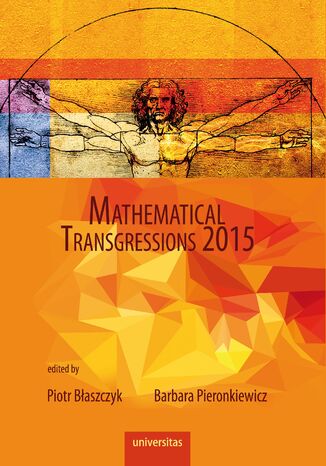
Mathematical Transgressions 2015
praca zbiorowa
During the last decades of the 20th century, we have entered the Digital Era. The Third Technological Revolution has an enormous socioeconomic impact. It affects modern science, including mathematics. It also determines the reforms of national education systems. Mathematicians seek to focus on the so-called concrete mathematics. They explore finite and discrete structures, rather than infinite and continuous ones. They prefer to develop combinatorics and algorithmic thinking, rather than contribute to Bourbaki’s edifice. Mathematics itself is expanding its boundaries by merging with computer science, while symbolic computations as well as computer-assisted and automated proofs are transforming it into a quasi-empirical science. We should agree that mathematics is no longer the Queen of the Sciences; while it is still believed to be the basis of modern education, its role needs to be re-defined. It is necessary to address this challenge. The first step in this direction consists of the adoption of a new perspective. The Latin word transgressio means an act that goes beyond generally accepted boundaries. This monograph draws together papers written by mathematicians, educators, pedagogues, psychologists, and philosophers. Their aim is to identify a new role of mathematics and mathematics education in the modern world. P.B.
Mercury Learning and Information, Paul Turner, Justine...
This book is designed for students, faculty, and professionals, describing the role of mathematics in economics and business. Starting with the basics of numbers and advancing into complex topics like hyperreal numbers and set theory, the book builds a strong foundation of mathematical concepts. Python code is used throughout to illustrate problems numerically, making the material accessible and practical.Readers will learn about linear simultaneous equations for market equilibrium analysis and the mechanics of matrices for solving larger systems. The book covers calculus, with applications in economics, including profit maximization and factor optimization, and introduces infinitesimal methods. Chapters on differential and difference equations reveal their importance in analyzing dynamic systems, all illuminated through practical examples and images from economics and business.The course begins with fundamental mathematical concepts, advancing to complex applications in economics and business. By integrating computational understanding with Python code, the book ensures learners can tackle real-world problems. This structured approach provides the tools needed for economic analysis and business decision-making, making it an invaluable resource for anyone in these fields.
Mathematics for Business. Explore Essential Mathematical Concepts and Techniques for Decision Making
Mercury Learning and Information, Gary Bronson, Richard...
This course provides a comprehensive understanding of quantitative methods essential for economic forecasting, resource allocation, portfolio analysis, inventory management, data-mining, and addressing social and climate challenges. Starting with foundational topics like finite mathematics and the mathematics of finance, it progresses to differential calculus, optimization, and curve fitting. These concepts are vital for solving contemporary business problems.Learners will explore algebra, finite math, finance mathematics, calculus, optimization techniques, and curve fitting, applying these methods to realistic business scenarios. Topics include cash flow, amortization, interest, loans, annuities, revenue/cost models, break-even analysis, inventory control, and econometrics. Each section includes extensive examples and exercises, reinforced by key terms and concepts, making the material accessible and practical.The course begins with basic mathematical concepts and advances through increasingly complex topics. By the end, learners will have the tools to tackle various business problems using quantitative methods, making this course invaluable for anyone in the business field. This structured approach ensures both theoretical knowledge and practical application, preparing learners for real-world challenges.
Penny de Byl
Mathematics is an essential skill when it comes to graphics and game development, particularly if you want to understand the generation of real-time computer graphics and the manipulation of objects and environments in a detailed way. Python, together with Pygame and PyOpenGL, provides you with the opportunity to explore these features under the hood, revealing how computers generate and manipulate 3D environments. Mathematics for Game Programming and Computer Graphics is an exhaustive guide to getting “back to the basics” of mathematics, using a series of problem-based, practical exercises to explore ideas around drawing graphic lines and shapes, applying vectors and vertices, constructing and rendering meshes, and working with vertex shaders. By leveraging Python, Pygame, and PyOpenGL, you’ll be able to create your own mathematics-based engine and API that will be used throughout to build applications. By the end of this graphics focussed book, you’ll have gained a thorough understanding of how essential mathematics is for creating, rendering, and manipulating 3D virtual environments and know the secrets behind today’s top graphics and game engines.
MATLAB for Machine Learning. Practical examples of regression, clustering and neural networks
Giuseppe Ciaburro
MATLAB is the language of choice for many researchers and mathematics experts for machine learning. This book will help you build a foundation in machine learning using MATLAB for beginners.You’ll start by getting your system ready with t he MATLAB environment for machine learning and you’ll see how to easily interact with the Matlab workspace. We’ll then move on to data cleansing, mining and analyzing various data types in machine learning and you’ll see how to display data values on a plot. Next, you’ll get to know about the different types of regression techniques and how to apply them to your data using the MATLAB functions. You’ll understand the basic concepts of neural networks and perform data fitting, pattern recognition, and clustering analysis. Finally, you’ll explore feature selection and extraction techniques for dimensionality reduction for performance improvement. At the end of the book, you will learn to put it all together into real-world cases covering major machine learning algorithms and be comfortable in performing machine learning with MATLAB.
Sandro Tosi
Providing appealing plots and graphs is an essential part of various fields such as scientific research, data analysis, and so on. Matplotlib, the Python 2D plotting library, is used to produce publication-quality figures in a variety of hardcopy formats and interactive environments across platforms. This book explains creating various plots, histograms, power spectra, bar charts, error charts, scatter-plots and much more using the powerful Matplotlib library to get impressive out-of-the-box results.This book gives you a comprehensive tour of the key features of the Matplotlib Python 2D plotting library, right from the simplest concepts to the most advanced topics. You will discover how easy it is to produce professional-quality plots when you have this book to hand.The book introduces the library in steps. First come the basics: introducing what the library is, its important prerequisites (and terminology), installing and configuring Matplotlib, and going through simple plots such as lines, grids, axes, and charts. Then we start with some introductory examples, and move ahead by discussing the various programming styles that Matplotlib allows, and several key features.Further, the book presents an important section on embedding applications. You will be introduced to three of the best known GUI libraries 'GTK+, Qt, and wxWidgets' and presented with the steps to implement to include Matplotlib in an application written using each of them. You will learn through an incremental approach: from a simple example that presents the peculiarities of the GUI library, to more complex ones, using GUI designer tools.Because the Web permeates all of our activities, a part of the book is dedicated to showing how Matplotlib can be used in a web environment, and another section focuses on using Matplotlib with common Python web frameworks, namely, Pylons and Django. Last, but not least, you will go through real-world examples, where you will see some real situations in which you can use Matplotlib.
Matura z informatyki. Zbiór zadań
Przemysław Głowacz, Waldemar Walczak
Matura z informatyki. Zbiór zadań to propozycja dla każdego, kto przygotowuje się do egzaminu dojrzałości. Ten obszerny zbiór zróżnicowanych zadań, podzielonych na zestawy i opatrzonych odpowiedziami, pozwala przygotować się do matury z informatyki w zakresie rozwiązywania problemów logicznych, przetwarzania danych występujących w różnych postaciach (między innymi ciągów, tablic), szyfrowania danych i wielu innych zagadnień, których można się spodziewać na egzaminie maturalnym. Dużym walorem książki jest obudowanie zadań krótkimi fabułami, które sprawiają, że Czytelnik nie ma do czynienia jedynie z danymi, poleceniami i kodem, lecz także zyskuje poczucie, że konfrontuje się z faktycznymi problemami, z jakimi mógłby się zetknąć także poza egzaminem. To kolejna w ofercie wydawnictwa Helion pozycja, dzięki której maturę z informatyki można zdać na najwyższym poziomie! Matura z informatyki. Zbiór zadań to: zestaw starannie opracowanych autorskich zadań okazja do gruntownego przećwiczenia umiejętności kompletne repetytorium maturalne zbiór ciekawych wyzwań logicznych
Grady Brett Beaubouef
Using packaged software for Customer Relationship Management or Enterprise Resource Planning is often seen as a sure-fire way to reduce costs, refocus scarce resources, and increase returns on investment. However, research shows that the majority of packaged or Commercial Off-The-Shelf (COTS) implementations fail to provide this value due to the implementation approach taken.Authored by Grady Brett Beaubouef, who has over fifteen years of packaged software implementation experience, this book will help you define an effective implementation strategy for your packaged software investment.The book focuses on Commercial Off-The-Shelf (COTS) implementations, and helps you to successfully implement packaged software. Using a step-by-step approach, it begins with an assessment of the limitations of current implementation methods for packaged software. It then helps you to analyze your requirements and offers 10 must-know principles gleaned from real-world packaged software implementations. These 10 principles cover how to maximize enhancements and minimize customizations, focus on business results, and negotiate for success, and so on. You will learn how to best leverage these principles as part of your implementation. As you progress through the book, you will learn how to put packaged software into action with forethought, planning, and proper execution. Doing so will lead to reductions in implementation costs, customizations, and development time.