
Informatyka
Zajrzyj do kategorii Informatyka w księgarni internetowej Ebookpoint. Znajdziesz tutaj bestsellerowe książki, ebooki i kursy video z branży IT. Sięgnij po najlepszą literaturę dla specjalistów i rozwijaj doświadczenie, które już posiadasz, lub rozpocznij swoją przygodę z programowaniem, cyberbezpieczeństwem lub grafiką komputerową. Pogłębiaj swoją wiedzę tak, jak Ci wygodnie - z tradycyjną książką, wygodnym ebookiem lub nowoczesnym videokursem. Sprawdź, jakie tytuły znajdziesz w kategorii Informatyka!
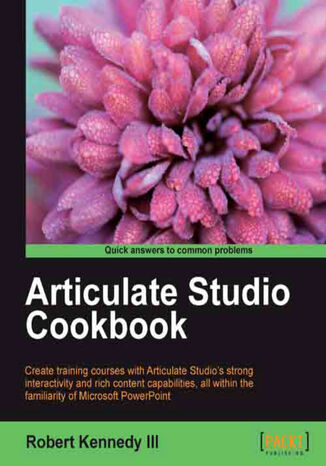
Articulate Studio Cookbook. Go from Studio newbie to Studio guru
Robert Kennedy
More and more companies find they need to build their training courses internally. They are turning to tools like Articulate Studio because it is easy to use and doesn't have a steep learning curve. If you are familiar with Microsoft PowerPoint in any way, you should feel right at home with Articulate Studio.Articulate Studio Cookbook will get you ready to add Articulate Studio to your enterprise toolkit. This book gives you detailed yet simple steps to complete your training course. By following the clear steps in each chapter, you will gain an understanding of the software but also be able to complete specific tasks and common activities.The good thing about this book is that you can start anywhere and get the information that you need for a specific activity. Cross-references are provided if there is a skill located elsewhere that you need to complete a task.It can be frustrating to pick up a new piece of software and not know where to begin. With Articulate Studio, there is a whole suite of software to work with. You need to know how to work with Presenter, Engage, Quizmaker and Encoder to make great Articulate courses. Then, you'll need to know how to put them all together in a way that makes a professional looking, cohesive and smooth-flowing course. We'll make it easy to follow step by step until you have a professional course.Articulate Studio Cookbook will help you go from Studio newbie to Studio guru. Dive in and choose your recipe.
Artificial Intelligence and Expert Systems. Techniques and Applications for Problem Solving
Mercury Learning and Information, I. Gupta, G....
This book covers current AI applications and techniques for solving problems and accomplishing tasks. It introduces branches of AI such as formal logic, reasoning, knowledge engineering, expert systems, neural networks, and fuzzy logic. It emphasizes expert systems, with sections on state space search, knowledge engineering, neural networks, fuzzy logic, and Prolog.It begins with an introduction to AI and its applications, setting the stage for foundational concepts. Readers are guided through state space search and heuristic search strategies, crucial for problem-solving in AI. The focus shifts to expert systems, covering their development life cycle, knowledge acquisition, and representation, providing a deep dive into emulating human decision-making.Later chapters cover neural networks and the learning process, essential for creating adaptive systems. Sections on fuzzy logic and fuzzy systems introduce methods for handling uncertainty in AI. Final chapters on programming in logic and advanced Prolog offer practical techniques for AI solutions. This approach equips readers with the skills to apply AI in various domains, enhancing their problem-solving abilities and understanding of intelligent systems.
Zsolt Nagy
Machine learning and neural networks are pillars on which you can build intelligent applications. Artificial Intelligence and Machine Learning Fundamentals begins by introducing you to Python and discussing AI search algorithms. You will cover in-depth mathematical topics, such as regression and classification, illustrated by Python examples.As you make your way through the book, you will progress to advanced AI techniques and concepts, and work on real-life datasets to form decision trees and clusters. You will be introduced to neural networks, a powerful tool based on Moore's law.By the end of this book, you will be confident when it comes to building your own AI applications with your newly acquired skills!
Artificial Intelligence Basics. A Self-Teaching Introduction
Mercury Learning and Information, N. Gupta, R....
This book is designed as a self-teaching introduction to the fundamental concepts of artificial intelligence (AI). It begins with the history of AI, the Turing test, and early applications, providing a strong foundation. Later chapters cover the basics of searching, game playing, and knowledge representation. The journey continues with detailed explorations of expert systems and machine learning, equipping readers with essential AI techniques.As the course progresses, you will delve into separate programming chapters on Prolog and Python, learning how to implement AI concepts in these languages. These chapters offer practical coding experience, enhancing your understanding of AI programming. The book culminates with a comprehensive chapter on AI machines and robotics, showcasing numerous modern applications and providing a glimpse into the future of AI technology.Understanding these AI concepts is crucial as they form the basis of many modern technologies and applications. This book ensures a smooth transition from a beginner to a proficient AI practitioner, equipped with both theoretical knowledge and practical skills. By the end of the book, you will have a thorough understanding of AI's history, core principles, and practical implementations, ready to apply this knowledge to real-world problems and projects.
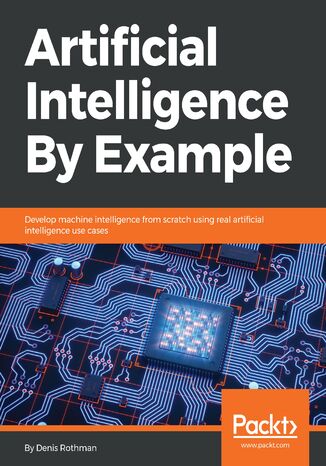
Denis Rothman, Nicolas GUET, Jérémie ROTHMAN
Artificial intelligence has the potential to replicate humans in every field. Artificial Intelligence By Example serves as a starting point for you to understand how AI is built, with the help of intriguing examples and case studies.Artificial Intelligence By Example will make you an adaptive thinker and help you apply concepts to real-life scenarios. Using some of the most interesting AI examples, right from a simple chess engine to a cognitive chatbot, you will learn how to tackle the machine you are competing with. You will study some of the most advanced machine learning models, understand how to apply AI to blockchain and IoT, and develop emotional quotient in chatbots using neural networks.You will move on to designing AI solutions in a simple manner rather than get confused by complex architectures and techniques. This comprehensive guide will be a starter kit for you to develop AI applications on your own.By the end of this book, you will have understood the fundamentals of AI and worked through a number of case studies that will help you develop your business vision.
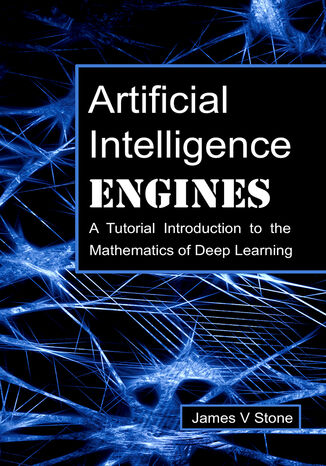
Artificial Intelligence Engines. A Tutorial Introduction to the Mathematics of Deep Learning
James V Stone
This book is a comprehensive guide to the mathematics behind artificial intelligence engines, taking readers from foundational concepts to advanced applications. It begins with an introduction to artificial neural networks, exploring topics like perceptrons, linear associative networks, and gradient descent. Practical examples accompany each chapter, making complex mathematical principles accessible, even for those with limited prior knowledge.The book's detailed structure covers key algorithms like backpropagation, Hopfield networks, and Boltzmann machines, advancing to deep restricted Boltzmann machines, variational autoencoders, and convolutional neural networks. Modern topics such as generative adversarial networks, reinforcement learning, and capsule networks are explored in depth. Each section connects theory to real-world AI applications, helping readers understand how these techniques are used in practice.Ideal for students, researchers, and AI enthusiasts, the book balances theoretical depth with practical insights. Basic mathematical knowledge or foundation is recommended, allowing readers to fully engage with the content. This book serves as an accessible yet thorough resource for anyone eager to dive deeper into artificial intelligence and machine learning.
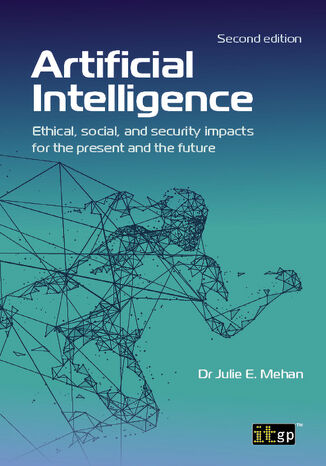
Artificial Intelligence. Ethical, social, and security impacts for the present and the future
IT Governance Publishing, Dr. Julie E. Mehan
This book offers an in-depth exploration of Artificial Intelligence (AI), from its origins to the ethical and societal challenges it presents today. It provides a comprehensive understanding of AI’s impact on human interaction, collaboration, privacy, and security. Through analyzing both opportunities and risks, the book emphasizes the ethical concerns surrounding AI, such as bias, privacy violations, and security threats.Chapters explore AI’s transformative role in cybersecurity, misinformation, and human-machine collaboration, highlighting its implications for job markets and human relationships. Real-world examples illustrate how AI can drive progress or cause harm. The ethical dilemmas around AI, including its use in surveillance and decision-making, are thoroughly examined, presenting challenges central to modern technology.Looking ahead, the book offers a forward-thinking perspective on AI’s future, discussing emerging trends and the need for responsible policy-making. It concludes by addressing how society can prepare for AI’s continued growth, offering strategies for navigating the evolving landscape. With practical insights and deep analysis, this book helps readers grasp AI’s profound implications for our future.
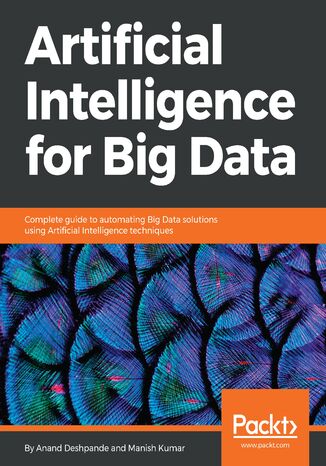
Anand Deshpande, Manish Kumar, Albenzo Coletta, Giancarlo...
In this age of big data, companies have larger amount of consumer data than ever before, far more than what the current technologies can ever hope to keep up with. However, Artificial Intelligence closes the gap by moving past human limitations in order to analyze data.With the help of Artificial Intelligence for big data, you will learn to use Machine Learning algorithms such as k-means, SVM, RBF, and regression to perform advanced data analysis. You will understand the current status of Machine and Deep Learning techniques to work on Genetic and Neuro-Fuzzy algorithms. In addition, you will explore how to develop Artificial Intelligence algorithms to learn from data, why they are necessary, and how they can help solve real-world problems.By the end of this book, you'll have learned how to implement various Artificial Intelligence algorithms for your big data systems and integrate them into your product offerings such as reinforcement learning, natural language processing, image recognition, genetic algorithms, and fuzzy logic systems.