
Informatyka
Puppet: Mastering Infrastructure Automation
Jaime Soriano Pastor
Puppet is a configuration management tool that allows you to automate all your IT configurations, giving you control. It was written for and by system administrators to manage large numbers of systems efficiently and prevent configuration drifts. Puppet gives you control of what you do to each node, when you do it, and how you do it.This Learning Path will take you from the basics of Puppet to extending it and then mastering it. We will start off with a primer on Puppet, its installation and get a sneak peek under its hood. We will then move on to designing and deploying your Puppet architecture, learning best practices for writing reusable and maintainable code, and executing, testing, and deploying Puppet across your systems. Finally, we will deal with problems of scale and exceptions in your code, automate workflows, and support multiple developers working simultaneously.This course is based on the following books: 1)Puppet 4 Essentials - Second Edition 2)Extending Puppet - Second Edition 3)Mastering Puppet - Second Edition
pytest Quick Start Guide. Write better Python code with simple and maintainable tests
Bruno Oliveira
Python's standard unittest module is based on the xUnit family of frameworks, which has its origins in Smalltalk and Java, and tends to be verbose to use and not easily extensible.The pytest framework on the other hand is very simple to get started, but powerful enough to cover complex testing integration scenarios, being considered by many the true Pythonic approach to testing in Python.In this book, you will learn how to get started right away and get the most out of pytest in your daily work?ow, exploring powerful mechanisms and plugins to facilitate many common testing tasks. You will also see how to use pytest in existing unittest-based test suites and will learn some tricks to make the jump to a pytest-style test suite quickly and easily.
Mike Ohlson de Fine
Python is a great object-oriented and interactive programming language that lets you develop graphics, both static and animated, using built-in vector graphics functions that are provided with Python.Python 2.6 Graphics Cookbook is a collection of straightforward recipes and illustrative screenshots for creating and animating graphic objects using the Python language. This book makes the process of developing graphics interesting and entertaining by working in a graphic workspace without the burden of mastering complicated language definitions and opaque examples.If you choose to work through all the recipes from the beginning, you will learn to install Python and create basic programs for making lines and shapes using the built-in Tkinter module. The confusing topic of color manipulation is explored in detail using existing Python tools as well as some new tools in the recipes. Next you will learn to manipulate font size, color, and placement of text as placing text exactly where you want on a screen can be tricky because font height, inter-character spacing, and text window dimensions all interfere with each other. Then you will learn how to animate graphics, for example having more than one independent graphic object co-exist and interact using various Python methods.You will also learn how you can work with raster images, such as converting their formats using the Python Imaging Library. Next you will learn how you can combine vector images with raster images so that you can animate the raster images with ease. You will also walk through a set of recipes with the help of which you can handle and manipulate blocks of raw data that may be hundreds of megabytes in size using datastreams, files, and hard drives. You will also learn how you can use Inkscape to dismantle existing images and use parts of them for your own graphics and Python programs. At the end of the book you will learn how you can create GUIs for different purposes.
Mercury Learning and Information, Oswald Campesato
This book bridges the gap between theoretical knowledge and practical application in Python programming, machine learning, and using ChatGPT-4 in data science. It starts with an introduction to Pandas for data manipulation and analysis. The book then explores various machine learning classifiers, from kNN to SVMs. Later chapters cover GPT-4's capabilities, enhancing linear regression analysis, and using ChatGPT in data visualization, including AI apps, GANs, and DALL-E.The journey begins with mastering Pandas and machine learning fundamentals. It progresses to applying GPT-4 in linear regression and machine learning classifiers. The final chapters focus on using ChatGPT for data visualization, making complex results accessible and understandable.Understanding these concepts is crucial for modern data scientists. This book transitions readers from basic Python programming to advanced applications of ChatGPT-4 in data science. Companion files with source code, datasets, and figures enhance learning, making this an essential resource for mastering Python, machine learning, and AI-driven data visualization.
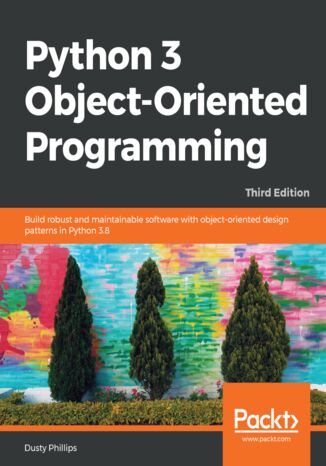
Dusty Phillips
Object-oriented programming (OOP) is a popular design paradigm in which data and behaviors are encapsulated in such a way that they can be manipulated together. This third edition of Python 3 Object-Oriented Programming fully explains classes, data encapsulation, and exceptions with an emphasis on when you can use each principle to develop well-designed software.Starting with a detailed analysis of object-oriented programming, you will use the Python programming language to clearly grasp key concepts from the object-oriented paradigm. You will learn how to create maintainable applications by studying higher level design patterns. The book will show you the complexities of string and file manipulation, and how Python distinguishes between binary and textual data. Not one, but two very powerful automated testing systems, unittest and pytest, will be introduced in this book. You'll get a comprehensive introduction to Python's concurrent programming ecosystem.By the end of the book, you will have thoroughly learned object-oriented principles using Python syntax and be able to create robust and reliable programs confidently.
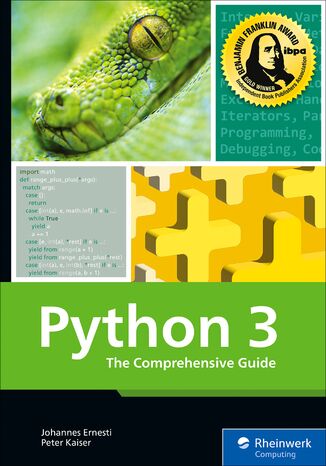
Python 3. The Comprehensive Guide
Rheinwerk Publishing, Inc, Johannes Ernesti, Peter Kaiser
This in-depth guide to Python 3 begins by helping readers install the language and understand its core syntax through interactive exploration. Early chapters cover variables, control structures, functions, and data types like lists, tuples, dictionaries, and sets. Readers then move into file handling, error management, and object-oriented programming, building a solid foundation for real-world development.As the journey continues, the book introduces advanced concepts including decorators, generators, type hints, structural pattern matching, and context managers. It thoroughly explores the Python standard library, with practical applications in math, file systems, logging, regular expressions, parallel processing, and debugging. Readers also learn how to manage packages, virtual environments, and distributions.Later chapters shift to applied development—building GUIs with tkinter and PySide6, creating web applications with Django, and working with scientific tools like NumPy, pandas, and SciPy. The book concludes with insights on using alternative interpreters, localization, and migrating from Python 2 to 3. This resource grows with the reader, from basics to expert-level Python programming.
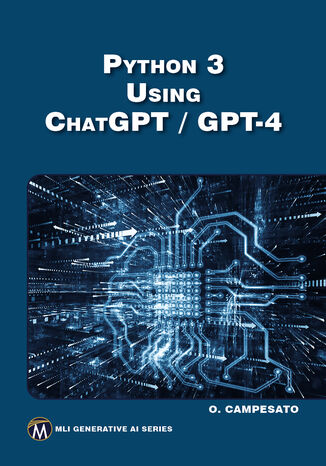
Python 3 Using ChatGPT / GPT-4. Harnessing AI for Efficient Python Programming
Mercury Learning and Information, Oswald Campesato
This book is for people who want to learn Python 3 and how to use ChatGPT with Python. It starts with an introduction to Python programming, covering data types, number formatting, Unicode handling, and text manipulation. The book then covers loops, conditional logic, reserved words, user input, exception management, and command-line arguments.The journey continues into Generative AI, discussing its distinction from Conversational AI. Popular platforms like ChatGPT and GPT-4 are explored, along with their strengths, weaknesses, and potential applications. The book shows how to generate Python 3 code samples via ChatGPT using the “Code Interpreter” plugin.Understanding these concepts is crucial for navigating Python and AI. This book transitions readers from basic Python programming to advanced AI applications, blending theory with practical skills. Companion files with code samples and figures enhance learning, making this an essential resource for mastering Python and ChatGPT.
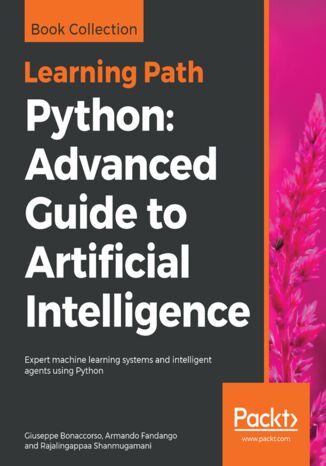
Giuseppe Bonaccorso, Rajalingappaa Shanmugamani
This Learning Path is your complete guide to quickly getting to grips with popular machine learning algorithms. You'll be introduced to the most widely used algorithms in supervised, unsupervised, and semi-supervised machine learning, and learn how to use them in the best possible manner. Ranging from Bayesian models to the MCMC algorithm to Hidden Markov models, this Learning Path will teach you how to extract features from your dataset and perform dimensionality reduction by making use of Python-based libraries. You'll bring the use of TensorFlow and Keras to build deep learning models, using concepts such as transfer learning, generative adversarial networks, and deep reinforcement learning. Next, you'll learn the advanced features of TensorFlow1.x, such as distributed TensorFlow with TF clusters, deploy production models with TensorFlow Serving. You'll implement different techniques related to object classification, object detection, image segmentation, and more. By the end of this Learning Path, you'll have obtained in-depth knowledge of TensorFlow, making you the go-to person for solving artificial intelligence problemsThis Learning Path includes content from the following Packt products:• Mastering Machine Learning Algorithms by Giuseppe Bonaccorso• Mastering TensorFlow 1.x by Armando Fandango• Deep Learning for Computer Vision by Rajalingappaa Shanmugamani