
Informatyka
Scala:Applied Machine Learning. Master the art of Machine Learning in Scala
Patrick R. Nicolas, Alex Kozlov, Pascal Bugnion
This Learning Path aims to put the entire world of machine learning with Scala in front of you. Scala for Data Science, the first module in this course, is a tutorial guide that provides tutorials on some of the most common Scala libraries for data science, allowing you to quickly get up to speed building data science and data engineering solutions.The second course, Scala for Machine Learning guides you through the process of building AI applications with diagrams, formal mathematical notation, source code snippets, and useful tips. A review of the Akka framework and Apache Spark clusters concludes the tutorial.The next module, Mastering Scala Machine Learning, is the final step in this course. It will take your knowledge to next level and help you use the knowledge to build advanced applications such as social media mining, intelligent news portals, and more. After a quick refresher on functional programming concepts using REPL, you will see some practical examples of setting up the development environment and tinkering with data. We will then explore working with Spark and MLlib using k-means and decision trees.By the end of this course, you will be a master at Scala machine learning and have enough expertise to be able to build complex machine learning projects using Scala.This Learning Path combines some of the best that Packt has to offer in one complete, curated package. It includes content from the following Packt products:? Scala for Data Science, Pascal Bugnion? Scala for Machine Learning, Patrick Nicolas? Mastering Scala Machine Learning, Alex Kozlov
Pacifique Linjanja
In this book, Pacifique Linjanja, a globally recognized software engineer and open-source contributor, shares his deep technical expertise and practical insights from his extensive experience delivering enterprise-level applications to unpack the full potential of NestJS, the cutting-edge Node.js framework.This book covers the core concepts, design patterns, and best practices for building scalable, high-performance applications with NestJS. You’ll learn REST API and GraphQL implementations, harness the power of microservices, and explore real-world case studies, including e-commerce, social networking, and ERP systems. The chapters provide step-by-step guidance for setting up your development environment with TypeScript and npm, structuring projects effectively, and using the Apollo Federation architecture to create efficient GraphQL APIs. This book offers hands-on guidance for testing and debugging APIs, handling exceptions, and validating data using pipes and guards, all while helping you build a complete NestJS application from scratch.By the end, you'll be ready to apply DevOps principles for continuous integration and deployment, as well as secure your NestJS applications using advanced techniques.*Email sign-up and proof of purchase required
Jason Myerscough
Azure Data Explorer (ADX) enables developers and data scientists to make data-driven business decisions. This book will help you rapidly explore and query your data at scale and secure your ADX clusters.The book begins by introducing you to ADX, its architecture, core features, and benefits. You'll learn how to securely deploy ADX instances and navigate through the ADX Web UI, cover data ingestion, and discover how to query and visualize your data using the powerful Kusto Query Language (KQL). Next, you'll get to grips with KQL operators and functions to efficiently query and explore your data, as well as perform time series analysis and search for anomalies and trends in your data. As you progress through the chapters, you'll explore advanced ADX topics, including deploying your ADX instances using Infrastructure as Code (IaC). The book also shows you how to manage your cluster performance and monthly ADX costs by handling cluster scaling and data retention periods. Finally, you'll understand how to secure your ADX environment by restricting access with best practices for improving your KQL query performance.By the end of this Azure book, you'll be able to securely deploy your own ADX instance, ingest data from multiple sources, rapidly query your data, and produce reports with KQL and Power BI.
Scales of Banach Spaces, Theory of Interpolation and their Applications
Łukasz Dawidowski
Celem niniejszej monografii jest omówienie teorii skal przestrzeni Banacha oraz teorii interpolacji wraz z podaniem przykładów ich zastosowań. W pierwszej kolejności opisano teoretyczne podstawy teorii interpolacji. Podano definicje oraz podstawowe twierdzenia dotyczące konstrukcji przestrzeni interpolacyjnych (interpolacja rzeczywista i zespolona). Druga, główna, część monografii przedstawia definicję potęg ułamkowych operatorów, w szczególności dodatnich operatorów sektorialnych. Zaprezentowano także ich zastosowanie do konstrukcji skal przestrzeni Banacha, które jako główny obiekt badań są przykładem przestrzeni interpolacyjnych. W pracy zamieszczono również charakteryzację skal przestrzeni Banacha, która służy jako podstawa teoretyczna do opisu zastosowań tej teorii. W trzeciej części pokazano wykorzystanie podanej wcześniej teorii do badania „zachowań” operatorów na różnych poziomach skali. Udowodniono twierdzenia dotyczące operatorów domkniętych oraz operatorów sektorialnych. Następnie opisano konkretne równania cząstkowe, w rozwiązywaniu których można zastosować wspomnianą teorię.
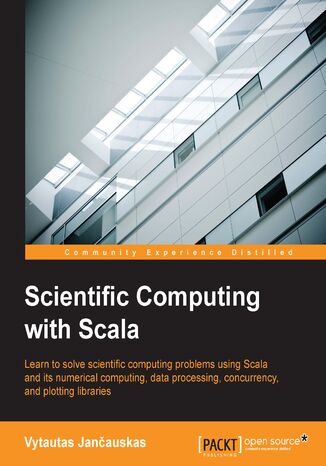
Vytautas Jancauskas
Scala is a statically typed, Java Virtual Machine (JVM)-based language with strong support for functional programming. There exist libraries for Scala that cover a range of common scientific computing tasks – from linear algebra and numerical algorithms to convenient and safe parallelization to powerful plotting facilities. Learning to use these to perform common scientific tasks will allow you to write programs that are both fast and easy to write and maintain.We will start by discussing the advantages of using Scala over other scientific computing platforms. You will discover Scala packages that provide the functionality you have come to expect when writing scientific software. We will explore using Scala's Breeze library for linear algebra, optimization, and signal processing. We will then proceed to the Saddle library for data analysis. If you have experience in R or with Python's popular pandas library you will learn how to translate those skills to Saddle. If you are new to data analysis, you will learn basic concepts of Saddle as well. Well will explore the numerical computing environment called ScalaLab. It comes bundled with a lot of scientific software readily available. We will use it for interactive computing, data analysis, and visualization. In the following chapters, we will explore using Scala's powerful parallel collections for safe and convenient parallel programming. Topics such as the Akka concurrency framework will be covered. Finally, you will learn about multivariate data visualization and how to produce professional-looking plots in Scala easily. After reading the book, you should have more than enough information on how to start using Scala as your scientific computing platform
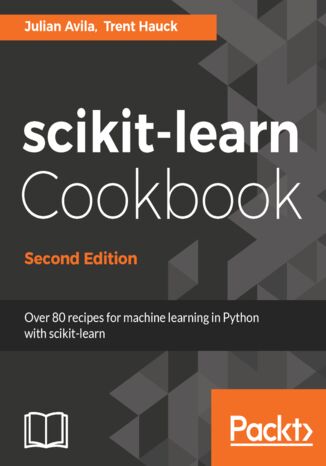
Julian Avila, Trent Hauck
Python is quickly becoming the go-to language for analysts and data scientists due to its simplicity and flexibility, and within the Python data space, scikit-learn is the unequivocal choice for machine learning. This book includes walk throughs and solutions to the common as well as the not-so-common problems in machine learning, and how scikit-learn can be leveraged to perform various machine learning tasks effectively.The second edition begins with taking you through recipes on evaluating the statistical properties of data and generates synthetic data for machine learning modelling. As you progress through the chapters, you will comes across recipes that will teach you to implement techniques like data pre-processing, linear regression, logistic regression, K-NN, Naïve Bayes, classification, decision trees, Ensembles and much more. Furthermore, you’ll learn to optimize your models with multi-class classification, cross validation, model evaluation and dive deeper in to implementing deep learning with scikit-learn. Along with covering the enhanced features on model section, API and new features like classifiers, regressors and estimators the book also contains recipes on evaluating and fine-tuning the performance of your model. By the end of this book, you will have explored plethora of features offered by scikit-learn for Python to solve any machine learning problem you come across.
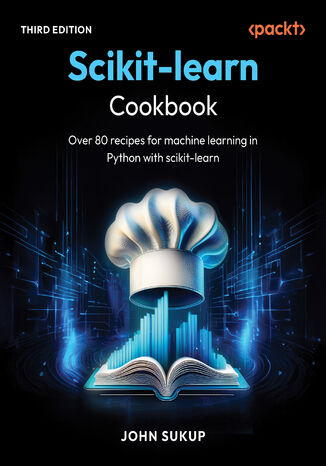
John Sukup
Trusted by data scientists, ML engineers, and software developers alike, scikit-learn offers a versatile, user-friendly framework for implementing a wide range of ML algorithms, enabling the efficient development and deployment of predictive models in real-world applications. This third edition of scikit-learn Cookbook will help you master ML with real-world examples and scikit-learn 1.5 features.This updated edition takes you on a journey from understanding the fundamentals of ML and data preprocessing, through implementing advanced algorithms and techniques, to deploying and optimizing ML models in production. Along the way, you’ll explore practical, step-by-step recipes that cover everything from feature engineering and model selection to hyperparameter tuning and model evaluation, all using scikit-learn.By the end of this book, you’ll have gained the knowledge and skills needed to confidently build, evaluate, and deploy sophisticated ML models using scikit-learn, ready to tackle a wide range of data-driven challenges.*Email sign-up and proof of purchase required
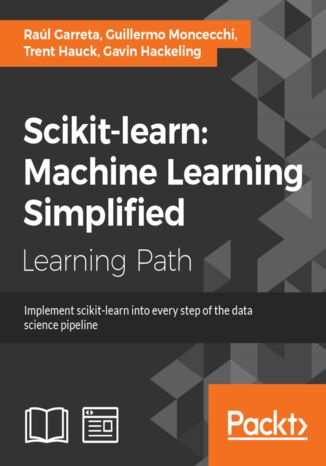
Guillermo Moncecchi, Raul G Tompson, Trent Hauck,...
Machine learning, the art of creating applications that learn from experience and data, has been around for many years. Python is quickly becoming the go-to language for analysts and data scientists due to its simplicity and flexibility; moreover, within the Python data space, scikit-learn is the unequivocal choice for machine learning. The course combines an introduction to some of the main concepts and methods in machine learning with practical, hands-on examples of real-world problems. The course starts by walking through different methods to prepare your data—be it a dataset with missing values or text columns that require the categories to be turned into indicator variables. After the data is ready, you'll learn different techniques aligned with different objectives—be it a dataset with known outcomes such as sales by state, or more complicated problems such as clustering similar customers. Finally, you'll learn how to polish your algorithm to ensure that it's both accurate and resilient to new datasets. You will learn to incorporate machine learning in your applications. Ranging from handwritten digit recognition to document classification, examples are solved step-by-step using scikit-learn and Python. By the end of this course you will have learned how to build applications that learn from experience, by applying the main concepts and techniques of machine learning.