
Informatyka
Zajrzyj do kategorii Informatyka w księgarni internetowej Ebookpoint. Znajdziesz tutaj bestsellerowe książki, ebooki i kursy video z branży IT. Sięgnij po najlepszą literaturę dla specjalistów i rozwijaj doświadczenie, które już posiadasz, lub rozpocznij swoją przygodę z programowaniem, cyberbezpieczeństwem lub grafiką komputerową. Pogłębiaj swoją wiedzę tak, jak Ci wygodnie - z tradycyjną książką, wygodnym ebookiem lub nowoczesnym videokursem. Sprawdź, jakie tytuły znajdziesz w kategorii Informatyka!
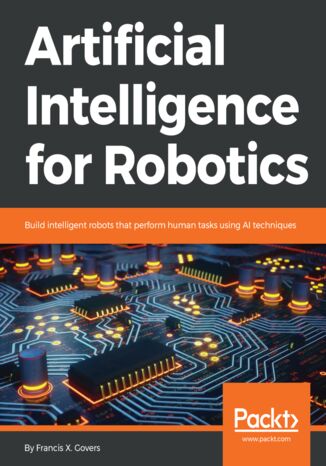
Francis X. Govers III
Artificial Intelligence for Robotics starts with an introduction to Robot Operating Systems (ROS), Python, robotic fundamentals, and the software and tools that are required to start out with robotics. You will learn robotics concepts that will be useful for making decisions, along with basic navigation skills.As you make your way through the chapters, you will learn about object recognition and genetic algorithms, which will teach your robot to identify and pick up an irregular object. With plenty of use cases throughout, you will explore natural language processing (NLP) and machine learning techniques to further enhance your robot. In the concluding chapters, you will learn about path planning and goal-oriented programming, which will help your robot prioritize tasks.By the end of this book, you will have learned to give your robot an artificial personality using simulated intelligence.
Francis X. Govers III
Artificial Intelligence for Robotics starts with an introduction to Robot Operating Systems (ROS), Python, robotic fundamentals, and the software and tools that are required to start out with robotics. You will learn robotics concepts that will be useful for making decisions, along with basic navigation skills.As you make your way through the chapters, you will learn about object recognition and genetic algorithms, which will teach your robot to identify and pick up an irregular object. With plenty of use cases throughout, you will explore natural language processing (NLP) and machine learning techniques to further enhance your robot. In the concluding chapters, you will learn about path planning and goal-oriented programming, which will help your robot prioritize tasks.By the end of this book, you will have learned to give your robot an artificial personality using simulated intelligence.
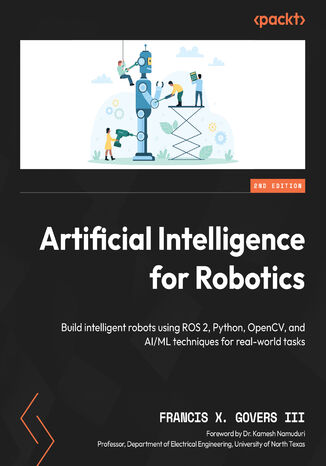
Francis X. Govers III, Dr. Kamesh Namuduri
Unlock the potential of your robots by enhancing their perception with cutting-edge artificial intelligence and machine learning techniques. From neural networks to computer vision, this second edition of the book equips you with the latest tools, new and expanded topics such as object recognition and creating artificial personality, and practical use cases to create truly smart robots.Starting with robotics basics, robot architecture, control systems, and decision-making theory, this book presents systems-engineering methods to design problem-solving robots with single-board computers. You'll explore object recognition using YOLO and genetic algorithms to teach your robot to identify and pick up objects, leverage natural language processing to give your robot a voice, and master neural networks to classify and separate objects and navigate autonomously, before advancing to guiding your robot arms using reinforcement learning and genetic algorithms. The book also covers path planning and goal-oriented programming to prioritize your robot's tasks, showing you how to connect all software using Python and ROS 2 for a seamless experience.By the end of this book, you'll have learned how to transform your robot into a helpful assistant with NLP and give it an artificial personality, ready to tackle real-world tasks and even crack jokes.
Tomasz Rymarczyk
This monograph aims to synthesize methods, measurement architectures, and algorithms that advance approaches to electrical and ultrasonic tomography, with a particular focus on artificial intelligence in image reconstruction and decision support. The work places these techniques in modern, complex environmental, industrial, and medical diagnostic systems, where non-invasive measurements are required for reliable observation, control, and process optimization. The scope of this work encompasses forward and inverse problems, numerical modelling, and data-driven learning methods, and is based on practical prototypes and verified applications. Tomographic imaging is presented as a family of techniques that infer internal structure based on boundary or remote measurements, enabling inspection without physical intervention. The theoretical foundations are outlined along with historical context and standard formulations of inverse problems, which are ill-posed and sensitive to noise and modelling errors. Established numerical frameworks, such as the Finite Element Method, are used to regularize and solve forward and inverse problems for electric and acoustic fields. These pillars provide a coherent path from physics to computation, and ultimately to images interpreted in an operational context. Artificial intelligence methods were applied to improve reconstruction fidelity, noise immunity, and computational efficiency. The text discusses deterministic frameworks such as Tikhonov, Gauss-Newton, and Total Variation, followed by a discussion of machine learning and deep learning architectures such as LSTM and CNN, along with ResNet, DiffNet, and specifically developed differential models for tomographic signals. The proposed multi-branch and pixel-centric strategies were evaluated using quantitative metrics such as RMSE, SSIM, ICC, Pearson correlation, relative image error, MAE, MAPE, and related metrics that reflect both perceptual and task-specific quality. The combination of physics-based modeling and prior knowledge has been shown to reduce inference time and increase noise tolerance compared to classical iterative solvers. A significant portion of the monograph is devoted to the design and evolution of measurement devices. Electrical and hybrid tomographs, next-generation ultrasound tomographs, a beamforming platform, and specialized flaw detection solutions are designed and characterized. Portable and mobile configurations, along with body potential mapping, are used to extend tomographic detection capabilities to include outpatient and situational monitoring. The measurement layer is integrated with distributed acquisition, synchronization, and embedded processing, allowing the systems to operate within industrial and clinical constraints. Applications in process engineering and medicine are presented. Fermentation control, crystallization monitoring, and autonomous process supervision illustrate industrial utility, including connections to the Internet of Things and real-time data infrastructure. Medical research includes non-invasive lung monitoring, portable diagnostics, and ultrasound brain detection, as well as portable hybrid ultrasound impedance solutions for lower urinary tract assessment. Non-destructive testing is addressed using advanced ultrasound imaging on the DefectoVision platform, which describes 3D reconstruction and quantitative assessment. These cases demonstrate that tomographic sensing can reveal internal states, detect anomalies, and support inspection without disrupting production or compromising safety. The book is designed to guide the reader from fundamentals to implementations and verified use cases. Chapter 1 introduces tomographic imaging, the physical principles underlying electrical and ultrasound techniques, and the challenges of the inverse problem. Chapter 2 discusses reconstruction methods, from deterministic regularization to machine learning and deep learning, along with evaluation metrics. Chapter 3 documents the designed measurement devices along with their electronics, sensor geometry, and system characteristics. Chapter 4 develops reconstruction processes based on simulated and experimental datasets and discusses comparative performance, including hybrid and 3D approaches. Chapter 5 consolidates applications in industrial processes and medical diagnostics, presenting experimental setups, results, and discussions that link quantitative metrics to operational requirements. Chapter 6 concludes with a summary, conclusions, and perspectives for further development. This publication is aimed at researchers and PhD students in the fields of sensors, inverse problems, and computational imaging, as well as engineers and practitioners responsible for process control, non-destructive testing, and medical technology assessment. The material was developed autonomously, with theoretical assumptions, numerical methods, device descriptions, and application studies, so that knowledge can be transferred from laboratory prototypes to real systems. This work was developed thanks to the research community and collaboration at the Netrix S.A. Research and Development Centre and the Institute of Information Technology and Innovative Technologies at the WSEI University in Lublin. Appreciation is expressed to my colleagues who collaborated with me on research projects in the areas of device prototyping, data acquisition, and algorithm development, which translated concepts into working systems. We also extend our gratitude to the reviewers, whose insightful comments contributed to improved clarity and completeness, and to our family for their continued support. The presented projects were developed to demonstrate how intelligent tomographic measurement systems can be constructed and deployed as reliable imaging, monitoring, and control tools. This synthesis of physics-based modelling and learning-based reasoning will be useful to both academia and industry seeking to implement practical, large-scale tomography.
Artificial Intelligence in the 21st Century. The Future of Technology and Human Innovation
Mercury Learning and Information, Stephen Lucci, Sarhan...
This third edition provides a comprehensive, accessible presentation of AI, including examples, applications, full-color images, and human interest boxes. New chapters on deep learning, AI security, and AI programming keep the content cutting-edge. Topics like neural networks, genetic algorithms, natural language processing, planning, and complex board games are covered.The course starts with an AI overview, moving through uninformed search, intelligent search methods, and game-based strategies. It delves into logic in AI, knowledge representation, production systems, uncertainty in AI, and expert systems. Middle chapters cover machine learning, neural networks, and deep learning. It continues with nature-inspired search methods, natural language processing, and automated planning, ending with robotics and advanced computer games.These AI concepts are crucial for developing sophisticated AI applications. This book transitions you from novice to proficient AI practitioner, equipped with practical skills and comprehensive knowledge. Companion files with resources, simulations, and figures enhance learning. By the end, you'll understand AI principles and applications, ready to tackle real-world challenges.
Mercury Learning and Information, Oswald Campesato
This book introduces AI, then explores machine learning, deep learning, natural language processing (NLP), and reinforcement learning. Readers learn about classifiers like logistic regression, k-NN, decision trees, random forests, and SVMs. It delves into deep learning architectures such as CNNs, RNNs, LSTMs, and autoencoders, with Keras-based code samples supplementing the theory.Starting with a foundational AI overview, the course progresses into machine learning, explaining classifiers and their applications. It continues with deep learning, focusing on architectures like CNNs and RNNs. Advanced topics include LSTMs and autoencoders, essential for modern AI. The book also covers NLP and reinforcement learning, emphasizing their importance.Understanding these concepts is vital for developing advanced AI systems. This book transitions you from beginner to proficient AI practitioner, combining theoretical knowledge and practical skills. Appendices on Keras, TensorFlow 2, and Pandas enrich the learning experience. By the end, readers will understand AI principles and be ready to apply them in real-world scenarios.
Mary-Jo Diepeveen
The artificial intelligence (AI) capabilities in Power BI enable organizations to quickly and easily gain more intelligent insights from unstructured and structured data.This book will teach you how to make use of the many AI features available today in Power BI to quickly and easily enrich your data and gain better insights into patterns that can be found in your data.You’ll begin by understanding the benefits of AI and how it can be used in Power BI. Next, you’ll focus on exploring and preparing your data for building AI projects and then progress to using prominent AI features already available in Power BI, such as forecasting, anomaly detection, and Q&A. Later chapters will show you how to apply text analytics and computer vision within Power BI reports. This will help you create your own Q&A functionality in Power BI, which allows you to ask FAQs from another knowledge base and then integrate it with PowerApps. Toward the concluding chapters, you’ll be able to create and deploy AutoML models trained in Azure ML and consume them in Power Query Editor. After your models have been trained, you’ll work through principles such as privacy, fairness, and transparency to use AI responsibly.By the end of this book, you’ll have learned when and how to enrich your data with AI using the out-of-the-box AI capabilities in Power BI.
Prateek Joshi
Artificial Intelligence is becoming increasingly relevant in the modern world. By harnessing the power of algorithms, you can create apps which intelligently interact with the world around you, building intelligent recommender systems, automatic speech recognition systems and more.Starting with AI basics you'll move on to learn how to develop building blocks using data mining techniques. Discover how to make informed decisions about which algorithms to use, and how to apply them to real-world scenarios. This practical book covers a range of topics including predictive analytics and deep learning.
Álvaro Morena Alberola, Gonzalo Molina Gallego, Unai...
Artificial Vision and Language Processing for Robotics begins by discussing the theory behind robots. You'll compare different methods used to work with robots and explore computer vision, its algorithms, and limits. You'll then learn how to control the robot with natural language processing commands. You'll study Word2Vec and GloVe embedding techniques, non-numeric data, recurrent neural network (RNNs), and their advanced models. You'll create a simple Word2Vec model with Keras, as well as build a convolutional neural network (CNN) and improve it with data augmentation and transfer learning. You'll study the ROS and build a conversational agent to manage your robot. You'll also integrate your agent with the ROS and convert an image to text and text to speech. You'll learn to build an object recognition system using a video.By the end of this book, you'll have the skills you need to build a functional application that can integrate with a ROS to extract useful information about your environment.
Álvaro Morena Alberola, Gonzalo Molina Gallego, Unai...
Artificial Vision and Language Processing for Robotics begins by discussing the theory behind robots. You'll compare different methods used to work with robots and explore computer vision, its algorithms, and limits. You'll then learn how to control the robot with natural language processing commands. You'll study Word2Vec and GloVe embedding techniques, non-numeric data, recurrent neural network (RNNs), and their advanced models. You'll create a simple Word2Vec model with Keras, as well as build a convolutional neural network (CNN) and improve it with data augmentation and transfer learning. You'll study the ROS and build a conversational agent to manage your robot. You'll also integrate your agent with the ROS and convert an image to text and text to speech. You'll learn to build an object recognition system using a video.By the end of this book, you'll have the skills you need to build a functional application that can integrate with a ROS to extract useful information about your environment.