
Informatyka
Burkhard Meier
Python is a multi-domain, interpreted programming language. It is a widely used general-purpose, high-level programming language. It is often used as a scripting language because of its forgiving syntax and compatibility with a wide variety of different eco-systems. Python GUI Programming Cookbook follows a task-based approach to help you create beautiful and very effective GUIs with the least amount of code necessary.This book will guide you through the very basics of creating a fully functional GUI in Python with only a few lines of code. Each and every recipe adds more widgets to the GUIs we are creating. While the cookbook recipes all stand on their own, there is a common theme running through all of them. As our GUIs keep expanding, using more and more widgets, we start to talk to networks, databases, and graphical libraries that greatly enhance our GUI’s functionality. This book is what you need to expand your knowledge on the subject of GUIs, and make sure you’re not missing out in the long run.
Python GUI programming with Tkinter. Develop responsive and powerful GUI applications with Tkinter
Alan D. Moore
Tkinter is a lightweight, portable, and easy-to-use graphical toolkit available in the Python Standard Library, widely used to build Python GUIs due to its simplicity and availability. This book teaches you to design and build graphical user interfaces that are functional, appealing, and user-friendly using the powerful combination of Python and Tkinter.After being introduced to Tkinter, you will be guided step-by-step through the application development process. Over the course of the book, your application will evolve from a simple data-entry form to a complex data management and visualization tool while maintaining a clean and robust design. In addition to building the GUI, you'll learn how to connect to external databases and network resources, test your code to avoid errors, and maximize performance using asynchronous programming. You'll make the most of Tkinter's cross-platform availability by learning how to maintain compatibility, mimic platform-native look and feel, and build executables for deployment across popular computing platforms.By the end of this book, you will have the skills and confidence to design and build powerful high-end GUI applications to solve real-world problems.
Dr. Gabriele Lanaro
Python is a versatile language that has found applications in many industries. The clean syntax, rich standard library, and vast selection of third-party libraries make Python a wildly popular language. Python High Performance is a practical guide that shows how to leverage the power of both native and third-party Python libraries to build robust applications. The book explains how to use various profilers to find performance bottlenecks and apply the correct algorithm to fix them. The reader will learn how to effectively use NumPy and Cython to speed up numerical code. The book explains concepts of concurrent programming and how to implement robust and responsive applications using Reactive programming. Readers will learn how to write code for parallel architectures using Tensorflow and Theano, and use a cluster of computers for large-scale computations using technologies such as Dask and PySpark. By the end of the book, readers will have learned to achieve performance and scale from their Python applications.
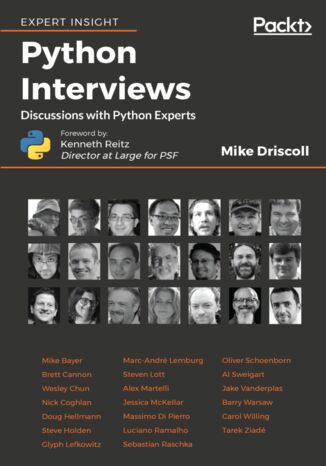
Python Interviews. Discussions with Python Experts
Michael Driscoll, Kenneth Reitz
Each of these twenty Python Interviews can inspire and refresh your relationship with Python and the people who make Python what it is today. Let these interviews spark your own creativity, and discover how you also have the ability to make your mark on a thriving tech community. This book invites you to immerse in the Python landscape, and let these remarkable programmers show you how you too can connect and share with Python programmers around the world. Learn from their opinions, enjoy their stories, and use their tech tips.• Brett Cannon - former director of the PSF, Python core developer, led the migration to Python 3.• Steve Holden - tireless Python promoter and former chairman and director of the PSF.• Carol Willing - former director of the PSF and Python core developer, Project Jupyter Steering Council member.• Nick Coghlan - founding member of the PSF's Packaging Working Group and Python core developer.• Jessica McKellar - former director of the PSF and Python activist.• Marc-André Lemburg - Python core developer and founding member of the PSF.• Glyph Lefkowitz - founder of Twisted and fellow of the PSF• Doug Hellmann - fellow of the PSF, creator of the Python Module of the Week blog, Python community member since 1998.• Massimo Di Pierro - fellow of the PSF, data scientist and the inventor of web2py. • Alex Martelli - fellow of the PSF and co-author of Python in a Nutshell.• Barry Warsaw - fellow of the PSF, Python core developer since 1995, and original member of PythonLabs.• Tarek Ziadé - founder of Afpy and author of Expert Python Programming.• Sebastian Raschka - data scientist and author of Python Machine Learning.• Wesley Chun - fellow of the PSF and author of the Core Python Programming books.• Steven Lott - Python blogger and author of Python for Secret Agents.• Oliver Schoenborn - author of Pypubsub and wxPython mailing list contributor.• Al Sweigart - bestselling author of Automate the Boring Stuff with Python and creator of the Python modules Pyperclip and PyAutoGUI.• Luciano Ramalho - fellow of the PSF and the author of Fluent Python.• Mike Bayer - fellow of the PSF, creator of open source libraries including SQLAlchemy.• Jake Vanderplas - data scientist and author of Python Data Science Handbook.
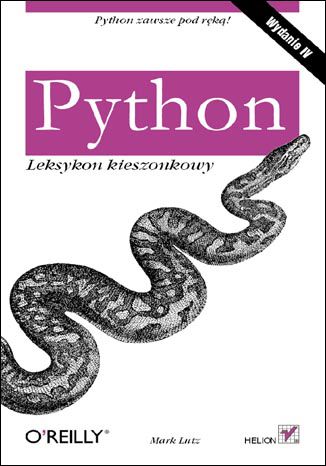
Python. Leksykon kieszonkowy. Wydanie IV
Mark Lutz
Jakie możliwości kryją standardowe moduły biblioteczne? Jak wykonywać operacje na plikach? Jak stworzyć graficzny interfejs użytkownika? Python to wyjątkowo praktyczny język programowania, idealnie nadający się do szybkiego rozwiązywania niecodziennych problemów, z którymi często borykają się koderzy. Nie wymusza on stosowania jednego stylu programowania, co pozwala na dużo większą elastyczność w trakcie pisania kodu. Umożliwia programowanie obiektowe, strukturalne i funkcyjne, a ponadto udostępnia zaawansowane mechanizmy zarządzania pamięcią, zapewnia dynamiczne sprawdzanie typów oraz czytelną składnię. Te wszystkie zalety powodują, że Python ma grupę swoich wiernych fanów. Niniejsza książka należy do popularnej serii "Leksykon kieszonkowy", dzięki której zawsze i wszędzie możesz przypomnieć sobie wybrane zagadnienia, związane z różną tematyką. Pozycja, którą właśnie trzymasz w rękach, została poświęcona językowi Python. W trakcie jej lektury zapoznasz się z takimi zagadnieniami, jak sterowanie przepływem programu, wykorzystanie pętli, list, słowników oraz operacje na plikach. Ponadto w każdej chwili będziesz mógł sprawdzić składnię oraz sposoby wykorzystania funkcji i wyjątków wbudowanych. Książka stanowi znakomite kompendium wiedzy na temat języka Python. Sprawdzi się ona w rękach początkującego użytkownika - jako przewodnik, a w rękach zaawansowanego programisty - jako pomocnik. Wbudowane typy i operatory Działania na liczbach Operacje na łańcuchach znaków Wykorzystanie Unicode w Pythonie Obsługa list oraz słowników Operacje na zbiorach i plikach Sterowanie przepływem programu Konwersja typów Obsługa wyjątków Wykorzystanie przestrzeni nazw Zasięgi zmiennych Przeciążanie operatorów Standardowe moduły biblioteczne Zastosowanie wyrażeń regularnych Tworzenie graficznego interfejsu użytkownika Wyciśnij jeszcze więcej z języka Python!
Alexander Combs, Michael Roman
Machine learning is transforming the way we understand and interact with the world around us. This book is the perfect guide for you to put your knowledge and skills into practice and use the Python ecosystem to cover key domains in machine learning. This second edition covers a range of libraries from the Python ecosystem, including TensorFlow and Keras, to help you implement real-world machine learning projects.The book begins by giving you an overview of machine learning with Python. With the help of complex datasets and optimized techniques, you’ll go on to understand how to apply advanced concepts and popular machine learning algorithms to real-world projects. Next, you’ll cover projects from domains such as predictive analytics to analyze the stock market and recommendation systems for GitHub repositories. In addition to this, you’ll also work on projects from the NLP domain to create a custom news feed using frameworks such as scikit-learn, TensorFlow, and Keras. Following this, you’ll learn how to build an advanced chatbot, and scale things up using PySpark. In the concluding chapters, you can look forward to exciting insights into deep learning and you'll even create an application using computer vision and neural networks.By the end of this book, you’ll be able to analyze data seamlessly and make a powerful impact through your projects.
Yuxi (Hayden) Liu
The surge in interest in machine learning (ML) is due to the fact that it revolutionizes automation by learning patterns in data and using them to make predictions and decisions. If you’re interested in ML, this book will serve as your entry point to ML.Python Machine Learning By Example begins with an introduction to important ML concepts and implementations using Python libraries. Each chapter of the book walks you through an industry adopted application. You’ll implement ML techniques in areas such as exploratory data analysis, feature engineering, and natural language processing (NLP) in a clear and easy-to-follow way.With the help of this extended and updated edition, you’ll understand how to tackle data-driven problems and implement your solutions with the powerful yet simple Python language and popular Python packages and tools such as TensorFlow, scikit-learn, gensim, and Keras. To aid your understanding of popular ML algorithms, the book covers interesting and easy-to-follow examples such as news topic modeling and classification, spam email detection, stock price forecasting, and more.By the end of the book, you’ll have put together a broad picture of the ML ecosystem and will be well-versed with the best practices of applying ML techniques to make the most out of new opportunities.
Python Machine Learning By Example. The easiest way to get into machine learning
Yuxi (Hayden) Liu
Data science and machine learning are some of the top buzzwords in the technical world today. A resurging interest in machine learning is due to the same factors that have made data mining and Bayesian analysis more popular than ever. This book is your entry point to machine learning. This book starts with an introduction to machine learning and the Python language and shows you how to complete the setup. Moving ahead, you will learn all the important concepts such as, exploratory data analysis, data preprocessing, feature extraction, data visualization and clustering, classification, regression and model performance evaluation. With the help of various projects included, you will find it intriguing to acquire the mechanics of several important machine learning algorithms – they are no more obscure as they thought. Also, you will be guided step by step to build your own models from scratch. Toward the end, you will gather a broad picture of the machine learning ecosystem and best practices of applying machine learning techniques. Through this book, you will learn to tackle data-driven problems and implement your solutions with the powerful yet simple language, Python. Interesting and easy-to-follow examples, to name some, news topic classification, spam email detection, online ad click-through prediction, stock prices forecast, will keep you glued till you reach your goal.