
Завантаження...
Деталі електронної книги
Увійти якщо вас цікавить зміст видання.
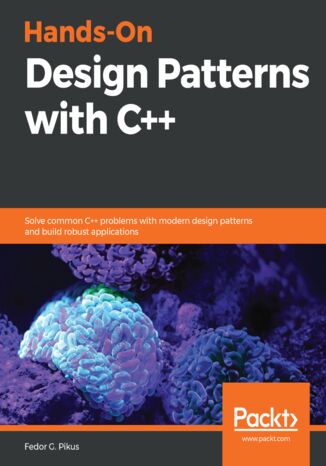
Hands-On Design Patterns with C++. Solve common C++ problems with modern design patterns and build robust applications
Fedor G. Pikus
Завантаження...
EЛЕКТРОННА КНИГА
Завантаження...
C++ is a general-purpose programming language designed with the goals of efficiency, performance, and flexibility in mind. Design patterns are commonly accepted solutions to well-recognized design problems. In essence, they are a library of reusable components, only for software architecture, and not for a concrete implementation.
The focus of this book is on the design patterns that naturally lend themselves to the needs of a C++ programmer, and on the patterns that uniquely benefit from the features of C++, in particular, the generic programming. Armed with the knowledge of these patterns, you will spend less time searching for a solution to a common problem and be familiar with the solutions developed from experience, as well as their advantages and drawbacks. The other use of design patterns is as a concise and an efficient way to communicate. A pattern is a familiar and instantly recognizable solution to specific problem; through its use, sometimes with a single line of code, we can convey a considerable amount of information. The code conveys: This is the problem we are facing, these are additional considerations that are most important in our case; hence, the following well-known solution was chosen.
By the end of this book, you will have gained a comprehensive understanding of design patterns to create robust, reusable, and maintainable code.
The focus of this book is on the design patterns that naturally lend themselves to the needs of a C++ programmer, and on the patterns that uniquely benefit from the features of C++, in particular, the generic programming. Armed with the knowledge of these patterns, you will spend less time searching for a solution to a common problem and be familiar with the solutions developed from experience, as well as their advantages and drawbacks. The other use of design patterns is as a concise and an efficient way to communicate. A pattern is a familiar and instantly recognizable solution to specific problem; through its use, sometimes with a single line of code, we can convey a considerable amount of information. The code conveys: This is the problem we are facing, these are additional considerations that are most important in our case; hence, the following well-known solution was chosen.
By the end of this book, you will have gained a comprehensive understanding of design patterns to create robust, reusable, and maintainable code.
- 1. An introduction to Inheritance and polymorphism
- 2. Class and function templates
- 3. Memory ownership
- 4. Swap - from simple to subtle
- 5. A Comprehensive Look at Resource Acquisition is Initialization (RAII)
- 6. Type Erasure
- 7. SFINAE and Overload Resolution Management
- 8. The Curiously Recurring Template Pattern
- 9. Named Arguments and Method Chaining
- 10. Local Buffer Optimization
- 11. Scopeguard
- 12. Friend Factory
- 13. Virtual Constructors and Factories
- 14. The Template Method Pattern and the Non-Virtual Idiom
- 15. Singleton: a Classic OOP Pattern
- 16. Policy-based design
- 17. Adaptors and Decorators
- 18. Visitor and multiple dispatch
- Назва:Hands-On Design Patterns with C++. Solve common C++ problems with modern design patterns and build robust applications
- Автор:Fedor G. Pikus
- Оригінальна назва:Hands-On Design Patterns with C++. Solve common C++ problems with modern design patterns and build robust applications
- ISBN:9781788837958, 9781788837958
- Дата видання:2019-01-30
- Формат:Eлектронна книга - EPUB
- Ідентифікатор видання: e_14om
- Видавець: Packt Publishing
Завантаження...
Завантаження...