
Wird geladen...
Details zum E-Book
Einloggen wenn Sie am Inhalt des Artikels interessiert sind.
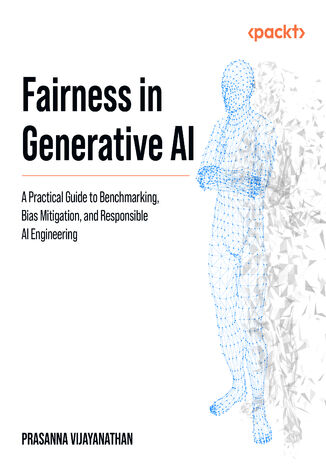
Fairness in Generative AI. A Practical Guide to Benchmarking, Bias Mitigation, and Responsible AI Engineering
Prasanna Vijayanathan
Wird geladen...
E-BOOK
Wird geladen...
As generative AI moves into critical applications like hiring, credit decisions, education, and healthcare, the potential for real-world harm escalates. When systems perpetuate stereotypes or skew outcomes based on identity, the impact goes far beyond poor user experience. It results in lost opportunities, violated dignity, and erosion of trust. This book offers practical methods for evaluating and ensuring fairness across text, image, and multimodal GenAI systems.
You'll begin with fairness principles that matter for GenAI and learn how to translate philosophical constructs into engineering artifacts. Abstract goals become measurable requirements: what constitutes harm, which groups are in scope, how fairness is defined, and which trade-offs are acceptable. Next, design a benchmarking framework that integrates with existing pipelines. Thereafter, create scenario and prompt libraries, model sensitive attributes and intersections, and run evaluations through an orchestrated pipeline. Implement quantitative metrics and qualitative rubrics, add human review with rater training and agreement checks, and publish results as scorecards and dashboards. Finally, integrate fairness checks into CI and model release gates, monitor drift, and run incident response playbooks so benchmarks stay credible as models and norms evolve.
You'll begin with fairness principles that matter for GenAI and learn how to translate philosophical constructs into engineering artifacts. Abstract goals become measurable requirements: what constitutes harm, which groups are in scope, how fairness is defined, and which trade-offs are acceptable. Next, design a benchmarking framework that integrates with existing pipelines. Thereafter, create scenario and prompt libraries, model sensitive attributes and intersections, and run evaluations through an orchestrated pipeline. Implement quantitative metrics and qualitative rubrics, add human review with rater training and agreement checks, and publish results as scorecards and dashboards. Finally, integrate fairness checks into CI and model release gates, monitor drift, and run incident response playbooks so benchmarks stay credible as models and norms evolve.
- 1. The Urgency of Fairness in Generative AI
- 2. From Intuition to Norms: Foundations of Fairness
- 3. Why Benchmarks: The Principals of Evaluation
- 4. Requirements for a Fairness Evaluation System
- 5. Architecture of a Fairness Benchmarking Platform
- 6. Data, Scenarios and Prompt Libraries
- 7. Metrics, Scorecards and Interpretation
- 8. Model Producers, Researchers and Platform Engineers
- 9. Solution Builders: Application and Product Teams
- 10. Consumers and Civil Society: External Accountability
- 11. Policy Makers, Regulators and Standards Bodies
- 12. Getting Started: Your End to End Benchmark at Scale
- 13. Industrial Strength: Integrating with MLOps and CI
- 14. Monitoring, Drifting and Incident Response
- 15. Community Contribution and Governance
- 16. Beyond Today: Limitation, Open Questions and Future Directions
- Titel:Fairness in Generative AI. A Practical Guide to Benchmarking, Bias Mitigation, and Responsible AI Engineering
- Autor:Prasanna Vijayanathan
- Originaler Titel:Fairness in Generative AI. A Practical Guide to Benchmarking, Bias Mitigation, and Responsible AI Engineering
- ISBN:9781807304867, 9781807304867
- Veröffentlichungsdatum:2026-08-31
- Format:E-Book - EPUB
- Artikel-ID: e_4trr
- Verleger: Packt Publishing
Wird geladen...
Wird geladen...