
Wydawca: 16
Pytest. Kurs video. Automatyzacja testów w Pythonie
Adam Szpilewicz
Obierz kurs na... testowanie oprogramowania w Pythonie W erze cyfrowej, w której obecnie funkcjonujemy, zainstalowane na towarzyszących nam urządzeniach oprogramowanie jest niezmiernie ważne. Można powiedzieć - i nie będzie w tym twierdzeniu przesady - że napędza ono niemal każdy aspekt życia. W związku z tym jego jakość i niezawodność stają się kluczowe. A co za tym idzie - kluczowe w procesie tworzenia oprogramowania jest jego testowanie. Na szczęście dysponujemy narzędziami, które doskonale radzą sobie z tym zadaniem. Jednym z nich jest Pytest - nowoczesny framework do uruchamiania testów automatycznych w języku Python. Można używać tej platformy do przeprowadzania testów jednostkowych, ale sprawdzi się świetnie także podczas konstruowania rozbudowanych testów wyższego poziomu (integracyjnych, end-to-end) dla całych aplikacji czy bibliotek. Z Pytestu do testowania kodu korzystają nie tylko freelancerzy i twórcy oprogramowania typu open source, ale również zespoły programistyczne funkcjonujące w ramach mniejszych i większych przedsiębiorstw. Chwalą framework za jego wszechstronność, mnogość dostępnych rozszerzeń, łatwość tworzenia własnych bibliotek, wreszcie za to, że Pytest radzi sobie bardzo dobrze z testowaniem aplikacji webowych i usług sieciowych. Jeśli chcesz się dowiedzieć, jak to wygląda w praktyce, zapraszamy do wzięcia udziału w naszym kursie. Wiedza, którą w jego trakcie zdobędziesz, niewątpliwie wpłynie pozytywnie na jakość tworzonego przez Ciebie kodu, pozwoli Ci na szybsze identyfikowanie błędów i zwiększenie efektywności rozwoju oprogramowania. Co Cię czeka podczas naszego profesjonalnego szkolenia Ucząc się z naszym kursem, między innymi: Opanujesz podstawową wiedzę dotyczącą testowania oprogramowania Dowiesz się, jak skonfigurować środowisko pracy Zaznajomisz się z plikami konfiguracyjnymi frameworka, takimi jak conftest.py i pytest.ini Poznasz zaawansowane techniki: używanie własnych i wbudowanych markerów integracja z GitHub Actions (w tym ruleset) parametryzacja testów fixtury i mocki (autouse, yield, name, ids, tmpdir, tmpdir_factory, capsys, mocker, magicmock, recwarn, doctest) Szkolenie Pytest. Kurs video. Automatyzacja testów w Pythonie stanowi kompleksowe wprowadzenie do automatyzacji testów w Pythonie i skupia się na praktycznych aspektach pisania testów i zarządzania nimi. Kurs kończy się na poziomie średnio zaawansowanym. Po jego ukończeniu będziesz w stanie tworzyć kompleksowe scenariusze testowe i efektywnie zarządzać procesem testowania w różnorodnych projektach.
pytest Quick Start Guide. Write better Python code with simple and maintainable tests
Bruno Oliveira
Python's standard unittest module is based on the xUnit family of frameworks, which has its origins in Smalltalk and Java, and tends to be verbose to use and not easily extensible.The pytest framework on the other hand is very simple to get started, but powerful enough to cover complex testing integration scenarios, being considered by many the true Pythonic approach to testing in Python.In this book, you will learn how to get started right away and get the most out of pytest in your daily work?ow, exploring powerful mechanisms and plugins to facilitate many common testing tasks. You will also see how to use pytest in existing unittest-based test suites and will learn some tricks to make the jump to a pytest-style test suite quickly and easily.
Mike Ohlson de Fine
Python is a great object-oriented and interactive programming language that lets you develop graphics, both static and animated, using built-in vector graphics functions that are provided with Python.Python 2.6 Graphics Cookbook is a collection of straightforward recipes and illustrative screenshots for creating and animating graphic objects using the Python language. This book makes the process of developing graphics interesting and entertaining by working in a graphic workspace without the burden of mastering complicated language definitions and opaque examples.If you choose to work through all the recipes from the beginning, you will learn to install Python and create basic programs for making lines and shapes using the built-in Tkinter module. The confusing topic of color manipulation is explored in detail using existing Python tools as well as some new tools in the recipes. Next you will learn to manipulate font size, color, and placement of text as placing text exactly where you want on a screen can be tricky because font height, inter-character spacing, and text window dimensions all interfere with each other. Then you will learn how to animate graphics, for example having more than one independent graphic object co-exist and interact using various Python methods.You will also learn how you can work with raster images, such as converting their formats using the Python Imaging Library. Next you will learn how you can combine vector images with raster images so that you can animate the raster images with ease. You will also walk through a set of recipes with the help of which you can handle and manipulate blocks of raw data that may be hundreds of megabytes in size using datastreams, files, and hard drives. You will also learn how you can use Inkscape to dismantle existing images and use parts of them for your own graphics and Python programs. At the end of the book you will learn how you can create GUIs for different purposes.
Python 3 and Data Analytics Pocket Primer. A Quick Guide to NumPy, Pandas, and Data Visualization
Mercury Learning and Information, Oswald Campesato
This book, part of the best-selling Pocket Primer series, introduces readers to the fundamental concepts of data analytics using Python 3. The course begins with a concise introduction to Python, covering essential programming constructs and data manipulation techniques. This foundation sets the stage for deeper dives into data analytics, emphasizing the importance of data cleaning, a critical step in any data analysis process.Following the Python basics, the course explores powerful libraries such as NumPy and Pandas for efficient data handling and manipulation. It then delves into statistical concepts, providing the necessary background for understanding data distributions and analytical methods. The course culminates in data visualization techniques using Matplotlib and Seaborn, demonstrating how to effectively communicate insights through graphical representations.Throughout the course, numerous code samples and practical examples are provided, reinforcing learning and offering hands-on experience. Companion files with source code and figures are available online, supporting the learning journey. This comprehensive guide equips both beginners and seasoned professionals with the skills needed to excel in data analytics.
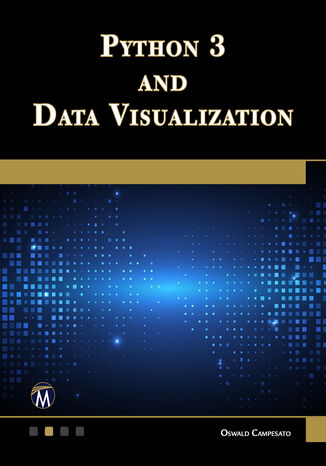
Python 3 and Data Visualization. Mastering Graphics and Data Manipulation with Python
Mercury Learning and Information, Oswald Campesato
Python 3 and Data Visualization provides an in-depth exploration of Python 3 programming and data visualization techniques. The course begins with an introduction to Python, covering essential topics from basic data types and loops to advanced constructs such as dictionaries and matrices. This foundation prepares readers for the next section, which focuses on NumPy and its powerful array operations, seamlessly leading into data visualization using prominent libraries like Matplotlib.Chapter 6 delves into Seaborn's rich visualization tools, providing insights into datasets like Iris and Titanic. The appendix covers additional visualization tools and techniques, including SVG graphics and D3 for dynamic visualizations. The companion files include numerous Python code samples and figures, enhancing the learning experience.From foundational Python concepts to advanced data visualization techniques, this course serves as a comprehensive resource for both beginners and seasoned professionals, equipping them with the necessary skills to effectively visualize data.
Mercury Learning and Information, Oswald Campesato
This book bridges the gap between theoretical knowledge and practical application in Python programming, machine learning, and using ChatGPT-4 in data science. It starts with an introduction to Pandas for data manipulation and analysis. The book then explores various machine learning classifiers, from kNN to SVMs. Later chapters cover GPT-4's capabilities, enhancing linear regression analysis, and using ChatGPT in data visualization, including AI apps, GANs, and DALL-E.The journey begins with mastering Pandas and machine learning fundamentals. It progresses to applying GPT-4 in linear regression and machine learning classifiers. The final chapters focus on using ChatGPT for data visualization, making complex results accessible and understandable.Understanding these concepts is crucial for modern data scientists. This book transitions readers from basic Python programming to advanced applications of ChatGPT-4 in data science. Companion files with source code, datasets, and figures enhance learning, making this an essential resource for mastering Python, machine learning, and AI-driven data visualization.
Mercury Learning and Information, Oswald Campesato
This book teaches Python 3 programming and data visualization, exploring cutting-edge techniques with ChatGPT/GPT-4 for generating compelling visuals. It starts with Python essentials, covering basic data types, loops, functions, and advanced constructs like dictionaries and matrices. The journey progresses to NumPy's array operations and data visualization using libraries such as Matplotlib and Seaborn. The book also covers tools like SVG graphics and D3 for dynamic visualizations.The course begins with foundational Python concepts, moves into NumPy and data visualization with Pandas, Matplotlib, and Seaborn. Advanced chapters explore ChatGPT and GPT-4, demonstrating their use in creating data visualizations from datasets like the Titanic. Each chapter builds on the previous one, ensuring a comprehensive understanding of Python and visualization techniques.These concepts are crucial for Python practitioners, data scientists, and anyone in data analytics. This book transitions readers from basic Python programming to advanced data visualization, blending theoretical knowledge with practical skills. Companion files with code, datasets, and figures enhance learning, making this an essential resource for mastering Python and data visualization.
Mercury Learning and Information, Oswald Campesato
This book teaches Python 3 programming and data visualization, exploring cutting-edge techniques with ChatGPT/GPT-4 for generating compelling visuals. It starts with Python essentials, covering basic data types, loops, functions, and advanced constructs like dictionaries and matrices. The journey progresses to NumPy's array operations and data visualization using libraries such as Matplotlib and Seaborn. The book also covers tools like SVG graphics and D3 for dynamic visualizations.The course begins with foundational Python concepts, moves into NumPy and data visualization with Pandas, Matplotlib, and Seaborn. Advanced chapters explore ChatGPT and GPT-4, demonstrating their use in creating data visualizations from datasets like the Titanic. Each chapter builds on the previous one, ensuring a comprehensive understanding of Python and visualization techniques.These concepts are crucial for Python practitioners, data scientists, and anyone in data analytics. This book transitions readers from basic Python programming to advanced data visualization, blending theoretical knowledge with practical skills. Companion files with code, datasets, and figures enhance learning, making this an essential resource for mastering Python and data visualization.