
Publisher: K-i-s-publishing

Rajvardhan Oak
Machine learning in security is harder than other domains because of the changing nature and abilities of adversaries, high stakes, and a lack of ground-truth data. This book will prepare machine learning practitioners to effectively handle tasks in the challenging yet exciting cybersecurity space.The book begins by helping you understand how advanced ML algorithms work and shows you practical examples of how they can be applied to security-specific problems with Python – by using open source datasets or instructing you to create your own. In one exercise, you’ll also use GPT 3.5, the secret sauce behind ChatGPT, to generate an artificial dataset of fabricated news. Later, you’ll find out how to apply the expert knowledge and human-in-the-loop decision-making that is necessary in the cybersecurity space. This book is designed to address the lack of proper resources available for individuals interested in transitioning into a data scientist role in cybersecurity. It concludes with case studies, interview questions, and blueprints for four projects that you can use to enhance your portfolio.By the end of this book, you’ll be able to apply machine learning algorithms to detect malware, fake news, deep fakes, and more, along with implementing privacy-preserving machine learning techniques such as differentially private ML.
101 UX Principles - 2nd edition. Actionable Solutions for Product Design Success - Second Edition
Will Grant
“This updated version of 101 UX Principles is a delight. It's an educational and fun provocation to look at the world of UX differently – solidly from the user's point of view.-Elizabeth Churchill, Director of User Experience, Google“A phenomenal reference guide. Complete with case studies, a record of personal experience, and visual examples, Grant makes it clear why these techniques have found their way into the canon of UX best practices.”-Jeff Gothelf, Author of Lean UX“..I recommend it to anyone looking to learn the basics and also for more experienced designers - the author’s candid opinions will force you to revisit some of your established assumptions!-Anne Marie-Leger, Staff Product Designer, Shopify“An absolute must-read, not only for UX designers, but this book is also super relevant for product managers trying to get better at product usability. Two enthusiastic thumbs up!-Trent Blakely, Sr. Product Manager, EquinixThis book is a manifesto of UX/UI design best practices to help you put the focus back on what really matters: the user. From UX laws to practical UI, color, typography, and accessibility advice, it’s all packed into this easy-to-consult and fun read:Essential UX lawsHandy best practicesSnippets of technical knowledge for anyone who wants to work in the digital space101 UX Principles demonstrates the success from best-in-class products and leads the way to delight your users. Keep it on your desk for quick reference, send as a gift to colleagues to build allies, or brandish it as your weapon of choice during meetings to fight for your users’ right to a better digital experience.Sneak a peek at some of the new and updated principles in this UX design book:Work with user expectations, not against themMake interactive elements obvious and discoverableOptimize your interface for mobileStreamline creating and entering passwordsRespect users' time and effort in your formsUse animation with care in user interfacesHow to handle destructive user actionsChatbots are usually a bad idea – and how to make them betterUse A/B testing to test your ideasLet users give feedback, but don't hassle themMake it clear to users if they're joining or signing-inOnly use modal views for blocking actionsHow complexity can be good for some users
101 UX Principles. A definitive design guide
Will Grant
We want our UX to be brilliant. We want to create stunning user experiences. We want our UX to drive the success of our business with useful and usable software products. This book draws on the wisdom and training of Jakob Nielsen and Don Norman to help you get your UX right - in 101 ways!101 UX Principles shows you the 101 most important things you need to know about usability and design. A practical reference for UX professionals, and a shortcut to greatness for anyone who needs a clear and wise selection of principles to guide their UX success. Learn the key principles that drive brilliant UX design.Enjoy 101 Principles including ‘Good UX has a Beginning, a Middle, and an End’, ‘Make Your Links Look Like Links’, ‘Don't Use Obsolete Icons’, ‘Decide Whether an Interaction Should Be Obvious, Easy, or Possible’, ‘Test with Real Users’, ‘Making the most of fonts’, ‘Good UX for search results’, and ‘Show your user - don't tell your user!’“Good to read from beginning to end, and a nice dip-in-and-out text, the chapter titles reminded me of principles I don't even think about explicitly when I likely should. The book inspired me to start more explicitly articulating some of the principles I just take for granted.”- Elizabeth Churchill, Director of User Experience at Google“This is a great practical read. It is convenient to use as a reference when solving real UX problems. I would definitely recommend it as an introduction to UX, but also as a good reminder of best practices for more experienced designers.”- Anne-Marie Léger, Designer at ShopifySome more of the 101 UX Principles featured in this book:Work with user expectations not against themHow to build upon established metaphorsHow to arrange navigation elementsHow to introduce new ideas to your userMatching pagination and content structureWhen invention is not good for UXStriving for simplicityReducing user tasksWhat to make clickableMaking the most of fontsMaking your links look like linksPicking the right control for the jobData input and what users care aboutHow to handle destructive user actionsWhen color should not convey informationTappable areas and the size of fingersGetting payment details the right wayUse the standard e-commerce patternIf you really must use a flat designWhen to use progress bars or spinnersDropdowns the right and wrong wayHandling just-off-screen contentHow to do Hamburger menus rightWhen to hide Advanced SettingsGood UX for Notifications
101 UX Principles audiobook. Actionable Solutions for Product Design Success - Second Edition
Will Grant
Design is everywhere. Take a look around you right now and consider the products and services we use every day. You'll notice that our computer and phone operating systems, our web browsers, and the apps we use to work, order food, socialize and even date have been designed by UX specialists to offer you the best experiences when using their products and services.Of course, not all online experiences are designed with our best interests in mind. That's exactly why UX design is such an exciting and rewarding field?by learning the logic behind what people engage with and implementing it in your UX work, you can craft intuitive, accessible, and highly functional designs for your digital products.The 2nd edition of 101 UX Principles is the perfect companion when working on digital projects and making the right decisions for your users. From landing pages and checkout basket UIs to startup launch products and enterprise software solutions, a rich user experience design will maximize the success of your product.The audiobook includes an exclusive invitation to join an online UX designers' community, where you can read the book alongside peers and other UX designers, and participate in various challenges and discussions with the author. See you there!
David Hoyle
Data science combines the power of data with the rigor of scientific methodology, with mathematics providing the tools and frameworks for analysis, algorithm development, and deriving insights. As machine learning algorithms become increasingly complex, a solid grounding in math is crucial for data scientists. David Hoyle, with over 30 years of experience in statistical and mathematical modeling, brings unparalleled industrial expertise to this book, drawing from his work in building predictive models for the world's largest retailers. Encompassing 15 crucial concepts, this book covers a spectrum of mathematical techniques to help you understand a vast range of data science algorithms and applications. Starting with essential foundational concepts, such as random variables and probability distributions, you’ll learn why data varies, and explore matrices and linear algebra to transform that data. Building upon this foundation, the book spans general intermediate concepts, such as model complexity and network analysis, as well as advanced concepts such as kernel-based learning and information theory. Each concept is illustrated with Python code snippets demonstrating their practical application to solve problems.By the end of the book, you’ll have the confidence to apply key mathematical concepts to your data science challenges.
Imran Ahmad
As AI evolves from passive tools into proactive collaborators, intelligent agents are leading a fundamental shift in computing. This guide provides the critical knowledge of agent architectures, practical tools, and industry approaches needed to build robust, autonomous AI systems that do more than just generate text—they act.You will begin by mastering foundational capabilities: perception, memory, reasoning, planning, and learning. You’ll gain deep insight into the cognitive loops that drive autonomous behavior and build sophisticated architectures using frameworks such as LangChain and LangGraph.The book explores high-impact applications across diverse sectors, including software development, finance, manufacturing, legal and education, to show how agents optimize workflows, automate quality control, and enhance advisory systems. Through real-world case studies, you will create agents capable of contextual reasoning, effective tool use, and seamless human collaboration. Finally, you’ll learn essential strategies for deployment, management, and ethical alignment, ensuring your AI solutions are both scalable and responsible in production environments.Whether you're building your first intelligent agent or improving business systems, this book provides clear, actionable guidance for creating scalable and responsible AI solutions.*Email sign-up and proof of purchase required

30 лет с Учением Жизни. Размышления врача о человеке и человечестве
Людмила Стрельцова
Книга популярно описывает основные положения Учения Жизни, подробно изложенные в трудах Е.П. Блаватской, Е.И. Рерих и З.В. Душковой. На страницах книги рассказывается о Братстве Великих Учителей, которые протянули руки помощи людям Земли миллионы лет назад. Мудрость Великих Учителей открывает нам удивительно разумную жизнь построений Космоса, братскую взаимопомощь Руководителей планет во всех построениях и даже в случаях бедствий.
Jaime Kelly
In the intricate world of 3D character rigging with Blender, aspiring artists often find themselves grappling with the daunting challenge of achieving results akin to seasoned professionals. This book is your guide to overcoming that very challenge, providing you with the necessary knowledge and skills to excel in this complex art form.As you embark on this creative journey, this book will guide you through a carefully crafted flow. Beginning with the basics, the first part of the book will teach you how to add structure to an empty canvas and master the art of weight painting in Blender. You'll delve into the intricacies of rigging humanoid characters, gain a deep understanding of the essential buttons and techniques, and discover invaluable success-boosting tips.Starting with simple mesh deformation using a single bone, you'll progress steadily toward the mastery of fully rigging a human character, all while comprehending the reasons behind each step in the process. Furthermore, the book leaves you with a selection of advanced techniques, fully explained, paving the way for a natural progression in your artistic journey and allowing you to continuously refine and enhance your skills.By the end of the book, you'll excel at crafting character rigs, seamlessly meeting professional pipeline demands in diverse teams and studios.
Xudong Ma, David Farrugia, Vishakh Hegde, Lilit...
With this hands-on guide to 3D deep learning, developers working with 3D computer vision will be able to put their knowledge to work and get up and running in no time.Complete with step-by-step explanations of essential concepts and practical examples, this book lets you explore and gain a thorough understanding of state-of-the-art 3D deep learning. You’ll see how to use PyTorch3D for basic 3D mesh and point cloud data processing, including loading and saving ply and obj files, projecting 3D points into camera coordination using perspective camera models or orthographic camera models, rendering point clouds and meshes to images, and much more. As you implement some of the latest 3D deep learning algorithms, such as differential rendering, Nerf, synsin, and mesh RCNN, you’ll realize how coding for these deep learning models becomes easier using the PyTorch3D library.By the end of this deep learning book, you’ll be ready to implement your own 3D deep learning models confidently.
Abdelilah Hamdani, Jason van Gumster, Carlos Barreto
Creating photorealistic 3D scenes in Blender can be tricky sometimes due to modeling inaccuracies, scale issues, flat materials, and lighting that fails to match real-world references. These problems can make scenes look artificial and inconsistent.Based on Blender 5, this updated second edition simplifies the complexities by guiding you through clear, practical workflows to overcome those challenges. You’ll start by addressing common modeling and proportion mistakes, then move on to realistic texturing and unwrapping to create stunning scenes based on actual references.As you progress, you’ll create natural assets such as plants, rocks, water, flowers, and terrain, learning how to assemble them into believable environments. The book introduces modern Blender workflows, including a dedicated chapter on node-based methods for creating and scattering plants. You will then focus on lighting and rendering, using Cycles, HDRIs, and accurate color management to achieve realistic results, before finalizing your scenes with rendering and compositing.By the end, you’ll be equipped to create beautiful, photorealistic renders that stand out.*Email sign-up and proof of purchase required
Abdelilah Hamdani, Carlos Barreto
Blender is a powerful tool for creating all kinds of visual assets, but with such power comes complexity. Creating a photorealistic 3D scene seems like a Herculean task for more than 90% of 3D designers, but don’t be discouraged! 3D Environment Design with Blender will get you up and running.This practical guide helps reduce the complexity of 3D environment design, advance your Blender skills, and produce lifelike scenes and animations in a time-efficient manner. You'll start by learning how to fix the most common mistakes 3D designers make with modeling and scale matching that stop them from achieving photorealism. Next, you’ll understand the basics of realistic texturing, efficient unwrapping and achieving photorealistic lighting by turning an actual reference of a wood cabin into a realistic 3D scene. These skills will be used and expanded as you build a realistic 3D environment with natural assets and materials that you’ll create from scratch. Once you’ve developed your natural environment, you’ll advance to creating realistic render shots by applying cool camera features, and compositing tricks that will make your final render look photorealistic and pleasing to the eye.By the end of this book, you'll be able to implement modeling tricks and best practices to make your 3D environments look stunningly lifelike.
Jessica Plowman
Unreal Engine 4 now has support for Blender, which was not available in earlier versions. This has opened up new possibilities and that is where this book comes in. This is the first book in the market combining these two powerful game and graphic engines. Readers will build an amazing high-level game environment with UE4 and will show them how to use the power of Blender 3D to create stunning animations and 3D effects for their game. This book will start with creating levels, 3D assets for the game, game progression, light and environment control, animation, and so on. Then it will teach readers to add amazing visual effects to their game by applying rendering, lighting, rigging, and compositing techniques in Blender. Finally, readers will learn how to smoothly transfer blender files to UE4 and animate the game assets. Each chapter will add complexities to the game environment.
Paolo Acampora, Nils Zweiling
Combine the best of two powerful tools, Blender 5 and Unity 6, to create stunning, real-time 3D games. This hands-on guide shows solo developers, artists, and small studios on how to unify modeling, animation, and scripting into a streamlined workflow.You’ll build a first-person exploration from scratch, designing locations, props, characters, and animations in Blender, then importing and optimizing them in Unity. Learn how to use Geometry Nodes, the Asset Browser, and procedural modeling to speed up production. Automate asset exports and scene updates using Python and implement game logic with C#. Whether you’re drafting scenes, creating worlds, or building assets for Unity, you’ll gain the technical skills to work smarter and faster.By the end, you'll have built an integrated pipeline and a playable level and acquired techniques that can be transferred across future projects.*Email sign-up and proof of purchase required
Gastón C. Hillar
Microsoft Silverlight is a programmable web browser plug-in that enables the animation, vector graphics, and audio-video playback features that characterize Rich Internet Applications. Silverlight is a great (and growing) RIA platform and games are the next level to exploit in it. But it doesn't offer 3D capabilities out of the box and integrating a 3D engine can involve lot of complex mathematics and matrix algebra. This book will help C# developers to get their fingers on the pulse of 3D in Silverlight.This book uses Balder, an open source 3D engine offering 3D capabilities for Silverlight 3. It leaves out boring matrix algebra and complex 3D mathematics. By the end of the book you will have explored the entire engine, and will be able to design and program your own 3D games with ease!The book begins by introducing you to the fundamental concepts of 2D games and then drives you into the 3D world, using easy-to-follow, step-by-step examples. The book employs amazing graphics and impressive performance, and increasingly adds more features to a 3D game giving you a rich interactive experience.By following the practical examples in this book, you will learn the important concepts, from the creation of the initial models, up to the addition of physics and artificial intelligence.The book helps you to provide realistic behaviors for 3D characters by enveloping models with different textures, using lights to create effects, animating multiple 3D characters using a physics engine (Farseer Physics Engine), and simulating real-life physics. Videos, music, and sounds associated with specific events offer the final touches to the 3D game development learning experience.
Sergey Kosarevsky, Viktor Latypov
OpenGL is a popular cross-language, cross-platform application programming interface (API) used for rendering 2D and 3D graphics, while Vulkan is a low-overhead, cross-platform 3D graphics API that targets high-performance applications. 3D Graphics Rendering Cookbook helps you learn about modern graphics rendering algorithms and techniques using C++ programming along with OpenGL and Vulkan APIs.The book begins by setting up a development environment and takes you through the steps involved in building a 3D rendering engine with the help of basic, yet self-contained, recipes. Each recipe will enable you to incrementally add features to your codebase and show you how to integrate different 3D rendering techniques and algorithms into one large project. You'll also get to grips with core techniques such as physically based rendering, image-based rendering, and CPU/GPU geometry culling, to name a few. As you advance, you'll explore common techniques and solutions that will help you to work with large datasets for 2D and 3D rendering. Finally, you'll discover how to apply optimization techniques to build performant and feature-rich graphics applications.By the end of this 3D rendering book, you'll have gained an improved understanding of best practices used in modern graphics APIs and be able to create fast and versatile 3D rendering frameworks.
Joe Larson
A new industrial age is here. Machines designed to build useful and interesting objects have moved from the factory to the home. Whether you have a 3D printer or not, learning how to design your first 3D models is the best way to become part of the 3D printing movement. 3D Printing Blueprints will teach you, step by step, the tools and techniques of using Blender, a free 3D modelling program, to build 3D models for printing with simple and fun hands-on projects.3D Printing Blueprints uses engaging and fun projects that teach Blender modeling for 3D printing through hands-on lessons. First you'll learn basic modeling and make a small simple object. Then each new project brings with it new tools and techniques as well as teaching the rules of 3D printing design. Eventually you'll be building objects designed to repair or replace everyday objects. Finally you'll be able to even tackle other people's models and fix them to be 3D printable.Through the course of doing the blueprints you will custom build one-of-a-kind objects that you can call your own. Starting from a custom vase formed from a picture, lessons will progress to a multi-part modular robot toy. Then simple machines will be designed with custom gears and functions. Eventually you'll learn how to download models from the Internet and make custom objects. Finally you'll be able to build models with near real life specifications and make a print that can be used for small object repair.3D Printing Blueprints will teach you everything you need to know about building custom 3D models to print successfully on modern home 3D printers.
Joe Larson
Want to model a 3D printed prototype of an object that needs to be replaced or broken? This book will teach you how to accurately measure objects in the real world with a few basic measuring techniques and how to create an object for 3D printing around the objects measured. In this book, you'll learn to identify basic shapes from a given object, use Vernier and Digital calipers and grid paper tracing techniques to derive measurements for the objects. With the help of measurements, you'll see to model these objects using Blender, organize the parts into layers, and later combine them to create the desired object, which in this book is a 3D printable SD card holder ring that fits your finger.
Joe Larson
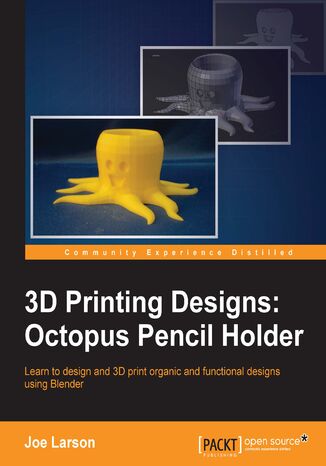
3D printing has revolutionized the way that global industries conceptualize and design products for mass consumption. Considered as the next “trillion-dollar” business, every industry is in the race to equip its personnel with techniques to prototype and simplify complex manufacturing process. This book will take you through some simple to complex and effective principles of designing 3D printed objects using Blender. There is a comprehensive coverage of projects such as a 3D print-ready octopus pencil holder, which will teach you how to add basic geometric shapes, and use techniques such as extruding and subdividing to transform these shapes into complex meshes. Furthermore, you’ll learn to use various techniques to derive measurements for an object, model these objects using Blender, organize the parts into layers, and later combine them to create the desired object with the help of a 3D printable SD card holder ring design project. The final project will help you master the techniques of designing simple to complex puzzles models for 3D printing. Through the course of the book, we'll explore various robust sculpting methods supported by Blender to create objects. You’ll move, rotate, and scale the object, and manipulate the view. You’ll edit objects with actions such as bends or curves, similar to drawing or building up a clay structure of different shapes and sizes. By the end of the book, you will have gained thorough practical hands-on experience to be able to create a real-world 3D printable object of your choice.
Joe Larson
This book will cover the very basic but essential techniques you need to model an organic and functional object for 3D printing using Blender. Starting with pen and paper and then moving on to the computer, you will create your first project in Blender, add basic geometric shapes, and use techniques such as extruding and subdividing to transform these shapes into complex meshes. You will learn how modifiers can automatically refine the shape further and combine multiple shapes into a single 3D printable model. By the end of the book, you will have gained enough practical hands-on experience to be able to create a 3D printable object of your choice, which in this case is a 3D print-ready octopus pencil holder.
3D Printing Designs: The Sun Puzzle. Bringing puzzles in 3 dimensions for 3D printing with Blender
Joe Larson
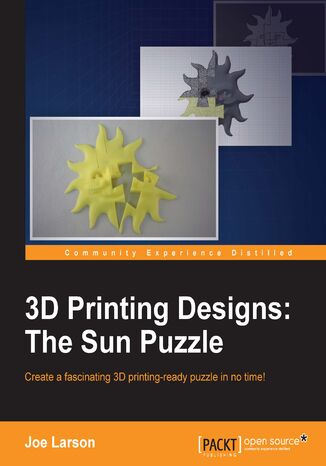
Jigsaw puzzles derive their name from when they were cut from wood sheets using a hand-woodworking tool called a jig saw back in the 1760s. Have you ever wondered how a model idea for a jigsaw puzzle is articulated, and how it was made with these traditional tools? Through this book, you will master the techniques of designing simple to complex puzzles models for 3D printing. We will quickly introduce you to some simple and effective principles of designing 3D printed objects using Blender. Through the course of the book, you'll explore various robust sculpting methods supported by Blender that allow you to edit objects with actions such as bends or curves, similar to drawing or building up a clay structure of different shapes and sizes. Finally, when the model is sculpted, you'll learn some methods to cut the model and carve out multiple pieces of perfectly-fitting edges of different geometries to complete the puzzle.-------------------------------------------Note from CM - [Page count: 60][Price: $9.99 eBook | $19.99 print]
Sualp Ozel
As 3D printing gains traction, the demand for CAD experts in manufacturing grows. If you're a fan of Autodesk Fusion and crave hands-on experience with automated modeling, generative design, and the full potential of additive manufacturing, this book is your guide to elevating your design and 3D printing skills.In this book, you’ll learn how to open CAD or Mesh files in Fusion and expertly repair, edit, and prepare them for 3D printing. You’ll unlock the secrets of effective print preparation, learning about print settings, support structures, and part orientation. This book also highlights Fusion’s diverse preferences designed specifically for additive manufacturing.Subsequent chapters will guide you in choosing the right part orientation and position, as well as creating suitable support structures based on your chosen printing technology. You’ll simulate the printing process to detect and remedy common print failures associated with the metal powder bed fusion process. Finally, you’ll leverage templates and scripts to automate routine tasks around print preparation.By the end of this 3D printing book, you'll be armed with the knowledge and skills necessary to harness the power of Fusion for additive manufacturing, meeting the growing demand with confidence.
3D printing with RepRap Cookbook. Over 80 fast-paced recipes to help you create and print 3D models
Richard Salinas
A systematic guide consisting of over 100 recipes which focus on helping you understand the process of 3D printing using RepRap machines. The book aims at providing professionals with a series of working recipes to help make their fuzzy notions into real, saleable projects/objects using 3D printing technology. This book is for novice designers and artists who own a RepRap-based 3D printer, have fundamental knowledge of its working, and who desire to gain better mastery of the printing process. For the more experienced user, it will provide a handy visual resource, with side-by-side comparisons of the two most popular slicers, Skeinforge and Slic3r. A basic understanding of designing and modeling principles and elementary knowledge of digital modeling would be a plus.
Meir Gottesman
This book is a practical tutorial, packed with real-world case studies to help you design models that print right the first time. If you are familiar with SketchUp and want to print the models you've designed, then this book is ideal for you. You don't need any experience in 3D printing; however, SketchUp beginners will require a companion book or video training series to teach them the basic SketchUp skills.
Aaron Dietzen aka 'The SketchUp Guy'
Working with the amazing 3D printing technology and getting access to the printing hardware is now easier than ever before. While there are many other resources that cover the general process of 3D printing, this book is the ultimate guide to creating models for 3D printing using SketchUp.You’ll start with a basic understanding of how SketchUp is used in the 3D printing workflow and jump into the steps to create a print-ready model using only SketchUp. This 3D printing book will guide you in using SketchUp to modify existing 3D files and cover additional tools that make SketchUp an even more powerful modeling tool. As you advance, you’ll learn how to transform 2D images into 3D printable solids, how to create multi-part prints that can be assembled without the use of fasteners or glue, and how to make sure your model, whether designed from scratch or assembled from preexisting geometry, is ready to be made real via your 3D printer.By the end of this book, you’ll have the confidence to bring your design ideas to life by generating your own 3D print-ready models with SketchUp.