Publisher: Oficyna Wydawnicza Politechniki Białostockiej
Systemotechnical assessment of the real cultural heritage management
Vladislavas Kutut, Leonas Ustinovičius
Identification of the immovable cultural property management options is analyzed in this book by applying mathematical modeling and selective – innovation of multipurpose methods, which allow us to make comprehensive assessments of infrastructural, technological, technical, heritage, social, economic, legal aspects of the immovable cultural property management. The main goal is to create a theory and a decision-making support system based on it, to increase the efficiency of investments in the immovable cultural property management by applying the mathematical modeling and selective – innovation of multi-purpose methods. The authors describe the multi-criteria decision-making support systems for the immovable cultural property management projects and the ways of their practical application. Several practical decision-making solutions are presented, and a decision-making support system is developed to implement the described methods and techniques. The publication is devoted to the researchers, engineering technologists, cultural heritage protection specialists, managers, Ph.D., and Master’s degree students that are interested in the immovable cultural property research, design, and restoration management.
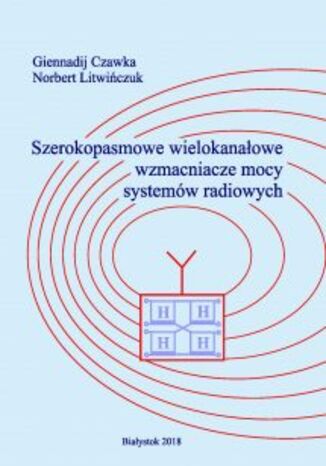
Szerokopasmowe wielokanałowe wzmacniacze mocy systemów radiowych
Giennadij Czawka, Norbert Litwińczuk
W niniejszej pracy przedstawiono opracowanie szerokopasmowych wielokanałowych wzmacniaczy mocy i radiowych kompleksów nadawczych przy jednoczesnym rozwiązywaniu zagadnień szerokopasmowego dopasowania układów wielowrotnikowych. Rozpatrzono struktury i parametry nadawczych i odbiorczych kanałów, właściwości macierzy rozproszenia układów wielowrotnikowych, wprowadzono parametry energetyczne układów antenowych na podstawie wartości i wektorów własnych macierzy zespolonych. Zaproponowane wzmacniacze mocy zawierają kilka bloków wzmacniających oraz specjalne wielokanałowe komutatory fazowe i częstotliwościowe. Szczegółowo przedstawiono struktury i właściwości szerokopasmowych komutatorów fazowych, zapewniających zadane rozkłady faz sygnałów wyjściowych przy wzbudzeniu poszczególnych wejść układu oraz komutatorów częstotliwościowych – multiplekserów, zapewniających zadany rozkład pasm częstotliwości na wyjściach komutatora przy wzbudzeniu poszczególnych wejść układu. Zaproponowano algorytmy syntezy i opracowania optymalnych szerokopasmowych układów dopasowujących do obciążeń zespolonych. Zostało opracowane i opisane własne użytkowe specjalistyczne oprogramowanie do projektowania, modelowania, analizy, symulacji komputerowej oraz optymalizacji zarówno poszczególnych układów i urządzeń, jak i całych szerokopasmowych wielokanałowych wzmacniaczy i kompleksów radiowych. Przedstawiono struktury i wyniki symulacji komputerowej szerokopasmowych wielokanałowych wzmacniaczy mocy do zastosowania w kompleksach nadawczych różnych systemów radiowych.
The problematic aspects of energy efficiency \'21
Maciej Zajkowski, Zbigniew Sołjan (Editors)
The structure of the monograph is very simple and contains 10 articles related to energy efficiency. The issues addressed in the publication are thematically different, but their common denominator, in addition to the aforementioned energy efficiency, is the area of electricity-using technologies. The articles cover issues including wireless transmission of electricity, modern lighting techniques for pedestrian crossings, or topics related to light pollution or reactive power compensation problems.
The problematic aspects of energy efficiency \'22
Maciej Zajkowski, Zbigniew Sołjan (red.)
Energy efficiency is not only energy yield related to the energy consumption in a specific device or building but also the possibility of optimal use of the stored energy in a determine area or in the system, without the necessity for its transmission. Generation, distribution and balancing of energy demand, in a limited area, becomes an energy cluster in which, under the agreement of the entities forming the cluster, there is a possibility for effective management of energy produced and its storage, according to the requirements and assumptions of the capacity market. The purpose of such an initiative is primarily the effective development of distributed energy, which does not have to be based solely on renewable energy sources, but can also use conventional sources, according to dedicated management models. The whole project is intended to improve energy security, have a positive impact on the environment, strengthen the local economy and generate lower costs for the end user. According to the RES Act, a member of an energy cluster can be an enterprise, a natural person, a local government unit and their organizational units. It can also include small, medium and large public transport companies and other entities functioning in the area covered by the energy cluster. A cluster initiative may be established and operate in an area no larger than five municipalities or one county, and its purpose is to obtain financial and non-financial benefits for the members of the energy cluster.
Theoretical and practical aspects of business activity. Business planing
Danuta Szpilko, Joanna Szydło, Ewa Glińska, Urszula...
This publication consists of four chapters. The first chapter refers to generating business ideas, the second to creating a product tailored to market needs, and the third is focused on creating a business plan. The fourth chapter is dedicated to the description of pre-acceleration and acceleration programmes. The publication concludes with a case study on activities supporting entrepreneurial initiatives. The book is dedicated to people seeking a good business solution and aiming to bring it to the market in a timely manner. It should be noted that this does not only apply to new businesses, but also those already existing on the market since they constantly have to generate ideas and adapt them to changing market conditions.
Theoretical and practical aspects of business activity. Starting a business
Joanna Szydło, Danuta Szpilko, Ewa Glińska, Urszula...
Entrepreneurship is a key factor for economic growth, improving the competitiveness of countries’ economies and increasing social prosperity. Young entrepreneurs face a number of challenges as a result of the rapidly changing socio-economic environment. In their activities aimed at launching a business, young entrepreneurs need knowledge and skills on a wide range of topics related to finance, law, marketing, product management, etc. This is why more and more projects aiming at comprehensive assistance in launching a business are being developed. One of them is the project “Acceleration of Business Support Ecosystem” (ACCESS), which was co-financed under the programme Interreg V-A Lithuania-Poland 2014-2020. ACCESS strengthens entrepreneurial initiatives by improving business support services in Kaunas and Marijampole region on the Lithuanian side, as well as Suwalki and Bialystok sub-regions in Poland. One of the many results of the project is the creation of two publications on theoretical and practical aspects of setting up and running a business. These publications aim to popularise entrepreneurial attitudes and provide knowledge necessary to achieve success in business. Young entrepreneurs, before embarking on their brave activities, should check where and what funds they can obtain to start or develop their own enterprise. They should gain knowledge about the target group they intend to reach. In addition, they should focus on ways to communicate with the hypothetical recipient. An equally important aspect is to create a team that will work effectively.
Ewa Pawłuszewicz, Krzysztof Piekarski
Tematyka niniejszego skryptu obejmuje podstawowe wiadomości z zakresu szeroko rozumianego rachunku operatorowego niezbędnego dla studentów między innymi kierunków takich jak automatyka i robotyka (i kierunki pokrewne), elektrotechnika, mechatronika, matematyka stosowana, ale także i kierunków informatycznych lub mechanicznych. W rozdziale pierwszym omawiamy własności transformaty Laplace'a, jej wykorzystywanie do rozwiązywania równań różniczkowych i podajemy przykłady jej zastosowań w analizie układów mechanicznych i elektrycznych. Omawiamy też pojęcie splotu funkcji. Rozdział drugi skupia się na Z -transformacie, nie pomijając też splotu dyskretnego, i wybranych jej zastosowań. W rozdziale trzecim wprowadzamy pojęcie transformaty Fouriera, przy czym nie tylko omawiamy jej własności, lecz także wykorzystanie w analizie spektralnej funkcji, która z kolei jest wykorzystywana między innymi w analizie sygnałów i drgań. Omawiamy też transformatę sinusową i transformatę cosinusową Fouriera.
Trening kompetencji społecznych dla studentów kierunków technicznych
Izabela Senderacka
Książka koncentruje się na treningu wybranych kompetencji społecznych. Przedstawiono tematykę zarządzania czasem, zaprezentowano techniki zwiększające skuteczność organizacji pracy. Wskazano przykładowe metody i aplikacje do organizacji myśli, pomysłów. Uwzględniono relacje studentów z wykonania z ćwiczeń. Książka dotyczy skutecznego planowania i wyznaczania priorytetów. Odnosi się również do budowania alternatywnych planów. Opisano skuteczne sposoby kształtowania postaw asertywnych. Książka może stanowić wsparcie dla studentów, którzy chcą rozwijać wybrane kompetencje społeczne przez indywidualną pracę. Kształtowanie tych kompetencji może odbywać się również przy wsparciu nauczyciela akademickiego, w różnych formach kształcenia. Publikacja dedykowana jest także nauczycielom poszukującym inspiracji do prowadzenia zajęć dydaktycznych w zakresie rozwijania kompetencji społecznych studentów