
Wydawca: Packt Publishing
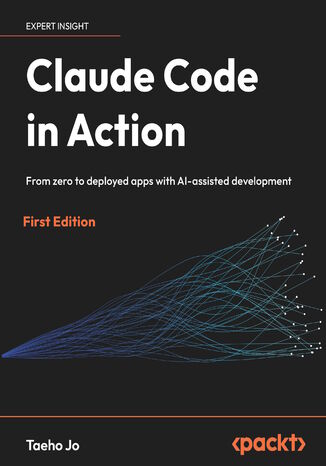
Claude Code in Action. From zero to deployed apps with AI-assisted development
Taeho Jo
You no longer need traditional programming experience to create real applications. This book introduces you to building software using Claude Code, where you will collaborate with AI to design, develop, and deploy applications from scratch.Starting with the basics, you’ll learn how to work effectively with AI assistants, structure prompts, and translate ideas into working software. As you progress, you’ll build a range of real-world projects from personal websites and portfolio apps to interactive tools and AI-powered applications. Each project is designed to reinforce practical skills while exposing you to modern development workflows.The book emphasizes a structured, step-by-step learning approach, guiding you through planning, iteration, debugging, and deployment. You’ll also explore advanced capabilities such as API integration, automation workflows, and AI agent-based development. Later chapters introduce MCP, plugins, and skills to extend Claude Code into a powerful development environment.By the end of this book, you won’t just understand AI-assisted development, you’ll confidently build, customize, and deploy your own applications.
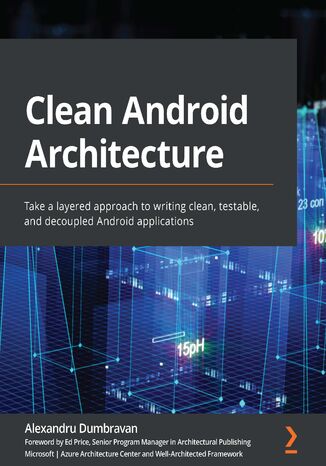
Alexandru Dumbravan
As an application’s code base increases, it becomes harder for developers to maintain existing features and introduce new ones. In this clean architecture book, you'll learn to identify when and how this problem emerges and how to structure your code to overcome it.The book starts by explaining clean architecture principles and Android architecture components and then explores the tools, frameworks, and libraries involved. You’ll learn how to structure your application in the data and domain layers, the technologies that go in each layer, and the role that each layer plays in keeping your application clean. You’ll understand how to arrange the code into these two layers and the components involved in assembling them. Finally, you'll cover the presentation layer and the patterns that can be applied to have a decoupled and testable code base.By the end of this architecture book, you'll be able to build an application following clean architecture principles and have the knowledge you need to maintain and test the application easily.
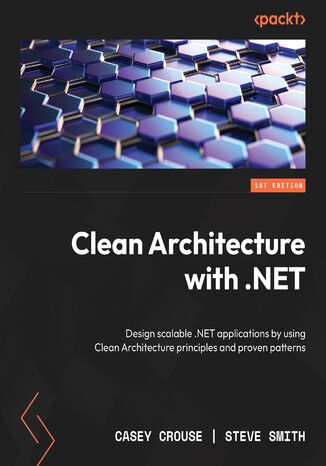
Casey Crouse, Steve "Ardalis" Smith, Jason Taylor
Learn how to apply Clean Architecture in real-world .NET applications with Azure in this guide. Designed around an e-commerce project - Project Odyssey, you’ll design and build every architectural layer, from core domain logic and application orchestration to infrastructure and presentation. This book equips you to apply DDD, CQRS, MediatR, and dependency injection, enabling loosely coupled, testable systems. You’ll build reusable and modular code structures that scale with your application’s complexity and learn how to persist data using EF Core with a code-first approach, managing schema evolution with migrations while keeping infrastructure concerns isolated from your domain logic. Learn how to develop secure systems by integrating Azure External ID, Azure Key Vault, and application-level authentication and authorization. Gain practical experience with Blazor Server, Razor components, and MudBlazor UI, all integrated within a layered architecture. Learn to enforce business logic boundaries, reduce boilerplate with generic request handlers, and use real-world use cases like payment processing and shopping cart management. Whether you're new to Clean Architecture or scaling up enterprise solutions, this book provides the patterns, tools, and mindset to succeed. *Email sign-up and proof of purchase required
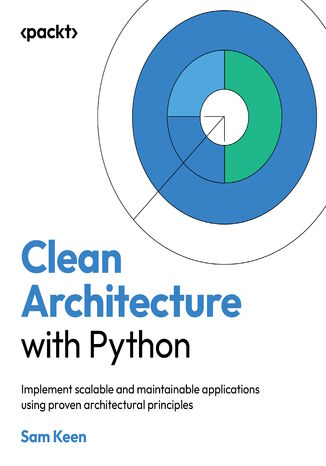
Sam Keen
In the rapidly evolving tech industry, software applications struggle to keep pace with changing business needs, leaving developers grappling with complex codebases that resist change, ultimately reducing productivity and increasing technical debt. Clean Architecture with Python offers a powerful approach to address these challenges. Drawing from his extensive experience architecting cloud-native systems, Sam Keen helps you transform complex architectural challenges into digestible, implementable solutions.This book teaches essential principles for effective development, emphasizing the Pythonic implementation of Clean Architecture. Through practical examples, you'll learn how to create modular, loosely coupled systems that are easy to understand, modify, and extend. The book covers key concepts such as the Dependency Rule, separation of concerns, and domain modeling, all tailored for Python development.By the end of this book, you'll be able to apply Clean Architecture principles effectively in your Python projects. Whether you're building new systems or managing existing ones, you'll have the skills to create more maintainable and adaptable applications. This approach will enhance your ability to respond to changing requirements, setting you up for long-term success in your development career.
Jason Alls
Traditionally associated with developing Windows desktop applications and games, C# is now used in a wide variety of domains, such as web and cloud apps, and has become increasingly popular for mobile development. Despite its extensive coding features, professionals experience problems related to efficiency, scalability, and maintainability because of bad code. Clean Code in C# will help you identify these problems and solve them using coding best practices.The book starts with a comparison of good and bad code, helping you understand the importance of coding standards, principles, and methodologies. You’ll then get to grips with code reviews and their role in improving your code while ensuring that you adhere to industry-recognized coding standards. This C# book covers unit testing, delves into test-driven development, and addresses cross-cutting concerns. You’ll explore good programming practices for objects, data structures, exception handling, and other aspects of writing C# computer programs. Once you’ve studied API design and discovered tools for improving code quality, you’ll look at examples of bad code and understand which coding practices you should avoid.By the end of this clean code book, you’ll have the developed skills you need in order to apply industry-approved coding practices to write clean, readable, extendable, and maintainable C# code.
Clean Code in JavaScript. Develop reliable, maintainable, and robust JavaScript
James Padolsey
Building robust apps starts with creating clean code. In this book, you’ll explore techniques for doing this by learning everything from the basics of JavaScript through to the practices of clean code. You’ll write functional, intuitive, and maintainable code while also understanding how your code affects the end user and the wider community.The book starts with popular clean-coding principles such as SOLID, and the Law of Demeter (LoD), along with highlighting the enemies of writing clean code such as cargo culting and over-management. You’ll then delve into JavaScript, understanding the more complex aspects of the language. Next, you’ll create meaningful abstractions using design patterns, such as the Class Pattern and the Revealing Module Pattern. You’ll explore real-world challenges such as DOM reconciliation, state management, dependency management, and security, both within browser and server environments. Later, you’ll cover tooling and testing methodologies and the importance of documenting code. Finally, the book will focus on advocacy and good communication for improving code cleanliness within teams or workplaces, along with covering a case study for clean coding.By the end of this book, you’ll be well-versed with JavaScript and have learned how to create clean abstractions, test them, and communicate about them via documentation.
Carsten Windler, Alexandre Daubois
PHP is a beginner-friendly language, but also one that is rife with complaints of bad code, yet no clean code books are specific to PHP. Enter Clean Code in PHP. This audiobook is a one-stop guide to learning the theory and best practices of clean code specific to real-world PHP app development environments.This PHP audiobook is cleanly split to help you navigate through coding practices and theories to understand and adopt the nuances of the clean code paradigm. In addition to covering best practices, tooling for code quality, and PHP design patterns, this audiobook also presents tips and techniques for working on large-scale PHP apps with a team and writing effective documentation for your PHP projects.By the end of this audiobook, you’ll be able to write human-friendly PHP code, which will fuel your PHP career growth and set you apart from the competition.
Carsten Windler, Alexandre Daubois
PHP is a beginner-friendly language, but also one that is rife with complaints of bad code,;yet no clean code books are specific to PHP. Enter Clean Code in PHP. This book is a one-stop guide to learning the theory and best practices of clean code specific to real-world PHP app development environments.This PHP book is cleanly split to help you navigate through coding practices and theories to understand and adopt the nuances of the clean code paradigm. In addition to covering best practices, tooling for code quality, and PHP design patterns, this book also presents tips and techniques for working on large-scale PHP apps with a team and writing effective documentation for your PHP projects.By the end of this book, you’ll be able to write human-friendly PHP code, which will fuel your PHP career growth and set you apart from the competition.
Clean Code in Python. Refactor your legacy code base
Mariano Anaya
Python is currently used in many different areas such as software construction, systems administration, and data processing. In all of these areas, experienced professionals can find examples of inefficiency, problems, and other perils, as a result of bad code. After reading this book, readers will understand these problems, and more importantly, how to correct them. The book begins by describing the basic elements of writing clean code and how it plays an important role in Python programming. You will learn about writing efficient and readable code using the Python standard library and best practices for software design. You will learn to implement the SOLID principles in Python and use decorators to improve your code. The book delves more deeply into object oriented programming in Python and shows you how to use objects with descriptors and generators. It will also show you the design principles of software testing and how to resolve software problems by implementing design patterns in your code. In the final chapter we break down a monolithic application to a microservice one, starting from the code as the basis for a solid platform. By the end of the book, you will be proficient in applying industry approved coding practices to design clean, sustainable and readable Python code.
Mariano Anaya
Experienced professionals in every field face several instances of disorganization, poor readability, and testability due to unstructured code.This second edition has been updated to reflect new best practices in Python 3.9, helping developers write professional, scalable, and maintainable code. It introduces advanced object-oriented design, decorators, descriptors, and refactoring strategies using SOLID principles. Whether modernizing legacy projects or building new applications, this book provides practical techniques to write cleaner and more efficient Python code using the Python standard library and manage your projects successfully.The book begins by describing the basic elements of writing clean code and how it plays a key role in Python programming. The book discusses object-oriented programming in Python and show you the design principles of software testing and how to resolve problems by implementing software design patterns in your code. In the concluding chapter, we break down a monolithic application into a microservices-based one starting from the code as the basis for a solid platform.By the end of this clean code book, you will be proficient in applying industry-approved coding practices to design clean, sustainable, and readable real-world Python code.
Jason Alls
Traditionally associated with Windows desktop applications and game development, C# has expanded into web, cloud, and mobile development. However, despite its extensive coding features, professionals often encounter issues with efficiency, scalability, and maintainability due to poor code. Clean Code in C# guides you in identifying and resolving these problems using coding best practices.This book starts by comparing good and bad code to emphasize the importance of coding standards, principles, and methodologies. It then covers code reviews, unit testing, and test-driven development, and addresses cross-cutting concerns. As you advance through the chapters, you’ll discover programming best practices for objects, data structures, exception handling, and other aspects of writing C# computer programs. You’ll also explore API design and code quality enhancement tools, while studying examples of poor coding practices to understand what to avoid.By the end of this clean code book, you’ll have the developed the skills needed to apply industry-approved coding practices to write clean, readable, extendable, and maintainable C# code.
Rukevwe Ojigbo, Dr. Sanjay Krishna Anbalagan
Clean Code with TypeScript is a practical guide to writing maintainable, efficient, and elegant TypeScript code. It equips developers with the essential principles and techniques to produce code that is both functional and easy to read and maintain.Written by Rukevwe Ojigbo and Dr. Sanjay Krishna Anbalagan, expert software engineers with extensive experience in building scalable, high-performance applications across industries, this book reflects practical lessons from their real-world projects. Throughout the book, you’ll work through hands-on implementations, including an LLM integration project and a full-stack TypeScript application, ensuring the concepts are grounded, relevant, and applicable to real development environments.What sets this book apart is its example-driven approach rooted in real-world scenarios. It goes beyond TypeScript best practices by developing your architectural thinking, enhancing team collaboration, and fostering long-term code quality. Whether you're new to TypeScript or an experienced developer, this guide will improve your TypeScript programming skills and help you deliver cleaner, more robust code.*Email sign-up and proof of purchase required
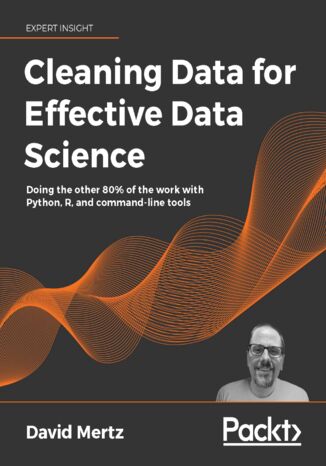
David Mertz
Data cleaning is the all-important first step to successful data science, data analysis, and machine learning. If you work with any kind of data, this book is your go-to resource, arming you with the insights and heuristics experienced data scientists had to learn the hard way.In a light-hearted and engaging exploration of different tools, techniques, and datasets real and fictitious, Python veteran David Mertz teaches you the ins and outs of data preparation and the essential questions you should be asking of every piece of data you work with.Using a mixture of Python, R, and common command-line tools, Cleaning Data for Effective Data Science follows the data cleaning pipeline from start to end, focusing on helping you understand the principles underlying each step of the process. You'll look at data ingestion of a vast range of tabular, hierarchical, and other data formats, impute missing values, detect unreliable data and statistical anomalies, and generate synthetic features. The long-form exercises at the end of each chapter let you get hands-on with the skills you've acquired along the way, also providing a valuable resource for academic courses.
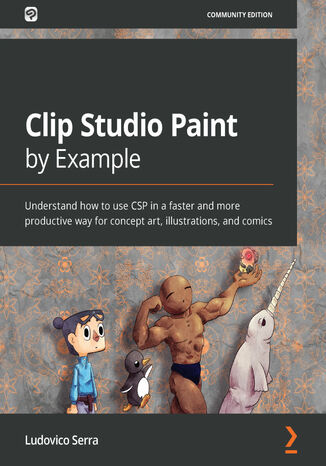
Ludovico Serra
Clip Studio Paint is powerful art software that can help you create artistic work with its in-built material organizer, 3D integration, and group work features. It also provides other features that can speed up the workflow of illustrators, concept artists, and comic artists. With Clip Studio Paint by Example, you’ll learn how to use CSP effectively for a wide variety of artistic purposes.The book starts by helping you create the right workspace for concept art, illustration, and comics. You’ll create a brush, set up a canvas, and develop an auto-auction. Along with covering how to work with CS Modeler that comes bundled with CSP, this book shows you how to import and rig characters easily. You’ll then create reusable changeable scenes and a 3D human character in Blender before exploring concept art, illustrations, comics, and how to create your own portfolio. The book features a glossary with brief explanations of all the main CSP functions. The focus of the book is not on drawing or painting but on helping you enhance your artistic skills using Clip Studio Paint to create an impressive portfolio.By the end of this book, you’ll be able to use the impressive capabilities of CSP to create beautiful digital art in a productive way.
Eric Richard Rochester
This book is for those with a basic knowledge of Clojure, who are looking to push the language to excel with data analysis.
Rafik Naccache
Data-structures and algorithms often cross your path when you compress files, compile programs, access databases, or simply use your favourite text editor. Understanding and implementing them can be daunting. Curious learners and industrial developers can find these complex, especially if they focus on the detailed implementation of these data structures.Clojure is a highly pragmatic and expressive language with efficient and easy data manipulation capabilities. As such, it is great for implementing these algorithms. By abstracting away a great share of the unnecessary complexity resulting from implementation, Clojure and its contrib libraries will help you address various algorithmic challenges, making your data exploration both profitable and enjoyable.Through 25 recipes, you'll explore advanced algorithms and data-structures, well served by a sound Clojure implementation.This book opens with an exploration of alternative uses of the array data-structure, covering LZ77 compression, drawing fractals using Pascal's triangles, simulating a multi-threaded program execution, and implementing a call-stack winding and un-winding operations.The book elaborates on linked lists, showing you how to construct doubly linked ones, speed up search times over the elements of such structures, use a linked-list as the foundation of a shift-reduce parser, and implement an immutable linked-list using skew binary numbers representation.After that, the tree data-structure is explored, focusing on building self-balancing Splay Trees, designing a B-Tree backing-up an efficient key-value data-store, constructing an undo capable Rope, and showing how Tries can make for an auto-completing facility.Next, some optimization and machine learning techniques are discussed, namely for building a co-occurrence-based recommendation engine, using branch-and-bound to optimize integral cost and profit problems, using Dijkstra's algorithm to determine optimal paths and summarizing texts using the LexRank algorithm.Particular attention is given to logic programming, you will learn to use this to discover interesting relations between social website data, by designing a simple type inferencer for a mini Java-like language, and by building a simple checkers game engine.Asynchronous programming will be addressed and you will design a concurrent web-crawler, an interactive HTML5 game, and an online taxi booking platform.Finally, you'll explore advanced cases for higher order functions in Clojure while implementing a recursive descent parser using efficient mutual resucrsion, devising a mini resusable firewall simulator thanks to Clojure 1.7 new tansducers feature or building a simple unification engine with the help of Continuation Passing Style.