
Publisher: Packt Publishing
Artan Sinani
Provided as a part of Microsoft's Bing suite of search engines, Bing Maps is a web mapping service powered by the Bing Maps for Enterprise framework. The need for geospatial data has increased dramatically in the last few years. Adding a mapping context to any location-based data is becoming more and more common, and businesses are embracing it to improve their user experience with new data richness. Comprising of simple, follow-along examples, Learning Bing Maps API will show you how to use the many features of Bing Maps, from dropping a simple map on a web page, to fetching geospatial data from the Microsoft servers. Through the course of this book you will build a solid foundation for creating your own geo-applications.Following the hands-on recipes of this book, you will build a different web app in each chapter as you communicate with different APIs provided by Bing Maps. You will build your own library of JavaScript modules that talk to the Microsoft Maps API.You will create a custom theme for the map, with your own controls. Taking advantage of the global reach of Bing Maps, you will learn how to build a route scheduler for a delivery company in Madrid, Spain, and then you will discover how to create jobs on the Bing Maps servers for geocoding addresses in California, USA. By the end of the book you will have learned everything you need to know to embed a map on a web page, with your own geo-data, or data obtained by the Bing Map Services.
Richard Caetano
The financial crisis of 2008 raised attention to the need for transparency and accountability in the financial world. As banks and governments were scrambling to stay solvent while seeking a sustainable plan, a powerfully new and resilient technology emerged.Bitcoin, built on a fundamentally new technology called “The Blockchain,” offered the promise of a new financial system where transactions are sent directly between two parties without the need for central control.Bitcoin exists as an open and transparent financial system without banks, governments, or corporate support. Simply put, Bitcoin is “programmable money” that has the potential to change the world on the same scale as the Internet itself.This book arms you with immense knowledge of Bitcoin and helps you implement the technology in your money matters, enabling secure transactions.We first walk through the fundamentals of Bitcoin, illustrate how the technology works, and exemplify how to interact with this powerful and new financial technology. You will learn how to set up your online Bitcoin wallet, indulge in buying and selling of bitcoins, and manage their storage. We then get to grips with the most powerful algorithm of all times: the Blockchain, and learn how crypto-currencies can reduce the risk of fraud for e-commerce merchants and consumers.With a solid base of Blockchain, you will write and execute your own custom transactions. Most importantly, you will be able to protect and secure your Bitcoin with the help of effective solutions provided in the book. Packed with plenty of screenshots, Learning Bitcoin is a simple and painless guide to working with Bitcoin.
Arindam Mukherjee
If you are a C++ programmer who has never used Boost libraries before, this book will get you up-to-speed with using them. Whether you are developing new C++ software or maintaining existing code written using Boost libraries, this hands-on introduction will help you decide on the right library and techniques to solve your practical programming problems.
Learning Bootstrap 4 by Building Projects. Develop 5 real-world Bootstrap 4.x projects from scratch
Eduonix Learning Solutions
Bootstrap, the world’s most popular frontend framework, is an open source toolkit for building web applications with HTML, CSS, and JavaScript.Learning Bootstrap 4 by Building Projects covers the essentials of Bootstrap 4 along with best practices. The book begins by introducing you to the latest features of Bootstrap 4. You will learn different elements and components of Bootstrap, such as the strict grid system, Sass, which replaced Less, flexbox, Font Awesome, and cards. As you make your way through the chapters, you will use a template that will help you to build different kinds of real-world websites, such as a social media website, a company landing page, a media hosting website, and a profile page, with ease.By the end of this book, you will have built websites that are visually appealing, responsive, and robust.
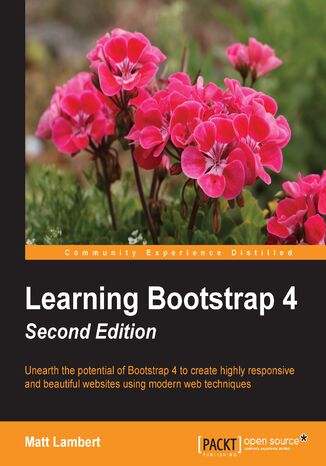
Learning Bootstrap 4. Modern, Elegant and Responsive Web Design Made Easy - Second Edition
Matt Lambert
Bootstrap, the most popular front-end framework built to design elegant, powerful, and responsive interfaces for professional-level web pages has undergone a major overhaul. Bootstrap 4 introduces a wide range of new features that make front-end web design even simpler and exciting.In this gentle and comprehensive book, we'll teach you everything that you need to know to start building websites with Bootstrap 4 in a practical way. You'll learn about build tools such as Node, Grunt, and many others. You'll also discover the principles of mobile-first design in order to ensure your pages can fit any screen size and meet the responsive requirements. Learn to play with Bootstrap's grid system and base CSS to ensure your designs are robust and that your development process is speedy and efficient. Then, you'll find out how you can extend your current build with some cool JavaScript Plugins, and throw in some Sass to spice things up and customize your themes. This book will make sure you're geared up and ready to build amazingly beautiful and responsive websites in a jiffy.
Aravind Shenoy
If you want to learn to build enterprise-level websites efficiently with Bootstrap, this book is for you. You must have a basic and fundamental understanding of HTML, CSS, and JavaScript; however, there is no need to have prior Bootstrap experience.
Micael DaGraça, Grzegorz Lukosek
Do you want to learn C# programming by creating fun and interactive games using the latest Unity 2017 platform? If so, look no further; this is the right book for you. Get started with programming C# so you can create 2D and 3D games in Unity. We will walk you through the basics to get you started with C# 7 and its latest features. Then, explore the use of C# 7 and its latest functional programming capabilities to create amazing games with Unity 2017.You will create your first C# script for Unity, add objects into it, and learn how to create game elements with it. Work with the latest functional programming features of C# and leverage them for great game scripting.Throughout the book, you will learn to use the new Unity 2017 2D tool set and create an interactive 2D game with it. You will make enemies appear to challenge your player, and discover some optimization techniques for great game performance. At the end, you will learn how to transform a 2D game into 3D, and you will be able to skill up to become a pro C# programmer with Unity 2017!
William Sherif
If you are really passionate about games and have always wanted to write your own, this book is perfect for you. It will help you get started with programming in C++ and explore the immense functionalities of UE4.