
Wydawca: Packt Publishing
Tom Ryder
Network monitoring requires significantly more than just pinging hosts. This cookbook will help you to comprehensively test your networks' major functions on a regular basis.Nagios Core Administration Cookbook will show you how to use Nagios Core as a monitoring framework that understands the layers and subtleties of the network for intelligent monitoring and notification behaviour. Nagios Core Administration Guide introduces the reader to methods of extending Nagios Core into a network monitoring solution. The book begins by covering the basic structure of hosts, services, and contacts and then goes on to discuss advanced usage of checks and notifications, and configuring intelligent behaviour with network paths and dependencies. The cookbook emphasizes using Nagios Core as an extensible monitoring framework. By the end of the book, you will learn that Nagios Core is capable of doing much more than pinging a host or to check if websites respond.
Native Docker Clustering with Swarm. Create and manage clusters of any size
Chanwit Kaewkasi, Fabrizio Soppelsa
Docker Swarm serves as one of the crucial components of the Docker ecosystem and offers a native solution for you to orchestrate containers. It’s turning out to be one of the preferred choices for Docker clustering thanks to its recent improvements. This book covers Swarm, Swarm Mode, and SwarmKit. It gives you a guided tour on how Swarm works and how to work with Swarm. It describes how to set up local test installations and then moves to huge distributed infrastructures. You will be shown how Swarm works internally, what’s new in Swarmkit, how to automate big Swarm deployments, and how to configure and operate a Swarm cluster on the public and private cloud. This book will teach you how to meet the challenge of deploying massive production-ready applications and a huge number of containers on Swarm. You'll also cover advanced topics that include volumes, scheduling, a Libnetwork deep dive, security, and platform scalability.
NativeScript for Angular Mobile Development. Creating dynamic mobile apps for iOS and Android
Nathanael J. Anderson, Nathan Walker
NativeScript is an open source framework that is built by Progress in order to build truly native mobile apps with TypeScript, JavaScript or just Angular which is an open source framework built by Google that offers declarative templates, dependency injection, and fully featured modules to build rich applications. Angular’s versatile view handling architecture allows your views to be rendered as highly performant UI components native to iOS and Android mobile platforms. This decoupling of the view rendering layer in Angular combined with the power of native APIs with NativeScript have together created the powerful and exciting technology stack of NativeScript for Angular.This book focuses on the key concepts that you will need to know to build a NativeScript for Angular mobile app for iOS and Android. We’ll build a fun multitrack recording studio app, touching on powerful key concepts from both technologies that you may need to know when you start building an app of your own. The structure of the book takes the reader from a void to a deployed app on both the App Store and Google Play, serving as a reference guide and valuable tips/tricks handbook.By the end of this book, you’ll know majority of key concepts needed to build a successful NativeScript for Angular app.
Brian Sacash, Bhargav Srinivasa-Desikan, Reddy Anil Kumar
Modern text analysis is now very accessible using Python and open source tools, so discover how you can now perform modern text analysis in this era of textual data.This book shows you how to use natural language processing, and computational linguistics algorithms, to make inferences and gain insights about data you have. These algorithms are based on statistical machine learning and artificial intelligence techniques. The tools to work with these algorithms are available to you right now - with Python, and tools like Gensim and spaCy.You'll start by learning about data cleaning, and then how to perform computational linguistics from first concepts. You're then ready to explore the more sophisticated areas of statistical NLP and deep learning using Python, with realistic language and text samples. You'll learn to tag, parse, and model text using the best tools. You'll gain hands-on knowledge of the best frameworks to use, and you'll know when to choose a tool like Gensim for topic models, and when to work with Keras for deep learning.This book balances theory and practical hands-on examples, so you can learn about and conduct your own natural language processing projects and computational linguistics. You'll discover the rich ecosystem of Python tools you have available to conduct NLP - and enter the interesting world of modern text analysis.
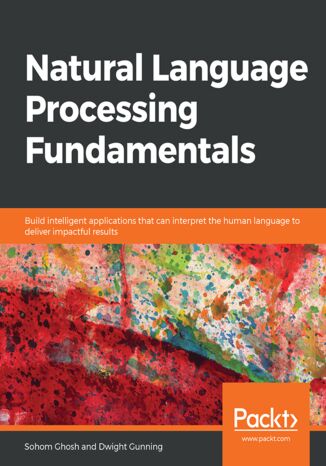
Sohom Ghosh , Dwight Gunning
If NLP hasn't been your forte, Natural Language Processing Fundamentals will make sure you set off to a steady start. This comprehensive guide will show you how to effectively use Python libraries and NLP concepts to solve various problems.You'll be introduced to natural language processing and its applications through examples and exercises. This will be followed by an introduction to the initial stages of solving a problem, which includes problem definition, getting text data, and preparing it for modeling. With exposure to concepts like advanced natural language processing algorithms and visualization techniques, you'll learn how to create applications that can extract information from unstructured data and present it as impactful visuals. Although you will continue to learn NLP-based techniques, the focus will gradually shift to developing useful applications. In these sections, you'll understand how to apply NLP techniques to answer questions as can be used in chatbots. By the end of this book, you'll be able to accomplish a varied range of assignments ranging from identifying the most suitable type of NLP task for solving a problem to using a tool like spacy or gensim for performing sentiment analysis. The book will easily equip you with the knowledge you need to build applications that interpret human language.
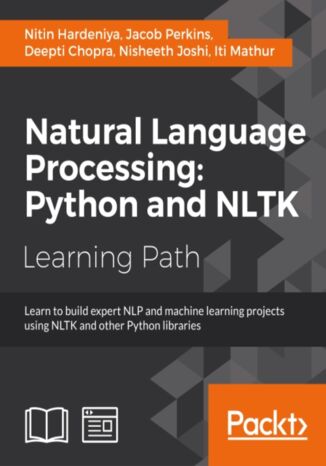
Natural Language Processing: Python and NLTK. Click here to enter text
Jacob Perkins, Nitin Hardeniya, Deepti Chopra, Iti...
Natural Language Processing is a field of computational linguistics and artificial intelligence that deals with human-computer interaction. It provides a seamless interaction between computers and human beings and gives computers the ability to understand human speech with the help of machine learning. The number of human-computer interaction instances are increasing so it’s becoming imperative that computers comprehend all major natural languages. The first NLTK Essentials module is an introduction on how to build systems around NLP, with a focus on how to create a customized tokenizer and parser from scratch. You will learn essential concepts of NLP, be given practical insight into open source tool and libraries available in Python, shown how to analyze social media sites, and be given tools to deal with large scale text. This module also provides a workaround using some of the amazing capabilities of Python libraries such as NLTK, scikit-learn, pandas, and NumPy.The second Python 3 Text Processing with NLTK 3 Cookbook module teaches you the essential techniques of text and language processing with simple, straightforward examples. This includes organizing text corpora, creating your own custom corpus, text classification with a focus on sentiment analysis, and distributed text processing methods. The third Mastering Natural Language Processing with Python module will help you become an expert and assist you in creating your own NLP projects using NLTK. You will be guided through model development with machine learning tools, shown how to create training data, and given insight into the best practices for designing and building NLP-based applications using Python.This Learning Path combines some of the best that Packt has to offer in one complete, curated package and is designed to help you quickly learn text processing with Python and NLTK. It includes content from the following Packt products:? NTLK essentials by Nitin Hardeniya? Python 3 Text Processing with NLTK 3 Cookbook by Jacob Perkins? Mastering Natural Language Processing with Python by Deepti Chopra, Nisheeth Joshi, and Iti Mathur
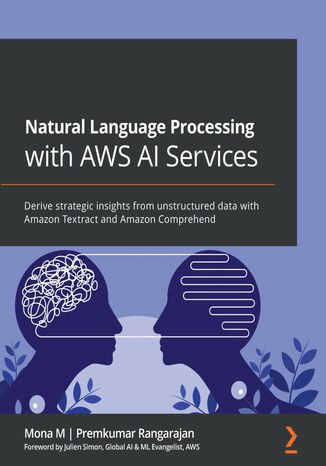
Mona M, Premkumar Rangarajan
Natural language processing (NLP) uses machine learning to extract information from unstructured data. This book will help you to move quickly from business questions to high-performance models in production.To start with, you'll understand the importance of NLP in today’s business applications and learn the features of Amazon Comprehend and Amazon Textract to build NLP models using Python and Jupyter Notebooks. The book then shows you how to integrate AI in applications for accelerating business outcomes with just a few lines of code. Throughout the book, you'll cover use cases such as smart text search, setting up compliance and controls when processing confidential documents, real-time text analytics, and much more to understand various NLP scenarios. You'll deploy and monitor scalable NLP models in production for real-time and batch requirements. As you advance, you'll explore strategies for including humans in the loop for different purposes in a document processing workflow. Moreover, you'll learn best practices for auto-scaling your NLP inference for enterprise traffic.Whether you're new to ML or an experienced practitioner, by the end of this NLP book, you'll have the confidence to use AWS AI services to build powerful NLP applications.
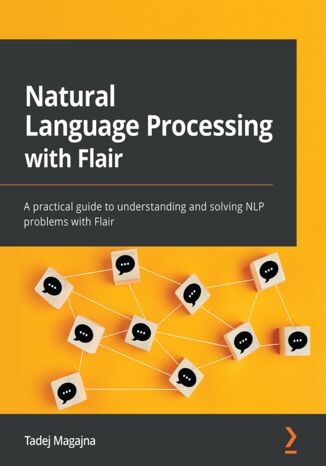
Tadej Magajna
Flair is an easy-to-understand natural language processing (NLP) framework designed to facilitate training and distribution of state-of-the-art NLP models for named entity recognition, part-of-speech tagging, and text classification. Flair is also a text embedding library for combining different types of embeddings, such as document embeddings, Transformer embeddings, and the proposed Flair embeddings.Natural Language Processing with Flair takes a hands-on approach to explaining and solving real-world NLP problems. You'll begin by installing Flair and learning about the basic NLP concepts and terminology. You will explore Flair's extensive features, such as sequence tagging, text classification, and word embeddings, through practical exercises. As you advance, you will train your own sequence labeling and text classification models and learn how to use hyperparameter tuning in order to choose the right training parameters. You will learn about the idea behind one-shot and few-shot learning through a novel text classification technique TARS. Finally, you will solve several real-world NLP problems through hands-on exercises, as well as learn how to deploy Flair models to production.By the end of this Flair book, you'll have developed a thorough understanding of typical NLP problems and you’ll be able to solve them with Flair.