
Publisher: Packt Publishing
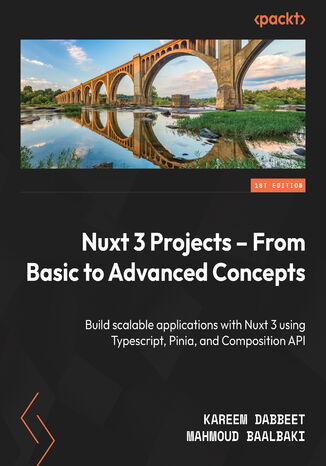
Kareem Dabbeet, Mahmoud Baalbaki, Daniel Kelly
Nuxt 3 Projects takes you on a hands-on learning journey through the world of Nuxt 3, the cutting-edge Vue.js framework. With a strong emphasis on project-based learning, this book ensures you gain practical, real-world experience in building robust and scalable applications.This book guides you through comprehensive projects, starting with Nuxt fundamentals, delving into Nuxt 3's unique features like project structure, file-based routing, views, layouts, and components. You'll cover aspects like the Composition API, reusable components, and state management with Pinia, intertwining theory with practical applications. Next, the book explores data fetching, error handling, authentication, SEO, and middleware. Each concept is paired with a real-life project for immediate practical reinforcement. Later chapters tackle testing, debugging, building custom modules, and building monorepos for superior code organization. Finally, a comprehensive capstone project helps you apply all the concepts you’ve learned, empowering you to architect robust, scalable Nuxt 3 applications.By the end of this book, you'll be able to efficiently apply Nuxt to Vue.js projects, confidently tackling real-world challenges and enhancing scalability.
Alessandro Benoit
If you are an experienced Node.js developer who wants to create amazing desktop applications using NW.js, this is the book for you. Prior knowledge of HTML5, jQuery, and CSS is assumed.
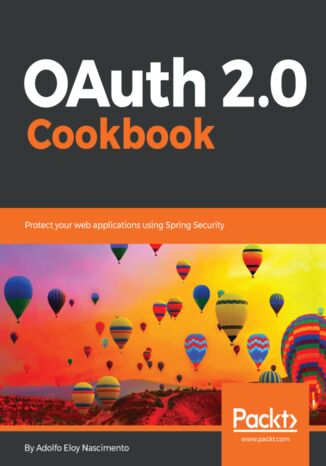
OAuth 2.0 Cookbook. Protect your web applications using Spring Security
Adolfo Eloy Nascimento
OAuth 2.0 is a standard protocol for authorization and focuses on client development simplicity while providing specific authorization flows for web applications, desktop applications, mobile phones, and so on. This book also provides useful recipes for solving real-life problems using Spring Security and creating Android applications.The book starts by presenting you how to interact with some public OAuth 2.0 protected APIs such as Facebook, LinkedIn and Google. You will also be able to implement your own OAuth 2.0 provider with Spring Security OAuth2. Next, the book will cover practical scenarios regarding some important OAuth 2.0 profiles such as Dynamic Client Registration, Token Introspection and how to revoke issued access tokens. You will then be introduced to the usage of JWT, OpenID Connect, and how to safely implement native mobile OAuth 2.0 Clients.By the end of this book, you will be able to ensure that both the server and client are protected against common vulnerabilities.
Gibson Tang
If you are new to Objective-C or a veteran in iOS application development, this is the book for you. This book will ensure that you can actively learn the methods and concepts in relation to memory management in a more engaging way. Basic knowledge of iOS development is required for this book.
Stoyan STEFANOV
The book requires no prior knowledge of JavaScript and works from the ground up to give you a thorough grounding in this powerful language. If you do already know some JavaScript, you will find plenty of eye-openers as you discover just what the language can do. This book takes a do-it-yourself approach when it comes to writing code, because the best way to really learn a programming language is by writing code. You are encouraged to type code into Firebug's console, see how it works and then tweak it and play around with it. There are practice questions at the end of each chapter to help review what you have learned.
Stoyan STEFANOV
JavaScript is the behavior, the third pillar in today's paradigm that looks at web pages as something that consists of clearly distinguishable parts: content (HTML), presentation (CSS) and behavior (JavaScript). Using JavaScript, you can create not only web pages but also desktop widgets, browser and application extensions, and other pieces of software. It's a pretty good deal: you learn one language and then code all kinds of different applications. While there's one chapter specifically dedicated to the web browser environment including DOM, Events and AJAX tutorials, the rest is applicable to the other environmentsMany web developers have tried coding or adopting some bits of JavaScript, but it is time to man up and learn the language properly because it is the language of the browser and is, virtually, everywhere. This book starts from zero, not assuming any prior JavaScript programming knowledge and takes you through all the in-depth and exciting futures hidden behind the facade. Once listed in the nice to have sections of job postings, these days the knowledge of JavaScript is a deciding factor when it comes to hiring web developers. After reading this book you'll be prepared to ace your JavaScript job interview and even impress with some bits that the interviewer maybe didn't know. You should read this book if you want to be able to take your JavaScript skills to a new level of sophistication.
Stoyan STEFANOV, Ved Antani
JavaScript is an object-oriented programming language that is used for website development. Web pages developed today currently follow a paradigm that has three clearly distinguishable parts: content (HTML), presentation (CSS), and behavior (JavaScript). JavaScript is one important pillar in this paradigm, and is responsible for the running of the web pages.This book will take your JavaScript skills to a new level of sophistication and get you prepared for your journey through professional web development. Updated for ES6, this book covers everything you will need to unleash the power of object-oriented programming in JavaScript while building professional web applications. The book begins with the basics of object-oriented programming in JavaScript and then gradually progresses to cover functions, objects, and prototypes, and how these concepts can be used to make your programs cleaner, more maintainable, faster, and compatible with other programs/libraries. By the end of the book, you will have learned how to incorporate object-oriented programming in your web development workflow to build professional JavaScript applications.
Matthew Gifford
Are you tired of procedural programming or is your extensive code base starting to become un-manageable? Breathe some new life into your code and improve your development skills with the basic concepts of object-oriented programming. Utilize objects, modular components, and design patterns to expand your skills and improve your ColdFusion applications. Packed with example code, and written in a friendly, easy-to-read style, this book is just what you need if you are serious about ColdFusion.This book is a fast-paced tutorial to important ColdFusion object-oriented programming topics. It will give you clear, concise, and practical guidance to take you from the basics of ColdFusion to the skills that will make you a ColdFusion developer to be reckoned with. Don't be put off by jargon or complex diagrams; read and see how you can benefit from this book and extend your development skills in the process.Using the practical examples within this guide, you will learn how to structure your applications and code, applying the fundamental basics of object-oriented programming to develop modular, reusable components that will scale easily with your application. You will learn the basic fundamental practices of object-oriented programming, from object creation and re-use, to Bean objects, service layers, Data Access objects, and sample design patterns to gain a better understanding of OOP using examples that can be altered and applied in your application. Complete with detailed code samples and snippets, and written in a friendly easy-to-follow style, you will be able to break free from writing purely procedural code and enhance your applications by building structured applications utilizing basic design patterns and object-oriented principles.