
Wydawca: Packt Publishing
Symeon Huang
If you are a programmer looking for a truly cross-platform GUI framework to help you save your time by side-stepping the incompatibility between different platforms and building applications using Qt 5 for multiple targets, then this book is most certainly intended for you. It is assumed that you have a basic programming experience of C++ and fundamental knowledge about Qt.
Lee Zhi Eng
With the advancement of computer technology, the software market is exploding with tons of software choices for the user, making their expectations higher in terms of functionality and the look and feel of the application. Therefore, improving the visual quality of your application is vital in order to overcome the market competition and stand out from the crowd.This book will teach you how to develop functional and appealing software using Qt5 through multiple projects that are interesting and fun. This book covers a variety of topics such as look-and-feel customization, GUI animation, graphics rendering, implementing Google Maps, and more. You will learn tons of useful information, and enjoy the process of working on the creative projects provided in this book
Lee Zhi Eng
With the growing need to develop GUIs for multiple targets and multiple screens, improving the visual quality of your application becomes important so that it stands out from your competitors. With its cross-platform ability and the latest UI paradigms, Qt makes it possible to build intuitive, interactive, and user-friendly user interfaces for your applications.Qt5 C++ GUI Programming Cookbook, Second Edition teaches you how to develop functional and appealing user interfaces using the latest version of QT5 and C++. This book will help you learn a variety of topics such as GUI customization and animation, graphics rendering, implementing Google Maps, and more. You will also be taken through advanced concepts like asynchronous programming, event handling using signals and slots, network programming, various aspects of optimizing your application. By the end of the book, you will be confident to design and customize GUI applications that meet your clients' expectations and have an understanding of best practice solutions for common problems.
B. M. Harwani
PyQt is one of the best cross-platform interface toolkits currently available; it's stable, mature, and completely native. If you want control over all aspects of UI elements, PyQt is what you need. This book will guide you through every concept necessary to create fully functional GUI applications using PyQt, with only a few lines of code.As you expand your GUI using more widgets, you will cover networks, databases, and graphical libraries that greatly enhance its functionality. Next, the book guides you in using Qt Designer to design user interfaces and implementing and testing dialogs, events, the clipboard, and drag and drop functionality to customize your GUI. You will learn a variety of topics, such as look and feel customization, GUI animation, graphics rendering, implementing Google Maps, and more. Lastly, the book takes you through how Qt5 can help you to create cross-platform apps that are compatible with Android and iOS. You will be able to develop functional and appealing software using PyQt through interesting and fun recipes that will expand your knowledge of GUIs
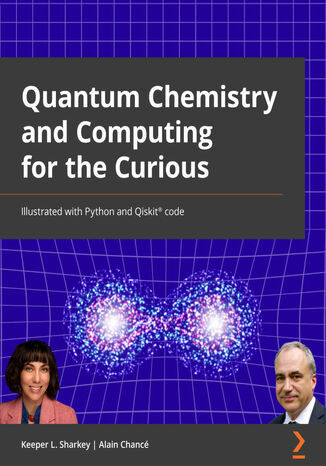
Quantum Chemistry and Computing for the Curious. Illustrated with Python and Qiskit® code
Keeper Layne Sharkey, Alex Khan, Alain Chancé
Explore quantum chemical concepts and the postulates of quantum mechanics in a modern fashion, with the intent to see how chemistry and computing intertwine. Along the way you’ll relate these concepts to quantum information theory and computation. We build a framework of computational tools that lead you through traditional computational methods and straight to the forefront of exciting opportunities. These opportunities will rely on achieving next-generation accuracy by going further than the standard approximations such as beyond Born-Oppenheimer calculations.Discover how leveraging quantum chemistry and computing is a key enabler for overcoming major challenges in the broader chemical industry. The skills that you will learn can be utilized to solve new-age business needs that specifically hinge on quantum chemistry
Quantum Computing Algorithms. Discover how a little math goes a long way
Barry Burd
Navigate the quantum computing spectrum with this book, bridging the gap between abstract, math-heavy texts and math-avoidant beginner guides. Unlike intermediate-level books that often leave gaps in comprehension, this all-encompassing guide offers the missing links you need to truly understand the subject.Balancing intuition and rigor, this book empowers you to become a master of quantum algorithms. No longer confined to canned examples, you'll acquire the skills necessary to craft your own quantum code. Quantum Computing Algorithms is organized into four sections to build your expertise progressively.The first section lays the foundation with essential quantum concepts, ensuring that you grasp qubits, their representation, and their transformations. Moving to quantum algorithms, the second section focuses on pivotal algorithms — specifically, quantum key distribution and teleportation.The third section demonstrates the transformative power of algorithms that outpace classical computation and makes way for the fourth section, helping you to expand your horizons by exploring alternative quantum computing models.By the end of this book, quantum algorithms will cease to be mystifying as you make this knowledge your asset and enter a new era of computation, where you have the power to shape the code of reality.
Arunkumar Krishnakumar
Are quantum computing and Blockchain on a collision course or will they be the most important trends of this decade to disrupt industries and life as we know it?Fintech veteran and venture capitalist Arunkumar Krishnakumar cuts through the hype to bring us a first-hand look into how quantum computing and Blockchain together are redefining industries, including fintech, healthcare, and research. Through a series of interviews with domain experts, he also explores these technologies’ potential to transform national and global governance and policies – from how elections are conducted and how smart cities can be designed and optimized for the environment, to what cyberwarfare enabled by quantum cryptography might look like. In doing so, he also highlights challenges that these technologies have to overcome to go mainstream.Quantum Computing and Blockchain in Business explores the potential changes that quantum computing and Blockchain might bring about in the real world. After expanding on the key concepts and techniques, such as applied cryptography, qubits, and digital annealing, that underpin quantum computing and Blockchain, the book dives into how major industries will be impacted by these technologies. Lastly, we consider how the two technologies may come together in a complimentary way.
Alex Khan
Amazon Braket is a cloud-based pay-per-use platform for executing quantum algorithms on cutting-edge quantum computers and simulators. It is ideal for developing robust apps with the latest quantum devices.With this book, you'll take a hands-on approach to learning how to take real-world problems and run them on quantum devices. You'll begin with an introduction to the Amazon Braket platform and learn about the devices currently available on the platform, their benefits, and their purpose. Then, you'll review key quantum concepts and algorithms critical to converting real-world problems into a quantum circuit or binary quadratic model based on the appropriate device and its capability. The book also covers various optimization use cases, along with an explanation of the code. Finally, you'll work with a framework using code examples that will help to solve your use cases with quantum and quantum-inspired technologies. Later chapters cover custom-built functions and include almost 200 figures and diagrams to visualize key concepts. You’ll be able to scan the capabilities provided by Amazon Braket and explore the functions to adapt them for specific use cases.By the end of this book, you’ll have the tools to integrate your current business apps and AWS data with Amazon Braket to solve constrained and multi-objective optimization problems.