
Verleger: Packt Publishing
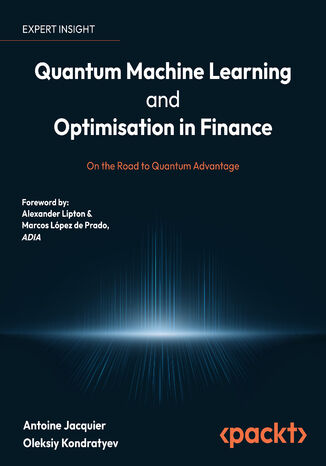
Quantum Machine Learning and Optimisation in Finance. On the Road to Quantum Advantage
Antoine Jacquier, Oleksiy Kondratyev
With recent advances in quantum computing technology, we finally reached the era of Noisy Intermediate-Scale Quantum (NISQ) computing. NISQ-era quantum computers are powerful enough to test quantum computing algorithms and solve hard real-world problems faster than classical hardware.Speedup is so important in financial applications, ranging from analysing huge amounts of customer data to high frequency trading. This is where quantum computing can give you the edge. Quantum Machine Learning and Optimisation in Finance shows you how to create hybrid quantum-classical machine learning and optimisation models that can harness the power of NISQ hardware.This book will take you through the real-world productive applications of quantum computing. The book explores the main quantum computing algorithms implementable on existing NISQ devices and highlights a range of financial applications that can benefit from this new quantum computing paradigm.This book will help you be one of the first in the finance industry to use quantum machine learning models to solve classically hard real-world problems. We may have moved past the point of quantum computing supremacy, but our quest for establishing quantum computing advantage has just begun!
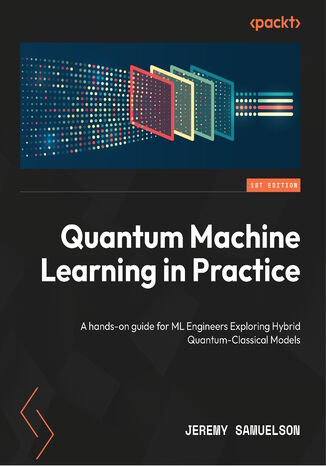
Jeremy Samuelson
Quantum computing is advancing rapidly, yet practical guidance for machine learning engineers remains limited. Most resources emphasize physics or theory, leaving practitioners unsure how quantum methods fit into real-world ML workflows. 'Quantum Machine Learning in Practice' addresses this gap with a hands-on, Python-first approach built for data scientists and ML engineers.Rather than presenting quantum models as replacements for classical ML, this book focuses on disciplined experimentation, hybrid architectures, and rigorous benchmarking. You will learn how classical data is encoded into quantum circuits, how variational models serve as classifiers and regressors, and how to evaluate quantum kernels and generative models responsibly. Concepts are grounded in simulator-based experiments using PennyLane, Qiskit, TensorFlow Quantum, and Cirq. Classical baselines are treated as first-class citizens throughout. You will design fair comparisons, analyze computational tradeoffs, and identify when classical ML remains superior. A complete end-to-end mini project reinforces transferable workflow skills, from problem framing through evaluation and interpretation.By the end, you will be able to design, implement, and critically assess hybrid quantum-classical machine learning systems with clarity and confidence.
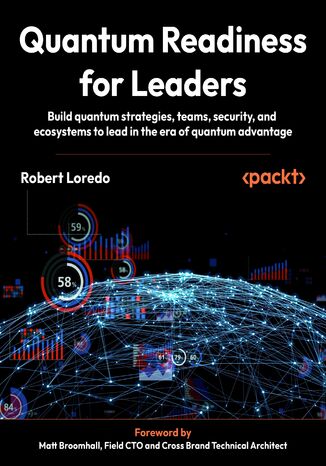
Robert Loredo, Matt Broomhall
Prepare for a computing shift that will reshape security, optimization, and competitive advantage across every industry. This book helps you build a clear actionable approach to quantum readiness covering strategy, technology, talent, and risk in one framework.Written by Robert Loredo, Founder and CEO of Entangled Solutions Group, this book draws on 25 years of experience across IBM, academia, and enterprise innovation. As a former IBM Quantum Global Strategist, leader of the IBM Quantum Ambassador program, and holds over 275 patents, he translates this complex technology transition into decisions leaders can act on immediately.This book is organized as a complete strategic operating system for the quantum transition. Part One equips executives with investment frameworks, governance structures, and talent roadmaps. Part Two guides technical leaders through infrastructure assessment, workforce development, and quantum-era data strategy. Part Three delivers a security playbook covering post-quantum cryptography and adaptive architecture. Part Four maps the full quantum ecosystem and partnerships that will determine which institutions lead commercially.By the end, you’ll be able to define a quantum strategy, build the right capabilities, and lead your organization through quantum-driven change with clarity and control.
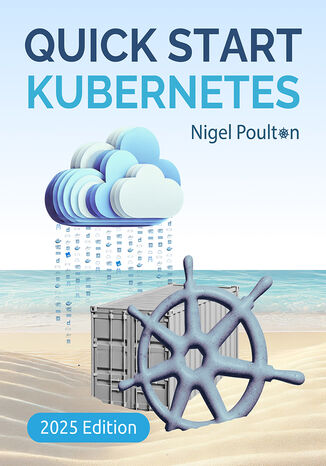
Quick Start Kubernetes. A Beginner's Guide to Container Orchestration in the Cloud - Third Edition
Nigel Poulton
This book is the backbone of modern cloud-native application deployment, but its complexity can be daunting for beginners. This book provides a practical and approachable guide to mastering Kubernetes, starting with fundamental concepts like microservices, orchestration, and cloud-native development. Readers will explore Kubernetes architecture, including control planes, worker nodes, and hosted solutions.Step-by-step instructions guide readers through setting up Kubernetes clusters on local and cloud platforms, containerizing applications, and pushing images to registries. Learn how to deploy containerized applications, connect them via services, and enable self-healing to ensure resilience.As you advance, discover how to scale applications dynamically, perform rolling updates for zero-downtime deployments, and troubleshoot real-world issues. The book concludes with resources for further learning, empowering readers to confidently manage Kubernetes environments in DevOps or cloud-native roles. Perfect for beginners, this hands-on guide simplifies Kubernetes for practical use.
Nigel Poulton
Begin with an introduction to Kubernetes, understanding its importance and architecture. These foundational chapters will set the stage for your exploration into Kubernetes' capabilities. As you progress, you'll learn how to set up Kubernetes and containerize an application, equipping you with practical skills for real-world application management.The course continues with a focus on running applications on Kubernetes, where you will delve into self-healing mechanisms, scaling, and performing rolling updates. Each chapter builds on the last, ensuring a seamless learning experience that integrates theoretical knowledge with hands-on practice. You'll understand how Kubernetes maintains application health and performance, providing a robust environment for modern applications.Concluding with advanced operational techniques and future steps, the course prepares you to leverage Kubernetes for continuous development and deployment. Whether you're scaling applications to meet demand or ensuring seamless updates with minimal downtime, you'll be equipped with the skills necessary for efficient and effective Kubernetes management. This course is your gateway to becoming proficient in one of the most essential tools in the DevOps toolkit.
Dan MacLean
Handling biological data effectively requires an in-depth knowledge of machine learning techniques and computational skills, along with an understanding of how to use tools such as edgeR and DESeq. With the R Bioinformatics Cookbook, you’ll explore all this and more, tackling common and not-so-common challenges in the bioinformatics domain using real-world examples.This book will use a recipe-based approach to show you how to perform practical research and analysis in computational biology with R. You will learn how to effectively analyze your data with the latest tools in Bioconductor, ggplot, and tidyverse. The book will guide you through the essential tools in Bioconductor to help you understand and carry out protocols in RNAseq, phylogenetics, genomics, and sequence analysis. As you progress, you will get up to speed with how machine learning techniques can be used in the bioinformatics domain. You will gradually develop key computational skills such as creating reusable workflows in R Markdown and packages for code reuse.By the end of this book, you’ll have gained a solid understanding of the most important and widely used techniques in bioinformatic analysis and the tools you need to work with real biological data.
Dan MacLean
The updated second edition of R Bioinformatics Cookbook takes a recipe-based approach to show you how to conduct practical research and analysis in computational biology with R. You’ll learn how to create a useful and modular R working environment, along with loading, cleaning, and analyzing data using the most up-to-date Bioconductor, ggplot2, and tidyverse tools.This book will walk you through the Bioconductor tools necessary for you to understand and carry out protocols in RNA-seq and ChIP-seq, phylogenetics, genomics, gene search, gene annotation, statistical analysis, and sequence analysis. As you advance, you'll find out how to use Quarto to create data-rich reports, presentations, and websites, as well as get a clear understanding of how machine learning techniques can be applied in the bioinformatics domain. The concluding chapters will help you develop proficiency in key skills, such as gene annotation analysis and functional programming in purrr and base R. Finally, you'll discover how to use the latest AI tools, including ChatGPT, to generate, edit, and understand R code and draft workflows for complex analyses.By the end of this book, you'll have gained a solid understanding of the skills and techniques needed to become a bioinformatics specialist and efficiently work with large and complex bioinformatics datasets.
R: Data Analysis and Visualization. Master the art of building analytical models using R
Tony Fischetti, Brett Lantz, Hrishi V. Mittal,...
The R learning path created for you has five connected modules, which are a mini-course in their own right. As you complete each one, you'll have gained key skills and be ready for the material in the next module!This course begins by looking at the Data Analysis with R module. This will help you navigate the R environment. You'll gain a thorough understanding of statistical reasoning and sampling. Finally, you'll be able to put best practices into effect to make your job easier and facilitate reproducibility.The second place to explore is R Graphs, which will help you leverage powerful default R graphics and utilize advanced graphics systems such as lattice and ggplot2, the grammar of graphics. You'll learn how to produce, customize, and publish advanced visualizations using this popular and powerful framework.With the third module, Learning Data Mining with R, you will learn how to manipulate data with R using code snippets and be introduced to mining frequent patterns, association, and correlations while working with R programs.The Mastering R for Quantitative Finance module pragmatically introduces both the quantitative finance concepts and their modeling in R, enabling you to build a tailor-made trading system on your own. By the end of the module, you will be well-versed with various financial techniques using R and will be able to place good bets while making financial decisions.Finally, we'll look at the Machine Learning with R module. With this module, you'll discover all the analytical tools you need to gain insights from complex data and learn how to choose the correct algorithm for your specific needs. You'll also learn to apply machine learning methods to deal with common tasks, including classification, prediction, forecasting, and so on.