
Publisher: Packt Publishing
Alex Antonov
The Spring framework provides great flexibility for Java development, which also results in tedious configuration work. Spring Boot addresses the configuration difficulties of Spring and makes it easy to create standalone, production-grade Spring-based applications.This practical guide makes the existing development process more efficient. Spring Boot Cookbook 2.0 Second Edition smartly combines all the skills and expertise to efficiently develop, test, deploy, and monitor applications using Spring Boot on premise and in the cloud. We start with an overview of the important Spring Boot features you will learn to create a web application for a RESTful service. Learn to fine-tune the behavior of a web application by learning about custom routes and asset paths and how to modify routing patterns. Address the requirements of a complex enterprise application and cover the creation of custom Spring Boot starters.This book also includes examples of the new and improved facilities available to create various kinds of tests introduced in Spring Boot 1.4 and 2.0, and gain insights into Spring Boot DevTools. Explore the basics of Spring Boot Cloud modules and various Cloud starters to make applications in “Cloud Native” and take advantage of Service Discovery and Circuit Breakers.
Mohamed Shazin Sadakath
Spring Boot is a lightweight framework that provides a set of tools to create production-grade applications and services. Spring Boot 2.0 Projects is a comprehensive project-based guide for those who are new to Spring, that will get you up to speed with building real-world projects. Complete with clear step-by-step instructions, these easy-to-follow tutorials demonstrate best practices and key insights into building efficient applications with Spring Boot. The book starts off by teaching you how to develop a web application using Spring Boot, followed by giving you an understanding of creating a Spring Boot-based simple blog management system that uses Elasticsearch as the data store. Next, you’ll build a RESTful web services application using Kotlin and the Spring WebFlux framework - a new framework that enables you to create reactive applications in a functional way. Toward the last few chapters, you will build a taxi-hailing API with reactive microservices using Spring Boot, in addition to developing a Twitter clone with the help of a Spring Boot backend. To build on your knowledge further, you’ll also learn how to construct an asynchronous email formatter.By the end of this book, you’ll have a firm foundation in Spring programming and understand how to build powerful, engaging applications in Java using the Spring Boot framework.
Felip Miguel Puig
In today's dynamic landscape, crafting robust and scalable Java web applications presents formidable challenges. Spring Boot emerges as the leading framework for web and microservices development, featuring a dynamic ecosystem and seamless integrations to address a spectrum of scenarios, from scaling apps on the cloud to deploying them to production. In this book, you’ll explore its streamlined, convention-over-configuration approach, simplifying application development.You’ll start by covering recipes showcasing Spring Boot's features. As you progress, you’ll understand how it helps streamline application development while staying ahead of technology trends. The book helps you grasp concepts effectively, explores basic REST APIs, shows you how to escalate to advanced scenarios, and tackle common cloud application challenges like security, scalability, performance optimization, and automated deployments. Dedicated sections are designed to help you stay ahead of the curve with recipes that delve into the latest trends such as containers, observability, native images, DevOps, test automation, and microservices, ensuring your applications align with evolving industry standards.By the end of this book, you’ll be able to build and automate the deployment of a scalable and high-performing distributed solution using Spring Boot 3.
Spring Boot and Angular. Hands-on full stack web development with Java, Spring, and Angular
Devlin Basilan Duldulao, Seiji Ralph Villafranca
Angular makes building applications with the web easy and Spring Boot helps get an application up and running using just a few lines of code and minimal configuration. This book provides insights into building full-stack apps using Angular and Spring Boot effectively to reduce overall development time and increase efficiency.You'll start by setting up your CI/CD pipeline and then build your web application’s backend guided by best practices. You'll then see how Spring Boot allows you to build applications faster and more efficiently by letting the Spring Framework and Spring Boot extension do the heavy lifting. The book demonstrates how to use Spring Data JPA and add its dependencies along with Postgres dependencies in the project to save or persist a user's data in a database for future use. As you advance, you'll see how to write tests and test a service using Mockito. Finally, you'll create a CI workflow or pipeline for a Spring Boot and Angular application to enable operations to deliver quality applications faster.By the end of this Spring Boot and Angular book, you'll be able to build a full-stack web application and deploy it through continuous integration and continuous deployment.
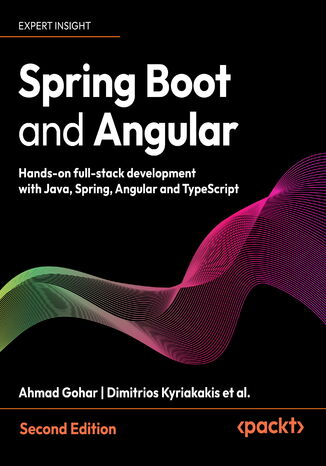
Ahmad Gohar, Dimitrios Kyriakakis
This book is your practical roadmap to building modern, production-ready full-stack applications. Through real-world examples and proven workflows, you’ll combine Spring Boot 3 microservices with Angular 20’s latest features to build secure, scalable systems that are ready for deployment.This second edition of Spring Boot and Angular written by two seasoned full-stack experts with decades of combined experience starts by laying a solid backend foundation by developing microservices with Spring Boot and Spring Cloud, implementing JWT security, and working with both SQL and NoSQL databases using Spring Data. You’ll then switch to the frontend to build reactive user interfaces with Angular, enable server-side rendering (SSR), and manage real-time data sharing for dynamic applications. You’ll also be guided through connecting Spring Boot APIs to Angular frontends using best practices and reactive integration patterns.The chapters help you to not only master the development aspects but also boost your efficiency with AI-powered coding using GitHub Copilot in VSCode. This guide will enable you to deploy containerized Spring Boot services, optimize Angular builds, and set up streamlined CI/CD pipelines for cloud delivery.By the end of this book, you’ll have built a complete, deployable application along with mastering the full development lifecycle.
Alex Antonov
Spring Boot is Spring's convention-over-configuration solution. This feature makes it easy to create Spring applications and services with absolute minimum fuss. Spring Boot has the great ability to be customized and enhanced, and is specifically designed to simplify development of a new Spring application.This book will provide many detailed insights about the inner workings of Spring Boot, as well as tips and recipes to integrate the third-party frameworks and components needed to build complex enterprise-scale applications.The book starts with an overview of the important and useful Spring Boot starters that are included in the framework, and teaches you to create and add custom Servlet Filters, Interceptors, Converters, Formatters, and PropertyEditors to a Spring Boot web application. Next it will cover configuring custom routing rules and patterns, adding additional static asset paths, and adding and modifying servlet container connectors and other properties such as enabling SSL.Moving on, the book will teach you how to create custom Spring Boot Starters, and explore different techniques to test Spring Boot applications. Next, the book will show you examples of configuring your build to produce Docker images and self-executing binary files for Linux/OSX environments.Finally, the book will teach you how to create custom health indicators, and access monitoring data via HTTP and JMX.
SPRING COOKBOOK. Over 100 hands-on recipes to build Spring web applications easily and efficiently
Jerome Jaglale, Murat Yilmaz
This book is for you if you have some experience with Java and web development (not necessarily in Java) and want to become proficient quickly with Spring.
Petri Kainulainen
Spring Framework has always had a good support for different data access technologies. However, developers had to use technology-specific APIs, which often led to a situation where a lot of boilerplate code had to be written in order to implement even the simplest operations. Spring Data changed all this. Spring Data makes it easier to implement Spring-powered applications that use cloud-based storage services, NoSQL databases, map-reduce frameworks or relational databases.Spring Data is a practical guide that is full of step-by-step instructions and examples which ensure that you can start using the Java Persistence API and Redis in your applications without extra hassle.This book provides a brief introduction to the underlying data storage technologies, gives step-by-step instructions that will help you utilize the discussed technologies in your applications, and provides a solid foundation for expanding your knowledge beyond the concepts described in this book.You will learn an easier way to manage your entities and to create database queries with Spring Data JPA. This book also demonstrates how you can add custom functions to your repositories. You will also learn how to use the Redis key-value store as data storage and to use its other features for enhancing your applications.Spring Data includes all the practical instructions and examples that provide you with all the information you need to create JPA repositories with Spring Data JPA and to utilize the performance of Redis in your applications by using Spring Data Redis.