
Biznes IT
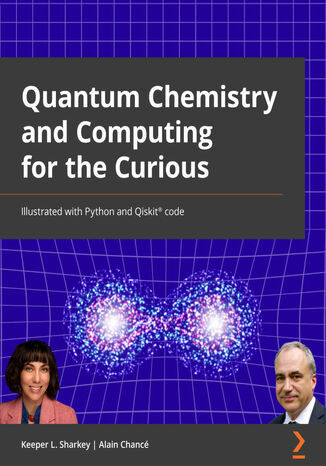
Quantum Chemistry and Computing for the Curious. Illustrated with Python and Qiskit® code
Keeper Layne Sharkey, Alex Khan, Alain Chancé
Explore quantum chemical concepts and the postulates of quantum mechanics in a modern fashion, with the intent to see how chemistry and computing intertwine. Along the way you’ll relate these concepts to quantum information theory and computation. We build a framework of computational tools that lead you through traditional computational methods and straight to the forefront of exciting opportunities. These opportunities will rely on achieving next-generation accuracy by going further than the standard approximations such as beyond Born-Oppenheimer calculations.Discover how leveraging quantum chemistry and computing is a key enabler for overcoming major challenges in the broader chemical industry. The skills that you will learn can be utilized to solve new-age business needs that specifically hinge on quantum chemistry
Quantum Computing Algorithms. Discover how a little math goes a long way
Barry Burd
Navigate the quantum computing spectrum with this book, bridging the gap between abstract, math-heavy texts and math-avoidant beginner guides. Unlike intermediate-level books that often leave gaps in comprehension, this all-encompassing guide offers the missing links you need to truly understand the subject.Balancing intuition and rigor, this book empowers you to become a master of quantum algorithms. No longer confined to canned examples, you'll acquire the skills necessary to craft your own quantum code. Quantum Computing Algorithms is organized into four sections to build your expertise progressively.The first section lays the foundation with essential quantum concepts, ensuring that you grasp qubits, their representation, and their transformations. Moving to quantum algorithms, the second section focuses on pivotal algorithms — specifically, quantum key distribution and teleportation.The third section demonstrates the transformative power of algorithms that outpace classical computation and makes way for the fourth section, helping you to expand your horizons by exploring alternative quantum computing models.By the end of this book, quantum algorithms will cease to be mystifying as you make this knowledge your asset and enter a new era of computation, where you have the power to shape the code of reality.
Arunkumar Krishnakumar
Are quantum computing and Blockchain on a collision course or will they be the most important trends of this decade to disrupt industries and life as we know it?Fintech veteran and venture capitalist Arunkumar Krishnakumar cuts through the hype to bring us a first-hand look into how quantum computing and Blockchain together are redefining industries, including fintech, healthcare, and research. Through a series of interviews with domain experts, he also explores these technologies’ potential to transform national and global governance and policies – from how elections are conducted and how smart cities can be designed and optimized for the environment, to what cyberwarfare enabled by quantum cryptography might look like. In doing so, he also highlights challenges that these technologies have to overcome to go mainstream.Quantum Computing and Blockchain in Business explores the potential changes that quantum computing and Blockchain might bring about in the real world. After expanding on the key concepts and techniques, such as applied cryptography, qubits, and digital annealing, that underpin quantum computing and Blockchain, the book dives into how major industries will be impacted by these technologies. Lastly, we consider how the two technologies may come together in a complimentary way.
Alex Khan
Amazon Braket is a cloud-based pay-per-use platform for executing quantum algorithms on cutting-edge quantum computers and simulators. It is ideal for developing robust apps with the latest quantum devices.With this book, you'll take a hands-on approach to learning how to take real-world problems and run them on quantum devices. You'll begin with an introduction to the Amazon Braket platform and learn about the devices currently available on the platform, their benefits, and their purpose. Then, you'll review key quantum concepts and algorithms critical to converting real-world problems into a quantum circuit or binary quadratic model based on the appropriate device and its capability. The book also covers various optimization use cases, along with an explanation of the code. Finally, you'll work with a framework using code examples that will help to solve your use cases with quantum and quantum-inspired technologies. Later chapters cover custom-built functions and include almost 200 figures and diagrams to visualize key concepts. You’ll be able to scan the capabilities provided by Amazon Braket and explore the functions to adapt them for specific use cases.By the end of this book, you’ll have the tools to integrate your current business apps and AWS data with Amazon Braket to solve constrained and multi-objective optimization problems.
Hassi Norlen
IBM Quantum Experience® is a leading platform for programming quantum computers and implementing quantum solutions directly on the cloud. This book will help you get up to speed with programming quantum computers and provide solutions to the most common problems and challenges.You’ll start with a high-level overview of IBM Quantum Experience® and Qiskit®, where you will perform the installation while writing some basic quantum programs. This introduction puts less emphasis on the theoretical framework and more emphasis on recent developments such as Shor’s algorithm and Grover’s algorithm. Next, you’ll delve into Qiskit®, a quantum information science toolkit, and its constituent packages such as Terra, Aer, Ignis, and Aqua. You’ll cover these packages in detail, exploring their benefits and use cases. Later, you’ll discover various quantum gates that Qiskit® offers and even deconstruct a quantum program with their help, before going on to compare Noisy Intermediate-Scale Quantum (NISQ) and Universal Fault-Tolerant quantum computing using simulators and actual hardware. Finally, you’ll explore quantum algorithms and understand how they differ from classical algorithms, along with learning how to use pre-packaged algorithms in Qiskit® Aqua.By the end of this quantum computing book, you’ll be able to build and execute your own quantum programs using IBM Quantum Experience® and Qiskit® with Python.
Srinjoy Ganguly, Thomas Cambier
Quantum computing is a growing field, with many research projects focusing on programming quantum computers in the most efficient way possible. One of the biggest challenges faced with existing languages is that they work on low-level circuit model details and are not able to represent quantum programs accurately. Developed by researchers at ETH Zurich after analyzing languages including Q# and Qiskit, Silq is a high-level programming language that can be viewed as the C++ of quantum computers! Quantum Computing with Silq Programming helps you explore Silq and its intuitive and simple syntax to enable you to describe complex tasks with less code. This book will help you get to grips with the constructs of the Silq and show you how to write quantum programs with it. You’ll learn how to use Silq to program quantum algorithms to solve existing and complex tasks. Using quantum algorithms, you’ll also gain practical experience in useful applications such as quantum error correction, cryptography, and quantum machine learning. Finally, you’ll discover how to optimize the programming of quantum computers with the simple Silq.By the end of this Silq book, you’ll have mastered the features of Silq and be able to build efficient quantum applications independently.
Antoine Jacquier, Oleksiy Kondratyev, Alexander Lipton, Marcos...
As quantum machine learning (QML) continues to evolve, many professionals struggle to apply its powerful algorithms to real-world problems using noisy intermediate-scale quantum (NISQ) hardware. This book bridges that gap by focusing on hands-on QML applications tailored to NISQ systems, moving beyond the traditional textbook approaches that explore standard algorithms like Shor's and Grover's, which lie beyond current NISQ capabilities.You’ll get to grips with major QML algorithms that have been widely studied for their transformative potential in finance and learn hybrid quantum-classical computational protocols, the most effective way to leverage quantum and classical computing systems together.The authors, Antoine Jacquier, a distinguished researcher in quantum computing and stochastic analysis, and Oleksiy Kondratyev, a Quant of the Year awardee with over 20 years in quantitative finance, offer a hardware-agnostic perspective. They present a balanced view of both analog and digital quantum computers, delving into the fundamental characteristics of the algorithms while highlighting the practical limitations of today’s quantum hardware.By the end of this quantum book, you’ll have a deeper understanding of the significance of quantum computing in finance and the skills needed to apply QML to solve complex challenges, driving innovation in your work.
Quantum Machine Learning and Optimisation in Finance. On the Road to Quantum Advantage
Antoine Jacquier, Oleksiy Kondratyev
With recent advances in quantum computing technology, we finally reached the era of Noisy Intermediate-Scale Quantum (NISQ) computing. NISQ-era quantum computers are powerful enough to test quantum computing algorithms and solve hard real-world problems faster than classical hardware.Speedup is so important in financial applications, ranging from analysing huge amounts of customer data to high frequency trading. This is where quantum computing can give you the edge. Quantum Machine Learning and Optimisation in Finance shows you how to create hybrid quantum-classical machine learning and optimisation models that can harness the power of NISQ hardware.This book will take you through the real-world productive applications of quantum computing. The book explores the main quantum computing algorithms implementable on existing NISQ devices and highlights a range of financial applications that can benefit from this new quantum computing paradigm.This book will help you be one of the first in the finance industry to use quantum machine learning models to solve classically hard real-world problems. We may have moved past the point of quantum computing supremacy, but our quest for establishing quantum computing advantage has just begun!
Dan MacLean
The updated second edition of R Bioinformatics Cookbook takes a recipe-based approach to show you how to conduct practical research and analysis in computational biology with R. You’ll learn how to create a useful and modular R working environment, along with loading, cleaning, and analyzing data using the most up-to-date Bioconductor, ggplot2, and tidyverse tools.This book will walk you through the Bioconductor tools necessary for you to understand and carry out protocols in RNA-seq and ChIP-seq, phylogenetics, genomics, gene search, gene annotation, statistical analysis, and sequence analysis. As you advance, you'll find out how to use Quarto to create data-rich reports, presentations, and websites, as well as get a clear understanding of how machine learning techniques can be applied in the bioinformatics domain. The concluding chapters will help you develop proficiency in key skills, such as gene annotation analysis and functional programming in purrr and base R. Finally, you'll discover how to use the latest AI tools, including ChatGPT, to generate, edit, and understand R code and draft workflows for complex analyses.By the end of this book, you'll have gained a solid understanding of the skills and techniques needed to become a bioinformatics specialist and efficiently work with large and complex bioinformatics datasets.
Kuntal Ganguly, Davor Lozić, Mzabalazo Z. Ngwenya,...
Data analytics with R has emerged as a very important focus for organizations of all kinds. R enables even those with only an intuitive grasp of the underlying concepts, without a deep mathematical background, to unleash powerful and detailed examinations of their data.This book will show you how you can put your data analysis skills in R to practical use, with recipes catering to the basic as well as advanced data analysis tasks. Right from acquiring your data and preparing it for analysis to the more complex data analysis techniques, the book will show you how you can implement each technique in the best possible manner. You will also visualize your data using the popular R packages like ggplot2 and gain hidden insights from it. Starting with implementing the basic data analysis concepts like handling your data to creating basic plots, you will master the more advanced data analysis techniques like performing cluster analysis, and generating effective analysis reports and visualizations. Throughout the book, you will get to know the common problems and obstacles you might encounter while implementing each of the data analysis techniques in R, with ways to overcoming them in the easiest possible way.By the end of this book, you will have all the knowledge you need to become an expert in data analysis with R, and put your skills to test in real-world scenarios.
R Data Analysis Projects. Build end to end analytics systems to get deeper insights from your data
Mark Hodnett, Gopi Subramanian
R offers a large variety of packages and libraries for fast and accurate data analysis and visualization. As a result, it’s one of the most popularly used languages by data scientists and analysts, or anyone who wants to perform data analysis. This book will demonstrate how you can put to use your existing knowledge of data analysis in R to build highly efficient, end-to-end data analysis pipelines without any hassle.You’ll start by building a content-based recommendation system, followed by building a project on sentiment analysis with tweets. You’ll implement time-series modeling for anomaly detection, and understand cluster analysis of streaming data. You’ll work through projects on performing efficient market data research, building recommendation systems, and analyzing networks accurately, all provided with easy to follow codes. With the help of these real-world projects, you’ll get a better understanding of the challenges faced when building data analysis pipelines, and see how you can overcome them without compromising on the efficiency or accuracy of your systems. The book covers some popularly used R packages such as dplyr, ggplot2, RShiny, and others, and includes tips on using them effectively.By the end of this book, you’ll have a better understanding of data analysis with R, and be able to put your knowledge to practical use without any hassle.
R Data Mining. Implement data mining techniques through practical use cases and real-world datasets
Enrico Pegoraro, Andrea Cirillo
R is widely used to leverage data mining techniques across many different industries, including finance, medicine, scientific research, and more. This book will empower you to produce and present impressive analyses from data, by selecting and implementing the appropriate data mining techniques in R.It will let you gain these powerful skills while immersing in a one of a kind data mining crime case, where you will be requested to help resolving a real fraud case affecting a commercial company, by the mean of both basic and advanced data mining techniques. While moving along the plot of the story you will effectively learn and practice on real data the various R packages commonly employed for this kind of tasks. You will also get the chance of apply some of the most popular and effective data mining models and algos, from the basic multiple linear regression to the most advanced Support Vector Machines. Unlike other data mining learning instruments, this book will effectively expose you the theory behind these models, their relevant assumptions and when they can be applied to the data you are facing. By the end of the book you will hold a new and powerful toolbox of instruments, exactly knowing when and how to employ each of them to solve your data mining problems and get the most out of your data.Finally, to let you maximize the exposure to the concepts described and the learning process, the book comes packed with a reproducible bundle of commented R scripts and a practical set of data mining models cheat sheets.
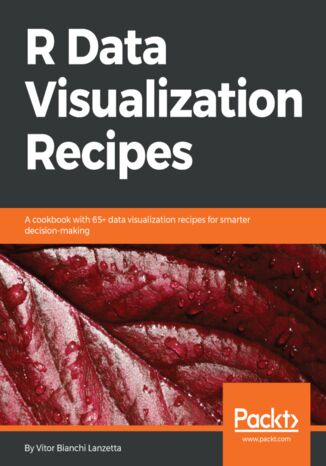
Vitor Bianchi Lanzetta
R is an open source language for data analysis and graphics that allows users to load various packages for effective and better data interpretation. Its popularity has soared in recent years because of its powerful capabilities when it comes to turning different kinds of data into intuitive visualization solutions.This book is an update to our earlier R data visualization cookbook with 100 percent fresh content and covering all the cutting edge R data visualization tools. This book is packed with practical recipes, designed to provide you with all the guidance needed to get to grips with data visualization using R. It starts off with the basics of ggplot2, ggvis, and plotly visualization packages, along with an introduction to creating maps and customizing them, before progressively taking you through various ggplot2 extensions, such as ggforce, ggrepel, and gganimate. Using real-world datasets, you will analyze and visualize your data as histograms, bar graphs, and scatterplots, and customize your plots with various themes and coloring options. The book also covers advanced visualization aspects such as creating interactive dashboards using ShinyBy the end of the book, you will be equipped with key techniques to create impressive data visualizations with professional efficiency and precision.
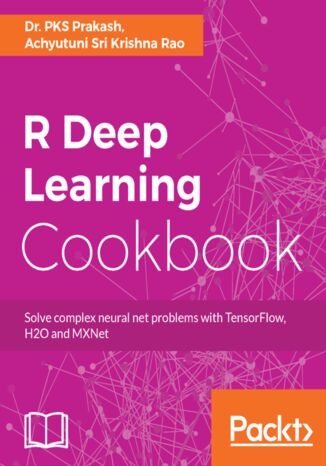
R Deep Learning Cookbook. Solve complex neural net problems with TensorFlow, H2O and MXNet
PKS Prakash, Achyutuni Sri Krishna Rao
Deep Learning is the next big thing. It is a part of machine learning. It's favorable results in applications with huge and complex data is remarkable. Simultaneously, R programming language is very popular amongst the data miners and statisticians. This book will help you to get through the problems that you face during the execution of different tasks and Understand hacks in deep learning, neural networks, and advanced machine learning techniques. It will also take you through complex deep learning algorithms and various deep learning packages and libraries in R. It will be starting with different packages in Deep Learning to neural networks and structures. You will also encounter the applications in text mining and processing along with a comparison between CPU and GPU performance.By the end of the book, you will have a logical understanding of Deep learning and different deep learning packages to have the most appropriate solutions for your problems.
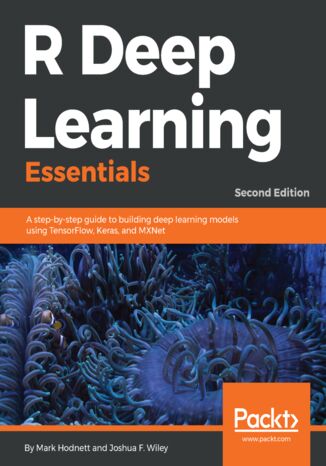
Mark Hodnett, Joshua F. Wiley
Deep learning is a powerful subset of machine learning that is very successful in domains such as computer vision and natural language processing (NLP). This second edition of R Deep Learning Essentials will open the gates for you to enter the world of neural networks by building powerful deep learning models using the R ecosystem.This book will introduce you to the basic principles of deep learning and teach you to build a neural network model from scratch. As you make your way through the book, you will explore deep learning libraries, such as Keras, MXNet, and TensorFlow, and create interesting deep learning models for a variety of tasks and problems, including structured data, computer vision, text data, anomaly detection, and recommendation systems. You’ll cover advanced topics, such as generative adversarial networks (GANs), transfer learning, and large-scale deep learning in the cloud. In the concluding chapters, you will learn about the theoretical concepts of deep learning projects, such as model optimization, overfitting, and data augmentation, together with other advanced topics.By the end of this book, you will be fully prepared and able to implement deep learning concepts in your research work or projects.
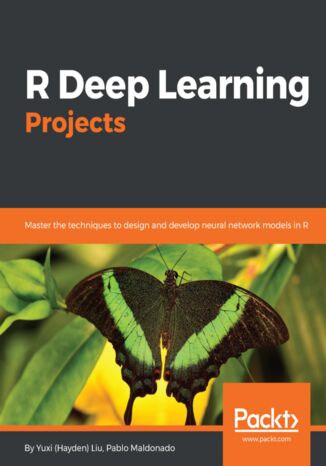
R Deep Learning Projects. Master the techniques to design and develop neural network models in R
Yuxi (Hayden) Liu, Pablo Maldonado
R is a popular programming language used by statisticians and mathematicians for statistical analysis, and is popularly used for deep learning. Deep Learning, as we all know, is one of the trending topics today, and is finding practical applications in a lot of domains.This book demonstrates end-to-end implementations of five real-world projects on popular topics in deep learning such as handwritten digit recognition, traffic light detection, fraud detection, text generation, and sentiment analysis. You'll learn how to train effective neural networks in R—including convolutional neural networks, recurrent neural networks, and LSTMs—and apply them in practical scenarios. The book also highlights how neural networks can be trained using GPU capabilities. You will use popular R libraries and packages—such as MXNetR, H2O, deepnet, and more—to implement the projects. By the end of this book, you will have a better understanding of deep learning concepts and techniques and how to use them in a practical setting.