
Gry
Micheal Lanham
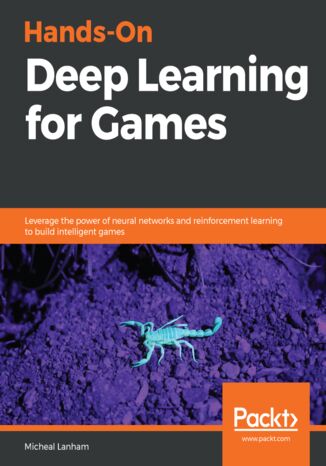
The number of applications of deep learning and neural networks has multiplied in the last couple of years. Neural nets has enabled significant breakthroughs in everything from computer vision, voice generation, voice recognition and self-driving cars. Game development is also a key area where these techniques are being applied. This book will give an in depth view of the potential of deep learning and neural networks in game development. We will take a look at the foundations of multi-layer perceptron’s to using convolutional and recurrent networks. In applications from GANs that create music or textures to self-driving cars and chatbots. Then we introduce deep reinforcement learning through the multi-armed bandit problem and other OpenAI Gym environments.As we progress through the book we will gain insights about DRL techniques such as Motivated Reinforcement Learning with Curiosity and Curriculum Learning. We also take a closer look at deep reinforcement learning and in particular the Unity ML-Agents toolkit. By the end of the book, we will look at how to apply DRL and the ML-Agents toolkit to enhance, test and automate your games or simulations. Finally, we will cover your possible next steps and possible areas for future learning.
Micheal Lanham
The number of applications of deep learning and neural networks has multiplied in the last couple of years. Neural nets has enabled significant breakthroughs in everything from computer vision, voice generation, voice recognition and self-driving cars. Game development is also a key area where these techniques are being applied. This book will give an in depth view of the potential of deep learning and neural networks in game development. We will take a look at the foundations of multi-layer perceptron’s to using convolutional and recurrent networks. In applications from GANs that create music or textures to self-driving cars and chatbots. Then we introduce deep reinforcement learning through the multi-armed bandit problem and other OpenAI Gym environments.As we progress through the book we will gain insights about DRL techniques such as Motivated Reinforcement Learning with Curiosity and Curriculum Learning. We also take a closer look at deep reinforcement learning and in particular the Unity ML-Agents toolkit. By the end of the book, we will look at how to apply DRL and the ML-Agents toolkit to enhance, test and automate your games or simulations. Finally, we will cover your possible next steps and possible areas for future learning.
Florent Vilmart, Giordano Scalzo, Sergio De Simone
Swift keeps gaining traction not only amongst Apple developers but also as a server-side language. This book demonstrates how to apply design patterns and best practices in real-life situations, whether that's for new or already existing projects.You’ll begin with a quick refresher on Swift, the compiler, the standard library, and the foundation, followed by the Cocoa design patterns – the ones at the core of many cocoa libraries – to follow up with the creational, structural, and behavioral patterns as defined by the GoF. You'll get acquainted with application architecture, as well as the most popular architectural design patterns, such as MVC and MVVM, and learn to use them in the context of Swift. In addition, you’ll walk through dependency injection and functional reactive programming. Special emphasis will be given to techniques to handle concurrency, including callbacks, futures and promises, and reactive programming. These techniques will help you adopt a test-driven approach to your workflow in order to use Swift Package Manager and integrate the framework into the original code base, along with Unit and UI testing.By the end of the book, you'll be able to build applications that are scalable, faster, and easier to maintain.
Ankur Patel
Making Swift an open-source language enabled it to share code between a native app and a server. Building a scalable and secure server backend opens up new possibilities, such as building an entire application written in one language—Swift.This book gives you a detailed walk-through of tasks such as developing a native shopping list app with Swift and creating a full-stack backend using Vapor (which serves as an API server for the mobile app). You'll also discover how to build a web server to support dynamic web pages in browsers, thereby creating a rich application experience.You’ll begin by planning and then building a native iOS app using Swift. Then, you'll get to grips with building web pages and creating web views of your native app using Vapor. To put things into perspective, you'll learn how to build an entire full-stack web application and an API server for your native mobile app, followed by learning how to deploy the app to the cloud, and add registration and authentication to it.Once you get acquainted with creating applications, you'll build a tvOS version of the shopping list app and explore how easy is it to create an app for a different platform with maximum code shareability. Towards the end, you’ll also learn how to create an entire app for different platforms in Swift, thus enhancing your productivity.
Rick Battagline
Within the next few years, WebAssembly will change the web as we know it. It promises a world where you can write an application for the web in any language, and compile it for native platforms as well as the web.This book is designed to introduce web developers and game developers to the world of WebAssembly by walking through the development of a retro arcade game. You will learn how to build a WebAssembly application using C++, Emscripten, JavaScript, WebGL, SDL, and HTML5.This book covers a lot of ground in both game development and web application development. When creating a game or application that targets WebAssembly, developers need to learn a plethora of skills and tools. This book is a sample platter of those tools and skills. It covers topics including Emscripten, C/C++, WebGL, OpenGL, JavaScript, HTML5, and CSS. The reader will also learn basic techniques for game development, including 2D sprite animation, particle systems, 2D camera design, sound effects, 2D game physics, user interface design, shaders, debugging, and optimization. By the end of the book, you will be able to create simple web games and web applications targeting WebAssembly.
Hands-On Game Development without Coding. Create 2D and 3D games with Visual Scripting in Unity
Lucas Bertolini
Hands-On Game Development without Coding is the first Visual Scripting book in the market. It was tailor made for a non programing audience who are wondering how a videogame is made.After reading this book you will be able to develop your own 2d and 3d videogames and use it on your presentations, to speed up your level design deliveries, test your game design ideas, work on your proofs of concept, or even doing it just for fun.The best thing about Hands-On Game Development without Coding is that you don’t need any previous knowledge to read and understand the process of creating a videogame. It is our main focus to provide you with the opportunity to create a videogame as easy and fast as possible.Once you go through the book, you will be able to create player input interaction, levels, object behaviours, enemy AI, creating your own UI and finally giving life to your game by building it.It’s Alive!
Micheal Lanham
With the increased presence of AI in the gaming industry, developers are challenged to create highly responsive and adaptive games by integrating artificial intelligence into their projects. This book is your guide to learning how various reinforcement learning techniques and algorithms play an important role in game development with Python.Starting with the basics, this book will help you build a strong foundation in reinforcement learning for game development. Each chapter will assist you in implementing different reinforcement learning techniques, such as Markov decision processes (MDPs), Q-learning, actor-critic methods, SARSA, and deterministic policy gradient algorithms, to build logical self-learning agents. Learning these techniques will enhance your game development skills and add a variety of features to improve your game agent’s productivity. As you advance, you’ll understand how deep reinforcement learning (DRL) techniques can be used to devise strategies to help agents learn from their actions and build engaging games.By the end of this book, you’ll be ready to apply reinforcement learning techniques to build a variety of projects and contribute to open source applications.
Nicolas Alejandro Borromeo, Juan Gabriel Gomila Salas
Take your game development skills to the next level. Dive into the world of game creation confidently by elevating your game development skills. This book is your definitive and practical guide to unlocking the full potential of Unity 2023. Every chapter is designed to empower you to customize your own game, not just replicate what's in the book. This new edition includes immersive Augmented Reality (AR) experiences and performance optimization with Data-Oriented Technology Stack (DOTS).From Scene Creation to seamless Assert Integration, dive into C# programming and Visual Scripting with step-by-step guidance for beginners. Implement dynamic gameplay elements, including movement, spawning, physics, and health systems. Delve deeper into the magic of Game AI through sensor-driven decision-making with Finite State Machines (FSMs). Elevate your visuals with materials, shaders, textures, and particle systems. Optimize performance with Profiler insights and debug your game for a polished final product. Whether you're a beginner or a seasoned pro, this book will equip you with the skills needed to bring your game ideas to life.
Nicolas Alejandro Borromeo, Juan Gabriel Gomila Salas
Take your game development skills to the next level. Dive into the world of game creation confidently by elevating your game development skills. This book is your definitive and practical guide to unlocking the full potential of Unity 2023. Every chapter is designed to empower you to customize your own game, not just replicate what's in the book. This new edition includes immersive Augmented Reality (AR) experiences and performance optimization with Data-Oriented Technology Stack (DOTS).From Scene Creation to seamless Assert Integration, dive into C# programming and Visual Scripting with step-by-step guidance for beginners. Implement dynamic gameplay elements, including movement, spawning, physics, and health systems. Delve deeper into the magic of Game AI through sensor-driven decision-making with Finite State Machines (FSMs). Elevate your visuals with materials, shaders, textures, and particle systems. Optimize performance with Profiler insights and debug your game for a polished final product. Whether you're a beginner or a seasoned pro, this book will equip you with the skills needed to bring your game ideas to life.
Nicolas Alejandro Borromeo
Over the years, the Unity game engine has extended its scope from just being about creating video games to building AR/VR experiences, complex simulations, real-time realistic rendering, films, and serious games for training and education. Its features for implementing gameplay, graphics, and customization using C# programming make Unity a comprehensive platform for developing professional-level, rich experiences.With this book, you'll be able to build impressive Unity projects in a step-by-step manner and apply your knowledge of Unity concepts to create a real-world game. Complete with hands-on tutorials and projects, this easy-to-follow guide will show you how to develop your first complete game using a variety of Unity tools. As you make progress, you'll learn how to make the most of the Unity Editor and create scripts using the C# programming language. This Unity game development book will then take you through integrating graphics, sound, and animations and manipulating physics to create impressive mechanics for your games. You'll also learn how to code a simple AI agent to challenge the user and use profiling tools to ensure that the code runs in a performant way. Finally, you'll get to grips with Unity's AR Foundation for creating AR experiences for 3D apps and games.By the end of this book, you'll have developed a complete game and will have built a solid foundation using Unity's tooling ecosystem to develop game projects of any scale.
Nicolas Alejandro Borromeo
Over the years, the Unity game engine has extended its scope from just being about creating video games to building AR/VR experiences, complex simulations, real-time realistic rendering, films, and serious games for training and education. Its features for implementing gameplay, graphics, and customization using C# programming make Unity a comprehensive platform for developing professional-level, rich experiences.With this book, you'll be able to build impressive Unity projects in a step-by-step manner and apply your knowledge of Unity concepts to create a real-world game. Complete with hands-on tutorials and projects, this easy-to-follow guide will show you how to develop your first complete game using a variety of Unity tools. As you make progress, you'll learn how to make the most of the Unity Editor and create scripts using the C# programming language. This Unity game development book will then take you through integrating graphics, sound, and animations and manipulating physics to create impressive mechanics for your games. You'll also learn how to code a simple AI agent to challenge the user and use profiling tools to ensure that the code runs in a performant way. Finally, you'll get to grips with Unity's AR Foundation for creating AR experiences for 3D apps and games.By the end of this book, you'll have developed a complete game and will have built a solid foundation using Unity's tooling ecosystem to develop game projects of any scale.