
Sztuczna inteligencja

Mercury Learning and Information, Oswald Campesato
This book provides a comprehensive overview of large language models (LLMs) and generative AI, covering foundational principles, advanced concepts, and practical applications. It begins with an introduction to the generative AI landscape, examining key features, popular techniques, and its influence on industries like art, business, and technology. The book also explores prominent models like ChatGPT and GPT-4, detailing their architectures, capabilities, and applications in text generation, code assistance, and conversational AI.Additionally, the book traces the evolution of LLMs, particularly focusing on the BERT family and its wide-ranging applications in natural language processing, translation, and multilingual tasks. Readers will also gain expertise in prompt engineering, learning practical tips and examples to interact more effectively with LLMs.In later chapters, the book tackles advanced topics such as fine-tuning LLMs, working with SVG, and concepts like few-shot learning and reinforcement learning. It concludes with discussions on ethical issues, biases in generative AI, and emerging trends like AI’s integration with IoT, quantum computing, and neuromorphic computing. This guide equips professionals and enthusiasts with a thorough understanding of generative AI's present and future.
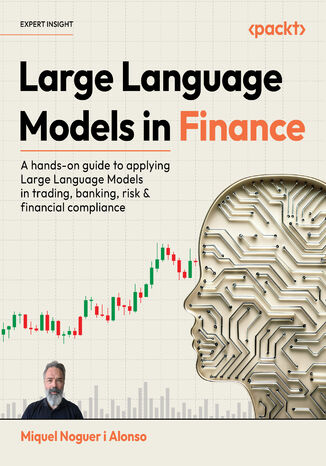
Miquel Noguer i Alonso
Large language models are revolutionizing finance from market analysis to compliance automation but applying them in practice can be challenging. LLMs in Finance is a step-by-step guide that demystifies these powerful models and shows you how to implement them in real financial projects. You'll begin with the fundamentals of how LLMs work, including the transformer architecture, prompt engineering, and fine-tuning for financial data. Next, you'll build applications: intelligent agents for trading; tools for banking tasks like credit scoring and fraud detection; and automated solutions for risk management and regulatory compliance. To deploy these solutions, you'll learn how to scale LLM implementations, from choosing the right hardware to adopting effective cloud strategies. You'll also explore advanced methods to improve model performance, including reinforcement learning for fine-tuning. Finally, learn how to address AI bias and ensure your LLM solutions comply with ethical and regulatory requirements. Real-world case studies illustrate how financial organizations are leveraging LLMs in trading systems, customer service chatbots, and more. By the end of the book, you'll have the expertise to build LLM-powered applications and pick up on trends such as multimodal AI
Learn Mistral. Elevating Mistral systems through embeddings, agents, RAG, AWS Bedrock, and Vertex AI
Pavlo Cherkashin
This is a practical, project-driven guide to turning open-source Mistral models into production-ready AI solutions. Through hands-on workshops and use cases, you’ll learn how to build private chat systems, semantic search engines, intelligent agents, coding assistants, and secure deployments that go beyond simple experimentation. The journey begins by exploring where Mistral excels and where human oversight is essential. You’ll then learn to set up a secure, locally hosted chat system with Ollama, customize behavior with system prompts and parameters, and dive deep into embeddings to unlock semantic search with Pinecone. As you progress, you’ll build multi-agent workflows, unpack advanced Retrieval-Augmented Generation pipelines, and integrate Mistral with Codestral to accelerate coding. You'll also learn to apply Mistral to cybersecurity, be challenged with open-ended RAG projects, and be guided through deploying scalable AI on AWS Bedrock and Google Vertex AI.By the end of this book, you will be ready to design and build AI systems that are innovative, compliant, and production-ready.*Email sign-up and proof of purchase required
Christoffer Noring, Dan Wahlin
Learn Model Context Protocol with TypeScript introduces developers, architects, and AI practitioners to the transformative capabilities of Model Context Protocol (MCP), an emerging protocol designed to standardize, distribute, and scale AI-driven applications. Through the lens of a practical project, the book tackles the modern challenges of resource management, client-server interaction, and deployment at scale.Drawing from Christoffer's expertise as a published author and tutor at the University of Oxford, you’ll explore the components of MCP and how they streamline server and client development. After that, you’ll progress from building robust backends and integrating LLMs into intelligent clients to interacting with servers via tools such as Claude for desktop and Visual Studio Code agents. The chapters help you understand the capabilities of hosts, clients, and servers, facilitating better interoperability, easier integration, and clearer communication between different components.The book also covers security best practices and building for the cloud, ensuring that you're ready to deploy your MCP-based apps. Each chapter enables you to develop hands-on skills for building and operating MCP-based agentic apps.*Email sign-up and proof of purchase required
Josué R. Batista, Christopher Papile
As the field of generative AI evolves, so does the demand for intelligent systems that can understand human speech. Navigating the complexities of automatic speech recognition (ASR) technology is a significant challenge for many professionals. This book offers a comprehensive solution that guides you through OpenAI's advanced ASR system.You’ll begin your journey with Whisper's foundational concepts, gradually progressing to its sophisticated functionalities. Next, you’ll explore the transformer model, understand its multilingual capabilities, and grasp training techniques using weak supervision. The book helps you customize Whisper for different contexts and optimize its performance for specific needs. You’ll also focus on the vast potential of Whisper in real-world scenarios, including its transcription services, voice-based search, and the ability to enhance customer engagement. Advanced chapters delve into voice synthesis and diarization while addressing ethical considerations.By the end of this book, you'll have an understanding of ASR technology and have the skills to implement Whisper. Moreover, Python coding examples will equip you to apply ASR technologies in your projects as well as prepare you to tackle challenges and seize opportunities in the rapidly evolving world of voice recognition and processing.
Eduardo Sojo
Unlock the full potential of AI with Microsoft Foundry, Microsoft’s unified platform for building, orchestrating, and operating AI solutions at scale. This hands-on guide walks you through the full AI application lifecycle, from data preparation and model selection to deployment, monitoring, and continuous evaluation.Written by Eduardo Sojo, a former Microsoft consultant and current solutions architect at Databricks with over 15 years of experience, the book focuses on practical implementation using the latest Microsoft Foundry portal. You’ll learn to design intelligent workflows, build agents, and apply guardrails to ensure safe, reliable AI behavior in real-world scenarios.Rather than focusing only on models, the book shows how to connect workflows, agents, evaluations, and observability so solutions are not just functional, but production-ready.You’ll explore real-world use cases such as building copilots, integrating external systems like Databricks, and creating multi-agent architectures that work with enterprise data. By the end, you’ll be able to design, build, and operate secure, scalable, intelligent AI solutions using Microsoft Foundry.
David Young
If you are a game developer or a general programmer who wishes to focus on programming systems and techniques to build your game AI without creating low-level interfaces in a game engine, then this book is for you. Knowledge of C++ will come in handy to debug the entirety of the AI sandbox and expand on the features present within the book, but it is not required.
Joe Minichino, Joseph Howse
OpenCV 3 is a state-of-the-art computer vision library that allows a great variety of image and video processing operations. Some of the more spectacular and futuristic features such as face recognition or object tracking are easily achievable with OpenCV 3. Learning the basic concepts behind computer vision algorithms, models, and OpenCV's API will enable the development of all sorts of real-world applications, including security and surveillance.Starting with basic image processing operations, the book will take you through to advanced computer vision concepts. Computer vision is a rapidly evolving science whose applications in the real world are exploding, so this book will appeal to computer vision novices as well as experts of the subject wanting to learn the brand new OpenCV 3.0.0. You will build a theoretical foundation of image processing and video analysis, and progress to the concepts of classification through machine learning, acquiring the technical know-how that will allow you to create and use object detectors and classifiers, and even track objects in movies or video camera feeds. Finally, the journey will end in the world of artificial neural networks, along with the development of a hand-written digits recognition application.

Joseph Howse, Joe Minichino
Computer vision is a rapidly evolving science in the field of artificial intelligence, encompassing diverse use cases and techniques. This book will not only help those who are getting started with computer vision but also experts in the domain. You'll be able to put theory into practice by building apps with OpenCV 5 and Python 3.You'll start by setting up OpenCV 5 with Python 3 on various platforms. Next, you'll learn how to perform basic operations such as reading, writing, manipulating, and displaying images, videos, and camera feeds. From taking you through image processing, video analysis, depth estimation, and segmentation, to helping you gain practice by building a GUI app, this book ensures you'll have opportunities for hands-on activities. You'll tackle two popular challenges: face detection and face recognition. You'll also learn about object classification and machine learning, which will enable you to create and use object detectors and even track moving objects in real time. Later, you'll develop your skills in augmented reality and real-world 3D navigation. Finally, you'll cover ANNs and DNNs, learning how to develop apps for recognizing handwritten digits and classifying a person's gender and age, and you'll deploy your solutions to the Cloud.By the end of this book, you'll have the skills you need to execute real-world computer vision projects.
Jarrod Anderson
Nowoczesne organizacje muszą używać sztucznej inteligencji, aby realizować cele strategiczne i wprowadzać innowacje. W świecie napędzanym przez AI przetrwanie i rozwój wymagają inteligentnych systemów, modeli wspierających kluczowe decyzje i przełomowych aplikacji. Wizjonerskie przywództwo jednak powinno się harmonijnie łączyć z praktyką codziennego działania firmy. Ten podręcznik na nowo definiuje rolę lidera do spraw sztucznej inteligencji w środowisku, w którym używa się predykcyjnej, deterministycznej, generatywnej i agentowej AI do rozwiązywania złożonych problemów i wspierania innowacyjności. Autor przedstawia strategie realizacji transformacyjnych inicjatyw z obszaru AI, budowania skutecznych zespołów i zarządzania nimi. Dużo miejsca poświęca odpowiedzialnemu wdrażaniu AI i zachowaniu zgodności z regulacjami. Książka spełnia rolę mapy drogowej od projektowania przełomowych rozwiązań po osiąganie wymiernych rezultatów biznesowych. W książce: rozwój i realizacja strategii AI w zgodzie z regulacjami zarządzanie projektami z wykorzystaniem metodyk zwinnych przykłady zastosowania deterministycznej i probabilistycznej AI optymalizacja działania systemów autonomicznych zasady projektowania systemów AI skoncentrowanych na człowieku mechanizmy ochrony danych i prywatności modeli AI nie jest wyborem. To paradygmat przywództwa!
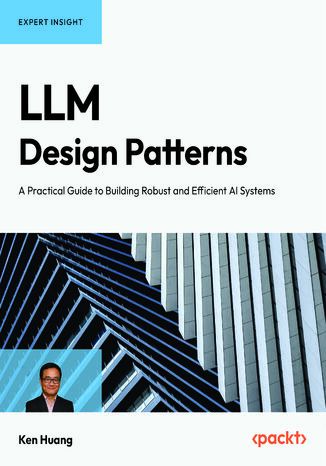
LLM Design Patterns. A Practical Guide to Building Robust and Efficient AI Systems
Ken Huang
This practical guide for AI professionals enables you to build on the power of design patterns to develop robust, scalable, and efficient large language models (LLMs). Written by a global AI expert and popular author driving standards and innovation in Generative AI, security, and strategy, this book covers the end-to-end lifecycle of LLM development and introduces reusable architectural and engineering solutions to common challenges in data handling, model training, evaluation, and deployment.You’ll learn to clean, augment, and annotate large-scale datasets, architect modular training pipelines, and optimize models using hyperparameter tuning, pruning, and quantization. The chapters help you explore regularization, checkpointing, fine-tuning, and advanced prompting methods, such as reason-and-act, as well as implement reflection, multi-step reasoning, and tool use for intelligent task completion. The book also highlights Retrieval-Augmented Generation (RAG), graph-based retrieval, interpretability, fairness, and RLHF, culminating in the creation of agentic LLM systems.By the end of this book, you’ll be equipped with the knowledge and tools to build next-generation LLMs that are adaptable, efficient, safe, and aligned with human values.*Email sign-up and proof of purchase required
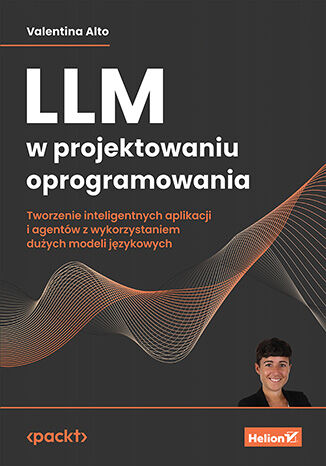
Valentina Alto
Duże modele językowe (LLM) stały się technologicznym przełomem. Ich wszechstronność i funkcjonalność sprawiły, że coraz częściej mówi się o nowej erze inteligentnie działających urządzeń i aplikacji. Umiejętność zastosowania LLM we własnych projektach już dziś jest koniecznością dla wielu projektantów i programistów. Dzięki tej książce opanujesz podstawowe koncepcje związane z użyciem LLM. Poznasz unikatowe cechy i mocne strony kilku najważniejszych modeli (w tym GPT, Gemini, Falcon). Następnie dowiesz się, w jaki sposób LangChain, lekki framework Pythona, pozwala na projektowanie inteligentnych agentów do przetwarzania danych o nieuporządkowanej strukturze. Znajdziesz tu również informacje dotyczące dużych modeli podstawowych, które wykraczają poza obsługę języka i potrafią wykonywać różne zadania związane na przykład z grafiką i dźwiękiem. Na koniec zgłębisz zagadnienia dotyczące ryzyka związanego z LLM, a także poznasz techniki uniemożliwiania tym modelom potencjalnie szkodliwych działań w aplikacji. Najciekawsze zagadnienia: architektura dużych modeli językowych unikatowe funkcje LLM komponenty służące do koordynacji sztucznej inteligencji, w tym tworzenia frontendu użycie wiedzy nieparametrycznej i wektorowych baz danych dostrajanie dużych modeli językowych do własnych potrzeb odpowiedzialność i etyka w systemach korzystających z LLM Odkryj, jak łatwo model generatywnej AI zintegruje się z Twoją aplikacją! O książce w mediach: Eksperyment Myślowy - recenzja książki
Oliver Theobald
Starting with Python syntax and data types, this guide builds toward implementing key machine learning models. Learn about loops, functions, OOP, and data cleaning, then transition into algorithms like regression, KNN, and neural networks. A final section walks you through model optimization and building projects in Python.The book is split into two major sections—foundational Python programming and introductory machine learning. Readers are guided through essential concepts such as data types, variables, control flow, object-oriented programming, and using libraries like pandas for data manipulation.In the machine learning section, topics like model selection, supervised vs unsupervised learning, bias-variance, and common algorithms are demystified with practical coding examples. It’s a structured, clear roadmap to mastering both programming and applied ML from zero knowledge.
Oliver Theobald
This book is an ideal starting point for anyone interested in Artificial Intelligence and Machine Learning. It begins with the foundational principles of AI, offering a deep dive into its history, building blocks, and the stages of development. Readers will explore key AI concepts and gradually transition to practical applications, starting with machine learning algorithms such as linear regression and k-nearest neighbors. Through step-by-step Python tutorials, the book helps readers build and implement models with hands-on experience.As the book progresses, readers will dive into advanced AI topics like deep learning, natural language processing (NLP), and generative AI. Topics such as recommender systems and computer vision demonstrate the real-world applications of AI technologies. Ethical considerations and privacy concerns are also addressed, providing insight into the societal impact of these technologies.By the end of the book, readers will have a solid understanding of both the theory and practice of AI and Machine Learning. The final chapters provide resources for continued learning, ensuring that readers can continue to grow their AI expertise beyond the book.
Uday Kamath, Krishna Choppella
Machine Learning is one of the core area of Artificial Intelligence where computers are trained to self-learn, grow, change, and develop on their own without being explicitly programmed. In this course, we cover how Java is employed to build powerful machine learning models to address the problems being faced in the world of Data Science. The course demonstrates complex data extraction and statistical analysis techniques supported by Java, applying various machine learning methods, exploring machine learning sub-domains, and exploring real-world use cases such as recommendation systems, fraud detection, natural language processing, and more, using Java programming. The course begins with an introduction to data science and basic data science tasks such as data collection, data cleaning, data analysis, and data visualization. The next section has a detailed overview of statistical techniques, covering machine learning, neural networks, and deep learning. The next couple of sections cover applying machine learning methods using Java to a variety of chores including classifying, predicting, forecasting, market basket analysis, clustering stream learning, active learning, semi-supervised learning, probabilistic graph modeling, text mining, and deep learning.The last section highlights real-world test cases such as performing activity recognition, developing image recognition, text classification, and anomaly detection. The course includes premium content from three of our most popular books:[*]Java for Data Science[*]Machine Learning in Java [*]Mastering Java Machine LearningOn completion of this course, you will understand various machine learning techniques, different machine learning java algorithms you can use to gain data insights, building data models to analyze larger complex data sets, and incubating applications using Java and machine learning algorithms in the field of artificial intelligence.
Joshua Arvin Lat
Modern AI systems increasingly leverage large language models, retrieval-augmented generation, and AI agents to power generative AI applications in the cloud. As organizations operationalize these systems at scale, there is a growing need for engineers with strong machine learning engineering expertise. To stay ahead in this rapidly evolving field, you need a deep understanding of AI and ML concepts as well as, practical, hands-on experience with the platforms and tools used to build and operate production-grade AI systems.Machine Learning Engineering on AWS is a practical guide that shows you how to use AWS services such as Amazon Bedrock and Amazon SageMaker AI to fine-tune, evaluate, and deploy LLMs and generative AI systems. You'll learn how to develop RAG-powered systems, build and deploy AI agents using Bedrock AgentCore and Strands Agents, evaluate models using LLM-as-a-judge techniques, and automate LLMOps pipelines using SageMaker Pipelines. The book also covers best practices for building scalable, secure, and production-ready GenAI systems.AWS AI hero Joshua Arvin Lat equips you with the skills and practical knowledge to handle a wide variety of ML engineering requirements, helping you design, operationalize, and secure generative AI systems and AI agents on AWS with confidence.*Email sign-up and proof of purchase required