
Sztuczna inteligencja
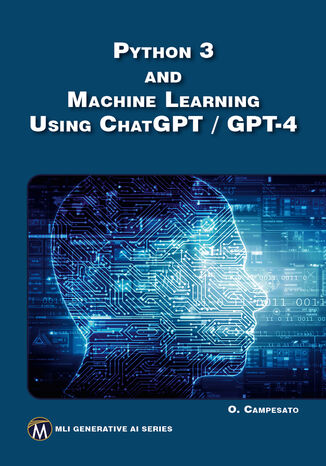
Mercury Learning and Information, Oswald Campesato
This book bridges the gap between theoretical knowledge and practical application in Python programming, machine learning, and using ChatGPT-4 in data science. It starts with an introduction to Pandas for data manipulation and analysis. The book then explores various machine learning classifiers, from kNN to SVMs. Later chapters cover GPT-4's capabilities, enhancing linear regression analysis, and using ChatGPT in data visualization, including AI apps, GANs, and DALL-E.The journey begins with mastering Pandas and machine learning fundamentals. It progresses to applying GPT-4 in linear regression and machine learning classifiers. The final chapters focus on using ChatGPT for data visualization, making complex results accessible and understandable.Understanding these concepts is crucial for modern data scientists. This book transitions readers from basic Python programming to advanced applications of ChatGPT-4 in data science. Companion files with source code, datasets, and figures enhance learning, making this an essential resource for mastering Python, machine learning, and AI-driven data visualization.
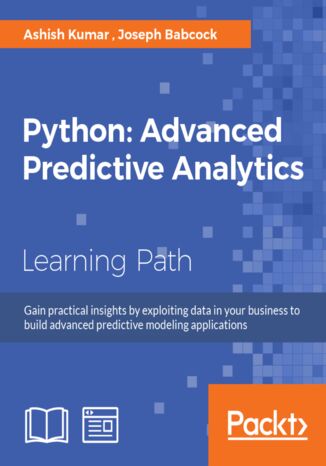
Ashish Kumar, Joseph Babcock
Social Media and the Internet of Things have resulted in an avalanche of data. Data is powerful but not in its raw form; it needs to be processed and modeled, and Python is one of the most robust tools out there to do so. It has an array of packages for predictive modeling and a suite of IDEs to choose from. Using the Python programming language, analysts can use these sophisticated methods to build scalable analytic applications. This book is your guide to getting started with predictive analytics using Python.You'll balance both statistical and mathematical concepts, and implement them in Python using libraries such as pandas, scikit-learn, and NumPy. Through case studies and code examples using popular open-source Python libraries, this book illustrates the complete development process for analytic applications. Covering a wide range of algorithms for classification, regression, clustering, as well as cutting-edge techniques such as deep learning, this book illustrates explains how these methods work. You will learn to choose the right approach for your problem and how to develop engaging visualizations to bring to life the insights of predictive modeling.Finally, you will learn best practices in predictive modeling, as well as the different applications of predictive modeling in the modern world. The course provides you with highly practical content from the following Packt books:1. Learning Predictive Analytics with Python2. Mastering Predictive Analytics with Python
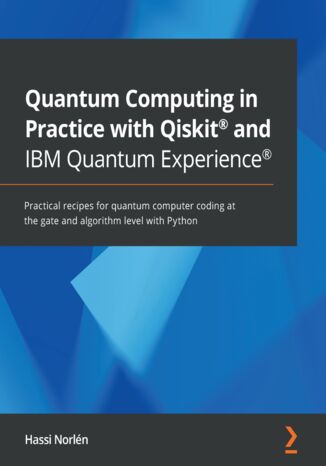
Hassi Norlen
IBM Quantum Experience® is a leading platform for programming quantum computers and implementing quantum solutions directly on the cloud. This book will help you get up to speed with programming quantum computers and provide solutions to the most common problems and challenges.You’ll start with a high-level overview of IBM Quantum Experience® and Qiskit®, where you will perform the installation while writing some basic quantum programs. This introduction puts less emphasis on the theoretical framework and more emphasis on recent developments such as Shor’s algorithm and Grover’s algorithm. Next, you’ll delve into Qiskit®, a quantum information science toolkit, and its constituent packages such as Terra, Aer, Ignis, and Aqua. You’ll cover these packages in detail, exploring their benefits and use cases. Later, you’ll discover various quantum gates that Qiskit® offers and even deconstruct a quantum program with their help, before going on to compare Noisy Intermediate-Scale Quantum (NISQ) and Universal Fault-Tolerant quantum computing using simulators and actual hardware. Finally, you’ll explore quantum algorithms and understand how they differ from classical algorithms, along with learning how to use pre-packaged algorithms in Qiskit® Aqua.By the end of this quantum computing book, you’ll be able to build and execute your own quantum programs using IBM Quantum Experience® and Qiskit® with Python.
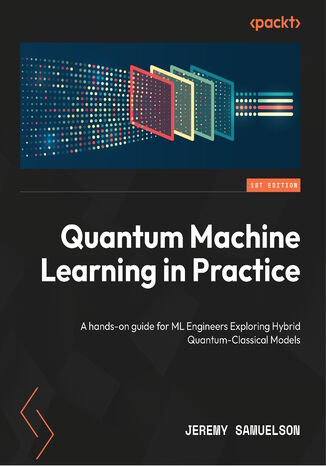
Jeremy Samuelson
Quantum computing is advancing rapidly, yet practical guidance for machine learning engineers remains limited. Most resources emphasize physics or theory, leaving practitioners unsure how quantum methods fit into real-world ML workflows. 'Quantum Machine Learning in Practice' addresses this gap with a hands-on, Python-first approach built for data scientists and ML engineers.Rather than presenting quantum models as replacements for classical ML, this book focuses on disciplined experimentation, hybrid architectures, and rigorous benchmarking. You will learn how classical data is encoded into quantum circuits, how variational models serve as classifiers and regressors, and how to evaluate quantum kernels and generative models responsibly. Concepts are grounded in simulator-based experiments using PennyLane, Qiskit, TensorFlow Quantum, and Cirq. Classical baselines are treated as first-class citizens throughout. You will design fair comparisons, analyze computational tradeoffs, and identify when classical ML remains superior. A complete end-to-end mini project reinforces transferable workflow skills, from problem framing through evaluation and interpretation.By the end, you will be able to design, implement, and critically assess hybrid quantum-classical machine learning systems with clarity and confidence.
Robert Loredo, Matt Broomhall
Prepare for a computing shift that will reshape security, optimization, and competitive advantage across every industry. This book helps you build a clear actionable approach to quantum readiness covering strategy, technology, talent, and risk in one framework.Written by Robert Loredo, Founder and CEO of Entangled Solutions Group, this book draws on 25 years of experience across IBM, academia, and enterprise innovation. As a former IBM Quantum Global Strategist, leader of the IBM Quantum Ambassador program, and holds over 275 patents, he translates this complex technology transition into decisions leaders can act on immediately.This book is organized as a complete strategic operating system for the quantum transition. Part One equips executives with investment frameworks, governance structures, and talent roadmaps. Part Two guides technical leaders through infrastructure assessment, workforce development, and quantum-era data strategy. Part Three delivers a security playbook covering post-quantum cryptography and adaptive architecture. Part Four maps the full quantum ecosystem and partnerships that will determine which institutions lead commercially.By the end, you’ll be able to define a quantum strategy, build the right capabilities, and lead your organization through quantum-driven change with clarity and control.
Jia Huang
Most developers can spin up a RAG pipeline in an afternoon using LangChain or LlamaIndex. Far fewer understand why retrieval fails or how to fix it. This book is for those who want to go deeper.'RAG From First Principles' dismantles the retrieval-augmented generation stack layer by layer, how documents are ingested and parsed, why chunking strategy directly impacts answer quality, how embedding models encode meaning, what happens inside a vector database, and how sparse and dense retrieval interact in a hybrid system. Written by Jia Huang, a research engineer and bestselling AI author, it brings research depth and production experience to one of AI's most critical engineering disciplines.Structured as a progressive dialogue between a seasoned engineer and two students, the book surfaces the questions practitioners actually ask. Each chapter builds on the last, from data import and chunking through embedding selection, index design, hybrid search, and post-retrieval processing, into response generation, evaluation, and advanced paradigms including GraphRAG, Agentic RAG, and Modular RAG.By the end, you'll have the architectural understanding to optimize, debug, and extend your RAG systems with confidence.
Denis Rothman
Stop moving your data to the AI. This second edition defines a revolutionary architectural shift: bringing the AI to the data. By using Oracle Database 23ai as a converged engine in this book, you will architect Sovereign AI systems that eliminate the fragmentation, latency, and massive security risks inherent in traditional data extraction.You’ll work with DualRAG, synchronizing unstructured vector semantics with the deterministic truth of structured SQL, Graph, and Spatial retrieval. This allows your systems to reason over verified corporate data rather than probabilistic guesses, reducing hallucinations at the source. Moving beyond simple pipelines, you’ll also build MAS-RAG (multi-agent systems for RAG), where autonomous agents coordinate across hybrid retrieval workflows, multimodal video pipelines, and graph-based knowledge structures.Designed for developers and architects, these blueprints transform disconnected data silos into a unified engine to architect autonomous enterprise intelligence that scales with RLHF and model fine-tuning. By the end of the book, you’ll be able to design and deploy enterprise AI systems that combine retrieval, reasoning, and structured data to build reliable generative AI applications.*Email sign-up and proof of purchase required
Rewolucja sztucznej inteligencji w medycynie. Jak GPT-4 może zmienić przyszłość
Peter Lee, Carey Goldberg, Isaac Kohane
Odkąd się pojawił, ChatGPT wzbudza ogromne zainteresowanie wśród ludzi różnych profesji. Szybko stało się jasne, że to jeden z największych przełomów technologicznych ostatnich kilkudziesięciu lat. Możemy oczekiwać, że modele językowe radykalnie wpłyną na to, jak ludzie będą pracować, komunikować się ze sobą i zdobywać wiedzę. Szczególnie dużo nadziei ― i obaw ― wiąże się z zastosowaniem GPT w medycynie. Niezależnie od tego, czy jesteś pracownikiem ochrony zdrowia, medykiem, czy pacjentem, powinieneś jak najszybciej zrozumieć możliwości tej technologii. W tej książce opisano różne zastosowania GPT-4 w medycynie: jako źródło informacji medycznej, wsparcie w podejmowaniu decyzji dotyczących leczenia czy też pomoc w tworzeniu dokumentacji, takiej jak podsumowanie wizyty pacjenta. Podczas lektury odkryjesz niezwykły potencjał tej technologii, przekonasz się także, jak bardzo może poprawić skuteczność diagnozowania i usprawnić niektóre procedury. Znajdziesz tu spostrzeżenia o potencjalnych wadach sztucznej inteligencji i najświeższe wnioski związane z jej zastosowaniem. Nie zabrakło również opisu zagrożeń związanych z tą technologią i wskazówek, do czego GPT nie można używać. Poszczególne zagadnienia zilustrowano prawdziwymi rozmowami z GPT-4. Są one w pełni spontaniczne i pozbawione poprawek, często błyskotliwe i czasami nietaktowne, wzbogacone o cenny kontekst i szczere komentarze. AI w medycynie: jutro zaczęło się wczoraj!