
Sztuczna inteligencja
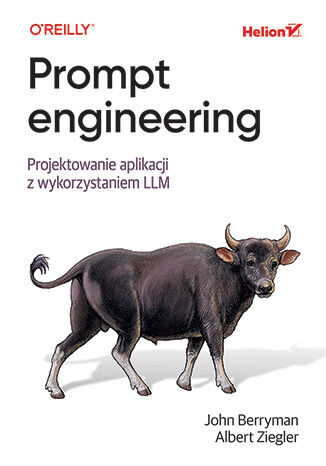
Prompt engineering. Projektowanie aplikacji z wykorzystaniem LLM
John Berryman, Albert Ziegler
Duże modele językowe (ang. large language models) są fundamentem istnienia wielu nowoczesnych aplikacji. LLM mogą realizować szeroki zakres zadań i służą do rozwiązywania złożonych problemów. Jednak projektowanie niezawodnych rozwiązań z wykorzystaniem modeli wymaga opanowania zupełnie nowych kompetencji. Dowiedz się, na czym polega skuteczne komunikowanie się z modelami LLM i w jaki sposób przekuwać śmiałe pomysły w działające aplikacje. Poznaj filozofię działania modeli i kluczowe techniki inżynierii promptów: od pozyskiwania i oceny kontekstu, przez konstruowanie efektywnych promptów, aż po tworzenie szablonów gwarantujących wysoką jakość odpowiedzi. W książce znajdziesz także opis bardziej zaawansowanych technik, takich jak konstruowanie pętli, potoków i przepływów pracy czy budowa agentów konwersacyjnych. Poznasz też metody oceniania modeli LLM. A ponadto: zrozumiesz architekturę modeli LLM i nauczysz się je stosować zaprojektujesz przemyślaną strategię tworzenia promptów nauczysz się budować kontekst i przekształcać go w skuteczne zapytania opanujesz najlepsze praktyki w tworzeniu aplikacji opartych na LLM Styl autorów sprawia, że tematyka promptów staje się dostępna dla każdego! Hamel Husain, niezależny badacz i konsultant
Prompt Engineering Using ChatGPT. Crafting Effective Interactions and Building GPT Apps
Mercury Learning and Information, Mehrzad Tabatabaian
This book is designed for mastering prompt engineering in artificial intelligence, focusing on ChatGPT, GPT-4, and GPT plug-ins. It explores fundamental principles, practical techniques, and real-world applications. Readers will learn the role of prompts in AI interactions, the anatomy of well-constructed prompts, and various prompt styles. The book also covers setting constraints to guide AI responses and ensure ethical interactions, making it ideal for both beginners and advanced users.The journey begins with the foundations of prompts and crafting contextual prompts. It progresses to asking specific questions, providing constraints, and creating diverse content prompts. Advanced chapters cover debugging, iterating prompts, and using GPT-4 with plug-ins. The book concludes with real-world applications, future trends, and ethical considerations, ensuring a comprehensive understanding of prompt engineering.Understanding these concepts is crucial for effective AI interactions. This book transitions readers from basic to advanced prompt engineering, blending theoretical knowledge with practical skills. It is an essential resource for mastering prompt engineering and building innovative GPT applications.
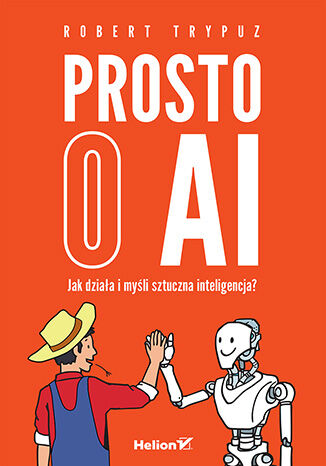
Prosto o AI. Jak działa i myśli sztuczna inteligencja?
Robert Trypuz
Książka Prosto o AI. Jak działa i myśli sztuczna inteligencja? Roberta Trypuza zdobyła III Nagrodę w konkursie na Najlepszą Polską Książkę Informatyczną 2025r. organizowanym przez Polskie Towarzystwo Informatyczne. Wszystko, co chcesz wiedzieć o AI i czego dotąd nikt nie był w stanie Ci (prosto) wyjaśnić Sztuczna inteligencja jest na ustach wszystkich. Odkąd pojawił się ChatGPT, newsy ze świata informatyki trafiają na pierwsze strony gazet, pojawiają się w serwisach informacyjnych, programach radiowych i telewizyjnych. Na temat AI dyskutują już nie tylko programiści, ale także fizycy, filozofowie i specjaliści zajmujący się rynkiem pracy. Wojskowi i naukowcy odkrywają dla niej kolejne zastosowania w swoich dziedzinach, futurolodzy zaś na zmianę straszą wizjami rodem z Terminatora i Czarnego lustra i uspokajają, że to wszystko dla naszego dobra, a sztuczna inteligencja pozostaje przecież pod ludzką kontrolą. W tym nowym, wspaniałym świecie, w którym każdy ma na temat AI swoje zdanie, opinie te są często sprzeczne, a ich uzasadnienia niezrozumiałe dla większości z nas, łatwo się pogubić. Jak się odnaleźć? Chcemy, by Twoim przewodnikiem po świecie sztucznej inteligencji stała się ta książka. Napisana prostym, przystępnym językiem przez informatyka i filozofa w jednej osobie, przybliży Ci najważniejsze zagadnienia związane z AI: Czym jest AI i jak się buduje sztuczną inteligencję, w tym ChatGPT Na jakich zasadach funkcjonują duże modele językowe W jaki sposób AI odczytuje tekst, a jak rozpoznaje obiekty na zdjęciu Czy sztuczna inteligencja może mieć wolną wolę Jakie znaczenie AI będzie miała dla edukacji O książce w mediach: Bać się, czy oswajać? „Prosto o AI”. Rozmowa z Robertem Trypuzem [Radio WNET] Eksperyment Myślowy - recenzja książki Kopalnia Wiedzy - recenzja książki Pozwól, że wyjaśnię - recenzja książki
Mercury Learning and Information, Oswald Campesato
This book bridges the gap between theoretical knowledge and practical application in Python programming, machine learning, and using ChatGPT-4 in data science. It starts with an introduction to Pandas for data manipulation and analysis. The book then explores various machine learning classifiers, from kNN to SVMs. Later chapters cover GPT-4's capabilities, enhancing linear regression analysis, and using ChatGPT in data visualization, including AI apps, GANs, and DALL-E.The journey begins with mastering Pandas and machine learning fundamentals. It progresses to applying GPT-4 in linear regression and machine learning classifiers. The final chapters focus on using ChatGPT for data visualization, making complex results accessible and understandable.Understanding these concepts is crucial for modern data scientists. This book transitions readers from basic Python programming to advanced applications of ChatGPT-4 in data science. Companion files with source code, datasets, and figures enhance learning, making this an essential resource for mastering Python, machine learning, and AI-driven data visualization.
Ashish Kumar, Joseph Babcock
Social Media and the Internet of Things have resulted in an avalanche of data. Data is powerful but not in its raw form; it needs to be processed and modeled, and Python is one of the most robust tools out there to do so. It has an array of packages for predictive modeling and a suite of IDEs to choose from. Using the Python programming language, analysts can use these sophisticated methods to build scalable analytic applications. This book is your guide to getting started with predictive analytics using Python.You'll balance both statistical and mathematical concepts, and implement them in Python using libraries such as pandas, scikit-learn, and NumPy. Through case studies and code examples using popular open-source Python libraries, this book illustrates the complete development process for analytic applications. Covering a wide range of algorithms for classification, regression, clustering, as well as cutting-edge techniques such as deep learning, this book illustrates explains how these methods work. You will learn to choose the right approach for your problem and how to develop engaging visualizations to bring to life the insights of predictive modeling.Finally, you will learn best practices in predictive modeling, as well as the different applications of predictive modeling in the modern world. The course provides you with highly practical content from the following Packt books:1. Learning Predictive Analytics with Python2. Mastering Predictive Analytics with Python
Hassi Norlen
IBM Quantum Experience® is a leading platform for programming quantum computers and implementing quantum solutions directly on the cloud. This book will help you get up to speed with programming quantum computers and provide solutions to the most common problems and challenges.You’ll start with a high-level overview of IBM Quantum Experience® and Qiskit®, where you will perform the installation while writing some basic quantum programs. This introduction puts less emphasis on the theoretical framework and more emphasis on recent developments such as Shor’s algorithm and Grover’s algorithm. Next, you’ll delve into Qiskit®, a quantum information science toolkit, and its constituent packages such as Terra, Aer, Ignis, and Aqua. You’ll cover these packages in detail, exploring their benefits and use cases. Later, you’ll discover various quantum gates that Qiskit® offers and even deconstruct a quantum program with their help, before going on to compare Noisy Intermediate-Scale Quantum (NISQ) and Universal Fault-Tolerant quantum computing using simulators and actual hardware. Finally, you’ll explore quantum algorithms and understand how they differ from classical algorithms, along with learning how to use pre-packaged algorithms in Qiskit® Aqua.By the end of this quantum computing book, you’ll be able to build and execute your own quantum programs using IBM Quantum Experience® and Qiskit® with Python.
Jeremy Samuelson
Quantum computing is advancing rapidly, yet practical guidance for machine learning engineers remains limited. Most resources emphasize physics or theory, leaving practitioners unsure how quantum methods fit into real-world ML workflows. 'Quantum Machine Learning in Practice' addresses this gap with a hands-on, Python-first approach built for data scientists and ML engineers.Rather than presenting quantum models as replacements for classical ML, this book focuses on disciplined experimentation, hybrid architectures, and rigorous benchmarking. You will learn how classical data is encoded into quantum circuits, how variational models serve as classifiers and regressors, and how to evaluate quantum kernels and generative models responsibly. Concepts are grounded in simulator-based experiments using PennyLane, Qiskit, TensorFlow Quantum, and Cirq. Classical baselines are treated as first-class citizens throughout. You will design fair comparisons, analyze computational tradeoffs, and identify when classical ML remains superior. A complete end-to-end mini project reinforces transferable workflow skills, from problem framing through evaluation and interpretation.By the end, you will be able to design, implement, and critically assess hybrid quantum-classical machine learning systems with clarity and confidence.
Robert Loredo, Matt Broomhall
Prepare for a computing shift that will reshape security, optimization, and competitive advantage across every industry. This book helps you build a clear actionable approach to quantum readiness covering strategy, technology, talent, and risk in one framework.Written by Robert Loredo, Founder and CEO of Entangled Solutions Group, this book draws on 25 years of experience across IBM, academia, and enterprise innovation. As a former IBM Quantum Global Strategist, leader of the IBM Quantum Ambassador program, and holds over 275 patents, he translates this complex technology transition into decisions leaders can act on immediately.This book is organized as a complete strategic operating system for the quantum transition. Part One equips executives with investment frameworks, governance structures, and talent roadmaps. Part Two guides technical leaders through infrastructure assessment, workforce development, and quantum-era data strategy. Part Three delivers a security playbook covering post-quantum cryptography and adaptive architecture. Part Four maps the full quantum ecosystem and partnerships that will determine which institutions lead commercially.By the end, you’ll be able to define a quantum strategy, build the right capabilities, and lead your organization through quantum-driven change with clarity and control.