
Informatyka
Stefan Boeykens
Architects have always relied on drawings, renderings, and sometimes even movies to present their design concepts to clients, contractors, and other stakeholders. The accessibility of current game engines provides new and exciting possibilities to turn any design into an interactive model that anyone can experience at their own pace.Unity for Architectural Visualization explains how you can create compelling, real-time models from your 3D architectural project. Filled with practical tips and in-depth information, this book explains every step in the process, starting from the very basics up to custom scripts that will get you up to the next level.This book begins with a general overview of the Unity workflow for architectural models. You will start with a simple project that lets you walk around in your design using basic Unity tools and methods. You will then learn how to easily get convincing lightning effects on your scene. You will then set up a basic navigation system in your project, and not only this; you will also cover some tips and tricks to take navigation to the next level. You will quickly learn how to fine-tune the shaders and how to set up materials that are a bit more advanced. Even when you finish Unity for Architectural Visualization, this book will make scripting easier with reusable examples of scripts that can be applied in most projects. After reading this book, you will be comfortable enough to tackle new projects and develop your own.
Will Goldstone
Game engines are central to the video games we know and love. From the artwork to the mathematics that underpin the frames onscreen, the engine calls the shots. Aside from offering one of the leading 3D game engines, Unity also provides a superlative development tool ñ a tool that can produce professional standard games for Mac, PC, and the Unity Web Player.This book is a complete exercise in game development covering environments, physics, sound, particles, and much more, to get you up and working with Unity quickly.Taking a practical approach, this book will introduce you to the concepts of developing 3D games before getting to grips with development in Unity itself. From creating 3D worlds to scripting and creating simple game elements you will learn everything you'll need to get started with game development for the PC, Mac, and Web.This book is designed to cover a set of easy to follow examples, which culminate in the production of a First Person 3D game, complete with an interactive island environment. By introducing common concepts of game and 3D production, you'll explore Unity to make a character interact with the game world, and build puzzles for the player to solve, in order to complete the game. At the end of the book, you will have a fully working 3D game and all the skills required to extend the game further, giving your end-user, the player, the best experience possible. Soon you will be creating your own 3D games with ease!
Alan R. Stagner
Unity is a game development engine that is fully integrated with a complete set of intuitive tools and rapid workflows used to create interactive 3D content. Multiplayer games have long been a staple of video games, and online multiplayer games have seen an explosion in popularity in recent years. Unity provides a unique platform for independent developers to create the most in-demand multiplayer experiences, from relaxing social MMOs to adrenaline-pumping competitive shooters.A practical guide to writing a variety of online multiplayer games with the Unity game engine, using a multitude of networking middleware from player-hosted games to standalone dedicated servers to cloud multiplayer technology. You can create a wide variety of online games with the Unity 4 as well as Unity 3 Engine.You will learn all the skills needed to make any multiplayer game you can think of using this practical guide. We break down complex multiplayer games into basic components, for different kinds of games, whether they be large multi-user environments or small 8-player action games. You will get started by learning networking technologies for a variety of situations with a Pong game, and also host a game server and learn to connect to it.Then, we will show you how to structure your game logic to work in a multiplayer environment. We will cover how to implement client-side game logic for player-hosted games and server-side game logic for MMO-style games, as well as how to deal with network latency, unreliability, and security.You will then gain an understanding of the Photon Server while creating a star collector game; and later, the Player.IO by creating a multiplayer RTS prototype game. You will also learn using PubNub with Unity by creating a chatbox application. Unity Multiplayer Games will help you learn how to use the most popular networking middleware available for Unity, from peer-oriented setups to dedicated server technology.
Unity. Przewodnik projektanta gier
Mike Geig
24 h do własnej gry! Unity to zaawansowane środowisko do tworzenia gier 3D, prezentacji i animacji zarówno na urządzenia mobilne, jak i stacjonarne. Wokół tego silnika skupiona jest ogromna społeczność, prezentująca produkcje o różnym stopniu zaawansowania. Jeżeli Twoim marzeniem jest stworzenie gry według własnego scenariusza, jeżeli chcesz sprawdzić się w roli projektanta gier wideo, to trafiłeś na doskonałą książkę, w całości poświęconą silnikowi Unity! Ta książka pozwoli Ci poznać zintegrowane środowisko (IDE) oraz dostosować je do własnych potrzeb. Nauczysz się tworzyć obiekty gry i wykonywać na nich operacje, stosować shadery i tekstury oraz korzystać z narzędzi do tworzenia terenu i środowiska Twojej gry. Kolejne rozdziały to interesujące informacje na temat oświetlenia, kamer oraz efektów dźwiękowych. Na sam koniec dowiesz się, jak dopracować stworzoną grę, wdrożyć ją oraz zmodyfikować tak, żeby działała na urządzeniach mobilnych. Dzięki lekturze stworzysz gry: Gauntlet Runner, Captain Blaster, Chaos Ball, Amazing Racer. Przekonaj się, jakie możliwości kryje silnik Unity! Dowiesz się, jak: tworzyć i pracować z obiektami gry, czyli podstawowymi blokami budulcowymi w Unity; efektywnie pracować z zasobami w Unity; stosować shadery i tekstury w dowolnym obiekcie 3D; przygotowywać niezwykłe światy za pomocą oferowanych przez Unity narzędzi przeznaczonych do tworzenia terenu i środowiska; wykonywać różne zadania w skryptach, począwszy od przechwytywania danych wejściowych aż po opracowanie skomplikowanych zachowań; szybko tworzyć możliwe do wielokrotnego użycia obiekty w postaci prefabrykatów; implementować łatwe i intuicyjne graficzne interfejsy użytkownika; tworzyć zdumiewające efekty za pomocą nowego w Unity systemu cząsteczek o nazwie Shurinken; wykorzystać pełne możliwości nowego w Unity systemu animacji o nazwie Mecanim; zintegrować dźwięk 2D i 3D z tworzonymi grami; używać wbudowanych w urządzenia mobilne przyśpieszeniomierzy i ekranów dotykowych; zmodyfikować grę w wersji biurkowej do wersji działającej w urządzeniach mobilnych; dopracować i wdrożyć grę. Zrealizuj swoje marzenie o stworzeniu własnej gry! * W książce wykorzystano Unity wersjach 4.1 i 4.2. ** Dodatkowe materiały do książki możesz pobrać >>> TU.
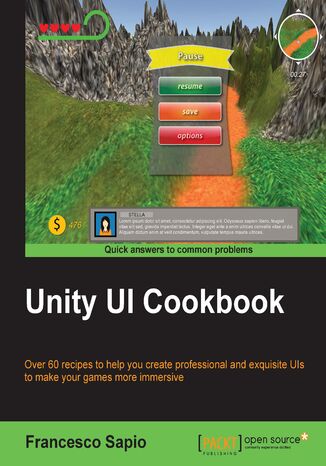
Francesco Sapio
With the increasing interest in game development, it's essential to design and implement a UI that reflects the game settings and shows the right information to the player. The Unity system is used to create complex and aesthetically pleasing user interfaces in order to give a professional look and feel to a game. Although the new Unity UI system is powerful and quite easy to use, by integrating it with C# scripts, it's possible to realize the potential of this system and bring an impressive UI to games.This guide is an invaluable collection of recipes if you are planning to use Unity to develop a game. Starting with the basic concepts of the UI components, we’ll take you all the way through to creating complex interfaces by including animations and dynamics elements.Based on real-world problems, these recipes will start by showing you how to make common UI elements such as counters and healthbars. You will then get a walkthrough of how to manage time using timers, and will learn how to format them. You will move on to decorating and animating the UI elements to vivify them and give them a professional touch. Furthermore, you will be guided into the 3D UI world and into HUD scripting. Finally, you will discover how to implement complex minimaps in the interface.
Michael Burton, Ellie Altomare
Photopea is a comprehensive image and photo editing design tool that provides essential features and capabilities comparable to Adobe Photoshop. This book covers the latest version of Photopea, featuring step-by-step instructions for image editing, improving and enhancing designs with text and effects, and creating eye-catching projects for print and the web.The first part of this book will teach you how to navigate the workspace, use the best tools for specific tasks and projects, and make perfect selections. You’ll also discover how to remove backgrounds, merge and/or add objects, and adjust colors to create impressive images. Later, you’ll explore layers and compositing techniques, and get hands on with retouching images like a pro. The book will demonstrate how to create collages and use brushes, color wheels, and swatches for drawing and painting. You’ll also learn how to apply impressive text to images to create posters, flyers, and logos.By the end of this book, you'll have learned how to retouch, paint, enhance, and manipulate images; how to use templates provided by Photopea; and finally, how to apply your skills to projects.
Keith Bourne, Shahul Es
Generative AI is helping organizations tap into their data in new ways, with RAG combining the strengths of LLMs with internal data for more intelligent and relevant AI applications. The author harnesses his decade of ML experience in this book to equip you with the strategic insights and technical expertise needed when using RAG to drive transformative outcomes.The book explores RAG’s role in enhancing organizational operations by blending theoretical foundations with practical techniques. You’ll work with detailed coding examples using tools such as LangChain and Chroma’s vector database to gain hands-on experience in integrating RAG into AI systems. The chapters contain real-world case studies and sample applications that highlight RAG’s diverse use cases, from search engines to chatbots. You’ll learn proven methods for managing vector databases, optimizing data retrieval, effective prompt engineering, and quantitatively evaluating performance. The book also takes you through advanced integrations of RAG with cutting-edge AI agents and emerging non-LLM technologies.By the end of this book, you’ll be able to successfully deploy RAG in business settings, address common challenges, and push the boundaries of what’s possible with this revolutionary AI technique.*Email sign-up and proof of purchase required
Keith Bourne
Developing AI agents that remember, adapt, and reason over complex knowledge isn’t a distant vision anymore; it’s happening now with Retrieval-Augmented Generation (RAG). This second edition of the bestselling guide leads you to the forefront of agentic system design, showing you how to build intelligent, explainable, and context-aware applications powered by RAG pipelines.You’ll master the building blocks of agentic memory, including semantic caches, procedural learning with LangMem, and the emerging CoALA framework for cognitive agents. You’ll also learn how to integrate GraphRAG with tools such as Neo4j to create deeply contextualized AI responses grounded in ontology-driven data.This book walks you through real implementations of working, episodic, semantic, and procedural memory using vector stores, prompting strategies, and feedback loops to create systems that continuously learn and refine their behavior. With hands-on code and production-ready patterns, you’ll be ready to build advanced AI systems that not only generate answers but also learn, recall, and evolve.Written by a seasoned AI educator and engineer, this book blends conceptual clarity with practical insight, offering both foundational knowledge and cutting-edge tools for modern AI development.*Email sign-up and proof of purchase required
Wladislav Cugunov
Unlocking the Power of Auto-GPT and Its Plugins reveals how Auto-GPT is transforming the way we work and live, by breaking down complex goals into manageable subtasks and intelligently utilizing the internet and other tools. With a background as a self-taught full stack developer and key contributor to Auto-GPT’s Inner Team, the author blends unconventional thinking with practical expertise to make Auto-GPT and its plugins accessible to developers at all levels.This book explores the potential of Auto-GPT and its associated plugins through practical applications. Beginning with an introduction to Auto-GPT, it guides you through setup, utilization, and the art of prompt generation. You'll gain a deep understanding of the various plugin types and how to create them. The book also offers expert guidance on developing AI applications such as chat assistants, research aides, and speech companions, while covering advanced topics such as Docker configuration, continuous mode operation, and integrating your own LLM with Auto-GPT.By the end of this book, you'll be equipped with the knowledge and skills needed for AI application development, plugin creation, setup procedures, and advanced Auto-GPT features to fuel your AI journey.
Gilbert Mizrahi, Daniel Serfaty
Unlocking the Secrets of Prompt Engineering is your key to mastering the art of AI-driven writing. This book propels you into the world of large language models (LLMs), empowering you to create and apply prompts effectively for diverse applications, from revolutionizing content creation and chatbots to coding assistance.Starting with the fundamentals of prompt engineering, this guide provides a solid foundation in LLM prompts, their components, and applications. Through practical examples and use cases, you'll discover how LLMs can be used for generating product descriptions, personalized emails, social media posts, and even creative writing projects like fiction and poetry. The book covers advanced use cases such as creating and promoting podcasts, integrating LLMs with other tools, and using AI for chatbot development. But that’s not all. You'll also delve into the ethical considerations, best practices, and limitations of using LLM prompts as you experiment and optimize your approach for best results.By the end of this book, you'll have unlocked the full potential of AI in writing and content creation to generate ideas, overcome writer's block, boost productivity, and improve communication skills.

Unmanned Aerial Vehicles. A Comprehensive Guide to UAV Technology and Applications
Mercury Learning and Information, P. K. Garg
This book offers a comprehensive overview of Unmanned Aerial Vehicles (UAVs), covering their basic concepts, components, and various applications. It delves into the different sensors used in UAVs, the architecture of autonomous UAVs, and the communication tools and devices required to acquire real-time data. The book also explores the software needed to analyze UAV data and the rules and regulations necessary for operating UAVs. The importance of UAV technology is highlighted through its diverse applications in fields such as construction, oil and gas, mining, agriculture, forestry, search and rescue, surveillance, transportation, disaster management, logistics, health, and journalism. The book underscores the potential of UAVs to revolutionize these industries by improving efficiency and safety.Throughout the book, readers will journey from understanding the theory, hardware, and software components of UAVs to exploring their practical uses. Each chapter includes review questions to reinforce understanding, ensuring that readers gain a solid grasp of the subject matter. This text is essential for anyone interested in the current and future impact of UAV technology.
Richard Moore
Unreal Development Kit (UDK) is the free version of the award-winning Unreal Engine 3. It is used to create a wide variety of games ranging from amateur to professional standard next generation AAA titles.This book will show you exactly how to create an enjoyable and immersive game environment using the UDK. You will learn how to implement, level design, lighting, environmental effects, movement, terrain, map creation, item placement, kismet, materials and complex event sequences.You will work through the level design process from navigating round the editor to learning how to develop a fully playable environment. You will quickly master all of the engine’s key tools that are accessible through Unreal Engine 3. You will then start putting together your first level using step-by-step instructions. Next we will implement real world features such as dynamic lighting and shadows, particle effects, physics, terrain, item placement and advanced AI/bot pathing. Finally you will learn how to use UDK’s cutting edge high level scripting. By the end of this book you will be equipped with the skills to create an entertaining and imaginative game world.
Thomas Mooney
UDK is a free, world class game editing tool and being so powerful it can be daunting to learn. This guide offers an excellent set of targeted recipes to help game artists get up to speed with game designing in UDK.Unreal Development Kit Game Design Cookbook contains everything you need to jumpstart your game design efforts. The lessons are aimed squarely at the artist's field of production, with recipes on asset handling, creating content within the editor, animation and visual scripting to get the content working in gameplay.Unreal Game Development Kit Game Design Cookbook exposes how real-time environments are built using UDK tools. Key features are examined ñ assets, animation, light, materials, game controls, user interface, special effects, and game interactivity - with the view of making UDK technically accessible so users can transcend technique and focus on their creative design process. The book has well prepared recipes for level designers and artists of all levels. It covers core design tools and processes in the editor, particularly setting up characters, UI approaches, configuration and scripting gameplay. It is a technical guide that allows game artists to go beyond just creating assets, and it includes creative, extensive demonstrations that extend on mere functionality.
Rachel Cordone
Unreal Development Kit is the free edition of Unreal Engine—the largest game engine in existence with hundreds of shipped commercial titles. The Unreal Engine is a very powerful tool for game development but with something so complex it's hard to know where to start.This book will teach you how to use the UnrealScript language to create your own games with the Unreal Development Kit by using an example game that you can create and play for yourself. It breaks down the UnrealScript language into easy to follow chapters that will quickly bring you up to speed with UnrealScript game programming.Unreal Development Kit Game Programming with UnrealScript takes you through the UnrealScript language for the Unreal Development Kit. It starts by walking through a project setup and setting up programs to write and browse code. It then takes you through using variables, functions, and custom classes to alter the game's behavior and create our own functionality. The use and creation of Kismet is also covered. Later, using replication to create and test multiplayer games is discussed. The book closes with code optimization and error handling as well as a few of the less common but useful features of UnrealScript.
Jie Feng, Peter Newton
Unreal Engine is a powerful game development engine that provides rich functionalities to create 2D and 3D games. Developers have the opportunity to build cross-platform mobile and desktop games from scratch. This book will show you how to apply artificial intelligence (AI) techniques to your Unreal project using blueprints as your scripting language. You will start with an introduction to AI, and learn how it is applied to gaming. Then you'll jump right in and create a simple AI bot and apply basic behaviors to allow it to move randomly. As you progress, you'll find out how to implement randomness and probability traits. Using NavMesh, you will impart navigation components such as character movement, MoveTo nodes, settings, and world objects, and implement Behavior Trees. At the end of the book, you will troubleshoot any issues that might crop up while building the game.
Tyson Butler-Boschma, Manea Castet
Written by multi-award-winning Unreal generalist Tyson J. Butler-Boschma, Founder and Creative Director of Toybox Games Studios, this book addresses common challenges you face when advancing your expertise in lighting, environment design, and cinematic storytelling. The chapters help you move quickly from mastering core skills to exploring the most innovative Unreal Engine 5 features, such as Lumen, ray tracing, Nanite, and Chaos Physics, to craft professional-quality immersive scenes and experiences.Packed with actionable insights and step-by-step workflows, this hands-on guide teaches you how to optimize performance without sacrificing visual fidelity, use Unreal’s built-in tools to create interactive environments, and implement cutting-edge techniques to enhance storytelling and interactivity. Each chapter features practical examples and troubleshooting tips to help you overcome real-world obstacles and bring your creative visions to life.By the end of this book, you’ll be fully equipped to design visually stunning, high-performance projects in Unreal Engine 5.*Email sign-up and proof of purchase required