
Informatyka
Martin Czygan, Phuong Vo.T.H, Ashish Kumar, Kirthi...
You will start the course with an introduction to the principles of data analysis and supported libraries, along with NumPy basics for statistics and data processing. Next, you will overview the Pandas package and use its powerful features to solve data-processing problems. Moving on, you will get a brief overview of the Matplotlib API .Next, you will learn to manipulate time and data structures, and load and store data in a file or database using Python packages. You will learn how to apply powerful packages in Python to process raw data into pure and helpful data using examples. You will also get a brief overview of machine learning algorithms, that is, applying data analysis results to make decisions or building helpful products such as recommendations and predictions using Scikit-learn. After this, you will move on to a data analytics specialization—predictive analytics. Social media and IOT have resulted in an avalanche of data. You will get started with predictive analytics using Python. You will see how to create predictive models from data. You will get balanced information on statistical and mathematical concepts, and implement them in Python using libraries such as Pandas, scikit-learn, and NumPy. You’ll learn more about the best predictive modeling algorithms such as Linear Regression, Decision Tree, and Logistic Regression. Finally, you will master best practices in predictive modeling.After this, you will get all the practical guidance you need to help you on the journey to effective data visualization. Starting with a chapter on data frameworks, which explains the transformation of data into information and eventually knowledge, this path subsequently cover the complete visualization process using the most popular Python libraries with working examplesThis Learning Path combines some of the best that Packt has to offer in one complete, curated package. It includes content from the following Packt products:? Getting Started with Python Data Analysis, Phuong Vo.T.H &Martin Czygan•Learning Predictive Analytics with Python, Ashish Kumar•Mastering Python Data Visualization, Kirthi Raman
Alberto Boschetti
The book starts by introducing you to setting up your essential data science toolbox. Then it will guide you across all the data munging and preprocessing phases. This will be done in a manner that explains all the core data science activities related to loading data, transforming and fixing it for analysis, as well as exploring and processing it. Finally, it will complete the overview by presenting you with the main machine learning algorithms, the graph analysis technicalities, and all the visualization instruments that can make your life easier in presenting your results.In this walkthrough, structured as a data science project, you will always be accompanied by clear code and simplified examples to help you understand the underlying mechanics and real-world datasets.
Python Data Science Essentials. Learn the fundamentals of Data Science with Python - Second Edition
Luca Massaron, Alberto Boschetti
Fully expanded and upgraded, the second edition of Python Data Science Essentials takes you through all you need to know to suceed in data science using Python. Get modern insight into the core of Python data, including the latest versions of Jupyter notebooks, NumPy, pandas and scikit-learn. Look beyond the fundamentals with beautiful data visualizations with Seaborn and ggplot, web development with Bottle, and even the new frontiers of deep learning with Theano and TensorFlow. Dive into building your essential Python 3.5 data science toolbox, using a single-source approach that will allow to to work with Python 2.7 as well. Get to grips fast with data munging and preprocessing, and all the techniques you need to load, analyse, and process your data. Finally, get a complete overview of principal machine learning algorithms, graph analysis techniques, and all the visualization and deployment instruments that make it easier to present your results to an audience of both data science experts and business users.
Benjamin Baka
Data structures allow you to organize data in a particular way efficiently. They are critical to any problem, provide a complete solution, and act like reusable code. In this book, you will learn the essential Python data structures and the most common algorithms. With this easy-to-read book, you will be able to understand the power of linked lists, double linked lists, and circular linked lists. You will be able to create complex data structures such as graphs, stacks and queues. We will explore the application of binary searches and binary search trees. You will learn the common techniques and structures used in tasks such as preprocessing, modeling, and transforming data. We will also discuss how to organize your code in a manageable, consistent, and extendable way. The book will explore in detail sorting algorithms such as bubble sort, selection sort, insertion sort, and merge sort. By the end of the book, you will learn how to build components that are easy to understand, debug, and use in different applications.
Indra den Bakker
Deep Learning is revolutionizing a wide range of industries. For many applications, deep learning has proven to outperform humans by making faster and more accurate predictions. This book provides a top-down and bottom-up approach to demonstrate deep learning solutions to real-world problems in different areas. These applications include Computer Vision, Natural Language Processing, Time Series, and Robotics. The Python Deep Learning Cookbook presents technical solutions to the issues presented, along with a detailed explanation of the solutions. Furthermore, a discussion on corresponding pros and cons of implementing the proposed solution using one of the popular frameworks like TensorFlow, PyTorch, Keras and CNTK is provided. The book includes recipes that are related to the basic concepts of neural networks. All techniques s, as well as classical networks topologies. The main purpose of this book is to provide Python programmers a detailed list of recipes to apply deep learning to common and not-so-common scenarios.
Ivan Vasilev, Daniel Slater, Gianmario Spacagna, Peter...
With the surge in artificial intelligence in applications catering to both business and consumer needs, deep learning is more important than ever for meeting current and future market demands. With this book, you’ll explore deep learning, and learn how to put machine learning to use in your projects.This second edition of Python Deep Learning will get you up to speed with deep learning, deep neural networks, and how to train them with high-performance algorithms and popular Python frameworks. You’ll uncover different neural network architectures, such as convolutional networks, recurrent neural networks, long short-term memory (LSTM) networks, and capsule networks. You’ll also learn how to solve problems in the fields of computer vision, natural language processing (NLP), and speech recognition. You'll study generative model approaches such as variational autoencoders and Generative Adversarial Networks (GANs) to generate images. As you delve into newly evolved areas of reinforcement learning, you’ll gain an understanding of state-of-the-art algorithms that are the main components behind popular games Go, Atari, and Dota.By the end of the book, you will be well-versed with the theory of deep learning along with its real-world applications.
Valentino Zocca, Gianmario Spacagna, Daniel Slater, Peter...
With an increasing interest in AI around the world, deep learning has attracted a great deal of public attention. Every day, deep learning algorithms are used broadly across different industries.The book will give you all the practical information available on the subject, including the best practices, using real-world use cases. You will learn to recognize and extract information to increase predictive accuracy and optimize results.Starting with a quick recap of important machine learning concepts, the book will delve straight into deep learning principles using Sci-kit learn. Moving ahead, you will learn to use the latest open source libraries such as Theano, Keras, Google's TensorFlow, and H20. Use this guide to uncover the difficulties of pattern recognition, scaling data with greater accuracy and discussing deep learning algorithms and techniques.Whether you want to dive deeper into Deep Learning, or want to investigate how to get more out of this powerful technology, you’ll find everything inside.
Matthew Lamons, Rahul Kumar, Abhishek Nagaraja
Deep learning has been gradually revolutionizing every field of artificial intelligence, making application development easier.Python Deep Learning Projects imparts all the knowledge needed to implement complex deep learning projects in the field of computational linguistics and computer vision. Each of these projects is unique, helping you progressively master the subject. You’ll learn how to implement a text classifier system using a recurrent neural network (RNN) model and optimize it to understand the shortcomings you might experience while implementing a simple deep learning system.Similarly, you’ll discover how to develop various projects, including word vector representation, open domain question answering, and building chatbots using seq-to-seq models and language modeling. In addition to this, you’ll cover advanced concepts, such as regularization, gradient clipping, gradient normalization, and bidirectional RNNs, through a series of engaging projects.By the end of this book, you will have gained knowledge to develop your own deep learning systems in a straightforward way and in an efficient way
Ivan Vasilev, Valentino Zocca
The field of deep learning has developed rapidly recently and today covers a broad range of applications. This makes it challenging to navigate and hard to understand without solid foundations. This book will guide you from the basics of neural networks to the state-of-the-art large language models in use today.The first part of the book introduces the main machine learning concepts and paradigms. It covers the mathematical foundations, the structure, and the training algorithms of neural networks and dives into the essence of deep learning.The second part of the book introduces convolutional networks for computer vision. We’ll learn how to solve image classification, object detection, instance segmentation, and image generation tasks.The third part focuses on the attention mechanism and transformers – the core network architecture of large language models. We’ll discuss new types of advanced tasks they can solve, such as chatbots and text-to-image generation.By the end of this book, you’ll have a thorough understanding of the inner workings of deep neural networks. You'll have the ability to develop new models and adapt existing ones to solve your tasks. You’ll also have sufficient understanding to continue your research and stay up to date with the latest advancements in the field.
Python dla DevOps. Naucz się bezlitośnie skutecznej automatyzacji
Noah Gift, Kennedy Behrman, Alfredo Deza, Grig...
Ostatnia dekada zmieniła oblicze IT. Kluczowego znaczenia nabrały big data, a chmura i automatyzacja rozpowszechniły się wszędzie tam, gdzie mowa o efektywności. Inżynierowie muszą wykorzystywać zalety systemów linuksowych w codziennej praktyce, aby zapewnić należyty poziom automatyzacji swoich zadań. Do tych celów świetnie nadaje się Python. Język ten zdobywa coraz większe uznanie z uwagi na jego wszechstronność, jak również wydajność, przenaszalność i bezpieczeństwo kodu. Warto więc wykorzystywać Pythona do administrowania systemami Linux wraz z takimi narzędziami DevOps jak Docker, Kubernetes i Terraform. Dzięki tej książce dowiesz się, jak sobie z tym poradzić. Znalazło się w niej krótkie wprowadzenie do Pythona oraz do automatyzacji przetwarzania tekstu i obsługi systemu plików, a także do pisania własnych narzędzi wiersza poleceń. Zaprezentowano również przydatne narzędzia linuksowe, systemy zarządzania pakietami oraz systemy budowania, monitorowania i automatycznego testowania kodu. Zagadnienia te szczególnie zainteresują specjalistów DevOps. Ponadto zawarto tu podstawowe informacje o chmurze obliczeniowej, usługach IaC i systemach Kubernetes. Omówiono zasady uczenia maszynowego i inżynierii danych z perspektywy DevOps. Przedstawiono także kompletny przewodnik po procesach budowania, wdrażania oraz operacyjnego wykorzystywania modelu uczenia maszynowego z użyciem systemów Flask, sklearn, Docker i Kubernetes. W tej książce: wprowadzenie do Pythona automatyczne przetwarzanie tekstu oraz automatyzacja operacji na plikach automatyzacja za pomocą sprawdzonych narzędzi linuksowych chmura, infrastruktura jako kod, Kubernetes i tryb bezserwerowy uczenie maszynowe i inżynieria danych z perspektywy DevOps tworzenie i operacjonalizacja projektu uczenia maszynowego Python: tutaj ważna jest prawdziwa nowoczesność oprogramowania!
Python dla nastolatków. Projekty graficzne z Python Turtle
Krzysztof Łos
Książka "Python dla nastolatków. Projekty graficzne z Python Turtle" Krzysztofa Łosa zdobyła wyróżnienie w kategorii podręczników w konkursie na Najlepszą Polską Książkę Informatyczną 2023r. organizowanym przez Polskie Towarzystwo Informatyczne. Każdy może zostać programistą! Czy wiesz, czym się zajmuje programista? To ktoś, kto, używając swojego umysłu i odpowiedniego języka programowania, rozwiązuje rozmaite problemy. Programista to taki współczesny superbohater. Przychodzi, siada do komputera, szybko przebiega palcami po klawiaturze i proszę ― działa. Oczywiście, to pewne uproszczenie, ale... Brzmi ciekawie? Słusznie. Bo praca programisty, kodera, developera jest ciekawa. I fajna. I daje dużo satysfakcji. A najlepsze jest to: podstaw programowania można się szybko nauczyć, po prostu się bawiąc. We własny, ulubiony sposób. Choć Twoim przewodnikiem po świecie programowania w Pythonie będzie żółw, obiecujemy ― praca pójdzie Ci w mig. Na początek nauczysz się konfigurować środowisko pracy, czyli uruchomisz na komputerze wszystko, co przyda się Tobie i żółwiowi. Potem zapoznasz się z językiem Python, z jego zmiennymi, funkcjami i klasami. Następnie zajrzysz do biblioteki turtle i dowiesz się, jak sterować swoim żółwiem. Wreszcie najlepsze: algorytmy. Przekonasz się między innymi, jak za pomocą kodu języka Python i elementów biblioteki turtle wygenerować niesamowite figury geometryczne. UWAGA! Książka jest polecana osobom biorącym udział w konkursie Logia. Informacje o konkursie można znaleźć pod adresem: logia.oeiizk.waw.pl
Python dla programistów. Big Data i AI. Studia przypadków
Paul J. Deitel, Harvey Deitel
Programiści lubią Pythona. Ujmuje ich wyrazistość, zwięzłość i interaktywność kodu, a także bogata kolekcja narzędzi i bibliotek. Zalety te są uzupełniane przez rozwój innych technologii, zwiększającą się dostępność coraz szybszego sprzętu oraz rosnącą przepustowość internetu. Z kolei to wszystko wiąże się z powstawaniem niewyobrażalnych ilości danych, które trzeba magazynować i efektywnie przetwarzać. Większość innowacji w świecie informatyki koncentruje się wokół danych. A z tymi zadaniami można sobie poradzić dzięki imponującym możliwościom Pythona i jego bibliotek. Ta książka ułatwi naukę Pythona metodą analizy i eksperymentów. Zawiera ponad 500 przykładów faktycznie wykorzystywanego kodu - od krótkich bloków po kompletne studia przypadków. Pokazano, w jaki sposób można kodować w interpreterze IPython i notatnikach Jupytera. Znalazł się tu obszerny opis Pythona oraz jego instrukcji sterujących i funkcji, omówiono pracę na plikach, kwestie serializacji w notacji JSON i obsługę wyjątków. Zaprezentowano różne paradygmaty programowania: proceduralnego, w stylu funkcyjnym i zorientowanego obiektowo. Sporo miejsca poświęcono bibliotekom: standardowej bibliotece Pythona i bibliotekom data science do realizacji złożonych zadań przy minimalnym udziale kodowania. Nie zabrakło wprowadzenia do takich zagadnień data science jak sztuczna inteligencja, symulacje, animacje czy przygotowanie danych do analizy. W książce między innymi: przetwarzanie języka naturalnego IBM stosowanie bibliotek scikit-learn i Keras big data, Hadoop(R), Spark™, NoSQL i usługi chmurowe programowanie dla internetu rzeczy (IoT) biblioteki: standardowa, NumPy, Pandas, SciPy, NLTK, YexyBlob, Tweepy, Matplotlib i inne
Python Essentials for AWS Cloud Developers. Run and deploy cloud-based Python applications using AWS
Serkan Sakinmaz
AWS provides a vast variety of services for implementing Python applications, which can pose a challenge for those without an AWS background. This book addresses one of the more predominant problems of choosing the right service and stepping into the implementation of exciting Python apps using AWS.The book begins by showing you how to install Python and create an AWS account, before helping you explore AWS Lambda, EC2, Elastic Beanstalk, and S3 for Python programming. You'll then gain hands-on experience in using these services to build the Python application. As you advance, you'll discover how to debug Python apps using PyCharm, and then start deploying the Python applications on Elastic Beanstalk. You’ll also learn how to monitor Python applications using the CloudWatch service, along with creating and publishing APIs on AWS to access the Python application. The concluding chapters will help you get to grips with storing unstructured and semi-structured data using NoSQL and DynamoDB, as well as advance your knowledge using the Glue serverless data integration service in AWS.By the end of this Python book, you’ll be able to take your application development skills up a notch with AWS services and advance in your career.
Fahad Ali Sarwar
Penetration testing enables you to evaluate the security or strength of a computer system, network, or web application that an attacker can exploit. With this book, you'll understand why Python is one of the fastest-growing programming languages for penetration testing. You'll find out how to harness the power of Python and pentesting to enhance your system security.Developers working with Python will be able to put their knowledge and experience to work with this practical guide. Complete with step-by-step explanations of essential concepts and practical examples, this book takes a hands-on approach to help you build your own pentesting tools for testing the security level of systems and networks. You'll learn how to develop your own ethical hacking tools using Python and explore hacking techniques to exploit vulnerabilities in networks and systems. Finally, you'll be able to get remote access to target systems and networks using the tools you develop and modify as per your own requirements.By the end of this ethical hacking book, you'll have developed the skills needed for building cybersecurity tools and learned how to secure your systems by thinking like a hacker.
Soledad Galli
Feature engineering, the process of transforming variables and creating features, albeit time-consuming, ensures that your machine learning models perform seamlessly. This second edition of Python Feature Engineering Cookbook will take the struggle out of feature engineering by showing you how to use open source Python libraries to accelerate the process via a plethora of practical, hands-on recipes.This updated edition begins by addressing fundamental data challenges such as missing data and categorical values, before moving on to strategies for dealing with skewed distributions and outliers. The concluding chapters show you how to develop new features from various types of data, including text, time series, and relational databases. With the help of numerous open source Python libraries, you'll learn how to implement each feature engineering method in a performant, reproducible, and elegant manner.By the end of this Python book, you will have the tools and expertise needed to confidently build end-to-end and reproducible feature engineering pipelines that can be deployed into production.
Oliver Theobald
This book provides a thorough introduction to Python, starting with basic operations like arithmetic and variable creation. As you progress, you'll delve into more complex topics such as loops, conditionals, functions, and object-oriented programming. By the end, you'll be able to write Python code and use libraries like Pandas to manipulate data efficiently. Practical challenges and exercises help solidify your learning. It’s designed to be engaging and easy to follow, making the Python learning experience as enjoyable as it is informative. As you build your skills, you will also gain hands-on experience by tackling coding exercises that reinforce each concept. Whether you're new to programming or looking to sharpen your Python skills, this book will guide you through every essential aspect of the language, preparing you for real-world applications.
Massimiliano Pippi
If you are a Python developer, whether you have experience in web applications development or not, and want to rapidly deploy a scalable backend service or a modern web application on Google App Engine, then this book is for you.
Mercury Learning and Information, Oswald Campesato
This book is designed for developers with little to no experience in Python or Pandas, providing a fast-paced introduction to Python programming and practical solutions to various tasks. The journey begins with a quick tour of basic Python 3, followed by a deep dive into loops and conditional logic. The text covers data structures extensively, and includes tasks involving strings and arrays.As the reader progresses, object-oriented programming concepts are introduced with illustrative code samples, along with an exploration of recursion and fundamental topics in combinatorics. An appendix provides an introduction to Pandas, equipping readers with essential tools for data manipulation and analysis.This book offers a comprehensive yet concise learning path, reinforced by numerous code samples and companion files available for download. It is an invaluable resource for beginners seeking to master Python and Pandas, providing a solid foundation for further exploration in programming and data science.
Ryan Marvin, Mark Nganga, Amos Omondi
After a brief history of Python and key differences between Python 2 and Python 3, you'll understand how Python has been used in applications such as YouTube and Google App Engine. As you work with the language, you'll learn about control statements, delve into controlling program flow and gradually work on more structured programs via functions.As you settle into the Python ecosystem, you'll learn about data structures and study ways to correctly store and represent information. By working through specific examples, you'll learn how Python implements object-oriented programming (OOP) concepts of abstraction, encapsulation of data, inheritance, and polymorphism. You'll be given an overview of how imports, modules, and packages work in Python, how you can handle errors to prevent apps from crashing, as well as file manipulation.By the end of this book, you'll have built up an impressive portfolio of projects and armed yourself with the skills you need to tackle Python projects in the real world.
Erik Westra
Geospatial development links your data to locations on the surface of the Earth. Writing geospatial programs involves tasks such as grouping data by location, storing and analyzing large amounts of spatial information, performing complex geospatial calculations, and drawing colorful interactive maps. In order to do this well, you’ll need appropriate tools and techniques, as well as a thorough understanding of geospatial concepts such as map projections, datums, and coordinate systems.This book provides an overview of the major geospatial concepts, data sources, and toolkits. It starts by showing you how to store and access spatial data using Python, how to perform a range of spatial calculations, and how to store spatial data in a database. Further on, the book teaches you how to build your own slippy map interface within a web application, and finishes with the detailed construction of a geospatial data editor using the GeoDjango framework. By the end of this book, you will be able to confidently use Python to write your own geospatial applications ranging from quick, one-off utilities to sophisticated web-based applications using maps and other geospatial data.
Burkhard Meier
Python is a multi-domain, interpreted programming language. It is a widely used general-purpose, high-level programming language. It is often used as a scripting language because of its forgiving syntax and compatibility with a wide variety of different eco-systems. Python GUI Programming Cookbook follows a task-based approach to help you create beautiful and very effective GUIs with the least amount of code necessary.This book will guide you through the very basics of creating a fully functional GUI in Python with only a few lines of code. Each and every recipe adds more widgets to the GUIs we are creating. While the cookbook recipes all stand on their own, there is a common theme running through all of them. As our GUIs keep expanding, using more and more widgets, we start to talk to networks, databases, and graphical libraries that greatly enhance our GUI’s functionality. This book is what you need to expand your knowledge on the subject of GUIs, and make sure you’re not missing out in the long run.
Python GUI Programming with Tkinter. Develop responsive and powerful GUI applications with Tkinter
Alan D. Moore
Tkinter is a lightweight, portable, and easy-to-use graphical toolkit available in the Python Standard Library, widely used to build Python GUIs due to its simplicity and availability. This book teaches you to design and build graphical user interfaces that are functional, appealing, and user-friendly using the powerful combination of Python and Tkinter.After being introduced to Tkinter, you will be guided step-by-step through the application development process. Over the course of the book, your application will evolve from a simple data-entry form to a complex data management and visualization tool while maintaining a clean and robust design. In addition to building the GUI, you'll learn how to connect to external databases and network resources, test your code to avoid errors, and maximize performance using asynchronous programming. You'll make the most of Tkinter's cross-platform availability by learning how to maintain compatibility, mimic platform-native look and feel, and build executables for deployment across popular computing platforms.By the end of this book, you will have the skills and confidence to design and build powerful high-end GUI applications to solve real-world problems.
Dr. Gabriele Lanaro
Python is a versatile language that has found applications in many industries. The clean syntax, rich standard library, and vast selection of third-party libraries make Python a wildly popular language. Python High Performance is a practical guide that shows how to leverage the power of both native and third-party Python libraries to build robust applications. The book explains how to use various profilers to find performance bottlenecks and apply the correct algorithm to fix them. The reader will learn how to effectively use NumPy and Cython to speed up numerical code. The book explains concepts of concurrent programming and how to implement robust and responsive applications using Reactive programming. Readers will learn how to write code for parallel architectures using Tensorflow and Theano, and use a cluster of computers for large-scale computations using technologies such as Dask and PySpark. By the end of the book, readers will have learned to achieve performance and scale from their Python applications.
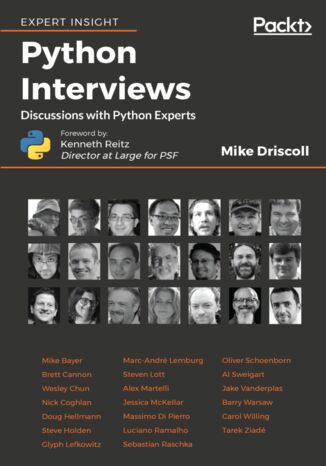
Python Interviews. Discussions with Python Experts
Michael Driscoll
Each of these twenty Python Interviews can inspire and refresh your relationship with Python and the people who make Python what it is today. Let these interviews spark your own creativity, and discover how you also have the ability to make your mark on a thriving tech community. This book invites you to immerse in the Python landscape, and let these remarkable programmers show you how you too can connect and share with Python programmers around the world. Learn from their opinions, enjoy their stories, and use their tech tips.• Brett Cannon - former director of the PSF, Python core developer, led the migration to Python 3.• Steve Holden - tireless Python promoter and former chairman and director of the PSF.• Carol Willing - former director of the PSF and Python core developer, Project Jupyter Steering Council member.• Nick Coghlan - founding member of the PSF's Packaging Working Group and Python core developer.• Jessica McKellar - former director of the PSF and Python activist.• Marc-André Lemburg - Python core developer and founding member of the PSF.• Glyph Lefkowitz - founder of Twisted and fellow of the PSF• Doug Hellmann - fellow of the PSF, creator of the Python Module of the Week blog, Python community member since 1998.• Massimo Di Pierro - fellow of the PSF, data scientist and the inventor of web2py. • Alex Martelli - fellow of the PSF and co-author of Python in a Nutshell.• Barry Warsaw - fellow of the PSF, Python core developer since 1995, and original member of PythonLabs.• Tarek Ziadé - founder of Afpy and author of Expert Python Programming.• Sebastian Raschka - data scientist and author of Python Machine Learning.• Wesley Chun - fellow of the PSF and author of the Core Python Programming books.• Steven Lott - Python blogger and author of Python for Secret Agents.• Oliver Schoenborn - author of Pypubsub and wxPython mailing list contributor.• Al Sweigart - bestselling author of Automate the Boring Stuff with Python and creator of the Python modules Pyperclip and PyAutoGUI.• Luciano Ramalho - fellow of the PSF and the author of Fluent Python.• Mike Bayer - fellow of the PSF, creator of open source libraries including SQLAlchemy.• Jake Vanderplas - data scientist and author of Python Data Science Handbook.