
Analiza danych
Andrea Janicijevic
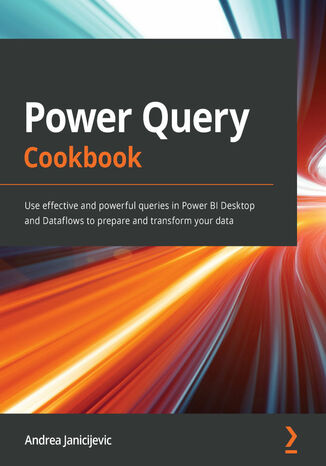
Power Query is a data preparation tool that enables data engineers and business users to connect, reshape, enrich, and transform their data to facilitate relevant business insights and analysis. With Power Query's wide range of features, you can perform no-code transformations and complex M code functions at the same time to get the most out of your data.This Power Query book will help you to connect to data sources, achieve intuitive transformations, and get to grips with preparation practices. Starting with a general overview of Power Query and what it can do, the book advances to cover more complex topics such as M code and performance optimization. You'll learn how to extend these capabilities by gradually stepping away from the Power Query GUI and into the M programming language. Additionally, the book also shows you how to use Power Query Online within Power BI Dataflows.By the end of the book, you'll be able to leverage your source data, understand your data better, and enrich it with a full stack of no-code and custom features that you'll learn to design by yourself for your business requirements.
Joshua N. Milligan
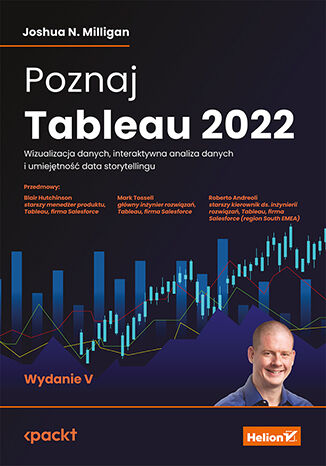
Dane stały się paliwem rozwoju cywilizacji. Wykorzystanie ich potencjału jest jednak trudne: problemem okazuje się wyciąganie z nich informacji i wniosków, aby można było na ich podstawie podejmować trafne decyzje. Jednym z narzędzi ułatwiających tę pracę jest Tableau - program do analityki danych, który umożliwia ich zrozumienie, interpretację i prowadzenie na nich efektywnych działań. Dzięki tej książce płynnie rozpoczniesz pracę z Tableau 2022 i nauczysz się wizualizacji danych. Dowiesz się, jak je analizować i przedstawiać w formie graficznej, a także jak opowiadać oparte na nich historie. W tym wydaniu ujęto najnowsze funkcje programu, między innymi rozszerzenia pulpitów nawigacyjnych, Explain Data i integrację z CRM Analytics (Einstein Analytics), służącym do modelowania predyktywnego w Tableau. Pokazano również, jak używać tabel i obliczeń na różnych poziomach szczegółowości i stosować wizualną analitykę statystyczną. Następnie zademonstrowano techniki łączenia różnych źródeł danych z funkcjonalnościami modeli danych Tableau wraz z mapami i wizualizacjami geoprzestrzennymi. Z tego przewodnika dowiesz się też, jak korzystać z funkcji Tableau Prep Builder, by skutecznie oczyścić i zorganizować dane. Dzięki książce nauczysz się: tworzyć zachwycające wizualizacje złożonych danych budować interaktywne pulpity nawigacyjne korzystać z obliczeń w celu rozwiązywania problemów i uzupełniania analiz wzbogacać możliwości Tableau poprzez rozszerzenia, skrypty i CRM Analytics oczyszczać i organizować dane w Tableau tworzyć angażujące historie oparte na danych Przekonaj się, co Tableau wyczaruje z Twoich danych!
Nataraj Dasgupta
Big Data analytics relates to the strategies used by organizations to collect, organize, and analyze large amounts of data to uncover valuable business insights that cannot be analyzed through traditional systems. Crafting an enterprise-scale cost-efficient Big Data and machine learning solution to uncover insights and value from your organization’s data is a challenge. Today, with hundreds of new Big Data systems, machine learning packages, and BI tools, selecting the right combination of technologies is an even greater challenge. This book will help you do that. With the help of this guide, you will be able to bridge the gap between the theoretical world of technology and the practical reality of building corporate Big Data and data science platforms. You will get hands-on exposure to Hadoop and Spark, build machine learning dashboards using R and R Shiny, create web-based apps using NoSQL databases such as MongoDB, and even learn how to write R code for neural networks.By the end of the book, you will have a very clear and concrete understanding of what Big Data analytics means, how it drives revenues for organizations, and how you can develop your own Big Data analytics solution using the different tools and methods articulatedin this book.
Practical Business Intelligence. Optimize Business Intelligence for Efficient Data Analysis
Ahmed Sherif
Business Intelligence (BI) is at the crux of revolutionizing enterprise. Everyone wants to minimize losses and maximize profits. Thanks to Big Data and improved methodologies to analyze data, Data Analysts and Data Scientists are increasingly using data to make informed decisions. Just knowing how to analyze data is not enough, you need to start thinking how to use data as a business asset and then perform the right analysis to build an insightful BI solution. Efficient BI strives to achieve the automation of data for ease of reporting and analysis. Through this book, you will develop the ability to think along the right lines and use more than one tool to perform analysis depending on the needs of your business. We start off by preparing you for data analytics. We then move on to teach you a range of techniques to fetch important information from various databases, which can be used to optimize your business.The book aims to provide a full end-to-end solution for an environment setup that can help you make informed business decisions and deliver efficient and automated BI solutions to any company.It is a complete guide for implementing Business intelligence with the help of the most powerful tools like D3.js, R, Tableau, Qlikview and Python that are available on the market.
Abhinav Dadhich
In this book, you will find several recently proposed methods in various domains of computer vision. You will start by setting up the proper Python environment to work on practical applications. This includes setting up libraries such as OpenCV, TensorFlow, and Keras using Anaconda. Using these libraries, you'll start to understand the concepts of image transformation and filtering. You will find a detailed explanation of feature detectors such as FAST and ORB; you'll use them to find similar-looking objects.With an introduction to convolutional neural nets, you will learn how to build a deep neural net using Keras and how to use it to classify the Fashion-MNIST dataset. With regard to object detection, you will learn the implementation of a simple face detector as well as the workings of complex deep-learning-based object detectors such as Faster R-CNN and SSD using TensorFlow. You'll get started with semantic segmentation using FCN models and track objects with Deep SORT. Not only this, you will also use Visual SLAM techniques such as ORB-SLAM on a standard dataset. By the end of this book, you will have a firm understanding of the different computer vision techniques and how to apply them in your applications.
Hector Cuesta
Plenty of small businesses face big amounts of data but lack the internal skills to support quantitative analysis. Understanding how to harness the power of data analysis using the latest open source technology can lead them to providing better customer service, the visualization of customer needs, or even the ability to obtain fresh insights about the performance of previous products. Practical Data Analysis is a book ideal for home and small business users who want to slice and dice the data they have on hand with minimum hassle.Practical Data Analysis is a hands-on guide to understanding the nature of your data and turn it into insight. It will introduce you to the use of machine learning techniques, social networks analytics, and econometrics to help your clients get insights about the pool of data they have at hand. Performing data preparation and processing over several kinds of data such as text, images, graphs, documents, and time series will also be covered.Practical Data Analysis presents a detailed exploration of the current work in data analysis through self-contained projects. First you will explore the basics of data preparation and transformation through OpenRefine. Then you will get started with exploratory data analysis using the D3js visualization framework. You will also be introduced to some of the machine learning techniques such as, classification, regression, and clusterization through practical projects such as spam classification, predicting gold prices, and finding clusters in your Facebook friends' network. You will learn how to solve problems in text classification, simulation, time series forecast, social media, and MapReduce through detailed projects. Finally you will work with large amounts of Twitter data using MapReduce to perform a sentiment analysis implemented in Python and MongoDB. Practical Data Analysis contains a combination of carefully selected algorithms and data scrubbing that enables you to turn your data into insight.
Practical Data Analysis. Pandas, MongoDB, Apache Spark, and more - Second Edition
Hector Cuesta, Dr. Sampath Kumar
Beyond buzzwords like Big Data or Data Science, there are a great opportunities to innovate in many businesses using data analysis to get data-driven products. Data analysis involves asking many questions about data in order to discover insights and generate value for a product or a service.This book explains the basic data algorithms without the theoretical jargon, and you’ll get hands-on turning data into insights using machine learning techniques. We will perform data-driven innovation processing for several types of data such as text, Images, social network graphs, documents, and time series, showing you how to implement large data processing with MongoDB and Apache Spark.
Marc Wintjen
Data literacy is the ability to read, analyze, work with, and argue using data. Data analysis is the process of cleaning and modeling your data to discover useful information. This book combines these two concepts by sharing proven techniques and hands-on examples so that you can learn how to communicate effectively using data.After introducing you to the basics of data analysis using Jupyter Notebook and Python, the book will take you through the fundamentals of data. Packed with practical examples, this guide will teach you how to clean, wrangle, analyze, and visualize data to gain useful insights, and you'll discover how to answer questions using data with easy-to-follow steps.Later chapters teach you about storytelling with data using charts, such as histograms and scatter plots. As you advance, you'll understand how to work with unstructured data using natural language processing (NLP) techniques to perform sentiment analysis. All the knowledge you gain will help you discover key patterns and trends in data using real-world examples. In addition to this, you will learn how to handle data of varying complexity to perform efficient data analysis using modern Python libraries.By the end of this book, you'll have gained the practical skills you need to analyze data with confidence.