
Sztuczna inteligencja
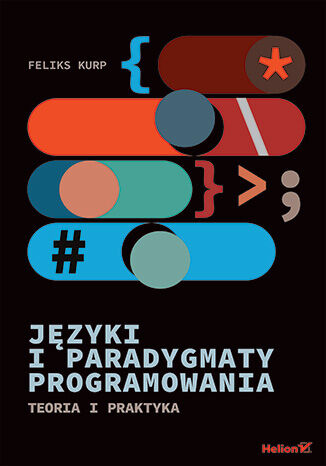
Języki i paradygmaty programowania. Teoria i praktyka
Feliks Kurp
Czym w rzeczywistości jest programowanie? I jak zacząć programować? Oprogramowanie jest dziś praktycznie wszędzie, a programiści od dawna należą do najbardziej poszukiwanych specjalistów. Na podstawie napisanego przez nich kodu funkcjonują już nie tylko komputery i smartfony. Oprogramowanie steruje sprzętami domowymi, telewizorem czy lodówką. W ramach tak zwanego internetu rzeczy wiele urządzeń technicznych komunikuje się między sobą bez udziału człowieka. Gwałtownie rozwija się sztuczna inteligencja, wymagająca specjalistycznego oprogramowania. Nie dziwi więc, że jego rozwój ciągle przyspiesza. W obliczu tych faktów odpowiedź na pytanie, jakiego języka programowania warto się nauczyć, jest trudna. Nawet dla osoby, która wie, w jaki sposób zamierza w przyszłości korzystać ze swoich informatycznych umiejętności. Autor książki proponuje nieco inne podejście do nauki programowania. Zachęca do zapoznania się z podstawowymi własnościami i możliwymi zastosowaniami kilku odległych od siebie, ale niezwykle ważnych aktualnie języków programowania, takich jak Python, Java SE, JavaScript i Prolog. W trakcie ich poznawania czytelnicy będą mieli okazję zgłębić filozofię programowania, a równocześnie zdobywać praktyczne umiejętności programistyczne na podstawowym poziomie. Starannie dobrany kod pokazuje możliwe zastosowania wybranych języków programowania. Pomoc w nauce stanowią też zadania do samodzielnego rozwiązania.
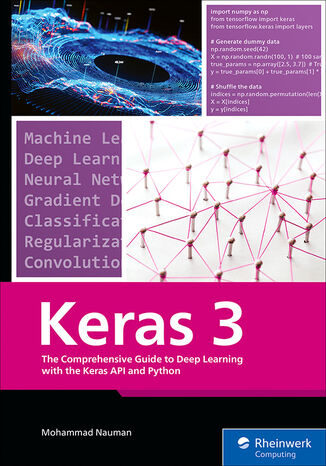
Keras 3. Comprehensive Insights into Keras for Deep Learning and AI Solutions
Rheinwerk Publishing, Inc, Mohammad Nauman
This book provides a comprehensive guide to mastering deep learning with Keras 3, starting from the fundamentals of machine learning and neural networks to advanced techniques in reinforcement learning, transformers, and generative AI. Readers will begin with understanding the core principles of machine learning, including supervised, unsupervised, and reinforcement learning. The book explains how neural networks function and how to build them using Keras, TensorFlow, and Python. You'll dive into critical topics such as convolutional neural networks (CNNs), dropout regularization, and gradient descent optimization. As you progress, you’ll learn advanced deep learning concepts like transfer learning, transformers, and the powerful Keras Functional API for building complex models. There’s a focus on practical applications, such as building and evaluating deep learning models for real-world tasks, and enhancing models using GPU acceleration. You'll also explore generative models, including autoencoders and GANs, and apply them to tasks like image generation and data augmentation. By the end of the book, you’ll be able to implement state-of-the-art AI models and deploy them in production environments.
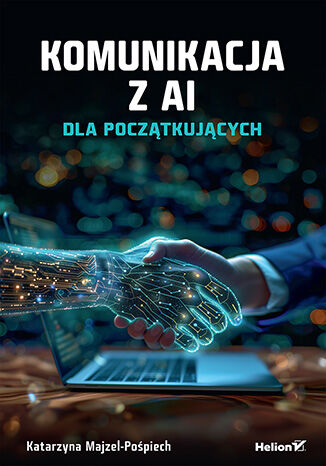
Komunikacja z AI. Dla początkujących
Katarzyna Majzel-Pośpiech
Naucz się promptować i skorzystaj w pełni z możliwości, jakie oferuje AI Jedni się jej obawiają, inni patrzą na nią z nadzieją. Sztuczna inteligencja, z angielskiego artificial intelligence (AI), to technologia, która oferuje niespotykane dotąd możliwości i imponującą wydajność. Jeśli w odpowiedni sposób zadać jej pytanie, jest w stanie precyzyjnie na nie odpowiedzieć i podsunąć rozwiązanie. Po otrzymaniu konkretnych wskazówek może wygenerować wysokiej jakości grafiki i filmy. Kluczowe jest, aby nauczyć się właściwie zadawać pytania i poprawnie formułować polecenia. Innymi słowy ― promptować. Prompt engineering polega na tworzeniu i optymalizowaniu promptów, czyli komend lub zapytań kierowanych do modeli sztucznej inteligencji. Promptowanie wymaga kreatywności, logicznego myślenia, znajomości języka i technologii AI, ale opanowanie jego reguł warte jest poświęconego czasu. W efekcie bowiem otrzymamy oczekiwane treści, grafiki, muzykę, wydajne wsparcie w kodowaniu i analizie danych. A to dopiero początek możliwości narzędzi takich jak ChatGPT czy Midjourney. Jeśli: chcesz zrozumieć, na jakich zasadach działa sztuczna inteligencja pragniesz poznać reguły prompt engineeringu zależy Ci na tym, by spróbować swoich sił w promptowaniu zamierzasz tworzyć skuteczne i kreatywne prompty to książka właśnie dla Ciebie! Znajdziesz w niej wiedzę i inspiracje, które pozwolą Ci rozpocząć współpracę z dostępnymi na rynku modelami AI.

Barbara Orzeł
W jaki sposób media przedstawiają kryzysy? Jak fake newsy oraz technologia deepfake wpływają na emocje użytkowników mediów? Jaka jest rola sztucznej inteligencji w działaniach dezinformacyjnych? Jakie zabiegi językowe i wizualne mają wpływ na zmianę nastrojów opinii publicznej? To tylko nieliczne pytania, na które próbuje odpowiedzieć najnowsza książka Barbary Orzeł o "świecie, który wypadł z formy", o tematach kryzysowych, które "zasilane" kontrowersją, fake newsami i algorytmami sztucznej inteligencji, wzbudzają określone emocje. A emocje, jak wiemy, znakomicie się sprzedają...
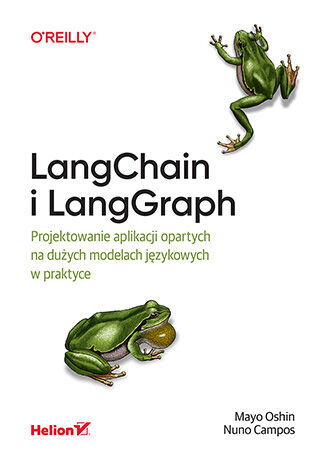
LangChain i LangGraph. Projektowanie aplikacji opartych na dużych modelach językowych w praktyce
Mayo Oshin, Nuno Campos
Jak zacząć tworzyć aplikacje AI, które potrafią wnioskować i wyszukiwać zewnętrzne dane w celu zapewniania odpowiedniego kontekstu? Sięgnij po LangChain! To popularne narzędzie programistyczne służy do tworzenia, uruchamiania aplikacji LLM, a także zarządzania nimi. LangChain jest używany przez wiele znanych firm, a jego popularność dynamicznie rośnie. To lektura obowiązkowa dla programistów, którzy chcą przesuwać granice możliwości LangChain! Tom Taulli, konsultant IT i autor książek Jeśli znasz Pythona lub JavaScript i chcesz rozpocząć przygodę z aplikacjami AI ta książka jest dla Ciebie! Krok po kroku zbudujesz agenta AI korzystającego ze wskazanego źródła danych, wyposażysz go w mechanizmy autoryzacji działań i umożliwisz mu zdobywanie dodatkowych informacji lub wyjaśnień. Dowiesz się, jak przygotować go do pracy w środowisku produkcyjnym z uwzględnieniem kwestii opóźnień, niezawodności i bezpieczeństwa. Nauczysz się również monitorować i stale ulepszać swoje aplikacje. Najciekawsze zagadnienia: zwiększanie dokładności LLM za pomocą techniki RAG inteligentna komunikacja aplikacji AI z użytkownikami architektura agentowa z wykorzystaniem LangGraph integracja z interfejsami API i narzędziami firm trzecich monitorowanie, testowanie i ewaluacja aplikacji AI praktyczne zastosowanie biblioteki LangChain Ta książka sprawia, że nauka LangChain jest interesująca i zabawna! Rajat K. Goel, IBM

Mercury Learning and Information, Oswald Campesato
This book provides a comprehensive overview of large language models (LLMs) and generative AI, covering foundational principles, advanced concepts, and practical applications. It begins with an introduction to the generative AI landscape, examining key features, popular techniques, and its influence on industries like art, business, and technology. The book also explores prominent models like ChatGPT and GPT-4, detailing their architectures, capabilities, and applications in text generation, code assistance, and conversational AI.Additionally, the book traces the evolution of LLMs, particularly focusing on the BERT family and its wide-ranging applications in natural language processing, translation, and multilingual tasks. Readers will also gain expertise in prompt engineering, learning practical tips and examples to interact more effectively with LLMs.In later chapters, the book tackles advanced topics such as fine-tuning LLMs, working with SVG, and concepts like few-shot learning and reinforcement learning. It concludes with discussions on ethical issues, biases in generative AI, and emerging trends like AI’s integration with IoT, quantum computing, and neuromorphic computing. This guide equips professionals and enthusiasts with a thorough understanding of generative AI's present and future.
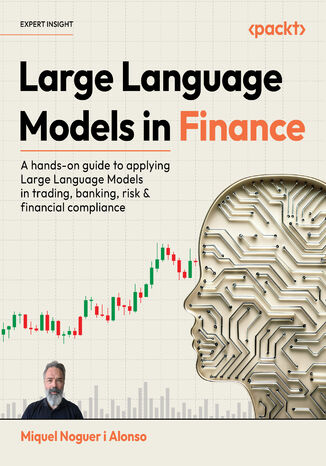
Miquel Noguer i Alonso
Large language models are revolutionizing finance from market analysis to compliance automation but applying them in practice can be challenging. LLMs in Finance is a step-by-step guide that demystifies these powerful models and shows you how to implement them in real financial projects. You'll begin with the fundamentals of how LLMs work, including the transformer architecture, prompt engineering, and fine-tuning for financial data. Next, you'll build applications: intelligent agents for trading; tools for banking tasks like credit scoring and fraud detection; and automated solutions for risk management and regulatory compliance. To deploy these solutions, you'll learn how to scale LLM implementations, from choosing the right hardware to adopting effective cloud strategies. You'll also explore advanced methods to improve model performance, including reinforcement learning for fine-tuning. Finally, learn how to address AI bias and ensure your LLM solutions comply with ethical and regulatory requirements. Real-world case studies illustrate how financial organizations are leveraging LLMs in trading systems, customer service chatbots, and more. By the end of the book, you'll have the expertise to build LLM-powered applications and pick up on trends such as multimodal AI
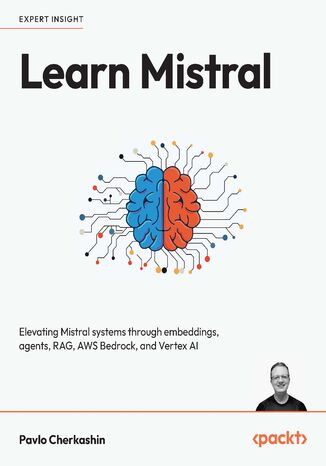
Learn Mistral. Elevating Mistral systems through embeddings, agents, RAG, AWS Bedrock, and Vertex AI
Pavlo Cherkashin
This is a practical, project-driven guide to turning open-source Mistral models into production-ready AI solutions. Through hands-on workshops and use cases, you’ll learn how to build private chat systems, semantic search engines, intelligent agents, coding assistants, and secure deployments that go beyond simple experimentation. The journey begins by exploring where Mistral excels and where human oversight is essential. You’ll then learn to set up a secure, locally hosted chat system with Ollama, customize behavior with system prompts and parameters, and dive deep into embeddings to unlock semantic search with Pinecone. As you progress, you’ll build multi-agent workflows, unpack advanced Retrieval-Augmented Generation pipelines, and integrate Mistral with Codestral to accelerate coding. You'll also learn to apply Mistral to cybersecurity, be challenged with open-ended RAG projects, and be guided through deploying scalable AI on AWS Bedrock and Google Vertex AI.By the end of this book, you will be ready to design and build AI systems that are innovative, compliant, and production-ready.*Email sign-up and proof of purchase required