
Sztuczna inteligencja
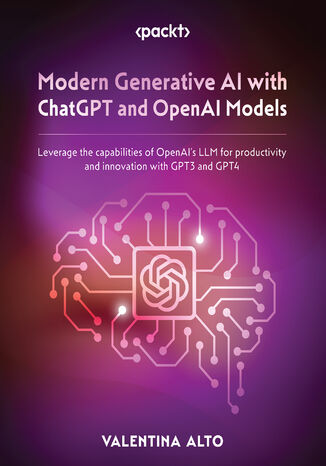
Valentina Alto
Generative AI models and AI language models are becoming increasingly popular due to their unparalleled capabilities. This book will provide you with insights into the inner workings of the LLMs and guide you through creating your own language models. You’ll start with an introduction to the field of generative AI, helping you understand how these models are trained to generate new data.Next, you’ll explore use cases where ChatGPT can boost productivity and enhance creativity. You’ll learn how to get the best from your ChatGPT interactions by improving your prompt design and leveraging zero, one, and few-shots learning capabilities. The use cases are divided into clusters of marketers, researchers, and developers, which will help you apply what you learn in this book to your own challenges faster.You’ll also discover enterprise-level scenarios that leverage OpenAI models’ APIs available on Azure infrastructure; both generative models like GPT-3 and embedding models like Ada. For each scenario, you’ll find an end-to-end implementation with Python, using Streamlit as the frontend and the LangChain SDK to facilitate models' integration into your applications.By the end of this book, you’ll be well equipped to use the generative AI field and start using ChatGPT and OpenAI models’ APIs in your own projects.
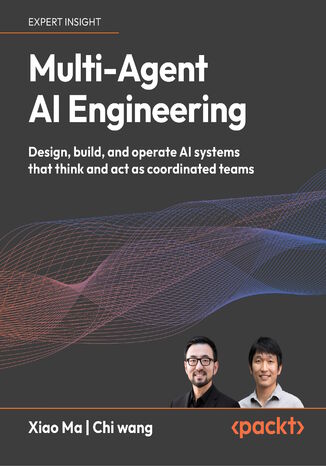
Xiao Ma, Chi Wang
As AI systems take on more complex tasks, the limits of single-model applications become increasingly clear. Problems requiring long-horizon reasoning, specialized expertise, coordination, and parallel execution demand multiple agents working together reliably in production.But building multi-agent systems is fundamentally an engineering challenge. Agents must communicate, delegate tasks, manage context, recover from failures, and stay aligned on shared goals under real-world constraints.Multi-Agent AI Engineering is a practical guide to designing and operating production-grade multi-agent systems. Drawing on the authors’ research, open-source contributions, and experience building AI systems at scale, the book focuses on architectural principles that extend beyond any single framework or trend.You’ll explore agent foundations, communication protocols, memory and context management, orchestration, interoperability standards, and canonical multi-agent patterns through hands-on Python examples. The book also covers production realities including evaluation, observability, reliability, safe self-improvement, and scaling agentic systems in practice.By the end, you’ll be equipped to design, build, and scale reliable multi-agent systems for real-world deployment.
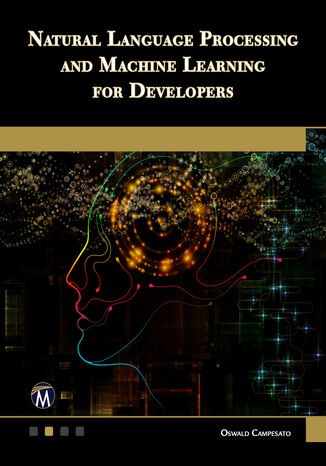
Mercury Learning and Information, Oswald Campesato
This book introduces developers to basic concepts in NLP and machine learning, providing numerous code samples to support the topics covered. The journey begins with introductory material on NumPy and Pandas, essential for data manipulation. Following this, chapters delve into NLP concepts, algorithms, and toolkits, providing a solid foundation in natural language processing.As you progress, the book covers machine learning fundamentals and classifiers, demonstrating how these techniques are applied in NLP. Practical examples using TF2 and Keras illustrate how to implement various NLP tasks. Advanced topics include the Transformer architecture, BERT-based models, and the GPT family of models, showcasing the latest advancements in the field.The final chapters and appendices offer a comprehensive overview of related topics, including data and statistics, Python3, regular expressions, and data visualization with Matplotlib and Seaborn. Companion files with source code and figures ensure a hands-on learning experience. This book equips you with the knowledge and tools needed to excel in NLP and machine learning.
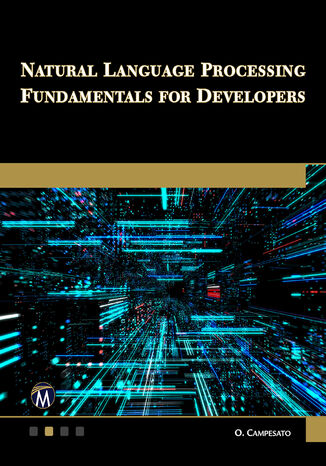
Mercury Learning and Information, Oswald Campesato
This book is for developers seeking an overview of basic concepts in Natural Language Processing (NLP). It caters to those with varied technical backgrounds, offering numerous code samples and listings to illustrate the wide range of topics covered. The journey begins with managing data relevant to NLP, followed by two chapters on fundamental NLP concepts. This foundation is reinforced with Python code samples that bring these concepts to life.The book then delves into practical NLP applications, such as sentiment analysis, recommender systems, COVID-19 analysis, spam detection, and chatbots. These examples provide real-world context and demonstrate how NLP techniques can be applied to solve common problems. The final chapter introduces advanced topics, including the Transformer architecture, BERT-based models, and the GPT family, highlighting the latest state-of-the-art developments in the field.Appendices offer additional resources, including Python code samples on regular expressions and probability/statistical concepts, ensuring a well-rounded understanding. Companion files with source code and figures enhance the learning experience, making this book a comprehensive guide for mastering NLP techniques and applications.
Natural Language Processing: Python and NLTK. Click here to enter text
Jacob Perkins, Nitin Hardeniya, Deepti Chopra, Iti...
Natural Language Processing is a field of computational linguistics and artificial intelligence that deals with human-computer interaction. It provides a seamless interaction between computers and human beings and gives computers the ability to understand human speech with the help of machine learning. The number of human-computer interaction instances are increasing so it’s becoming imperative that computers comprehend all major natural languages. The first NLTK Essentials module is an introduction on how to build systems around NLP, with a focus on how to create a customized tokenizer and parser from scratch. You will learn essential concepts of NLP, be given practical insight into open source tool and libraries available in Python, shown how to analyze social media sites, and be given tools to deal with large scale text. This module also provides a workaround using some of the amazing capabilities of Python libraries such as NLTK, scikit-learn, pandas, and NumPy.The second Python 3 Text Processing with NLTK 3 Cookbook module teaches you the essential techniques of text and language processing with simple, straightforward examples. This includes organizing text corpora, creating your own custom corpus, text classification with a focus on sentiment analysis, and distributed text processing methods. The third Mastering Natural Language Processing with Python module will help you become an expert and assist you in creating your own NLP projects using NLTK. You will be guided through model development with machine learning tools, shown how to create training data, and given insight into the best practices for designing and building NLP-based applications using Python.This Learning Path combines some of the best that Packt has to offer in one complete, curated package and is designed to help you quickly learn text processing with Python and NLTK. It includes content from the following Packt products:? NTLK essentials by Nitin Hardeniya? Python 3 Text Processing with NLTK 3 Cookbook by Jacob Perkins? Mastering Natural Language Processing with Python by Deepti Chopra, Nisheeth Joshi, and Iti Mathur
Mercury Learning and Information, Oswald Campesato
This book is for developers seeking an overview of basic concepts in Natural Language Processing (NLP). It caters to a technical audience, offering numerous code samples and listings to illustrate the wide range of topics covered. The journey begins with managing data relevant to NLP, followed by two chapters on fundamental NLP concepts. This foundation is reinforced with Python code samples that bring these concepts to life.The book then delves into practical NLP applications, such as sentiment analysis, recommender systems, COVID-19 analysis, spam detection, and chatbots. These examples provide real-world context and demonstrate how NLP techniques can be applied to solve common problems. The final chapter introduces advanced topics, including the Transformer architecture, BERT-based models, and the GPT family, highlighting the latest state-of-the-art developments in the field.Appendices offer additional resources, including Python code samples on regular expressions and probability/statistical concepts, ensuring a well-rounded understanding. Companion files with source code and figures enhance the learning experience, making this book a comprehensive guide for mastering NLP techniques and applications.
David Knickerbocker
Network analysis is often taught with tiny or toy data sets, leaving you with a limited scope of learning and practical usage. Network Science with Python helps you extract relevant data, draw conclusions and build networks using industry-standard – practical data sets. You’ll begin by learning the basics of natural language processing, network science, and social network analysis, then move on to programmatically building and analyzing networks. You’ll get a hands-on understanding of the data source, data extraction, interaction with it, and drawing insights from it. This is a hands-on book with theory grounding, specific technical, and mathematical details for future reference. As you progress, you’ll learn to construct and clean networks, conduct network analysis, egocentric network analysis, community detection, and use network data with machine learning. You’ll also explore network analysis concepts, from basics to an advanced level. By the end of the book, you’ll be able to identify network data and use it to extract unconventional insights to comprehend the complex world around you.
Neuro-Symbolic AI. Design transparent and trustworthy systems that understand the world as you do
Alexiei Dingli, David Farrugia
Neuro-symbolic AI offers the potential to create intelligent systems that possess both the reasoning capabilities of symbolic AI along with the learning capabilities of neural networks. This book provides an overview of AI and its inner mechanics, covering both symbolic and neural network approaches.You’ll begin by exploring the decline of symbolic AI and the recent neural network revolution, as well as their limitations. The book then delves into the importance of building trustworthy and transparent AI solutions using explainable AI techniques. As you advance, you’ll explore the emerging field of neuro-symbolic AI, which combines symbolic AI and modern neural networks to improve performance and transparency. You’ll also learn how to get started with neuro-symbolic AI using Python with the help of practical examples. In addition, the book covers the most promising technologies in the field, providing insights into the future of AI.Upon completing this book, you will acquire a profound comprehension of neuro-symbolic AI and its practical implications. Additionally, you will cultivate the essential abilities to conceptualize, design, and execute neuro-symbolic AI solutions.