
Wydawca: Packt Publishing
Ashish Choudhary
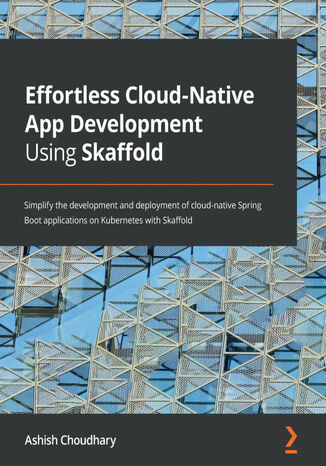
Kubernetes has become the de facto standard for container orchestration, drastically improving how we deploy and manage cloud-native apps. Although it has simplified the lives of support professionals, we cannot say the same for developers who need to be equipped with better tools to increase productivity. An automated workflow that solves a wide variety of problems that every developer faces can make all the difference!Enter Skaffold – a command-line tool that automates the build, push, and deploy steps for Kubernetes applications.This book is divided into three parts, starting with common challenges encountered by developers in building apps with Kubernetes. The second part covers Skaffold features, its architecture, supported container image builders, and more. In the last part, you'll focus on practical implementation, learning how to deploy Spring Boot apps to cloud platforms such as Google Cloud Platform (GCP) using Skaffold. You'll also create CI/CD pipelines for your cloud-native apps with Skaffold. Although the examples covered in this book are written in Java and Spring Boot, the techniques can be applied to apps built using other technologies too.By the end of this Skaffold book, you'll develop skills that will help accelerate your inner development loop and be able to build and deploy your apps to the Kubernetes cluster with Skaffold.
Michael Sikora
This book is a fast-paced tutorial that explores the key features of EJB 3 with many accompanying examples. This book is not a complete reference guide, but a concise exploration of EJB 3's core elements. This book is primarily aimed at professional developers who already have a working knowledge of Java. Enterprise architects and designers with a background in Java would also find this book of use. Previous experience of working with Java is essential and knowledge of relational databases is desirable. As this book is an introduction to EJB 3, it is aimed at those who are new to EJB 3. As the new version of EJB is so radically different from the previous version (EJB 2.x), the book is suitable for and should be of interest to those who have had experience working with EJB 2.x. The text makes it clear where the differences between the versions of EJB lie, although they are not explored in detail.
Deepak Vohra
EJB (Enterprise JavaBeans) 3.0 is a commonly used database persistence technology in Java EE applications. EJB 3.0 has simplified the development of EJBs with an annotations-based API that eliminates the use of remote/local interfaces, home/local home interfaces, and deployment descriptors. A number of other books are available on EJB 3.0, but none covers EJB 3.0 support in Oracle Fusion Middleware 11g, which is one of the leaders in the application server market.This is the first book that covers all aspects of EJB 3.0 database persistence development using Oracle Fusion Middleware technology. It covers all the best practices for database persistence ensuring that your applications are easily maintainable. Leaving theory behind, this book uses real-world examples to guide you in building your own EJB 3.0 applications that are well integrated with commonly used Java EE frameworks.The book gets going by discussing the new features in the EJB 3.0 specification. As some readers may still be using EJB 2.0, the book explains how to convert your EJB 2.0 entity beans to EJB 3.0. It then goes on to discuss using EJB 3.0 database persistence with JDeveloper, WebLogic Server, and Enterprise Pack for Eclipse, the main Java EE components of Oracle Fusion Middleware 11g. The book also covers EJB 3.0 relationships and integrating EJB 3.0 relationships with JSF user interfaces. EJB 3.0 database persistence with some of the commonly used frameworks such as ADF Faces, AJAX, and Web Services is also discussed in the book. It uses the integrated WebLogic Server 11g in some of the chapters and the standalone WebLogic Server in other chapters. While JDeveloper is the primary Java IDE used in the book, one of the chapters is based on the Oracle Enterprise Pack for Eclipse.By the time you reach the end of this book, you will be well-versed with developing EJB 3.0 applications using the different Java EE components of Oracle Fusion Middleware 11g.
Huage Chen, Yazid Akadiri, Shay Banon
Learn how to make the most of the Elastic Stack (ELK Stack) products—including Elasticsearch, Kibana, Elastic Agent, and Logstash—to take data reliably and securely from any source, in any format, and then search, analyze, and visualize it in real-time. This cookbook takes a practical approach to unlocking the full potential of Elastic Stack through detailed recipes step by step.Starting with installing and ingesting data using Elastic Agent and Beats, this book guides you through data transformation and enrichment with various Elastic components and explores the latest advancements in search applications, including semantic search and Generative AI. You'll then visualize and explore your data and create dashboards using Kibana. As you progress, you'll advance your skills with machine learning for data science, get to grips with natural language processing, and discover the power of vector search. The book covers Elastic Observability use cases for log, infrastructure, and synthetics monitoring, along with essential strategies for securing the Elastic Stack. Finally, you'll gain expertise in Elastic Stack operations to effectively monitor and manage your system.
Elasticsearch Indexing. How to Improve User's Search Experience
Huseyin Akdogan
Beginning with an overview of the way ElasticSearch stores data, you’ll begin to extend your knowledge to tackle indexing and mapping, and learn how to configure ElasticSearch to meet your users’ needs. You’ll then find out how to use analysis and analyzers for greater intelligence in how you organize and pull up search results – to guarantee that every search query is met with the relevant results! You’ll explore the anatomy of an ElasticSearch cluster, and learn how to set up configurations that give you optimum availability as well as scalability. Once you’ve learned how these elements work, you’ll find real-world solutions to help you improve indexing performance, as well as tips and guidance on safety so you can back up and restore data. Once you’ve learned each component outlined throughout, you will be confident that you can help to deliver an improved search experience – exactly what modern users demand and expect.
Elasticsearch 5.x Cookbook. Distributed Search and Analytics - Third Edition
Alberto Paro
Elasticsearch is a Lucene-based distributed search server that allows users to index and search unstructured content with petabytes of data. This book is your one-stop guide to master the complete Elasticsearch ecosystem. We’ll guide you through comprehensive recipes on what’s new in Elasticsearch 5.x, showing you how to create complex queries and analytics, and perform index mapping, aggregation, and scripting. Further on, you will explore the modules of Cluster and Node monitoring and see ways to back up and restore a snapshot of an index. You will understand how to install Kibana to monitor a cluster and also to extend Kibana for plugins. Finally, you will also see how you can integrate your Java, Scala, Python, and Big Data applications such as Apache Spark and Pig with Elasticsearch, and add enhanced functionalities with custom plugins.By the end of this book, you will have an in-depth knowledge of the implementation of the Elasticsearch architecture and will be able to manage data efficiently and effectively with Elasticsearch.
Anurag Srivastava, Douglas Miller
Elasticsearch is one of the most popular tools for distributed search and analytics. This Elasticsearch book highlights the latest features of Elasticsearch 7 and helps you understand how you can use them to build your own search applications with ease.Starting with an introduction to the Elastic Stack, this book will help you quickly get up to speed with using Elasticsearch. You'll learn how to install, configure, manage, secure, and deploy Elasticsearch clusters, as well as how to use your deployment to develop powerful search and analytics solutions. As you progress, you'll also understand how to troubleshoot any issues that you may encounter along the way. Finally, the book will help you explore the inner workings of Elasticsearch and gain insights into queries, analyzers, mappings, and aggregations as you learn to work with search results.By the end of this book, you'll have a basic understanding of how to build and deploy effective search and analytics solutions using Elasticsearch.
Alberto Paro
Elasticsearch is a Lucene-based distributed search server that allows users to index and search unstructured content with petabytes of data. With this book, you'll be guided through comprehensive recipes on what's new in Elasticsearch 7, and see how to create and run complex queries and analytics.Packed with recipes on performing index mapping, aggregation, and scripting using Elasticsearch, this fourth edition of Elasticsearch Cookbook will get you acquainted with numerous solutions and quick techniques for performing both every day and uncommon tasks such as deploying Elasticsearch nodes, integrating other tools to Elasticsearch, and creating different visualizations. You will install Kibana to monitor a cluster and also extend it using a variety of plugins. Finally, you will integrate your Java, Scala, Python, and big data applications such as Apache Spark and Pig with Elasticsearch, and create efficient data applications powered by enhanced functionalities and custom plugins.By the end of this book, you will have gained in-depth knowledge of implementing Elasticsearch architecture, and you'll be able to manage, search, and store data efficiently and effectively using Elasticsearch.