
Programowanie
Rami Sarieddine
Windows 8 has already been launched and been installed on millions of devices while the store is getting populated with apps, and soon enough everyone will want a Windows Store app. So start now and learn how to develop apps for Windows 8 using HTML5, CSS3, and JavaScript and you will be killing two birds with one stone by getting introduced to important features in HTML5 and CSS3 at the same time. You will gain the advantage of utilizing your web development skills to transform your website into an app or the other way round.Developing Windows Store Apps with HTML5 and JavaScript is a practical, hands-on guide that covers the basic and important features of a Windows Store App along with code examples which will show you how to develop these features, all the while learning some of the new features in HTML5 and CSS3 which you can utilize in other areas of development.This book starts with the new features in HTML5 and CSS3 that are incorporated with Windows 8 development, and then moves on to creating a blank Windows Store app and add features to it as we move through the chapters till we package the app and make it ready for publishing. Finally, we will have a look at how similar it is to develop the same app with XAML.You will also learn how to add and use new controls dedicated for Windows 8 and then see how to fetch data for the app and bind it to the controls. We will also take a look at making the app adapt to change in screen sizes and rotation as well as how to make the app live with tiles and allow users to sign in using their email accounts. Also you will learn how to add an app bar, and lastly you learn how to finalize the app and publish it. If you want to leverage your web development skills and utilize it in developing for Windows 8, then you came to the right place. Developing Windows Store Apps with HTML5 and JavaScript is packed with examples and screenshots which will make it easy for you to implement all the things you learned throughout the book.
Martyn Coupland
DevOps is a set of best practices enabling operations and development teams to work together to produce higher-quality work and, among other things, quicker releases. This book helps you to understand the fundamentals needed to get started with DevOps, and prepares you to start deploying technical tools confidently.You will start by learning the key steps for implementing successful DevOps transformations. The book will help you to understand how aspects of culture, people, and process are all connected, and that without any one of these elements DevOps is unlikely to be successful. As you make progress, you will discover how to measure and quantify the success of DevOps in your organization, along with exploring the pros and cons of the main tooling involved in DevOps. In the concluding chapters, you will learn about the latest trends in DevOps and find out how the tooling changes when you work with these specialties.By the end of this DevOps book, you will have gained a clear understanding of the connection between culture, people, and processes within DevOps, and learned why all three are critically important.
DevOps Bootcamp. The fastest way to learn DevOps
Mitesh Soni
DevOps Bootcamp delivers practical learning modules in manageable chunks. Each chunk is delivered in a day, and each day is a productive one. Each day builds your competency in DevOps. You will be able to take the task you learn every day and apply it to cultivate the DevOps culture.Each chapter presents core concepts and key takeaways about a topic in DevOps and provides a series of hands-on exercises. You will not only learn the importance of basic concepts or practices of DevOps but also how to use different tools to automate application lifecycle management. We will start off by building the foundation of the DevOps concepts. On day two, we will perform Continuous Integration using Jenkins and VSTS both by configuring Maven-based JEE Web Application?. We will also integrate Jenkins and Sonar qube for Static Code Analysis. Further, on day three, we will focus on Docker containers where we will install and configure Docker and also create a Tomcat Container to deploy our Java based web application. On day four, we will create and configure the environment for application deployment in AWS and Microsoft Azure Cloud for which we will use Infrastructure as a Service and Open Source Configuration Management tool Chef. For day five, our focus would be on Continuous Delivery. We will automate application deployment in Docker container using Jenkins Plugin, AWS EC2 using Script, AWS Elastic Beanstalk using Jenkins Plugin, Microsoft Azure VM using script, and Microsoft Azure App Services Using Jenkins. We will also configure Continuous Delivery using VSTS. We will then learn the concept of Automated Testing on day six using Apache JMeter and URL-based tests in VSTS. Further, on day seven, we will explore various ways to automate application lifecycle management using orchestration. We will see how Pipeline can be created in Jenkins and VSTS, so the moment Continuous? Integration is completed successfully, Continuous Delivery will start and application will be deployed. On the final day, our focus would be on Security access to Jenkins and Monitoring of CI resources, and cloud-based resources in AWS and Microsoft Azure Platform as a Service.
Sricharan Vadapalli
DevOps is the most widely used software engineering culture and practice that aim sat software development and operation. Continuous integration is a cornerstone technique of DevOps that merges software code updates from developers into a shared central mainline.This book takes a practical approach and covers the tools and strategies of DevOps. It starts with familiarizing you with DevOps framework and then shows how toper form continuous delivery, integration, and deployment with DevOps. You will explore DevOps process maturity frameworks and progression models with checklist templates for each phase of DevOps. You will also be familiar with agile terminology, methodology, and the benefits accrued by an organization by adopting it. You will also get acquainted with popular tools such as Git, Jenkins ,Maven, Gerrit, Nexus, Selenium, and so on.You will learn configuration, automation, and the implementation of infrastructure automation (Infrastructure as Code) with tools such as Chef and Ansible.This book is ideal for engineers, architects, and developers, who wish to learn the core strategies of DevOps.This book is embedded with useful assessments that will help you revise the concepts you have learned in this book. This book is repurposed for this specific learning experience from material from Packt's Hands-on DevOps by Sricharan Vadapalli.
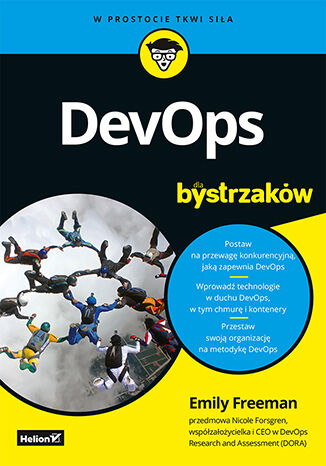
Emily Freeman
Postaw na przewagę konkurencyjną, jaką zapewnia DevOps Wprowadź technologie w duchu DevOps, w tym chmurę i kontenery Przestaw swoją organizację na metodykę DevOps Przedmowa Nicole Forsgren, współzałożycielka i CEO w DevOps Research and Assessment (DORA) Dołącz do DevOpsowej rewolucji! Dzięki DevOps możesz przyspieszyć cykl życia związany z dostarczaniem oprogramowania, jeśli tylko poznasz procesy, narzędzia i sposób myślenia będący podstawą kultury DevOps. Ta książka pomaga inżynierom oprogramowania i kierownikom do spraw technicznych w przekształcaniu organizacji w celu przyjęcia podejścia DevOps. Dowiedz się, jak tworzyć bardziej iteracyjny i zorientowany na klienta styl rozwoju i dostarczania, by w efekcie poprawić współpracę, wyeliminować wąskie gardła i zwiększyć produktywność zespołu. W książce: identyfikowanie wąskich gardeł w organizacji tworzenie własnych ram postępowania w duchu DevOps angażowanie zespołu w ten proces dostosowywanie kultury organizacyjnej wyciąganie nauki z porażek przygotowanie się do zarządzania incydentami automatyzowanie procesów manualnych
David Jambor
In today's rapidly evolving world of DevOps, traditional silos are a thing of the past. Database administrators are no longer the only experts; site reliability engineers (SREs) and DevOps engineers are database experts as well. This blurring of the lines has led to increased responsibilities, making members of high-performing DevOps teams responsible for end-to-end ownership. This book helps you master DevOps for databases, making it a must-have resource for achieving success in the ever-changing world of DevOps.You’ll begin by exploring real-world examples of DevOps implementation and its significance in modern data-persistent technologies, before progressing into the various types of database technologies and recognizing their strengths, weaknesses, and commonalities. As you advance, the chapters will teach you about design, implementation, testing, and operations using practical examples, as well as common design patterns, combining them with tooling, technology, and strategies for different types of data-persistent technologies. You’ll also learn how to create complex end-to-end implementation, deployment, and cloud infrastructure strategies defined as code.By the end of this book, you’ll be equipped with the knowledge and tools to design, build, and operate complex systems efficiently.
DevOps for Networking. Bringing Network Automation into DevOps culture
Steven Armstrong
Frustrated that your company’s network changes are still a manual set of activities that slow developers down? It doesn’t need to be that way any longer, as this book will help your company and network teams embrace DevOps and continuous delivery approaches, enabling them to automate all network functions.This book aims to show readers network automation processes they could implement in their organizations. It willteach you the fundamentals of DevOps in networking and how to improve DevOps processes and workflows by providing automation in your network. You will be exposed to various networking strategies that are stopping your organization from scaling new projects quickly.You will see how SDN and APIs are influencing DevOps transformations, which will in turn help you improve the scalability and efficiency of your organizations networks operations. You will also find out how to leverage variousconfiguration management tools such as Ansible, to automate your network.The book will also look at containers and the impact they are having on networking as well as looking at howautomation impacts network security in a software-defined network.
Shashikant Bangera
Serverless applications are becoming very popular among developers and are generating a buzz in the tech market. Many organizations struggle with the effective implementation of DevOps with serverless applications. DevOps for Serverless Applications takes you through different DevOps-related scenarios to give you a solid foundation in serverless deployment.You will start by understanding the concepts of serverless architecture and development, and why they are important. Then, you will get to grips with the DevOps ideology and gain an understanding of how it fits into the Serverless Framework. You'll cover deployment framework building and deployment with CI and CD pipelines for serverless applications. You will also explore log management and issue reporting in the serverless environment. In the concluding chapters, you will learn important security tips and best practices for secure pipeline management.By the end of this book, you will be in a position to effectively build a complete CI and CD delivery pipeline with log management for serverless applications.