
Techniki programowania
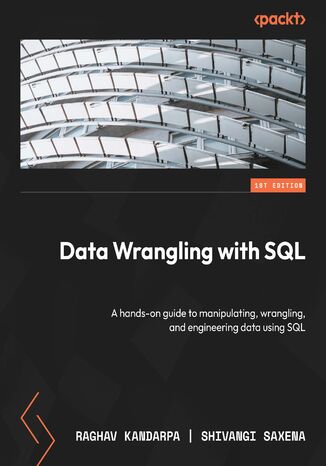
Data Wrangling with SQL. A hands-on guide to manipulating, wrangling, and engineering data using SQL
Raghav Kandarpa, Shivangi Saxena
The amount of data generated continues to grow rapidly, making it increasingly important for businesses to be able to wrangle this data and understand it quickly and efficiently. Although data wrangling can be challenging, with the right tools and techniques you can efficiently handle enormous amounts of unstructured data.The book starts by introducing you to the basics of SQL, focusing on the core principles and techniques of data wrangling. You’ll then explore advanced SQL concepts like aggregate functions, window functions, CTEs, and subqueries that are very popular in the business world. The next set of chapters will walk you through different functions within SQL query that cause delays in data transformation and help you figure out the difference between a good query and bad one. You’ll also learn how data wrangling and data science go hand in hand. The book is filled with datasets and practical examples to help you understand the concepts thoroughly, along with best practices to guide you at every stage of data wrangling.By the end of this book, you’ll be equipped with essential techniques and best practices for data wrangling, and will predominantly learn how to use clean and standardized data models to make informed decisions, helping businesses avoid costly mistakes.
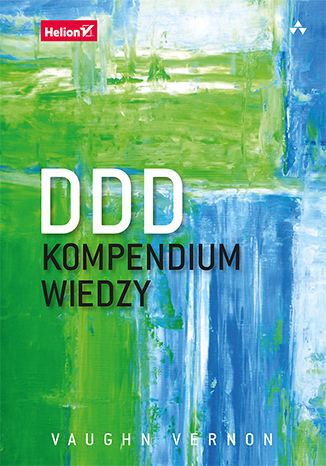
Vaughn Vernon
DDD w pigułce Modelowanie oprogramowania jest kojarzone z pojęciem programowania dziedzinowego, w skrócie zwanego DDD. Jest to dość nowatorskie podejście do tworzenia architektury oprogramowania, a jego największą zaletą jest wysoka pewność uzyskiwania bardzo dobrych rezultatów. Programiści często błyskawicznie dostrzegają zalety DDD i korzyści płynące ze stosowania odpowiednich narzędzi, stąd technika ta cieszy się coraz większym uznaniem. Dopiero jednak pełne zrozumienie zasad stosowania wzorców projektowych DDD przez wszystkich zaangażowanych w projekt pozwala na osiągnięcie imponujących wyników przy projektowaniu skomplikowanych systemów oprogramowania. Ten zwięzły i czytelnie napisany podręcznik jest przeznaczony dla programistów, ekspertów dziedzinowych, menedżerów, analityków biznesowych, architektów informacji i testerów. Koncentruje się na praktycznej wiedzy niezbędnej do uzyskania pożądanych rezultatów. Wyjaśniono, jak segregować modele dziedzin za pomocą wzorca kontekstu ograniczonego, jak rozwinąć język wszechobecny, a także w jaki sposób zintegrować wiele kontekstów ograniczonych poprzez wykorzystanie relacji zespołowych i mechanizmów technicznych. Co najważniejsze, dowiesz się, jak podejście DDD działa w rzeczywistości i co zrobić, aby jak najszybciej cieszyć się jego zaletami. W książce przedstawiono następujące zagadnienia: wprowadzenie do DDD i zalety tego podejścia do projektowania projektowanie strategiczne DDD integrowanie istniejących systemów w ramach tworzenia nowych aplikacji modelowanie taktyczne - agregaty i zdarzenia dziedziny narzędzia do zarządzania projektami i przyśpieszania prac Narzędzia DDD - ciesz się udanym wdrożeniem!
![Deciphering Object-Oriented Programming with C++ [WARNING: NOT FOR USE IN OTHER MATERIAL/SEE CONTRACT]. A practical, in-depth guide to implementing object-oriented design principles to create robust code](https://static01.helion.com.pl/global/okladki/326x466/e_39y5.jpg)
Dorothy R. Kirk
Even though object-oriented software design enables more easily maintainable code, companies choose C++ as an OO language for its speed. Object-oriented programming in C++ is not automatic – it is crucial to understand OO concepts and how they map to both C++ language features and OOP techniques. Distinguishing your code by utilizing well-tested, creative solutions, which can be found in popular design patterns, is crucial in today’s marketplace. This book will help you to harness OOP in C++ to write better code.Starting with the essential C++ features, which serve as building blocks for the key chapters, this book focuses on explaining fundamental object-oriented concepts and shows you how to implement them in C++. With the help of practical code examples and diagrams, you’ll learn how and why things work. The book’s coverage furthers your C++ repertoire by including templates, exceptions, operator overloading, STL, and OO component testing. You’ll discover popular design patterns with in-depth examples and understand how to use them as effective programming solutions to solve recurring OOP problems.By the end of this book, you’ll be able to employ essential and advanced OOP concepts to create enduring and robust software.
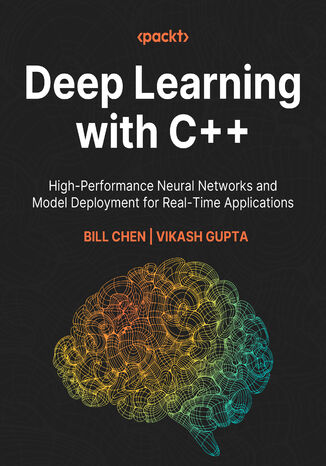
Deep Learning with C++. Design and deploy neural networks using CUDA for high-performance AI in C++
Bill Chen, Vikash Gupta
Deep learning systems often struggle to meet performance demands in real-time and production environments. This book shows you how to build high-performance deep learning systems in C++, enabling efficient and scalable artificial intelligence (AI) in resource-constrained environments where performance matters.You’ll start by setting up a complete C++ deep learning environment and implementing core neural networks from scratch. As you progress, you’ll build advanced architectures, including Convolutional Neural Networks (CNNs), Recurrent Neural Networks (RNNs), Long Short-Term Memory Networks (LSTMs), Generative Adversarial Networks (GANs), and Transformers, using C++, CUDA, and PyTorch’s C++ API. The book then focuses on model quantization and compression. It will guide you through the model deployment process in production with robust monitoring and explainability. You’ll also explore distributed training and techniques for real-time inference in performance-critical domains.By the end of this book, you’ll be able to design, optimize, and deploy deep learning systems in C++ that are production-ready, scalable, and efficient across multiple industries.*Email sign-up and proof of purchase required
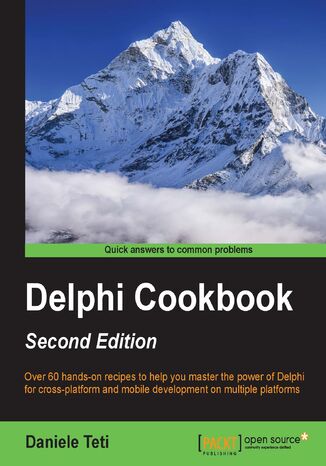
Daniele Teti
Delphi is a cross-platform Integrated Development Environment (IDE) that supports rapid application development for Microsoft Windows, Apple Mac OS X, Google Android, and Apple iOS. It helps you to concentrate on the real business and save yourself the pain of wandering amid GUI widget details, or having to tackle inter-platform incompatibilities. It also has a wide range of drag-and-drop controls, helping you code your business logic into your business model, and it compiles natively for desktop and mobile platforms.This book will teach you how to design and develop applications, deploy them on the cloud platform, and distribute them within an organization via Google Play and other similar platforms.You will begin with the basics of Delphi and get acquainted with JSON format strings, XSLT transformations, unicode encodings and various types of streams. We then move on to more advanced topics such as developing higher-order functions and using enumerators and RTTI. You will get an understanding of how Delphi RTL functions and how to use FireMonkey in a VCL application. We will then cover topics such as multithreading, using the parallel programming library and putting Delphi on a server. We will also take a look at the new feature of WebBroker Apache modules and then ride the mobile revolution with FireMonkey. By the end of the book, you will be able to develop and deploy cross-platform applications using Delphi .
Primož Gabrijelčič
Performance matters! Users hate to use programs that are not responsive to interactions or run too slow to be useful. While becoming a programmer is simple enough, you require dedication and hard work to achieve an advanced level of programming proficiency where you know how to write fast code.This book begins by helping you explore algorithms and algorithmic complexity and continues by describing tools that can help you find slow parts of your code. Subsequent chapters will provide you with practical ideas about optimizing code by doing less work or doing it in a smarter way. The book also teaches you how to use optimized data structures from the Spring4D library, along with exploring data structures that are not part of the standard Delphi runtime library.The second part of the book talks about parallel programming. You’ll learn about the problems that only occur in multithreaded code and explore various approaches to fixing them effectively. The concluding chapters provide instructions on writing parallel code in different ways – by using basic threading support or focusing on advanced concepts such as tasks and parallel patterns.By the end of this book, you’ll have learned to look at your programs from a totally different perspective and will be equipped to effortlessly make your code faster than it is now.
Alexei Khlebnikov
Security and networking are essential features of software today. The modern internet is full of worms, Trojan horses, men-in-the-middle, and other threats. This is why maintaining security is more important than ever.OpenSSL is one of the most widely used and essential open source projects on the internet for this purpose. If you are a software developer, system administrator, network security engineer, or DevOps specialist, you’ve probably stumbled upon this toolset in the past – but how do you make the most out of it? With the help of this book, you will learn the most important features of OpenSSL, and gain insight into its full potential.This book contains step-by-step explanations of essential cryptography and network security concepts, as well as practical examples illustrating the usage of those concepts. You’ll start by learning the basics, such as how to perform symmetric encryption and calculate message digests. Next, you will discover more about cryptography: MAC and HMAC, public and private keys, and digital signatures. As you progress, you will explore best practices for using X.509 certificates, public key infrastructure, and TLS connections.By the end of this book, you’ll be able to use the most popular features of OpenSSL, allowing you to implement cryptography and TLS in your applications and network infrastructure.
Gigi Sayfan
Frustrated by opaque agent frameworks that hide how things work? This book gives you complete control by guiding you through building a fully functional, extensible agentic AI framework in Python without relying on external orchestration tools.You’ll begin by implementing a simple tool-using agent, and then gradually extend its capabilities with structured tool schemas, user interfaces, and memory via the Model Context Protocol (MCP). From there, you’ll build collaborative multi-agent systems powered by Agent-to-Agent (A2A) messaging and deploy them in realistic environments. Along the way, you’ll explore secure tool invocation, message routing, observability, and human-in-the-loop workflows.With annotated code, deep engineering insights, and practical deployment patterns, this hands-on guide equips you to build AI agents that reason, plan, act, and adapt, whether you’re shipping production systems or experimenting with cutting-edge LLM-based architectures.Written by Gigi Sayfan, who builds AI agent infrastructure at Perplexity and is a bestselling author with decades of experience in AI and distributed systems, this book gives you the tools and knowledge to engineer your own advanced agentic systems.*Email sign-up and proof of purchase required
Evan Williams, Scott McKay
Many Rust developers run into problems when they try to apply familiar object-oriented or cross-language patterns to Rust projects. These mismatches often lead to confusing compiler errors, awkward workarounds, or brittle code. This book helps you avoid those traps by thinking in Rust and applying idiomatic design patterns that embrace ownership, borrowing, and type safety.The book begins with anti-patterns and common mistakes Rust developers often encounter, including misusing object-oriented thinking, over-relying on Clone, or treating the borrow checker as an obstacle. From there, you’ll explore how to rethink traditional design solutions for Rust, including creational, structural, and behavioral design patterns. You’ll also dive into architectural strategies, type-driven design, and Rust-specific techniques such as TypeState. The final chapter brings these ideas together into a design mindset rooted in idiomatic Rust.By the end of this book, you’ll know how to avoid costly mistakes, apply effective patterns confidently, and design Rust applications that are clean, scalable, and reliable.*Email sign-up and proof of purchase required
Werner Rall
The AZ-400 certification proves your ability to design and implement DevOps practices on Microsoft Azure, making it a key step forward for cloud engineers and DevOps professionals. This comprehensive study guide is designed to help you pass the AZ-400 exam on your first attempt, covering every objective in detail.You’ll find clear explanations, end-of-chapter review questions, full-length mock exams, and hands-on solutions that reinforce your understanding. Key topics include continuous integration, continuous delivery, infrastructure as code, containerization, security, and automation.Through practical labs and real-world scenarios, you'll gain the experience needed to apply these concepts in live environments. The book also explores advanced topics such as site reliability engineering, cloud transformation strategies, and compliance.By the end, you will have a solid foundation in Azure DevOps, the ability to deliver secure and reliable deployments, and the confidence to excel in the AZ-400 exam and your DevOps career.
Developing AI Applications. An Introduction
Rheinwerk Publishing, Inc, Metin Karatas
This book opens with a clear introduction to AI fundamentals, covering its history and key concepts while guiding readers through installing essential tools like KNIME and AutoKeras. It begins by building a strong foundation in artificial neural networks and decision trees, enabling readers to grasp core AI methods. The journey then advances to convolutional layers for image classification, transfer learning, and anomaly detection, offering practical, beginner-friendly examples.As the reader progresses, the book explores text classification, cluster analysis, and automated AI model creation with AutoKeras. Visual programming with KNIME is introduced to simplify complex AI workflows. Further chapters cover reinforcement learning and genetic algorithms, expanding the reader’s skill set and preparing them for more advanced challenges. Hands-on exercises throughout reinforce concepts and practical application.In its final chapters, the guide dives into cutting-edge AI tools by demonstrating how to leverage ChatGPT and DALL-E APIs, including prompt engineering and API programming. It concludes with an outlook on the future of AI, equipping readers with the knowledge and confidence to build and deploy their own AI-powered applications from start to finish.
Rami Sarieddine
Windows 8 has already been launched and been installed on millions of devices while the store is getting populated with apps, and soon enough everyone will want a Windows Store app. So start now and learn how to develop apps for Windows 8 using HTML5, CSS3, and JavaScript and you will be killing two birds with one stone by getting introduced to important features in HTML5 and CSS3 at the same time. You will gain the advantage of utilizing your web development skills to transform your website into an app or the other way round.Developing Windows Store Apps with HTML5 and JavaScript is a practical, hands-on guide that covers the basic and important features of a Windows Store App along with code examples which will show you how to develop these features, all the while learning some of the new features in HTML5 and CSS3 which you can utilize in other areas of development.This book starts with the new features in HTML5 and CSS3 that are incorporated with Windows 8 development, and then moves on to creating a blank Windows Store app and add features to it as we move through the chapters till we package the app and make it ready for publishing. Finally, we will have a look at how similar it is to develop the same app with XAML.You will also learn how to add and use new controls dedicated for Windows 8 and then see how to fetch data for the app and bind it to the controls. We will also take a look at making the app adapt to change in screen sizes and rotation as well as how to make the app live with tiles and allow users to sign in using their email accounts. Also you will learn how to add an app bar, and lastly you learn how to finalize the app and publish it. If you want to leverage your web development skills and utilize it in developing for Windows 8, then you came to the right place. Developing Windows Store Apps with HTML5 and JavaScript is packed with examples and screenshots which will make it easy for you to implement all the things you learned throughout the book.
Martyn Coupland
DevOps is a set of best practices enabling operations and development teams to work together to produce higher-quality work and, among other things, quicker releases. This book helps you to understand the fundamentals needed to get started with DevOps, and prepares you to start deploying technical tools confidently.You will start by learning the key steps for implementing successful DevOps transformations. The book will help you to understand how aspects of culture, people, and process are all connected, and that without any one of these elements DevOps is unlikely to be successful. As you make progress, you will discover how to measure and quantify the success of DevOps in your organization, along with exploring the pros and cons of the main tooling involved in DevOps. In the concluding chapters, you will learn about the latest trends in DevOps and find out how the tooling changes when you work with these specialties.By the end of this DevOps book, you will have gained a clear understanding of the connection between culture, people, and processes within DevOps, and learned why all three are critically important.
DevOps for Networking. Bringing Network Automation into DevOps culture
Steven Armstrong
Frustrated that your company’s network changes are still a manual set of activities that slow developers down? It doesn’t need to be that way any longer, as this book will help your company and network teams embrace DevOps and continuous delivery approaches, enabling them to automate all network functions.This book aims to show readers network automation processes they could implement in their organizations. It willteach you the fundamentals of DevOps in networking and how to improve DevOps processes and workflows by providing automation in your network. You will be exposed to various networking strategies that are stopping your organization from scaling new projects quickly.You will see how SDN and APIs are influencing DevOps transformations, which will in turn help you improve the scalability and efficiency of your organizations networks operations. You will also find out how to leverage variousconfiguration management tools such as Ansible, to automate your network.The book will also look at containers and the impact they are having on networking as well as looking at howautomation impacts network security in a software-defined network.
Mitesh Soni
The DevOps culture is growing at a massive rate, as many organizations are adopting it. However, implementing it for web applications is one of the biggest challenges experienced by many developers and admins, which this book will help you overcome using various tools, such as Chef, Docker, and Jenkins. On the basis of the functionality of these tools, the book is divided into three parts. The first part shows you how to use Jenkins 2.0 for Continuous Integration of a sample JEE application. The second part explains the Chef configuration management tool, and provides an overview of Docker containers, resource provisioning in cloud environments using Chef, and Configuration Management in a cloud environment. The third part explores Continuous Delivery and Continuous Deployment in AWS, Microsoft Azure, and Docker, all using Jenkins 2.0.This book combines the skills of both web application deployment and system configuration as each chapter contains one or more practical hands-on projects. You will be exposed to real-world project scenarios that are progressively presented from easy to complex solutions. We will teach you concepts such as hosting web applications, configuring a runtime environment, monitoring and hosting on various cloud platforms, and managing them. This book will show you how to essentially host and manage web applications along with Continuous Integration, Cloud Computing, Configuration Management, Continuous Monitoring, Continuous Delivery, and Deployment.
DevOps Paradox. The truth about DevOps by the people on the front line
Viktor Farcic
DevOps promises to break down silos, uniting organizations to deliver high quality output in a cross-functional way. In reality it often results in confusion and new silos: pockets of DevOps practitioners fight the status quo, senior decision-makers demand DevOps paint jobs without committing to true change. Even a clear definition of what DevOps is remains elusive.In DevOps Paradox, top DevOps consultants, industry leaders, and founders reveal their own approaches to all aspects of DevOps implementation and operation. Surround yourself with expert DevOps advisors. Viktor Farcic draws on experts from across the industry to discuss how to introduce DevOps to chaotic organizations, align incentives between teams, and make use of the latest tools and techniques.With each expert offering their own opinions on what DevOps is and how to make it work, you will be able to form your own informed view of the importance and value of DevOps as we enter a new decade. If you want to see how real DevOps experts address the challenges and resolve the paradoxes, this book is for you.