
JavaScript
Lektura podręczników z działu JavaScript pozwoli wam od podstaw poznać ten popularny, obiektowy język skryptowy, wykorzystywany głównie w celu tworzenia interaktywnych i dynamicznych elementów stron WWW.
Poznacie podstawowe elementy, składnię tego języka, zdarzenia i wyrażenia regularne. Opanujecie szereg metod pozwalających zidentyfikować przeglądarkę, dowiecie się jak sprawnie sterować ramkami i oknami przeglądarki a także jak obsługiwać pliki multimedialne.Zapoznacie się także z elementami technologii AJAX czy arkuszami stylów CSS. Teoria, poparta licznymi przykładami pozwoli wam skutecznie reagować na błędy w skrypcie oraz opracować mechanizmy komunikacji między klientem a serwerem.
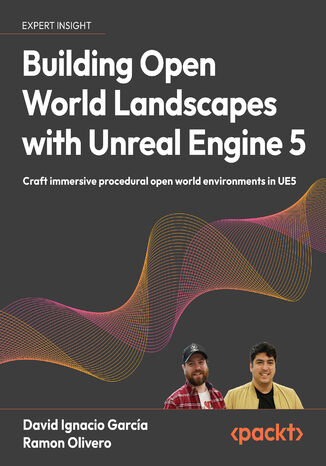
David Ignacio García, Ramón Olivero, Marco Secchi
Creating expansive open worlds in Unreal Engine 5 (UE5) can be daunting, especially if you’re just starting out. In this practical guide, the authors leverage their vast experience to break down the essential tools and workflows needed to design immersive environments with ease.The book guides you step by step through sculpting landscapes, painting foliage, setting up lighting, and applying post-processing effects to elevate your outdoor scenes. The chapters will walk you through the UE5 interface and core tools such as Landscape Mode, Foliage Mode, and related features. You’ll also sculpt terrain that evokes emotion in practical projects, design materials that bring surfaces to life, and create lush foliage to transform your landscapes into vibrant ecosystems. You’ll explore level design techniques, world composition, and World Partition for seamless integration of large environments. You’ll enhance visual fidelity with real-time lighting and post-processing techniques and gain the skills to optimize your creations for smooth performance.By the end of this UE5 book, you’ll have the confidence and technical foundation to create stylized and realistic outdoor environments and continue refining your UE5 skills.*Email sign-up and proof of purchase required
Joran Quinten
In the ever-evolving web development landscape, Vue.js stands out with its intuitive design and progressive framework, empowering developers to create interactive and dynamic web applications. This book will help you stay in the forefront of modern web technologies by mastering Vue.js through hands-on projects and practical applications.Building Real-World Web Applications with Vue.js 3 is your guide to exploring the core concepts of Vue.js, setting up your development environment, and creating your first Vue.js application. You’ll progress by building a recipe app using Vuetify, followed by leveraging data visualization to create a fitness tracker featuring dynamic dashboards using external databases and Vue-ChartJS. You'll then get to grips with multiplatform development with Quasar to deploy your app.As you develop an interactive quiz app, you’ll be introduced to server-side logic with Nuxt.js, WebSockets for real-time communication, and client-server differentiation. Additionally, you’ll study experimental object recognition using TensorFlow, leveraging machine learning and camera input, and conclude by creating a portfolio website with Nuxt and Storyblok.By the end of this book, you'll have the knowledge and confidence to create your own Vue.js applications and build a portfolio to showcase your Vue.js skills to potential employers.
Diego Zanon
This book will equip you with the knowledge needed to build your own serverless apps by showing you how to set up different services while making your application scalable, highly available, and efficient.We begin by giving you an idea of what it means to go serverless, exploring the pros and cons of the serverless model and its use cases. Next, you will be introduced to the AWS services that will be used throughout the book, how to estimate costs, and how to set up and use the Serverless Framework.From here, you will start to build an entire serverless project of an online store, beginning with a React SPA frontend hosted on AWS followed by a serverless backend with API Gateway and Lambda functions. You will also learn to access data from a SimpleDB database, secure the application with authentication and authorization, and implement serverless notifications for browsers using AWS IoT. This book will describe how to monitor the performance, efficiency, and errors of your apps and conclude by teaching you how to test and deploy your applications.
Fabian Vogelsteller
If you are a web developer with basic knowledge of JavaScript and want to take on Web 2.0, build real-time applications, or simply want to write a complete application using only JavaScript and HTML/CSS, this is the book for you.This book is based on Meteor 1.0.
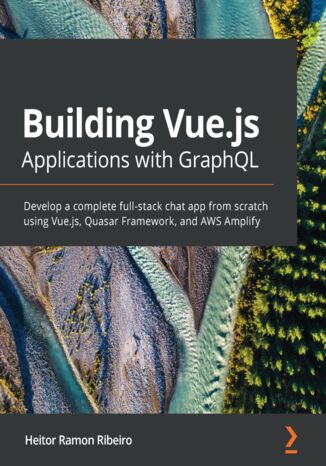
Heitor Ramon Ribeiro
Since its release by Facebook in 2012, GraphQL has taken the internet by storm. Huge companies such as Airbnb and Audi have started to adopt it, while small to medium-sized companies are now recognizing the potential of this query-based API.GraphQL may seem strange at first, but as you start to read about and experience more of it, you won’t want to use REST APIs anymore.With the recipes in this book, you will learn how to build a complete real-time chat app from scratch. Starting by creating an AWS Amplify environment, you will delve into developing your first GraphQL Schema. You will then learn how to add the AppSync GraphQL client and create your first GraphQL mutation. The book also helps you to discover the simplicity and data fetching capabilities of GraphQL that make it easy for front-end developers to communicate with the server. You will later understand how to use Quasar Framework to create application components and layouts. Finally, you will find out how to create Vuex modules in your application to manage the app state, fetch data using the GraphQL client, and deploy your application to the web.By the end of this book, you’ll be well versed in proof-of-concept full-stack applications that explore the power of GraphQL with AWS Amplify, and you'll be able to use Quasar Framework to create your Vue applications.
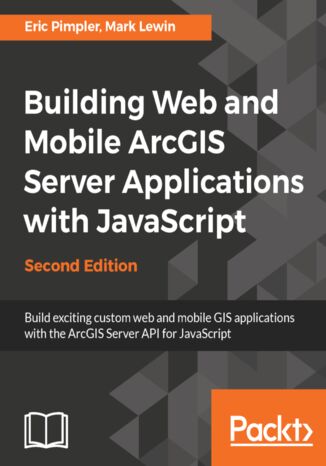
Mark Lewin, Eric Pimpler
The ArcGIS API for JavaScript enables you to quickly build web and mobile mapping applications that include sophisticated GIS capabilities, yet are easy and intuitive for the user.Aimed at both new and experienced web developers, this practical guide gives you everything you need to get started with the API. After a brief introduction to HTML/CSS/JavaScript, you'll embed maps in a web page, add the tiled, dynamic, and streaming data layers that your users will interact with, and mark up the map with graphics. You will learn how to quickly incorporate a broad range of useful user interface elements and GIS functionality to your application with minimal effort using prebuilt widgets. As the book progresses, you will discover and use the task framework to query layers with spatial and attribute criteria, search for and identify features on the map, geocode addresses, perform network analysis and routing, and add custom geoprocessing operations. Along the way, we cover exciting new features such as the client-side geometry engine, learn how to integrate content from ArcGIS.com, and use your new skills to build mobile web mapping applications.We conclude with a look at version 4 of the ArcGIS API for JavaScript (which is being developed in parallel with version 3.x) and what it means for you as a developer.
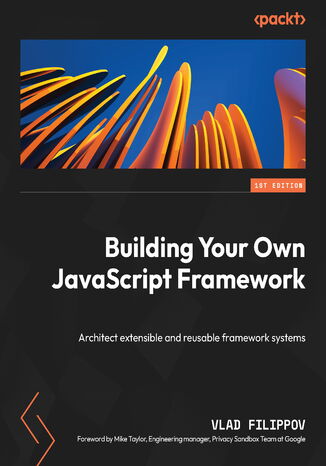
Building Your Own JavaScript Framework. Architect extensible and reusable framework systems
Vlad Filippov
JavaScript frameworks play an essential role in web application development; however, no single framework works perfectly for all projects. This book will help you understand existing projects, design new software architecture, and maintain projects as they grow. You’ll go through software architecture principles with JavaScript, along with a guided example of structuring your project and maintenance guidance.This book covers framework planning aspects, enabling you to identify key stakeholders, understand JavaScript API design, and leverage complex abstraction. The second part of the book takes a practical programming approach to building your own framework by showing you how to structure modules and interfaces. As you advance, you’ll discover how to develop data-binding components, work with JavaScript APIs, and much more. While writing a framework is half the job, continuing to develop it requires effort from everyone involved. The concluding chapters help to achieve this by teaching you the crucial aspects of software maintenance and highlighting the constants of framework development.By the end of this book, you’ll have gained a clear understanding of the JavaScript framework landscape, along with the ability to build frameworks for your use cases.
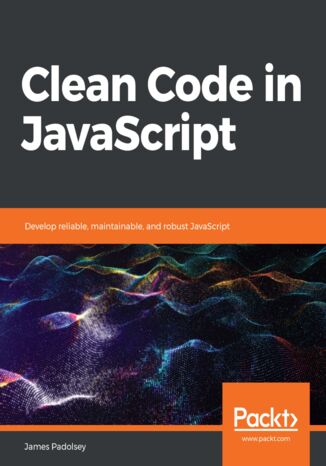
Clean Code in JavaScript. Develop reliable, maintainable, and robust JavaScript
James Padolsey
Building robust apps starts with creating clean code. In this book, you’ll explore techniques for doing this by learning everything from the basics of JavaScript through to the practices of clean code. You’ll write functional, intuitive, and maintainable code while also understanding how your code affects the end user and the wider community.The book starts with popular clean-coding principles such as SOLID, and the Law of Demeter (LoD), along with highlighting the enemies of writing clean code such as cargo culting and over-management. You’ll then delve into JavaScript, understanding the more complex aspects of the language. Next, you’ll create meaningful abstractions using design patterns, such as the Class Pattern and the Revealing Module Pattern. You’ll explore real-world challenges such as DOM reconciliation, state management, dependency management, and security, both within browser and server environments. Later, you’ll cover tooling and testing methodologies and the importance of documenting code. Finally, the book will focus on advocacy and good communication for improving code cleanliness within teams or workplaces, along with covering a case study for clean coding.By the end of this book, you’ll be well-versed with JavaScript and have learned how to create clean abstractions, test them, and communicate about them via documentation.
Sander Rossel
The challenge faced by many teams while implementing Continuous Deployment is that it requires the use of many tools and processes that all work together. Learning and implementing all these tools (correctly) takes a lot of time and effort, leading people to wonder whether it's really worth it. This book sets up a project to show you the different steps, processes, and tools in Continuous Deployment and the actual problems they solve.We start by introducing Continuous Integration (CI), deployment, and delivery as well as providing an overview of the tools used in CI. You'll then create a web app and see how Git can be used in a CI environment. Moving on, you'll explore unit testing using Jasmine and browser testing using Karma and Selenium for your app. You'll also find out how to automate tasks using Gulp and Jenkins. Next, you'll get acquainted with database integration for different platforms, such as MongoDB and PostgreSQL. Finally, you'll set up different Jenkins jobs to integrate with Node.js and C# projects, and Jenkins pipelines to make branching easier.By the end of the book, you'll have implemented Continuous Delivery and deployment from scratch.
Create React App 2 Quick Start Guide. Build React applications faster with Create React App
Brandon Richey
If you're a power user and you aren’t happy always reusing default configurations, from previous applications with each new application, then all you need is Create React App (CRA), a tool in the React ecosystem designed to help you create boilerplate code for building a web frontend.This book will help you use CRA to write React programs without significant configuration-related difficulties. With this quick start guide, you will integrate your applications with React to build efficient professional web services.You will learn to design UIs with the features of CRA and template your React applications.By the end of the book, you will be sufficiently skilled to be able to build faster and effective React apps using CRA.

Dmitry Sheiko
Building and maintaining cross-platform desktop applications with native languages isn’t a trivial task. Since it’s hard to simulate on a foreign platform, packaging and distribution can be quite platform-specific and testing cross-platform apps is pretty complicated.In such scenarios, web technologies such as HTML5 and JavaScript can be your lifesaver. HTML5 desktop applications can be distributed across different platforms (Window, MacOS, and Linux) without any modifications to the code. The book starts with a walk-through on building a simple file explorer from scratch powered by NW.JS. So you will practice the most exciting features of bleeding edge CSS and JavaScript. In addition you will learn to use the desktop environment integration API, source code protection, packaging, and auto-updating with NW.JS.As the second application you will build a chat-system example implemented with Electron and React. While developing the chat app, you will get Photonkit. Next, you will create a screen capturer with NW.JS, React, and Redux. Finally, you will examine an RSS-reader built with TypeScript, React, Redux, and Electron. Generic UI components will be reused from the React MDL library. By the end of the book, you will have built four desktop apps. You will have covered everything from planning, designing, and development to the enhancement, testing, and delivery of these apps.
D3.js 4.x Data Visualization. Learn to visualize your data with JavaScript - Third Edition
Aendrew Rininsland , Swizec Teller
Want to get started with impressive interactive visualizations and implement them in your daily tasks? This book offers the perfect solution-D3.js. It has emerged as the most popular tool for data visualization. This book will teach you how to implement the features of the latest version of D3 while writing JavaScript using the newest tools and techniqueYou will start by setting up the D3 environment and making your first basic bar chart. You will then build stunning SVG and Canvas-based data visualizations while writing testable, extensible code,as accurate and informative as it is visually stimulating. Step-by-step examples walk you through creating, integrating, and debugging different types of visualization and will have you building basic visualizations (such as bar, line, and scatter graphs) in no time.By the end of this book, you will have mastered the techniques necessary to successfully visualize data and will be ready to use D3 to transform any data into an engaging and sophisticated visualization.
D3.js Quick Start Guide. Create amazing, interactive visualizations in the browser with JavaScript
Matthew Huntington
D3.js is a JavaScript library that allows you to create graphs and data visualizations in the browser with HTML, SVG, and CSS. This book will take you from the basics of D3.js, so that you can create your own interactive visualizations, to creating the most common graphs that you will encounter as a developer, scientist, statistician, or data scientist.The book begins with an overview of SVG, the basis for creating two-dimensional graphics in the browser. Once the reader has a firm understanding of SVG, we will tackle the basics of how to use D3.js to connect data to our SVG elements. We will start with a scatter plot that maps run data to circles on a graph, and expand our scatter plot to make it interactive. You will see how you can easily allow the users of your graph to create, edit, and delete run data by simply dragging and clicking the graph. Next, we will explore creating a bar graph, using external data from a mock API.After that, we will explore animations and motion with a bar graph, and use various physics-based forces to create a force-directed graph. Finally, we will look at how to use GeoJSON data to create a map.

Elijah Meeks
D3.js jest biblioteką przeznaczoną do tworzenia zaawansowanych wizualizacji danych w rozmaitych aplikacjach internetowych. Ta solidnie zaprojektowana biblioteka oczywiście umożliwia generowanie wykresów, ale pozwala również na tworzenie map, interaktywnych diagramów, paneli kontrolnych dla danych, raportów i wielu innych animowanych elementów. Zapewnia co najmniej tę samą wydajność co Flash czy aplety Javy, ale jest zintegrowana ze standardami internetowymi i modelem DOM dla HTML. To nie koniec zalet D3.js — to także świetne narzędzie do dynamicznego aktualizowania bardziej standardowych witryn internetowych. Niniejsza książka pozwoli Ci na płynne rozpoczęcie pracy z tą biblioteką, dającą fantastyczne możliwości. Nauczysz się, jak tworzyć interaktywną grafikę i aplikacje sterowane danymi. Zaczniesz od zestawu praktycznych przykładów, dostosowanych do różnego rodzaju wykresów, sieci i map. Wykorzystasz przy tym gotowe układy z biblioteki D3. Zapoznasz się z praktycznymi technikami projektowania zawartości stron, tworzenia animacji i prezentowania zmieniających się danych. Zobaczysz między innymi, jak tworzyć interaktywną grafikę i wykorzystywać dane przesyłane strumieniowo. Dzięki tej książce zrozumiesz: zasady wizualizacji danych, techniki wiązania i wczytywania danych oraz tworzenia elementów graficznych na ich podstawie, metody pracy z grafiką wektorową, tworzenie elementów służących do wizualizacji danych, rozbudowane aplikacje wykorzystujące mapy, sposoby tworzenia kompletnych aplikacji opartych na bibliotece D3, również dla urządzeń przenośnych.

Darmowe sposoby na tworzenie profesjonalnych stron WWW. Podręcznik webmastera. Wydanie III
Mark William Bell
Stworzenie i prowadzenie witryny internetowej to obowiązkowa pozycja w budżecie każdej firmy. Koszt wykonania profesjonalnej, funkcjonalnej i imponującej klientom strony WWW może zszokować niejedną osobę. Czy da się go zminimalizować? Oczywiście! Z tym podręcznikiem pod ręką przy odrobinie samozaparcia i dużej dozie cierpliwości możesz osiągnąć naprawdę zadowalające efekty. W trakcie lektury dowiesz się, gdzie umieścić stronę internetową za darmo lub za minimalną opłatą oraz jak zaplanować proces tworzenia witryny. Przekonasz się również, że istnieje wiele narzędzi doskonale wspomagających proces tworzenia stron. Możesz wybierać spośród darmowych i płatnych platform. Po wstępie przejdziesz do konkretów, czyli poznasz język HTML! Tabele, listy, nagłówki i dziesiątki innych znaczników odkryją przed Tobą wszystkie tajemnice. W mig opanujesz CSS, JavaScript, osadzanie multimediów, statystyki oglądalności i wiele innych interesujących tematów. Książka ta będzie biblią dla każdego, kto chce rozpocząć przygodę z tworzeniem profesjonalnych stron WWW. Dowiedz się: jak zaprojektować witrynę WWW jakie narzędzia musisz mieć, żeby pracować szybko i wydajnie co to są kaskadowe arkusze stylów (CSS) i jak je połączyć z językiem HTML jak wykorzystać gotowe i darmowe systemy CMS, aby błyskawicznie stworzyć nową stronę Poznaj wydajne i oszczędne sposoby tworzenia nowych stron WWW!
Data Oriented Development with Angularjs
Manoj Waikar
This book helps beginner-level AngularJS developers organize AngularJS applications by discussing important AngularJS concepts and best practices. If you are an experienced AngularJS developer but haven't written directives or haven't created custom HTML controls before, then this book is ideal for you.