
Python
W kategorii Python zostały zebrane podręczniki poruszające tematykę programowania z zastosowaniem praktycznie niezależnego sprzętowo, dostępnego na licencji Open Source języka. Książki przedstawią Wam wszechstronności i elastyczności Pythona a także różne typy tworzenia kodu poprzez programowanie strukturalne, obiektowe czy funkcjonalne.
Nauczycie się tworzyć aplikacje sieciowe o dowolnym przeznaczeniu, komunikujące się z systemami operacyjnymi, lub korzystające z baz danych. Techniki analizy składni, przetwarzanie tekstu czy rozłożenie obciążenia programu na wiele wątków i procesów przestanie być problematyczne.
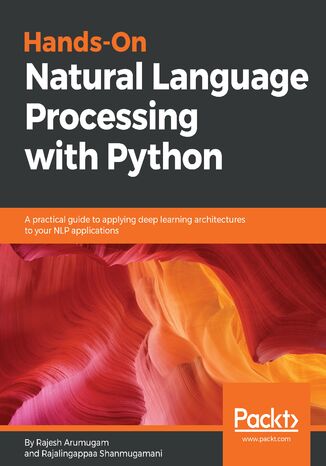
Rajesh Arumugam, Rajalingappaa Shanmugamani
Natural language processing (NLP) has found its application in various domains, such as web search, advertisements, and customer services, and with the help of deep learning, we can enhance its performances in these areas. Hands-On Natural Language Processing with Python teaches you how to leverage deep learning models for performing various NLP tasks, along with best practices in dealing with today’s NLP challenges.To begin with, you will understand the core concepts of NLP and deep learning, such as Convolutional Neural Networks (CNNs), recurrent neural networks (RNNs), semantic embedding, Word2vec, and more. You will learn how to perform each and every task of NLP using neural networks, in which you will train and deploy neural networks in your NLP applications. You will get accustomed to using RNNs and CNNs in various application areas, such as text classification and sequence labeling, which are essential in the application of sentiment analysis, customer service chatbots, and anomaly detection. You will be equipped with practical knowledge in order to implement deep learning in your linguistic applications using Python's popular deep learning library, TensorFlow.By the end of this book, you will be well versed in building deep learning-backed NLP applications, along with overcoming NLP challenges with best practices developed by domain experts.
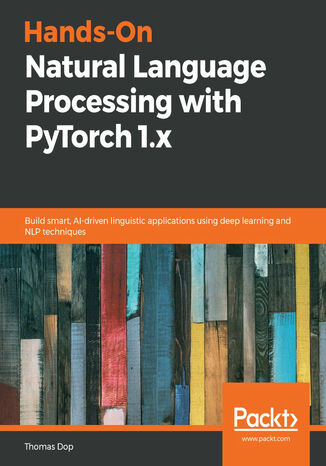
Thomas Dop
In the internet age, where an increasing volume of text data is generated daily from social media and other platforms, being able to make sense of that data is a crucial skill. With this book, you’ll learn how to extract valuable insights from text by building deep learning models for natural language processing (NLP) tasks.Starting by understanding how to install PyTorch and using CUDA to accelerate the processing speed, you’ll explore how the NLP architecture works with the help of practical examples. This PyTorch NLP book will guide you through core concepts such as word embeddings, CBOW, and tokenization in PyTorch. You’ll then learn techniques for processing textual data and see how deep learning can be used for NLP tasks. The book demonstrates how to implement deep learning and neural network architectures to build models that will allow you to classify and translate text and perform sentiment analysis. Finally, you’ll learn how to build advanced NLP models, such as conversational chatbots.By the end of this book, you’ll not only have understood the different NLP problems that can be solved using deep learning with PyTorch, but also be able to build models to solve them.
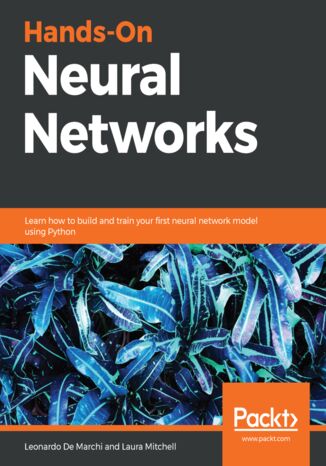
Hands-On Neural Networks. Learn how to build and train your first neural network model using Python
Leonardo De Marchi, Laura Mitchell
Neural networks play a very important role in deep learning and artificial intelligence (AI), with applications in a wide variety of domains, right from medical diagnosis, to financial forecasting, and even machine diagnostics.Hands-On Neural Networks is designed to guide you through learning about neural networks in a practical way. The book will get you started by giving you a brief introduction to perceptron networks. You will then gain insights into machine learning and also understand what the future of AI could look like. Next, you will study how embeddings can be used to process textual data and the role of long short-term memory networks (LSTMs) in helping you solve common natural language processing (NLP) problems. The later chapters will demonstrate how you can implement advanced concepts including transfer learning, generative adversarial networks (GANs), autoencoders, and reinforcement learning. Finally, you can look forward to further content on the latest advancements in the field of neural networks.By the end of this book, you will have the skills you need to build, train, and optimize your own neural network model that can be used to provide predictable solutions.
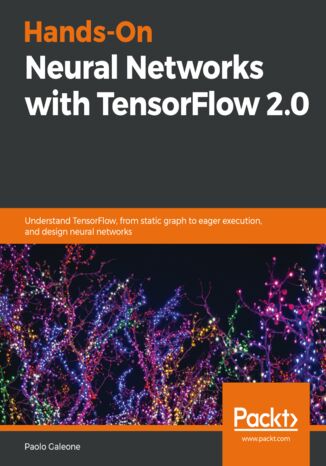
Paolo Galeone
TensorFlow, the most popular and widely used machine learning framework, has made it possible for almost anyone to develop machine learning solutions with ease. With TensorFlow (TF) 2.0, you'll explore a revamped framework structure, offering a wide variety of new features aimed at improving productivity and ease of use for developers.This book covers machine learning with a focus on developing neural network-based solutions. You'll start by getting familiar with the concepts and techniques required to build solutions to deep learning problems. As you advance, you’ll learn how to create classifiers, build object detection and semantic segmentation networks, train generative models, and speed up the development process using TF 2.0 tools such as TensorFlow Datasets and TensorFlow Hub.By the end of this TensorFlow book, you'll be ready to solve any machine learning problem by developing solutions using TF 2.0 and putting them into production.
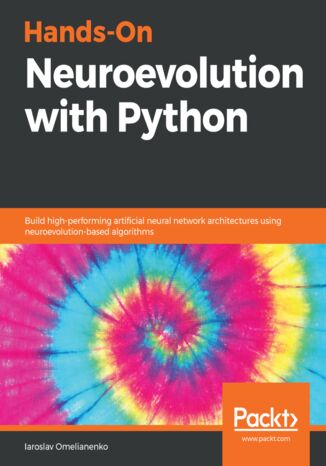
Iaroslav Omelianenko
Neuroevolution is a form of artificial intelligence learning that uses evolutionary algorithms to simplify the process of solving complex tasks in domains such as games, robotics, and the simulation of natural processes. This book will give you comprehensive insights into essential neuroevolution concepts and equip you with the skills you need to apply neuroevolution-based algorithms to solve practical, real-world problems.You'll start with learning the key neuroevolution concepts and methods by writing code with Python. You'll also get hands-on experience with popular Python libraries and cover examples of classical reinforcement learning, path planning for autonomous agents, and developing agents to autonomously play Atari games. Next, you'll learn to solve common and not-so-common challenges in natural computing using neuroevolution-based algorithms. Later, you'll understand how to apply neuroevolution strategies to existing neural network designs to improve training and inference performance. Finally, you'll gain clear insights into the topology of neural networks and how neuroevolution allows you to develop complex networks, starting with simple ones.By the end of this book, you will not only have explored existing neuroevolution-based algorithms, but also have the skills you need to apply them in your research and work assignments.
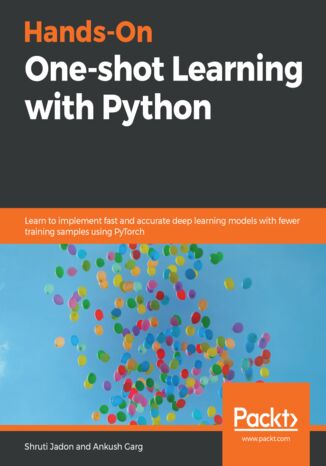
Shruti Jadon, Ankush Garg
One-shot learning has been an active field of research for scientists trying to develop a cognitive machine that mimics human learning. With this book, you'll explore key approaches to one-shot learning, such as metrics-based, model-based, and optimization-based techniques, all with the help of practical examples.Hands-On One-shot Learning with Python will guide you through the exploration and design of deep learning models that can obtain information about an object from one or just a few training samples. The book begins with an overview of deep learning and one-shot learning and then introduces you to the different methods you can use to achieve it, such as deep learning architectures and probabilistic models. Once you've got to grips with the core principles, you'll explore real-world examples and implementations of one-shot learning using PyTorch 1.x on datasets such as Omniglot and MiniImageNet. Finally, you'll explore generative modeling-based methods and discover the key considerations for building systems that exhibit human-level intelligence.By the end of this book, you'll be well-versed with the different one- and few-shot learning methods and be able to use them to build your own deep learning models.
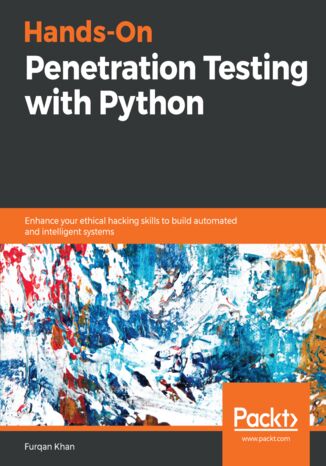
Furqan Khan
With the current technological and infrastructural shift, penetration testing is no longer a process-oriented activity. Modern-day penetration testing demands lots of automation and innovation; the only language that dominates all its peers is Python. Given the huge number of tools written in Python, and its popularity in the penetration testing space, this language has always been the first choice for penetration testers.Hands-On Penetration Testing with Python walks you through advanced Python programming constructs. Once you are familiar with the core concepts, you’ll explore the advanced uses of Python in the domain of penetration testing and optimization. You’ll then move on to understanding how Python, data science, and the cybersecurity ecosystem communicate with one another. In the concluding chapters, you’ll study exploit development, reverse engineering, and cybersecurity use cases that can be automated with Python.By the end of this book, you’ll have acquired adequate skills to leverage Python as a helpful tool to pentest and secure infrastructure, while also creating your own custom exploits.
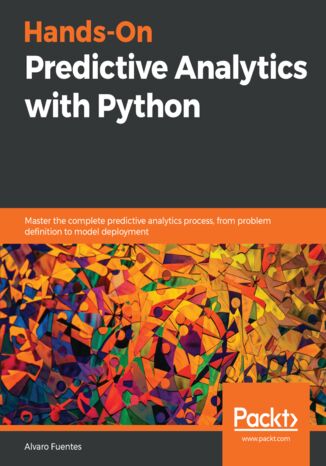
Alvaro Fuentes
Predictive analytics is an applied field that employs a variety of quantitative methods using data to make predictions. It involves much more than just throwing data onto a computer to build a model. This book provides practical coverage to help you understand the most important concepts of predictive analytics. Using practical, step-by-step examples, we build predictive analytics solutions while using cutting-edge Python tools and packages.The book's step-by-step approach starts by defining the problem and moves on to identifying relevant data. We will also be performing data preparation, exploring and visualizing relationships, building models, tuning, evaluating, and deploying model.Each stage has relevant practical examples and efficient Python code. You will work with models such as KNN, Random Forests, and neural networks using the most important libraries in Python's data science stack: NumPy, Pandas, Matplotlib, Seaborn, Keras, Dash, and so on. In addition to hands-on code examples, you will find intuitive explanations of the inner workings of the main techniques and algorithms used in predictive analytics.By the end of this book, you will be all set to build high-performance predictive analytics solutions using Python programming.